Earth's Age Evidence
A free science worksheet ready for your classroom. Open in Kuraplan to grab the print-ready PDF, customize it for your students, or generate a fresh version in seconds.
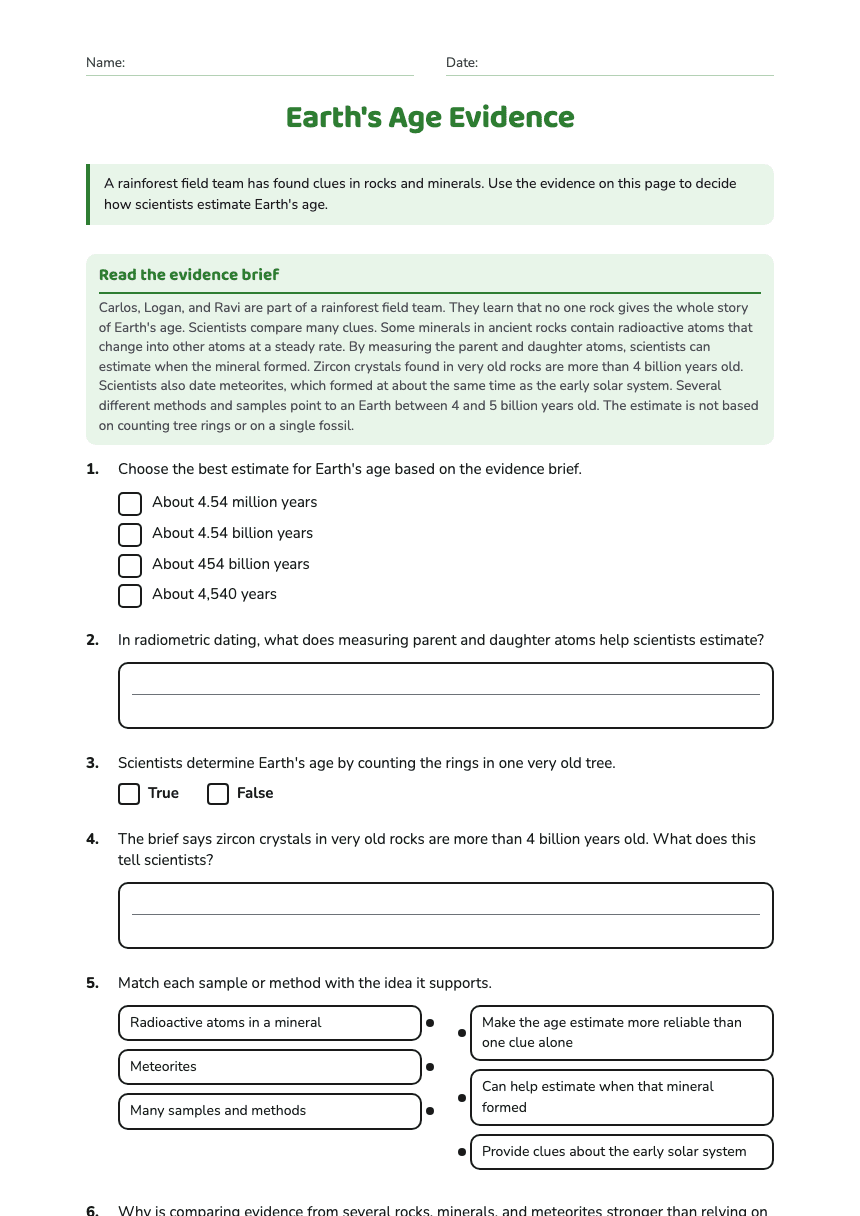
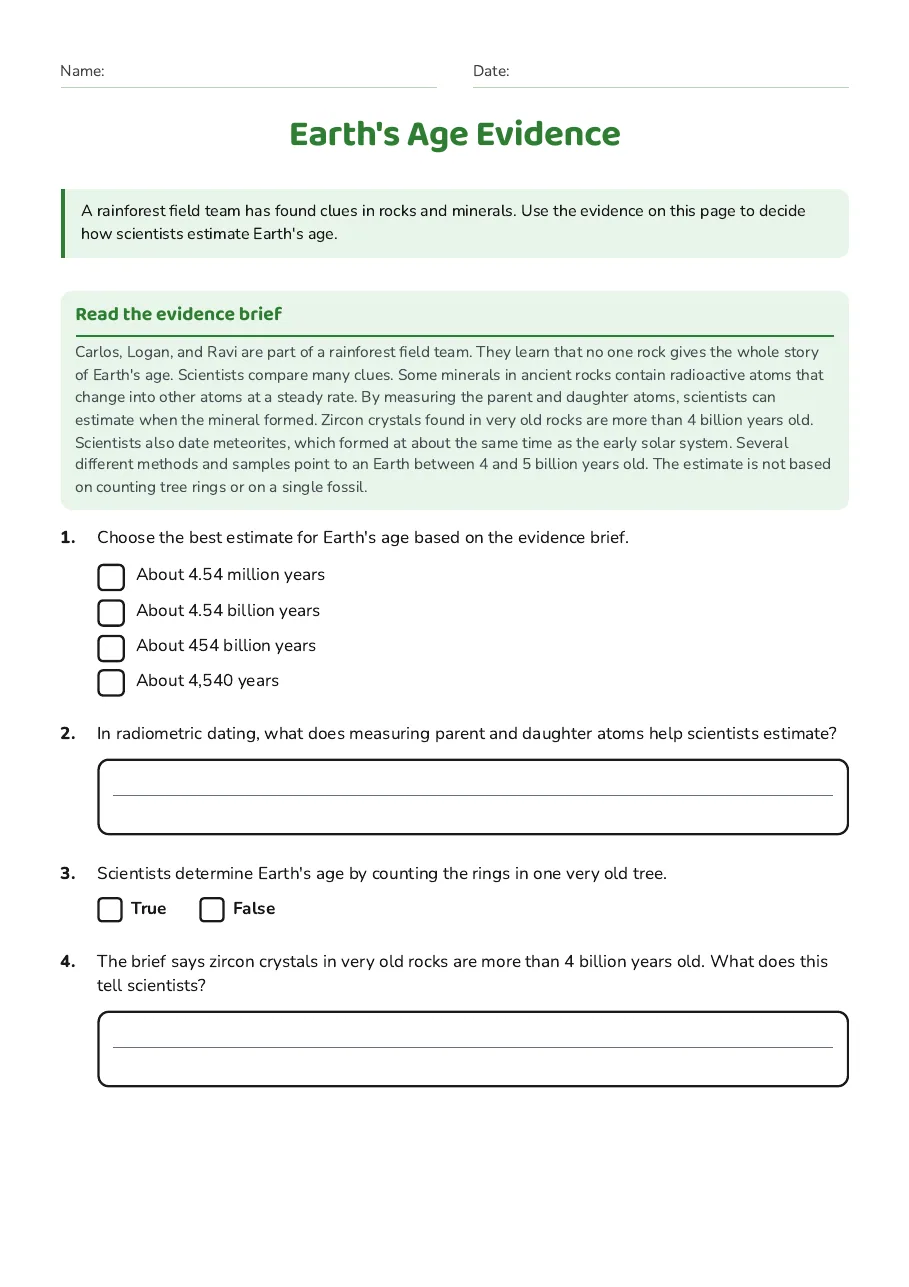
Earth's Age Evidence
Read the evidence brief
Carlos, Logan, and Ravi are part of a rainforest field team. They learn that no one rock gives the whole story of Earth's age. Scientists compare many clues. Some minerals in ancient rocks contain radioactive atoms that change into other atoms at a steady rate. By measuring the parent and daughter atoms, scientists can estimate when the mineral formed. Zircon crystals found in very old rocks are more than 4 billion years old. Scientists also date meteorites, which formed at about the same time as the early solar system. Several different methods and samples point to an Earth between 4 and 5 billion years old. The estimate is not based on counting tree rings or on a single fossil.
- About 4.54 million years
- About 4.54 billion years
- About 454 billion years
- About 4,540 years
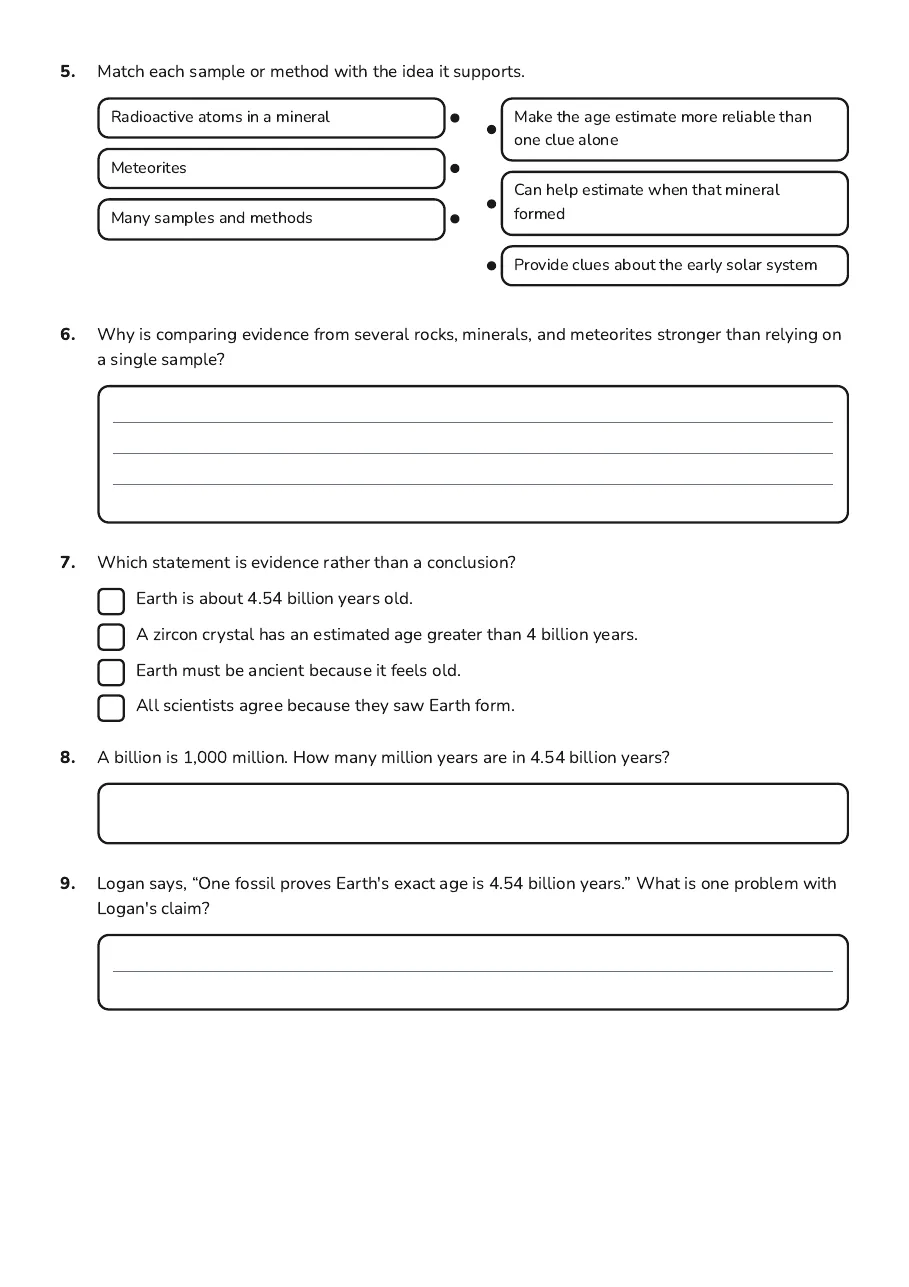
- Radioactive atoms in a mineral
- Meteorites
- Many samples and methods
- Make the age estimate more reliable than one clue alone
- Can help estimate when that mineral formed
- Provide clues about the early solar system
- Earth is about 4.54 billion years old.
- A zircon crystal has an estimated age greater than 4 billion years.
- Earth must be ancient because it feels old.
- All scientists agree because they saw Earth form.
3 printable pages
Page 1
Page 2
Page 3
About This Worksheet
Free in Kuraplan
Sign up free, grab the PDF, and customize it for your class.
Print-Ready
Formatted for standard paper. Clean layout, easy to read.
AI-Generated
Created with Kuraplan's AI, designed for real classroom use.
For Teachers & Parents
Use in classrooms, for homework, tutoring, or homeschool.
Need a custom version of this worksheet?
Kuraplan's AI generates custom worksheets in seconds — differentiated for every learner, aligned to your curriculum.
Generate Custom Worksheets — Free