ScienceFreePrintable

Investigating Friction

A free science worksheet ready for your classroom. Open in Kuraplan to grab the print-ready PDF, customize it for your students, or generate a fresh version in seconds.

Investigating Friction worksheet preview
Name:Date:

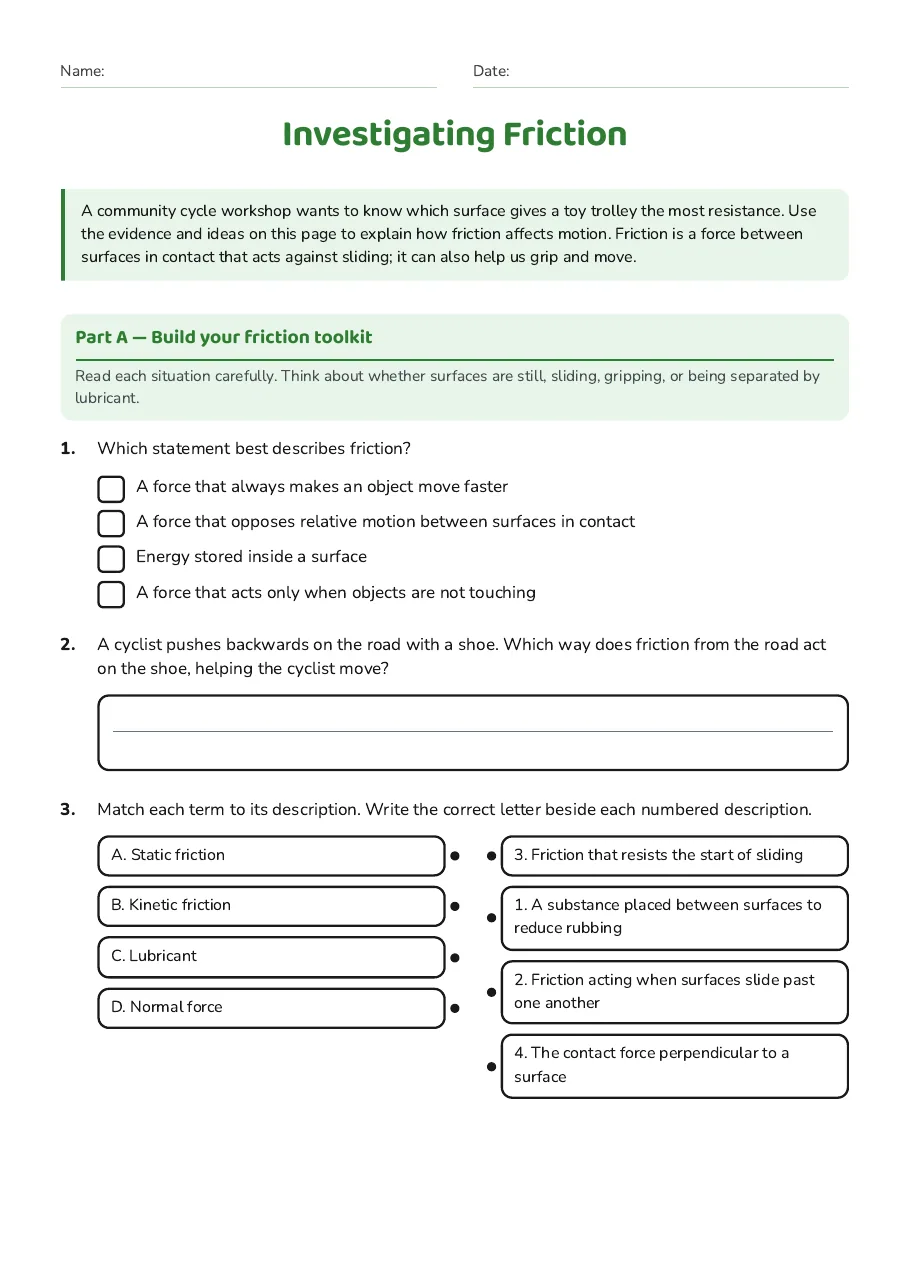
Investigating Friction

A community cycle workshop wants to know which surface gives a toy trolley the most resistance. Use the evidence and ideas on this page to explain how friction affects motion. Friction is a force between surfaces in contact that acts against sliding; it can also help us grip and move.

Part A — Build your friction toolkit

Read each situation carefully. Think about whether surfaces are still, sliding, gripping, or being separated by lubricant.

1.Which statement best describes friction?
  • A force that always makes an object move faster
  • A force that opposes relative motion between surfaces in contact
  • Energy stored inside a surface
  • A force that acts only when objects are not touching
2.A cyclist pushes backwards on the road with a shoe. Which way does friction from the road act on the shoe, helping the cyclist move?
3.Match each term to its description. Write the correct letter beside each numbered description.
  • A. Static friction
  • B. Kinetic friction
  • C. Lubricant
  • D. Normal force
  • 3. Friction that resists the start of sliding
  • 1. A substance placed between surfaces to reduce rubbing
  • 2. Friction acting when surfaces slide past one another
  • 4. The contact force perpendicular to a surface
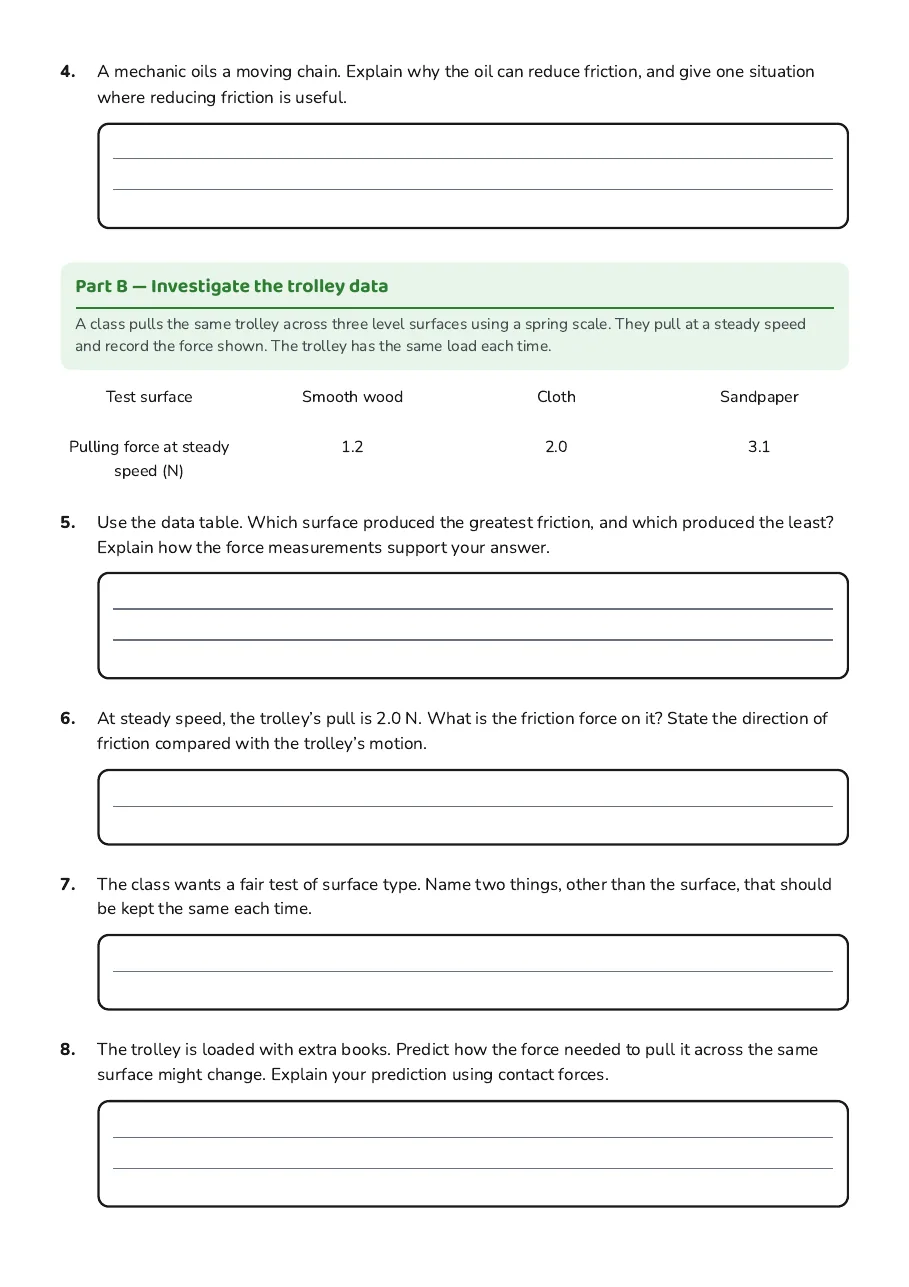
4.A mechanic oils a moving chain. Explain why the oil can reduce friction, and give one situation where reducing friction is useful.

Part B — Investigate the trolley data

A class pulls the same trolley across three level surfaces using a spring scale. They pull at a steady speed and record the force shown. The trolley has the same load each time.

Test surface

Smooth wood

Cloth

Sandpaper

Pulling force at steady speed (N)

1.2

2.0

3.1

5.Use the data table. Which surface produced the greatest friction, and which produced the least? Explain how the force measurements support your answer.
6.At steady speed, the trolley’s pull is 2.0 N. What is the friction force on it? State the direction of friction compared with the trolley’s motion.
7.The class wants a fair test of surface type. Name two things, other than the surface, that should be kept the same each time.
8.The trolley is loaded with extra books. Predict how the force needed to pull it across the same surface might change. Explain your prediction using contact forces.
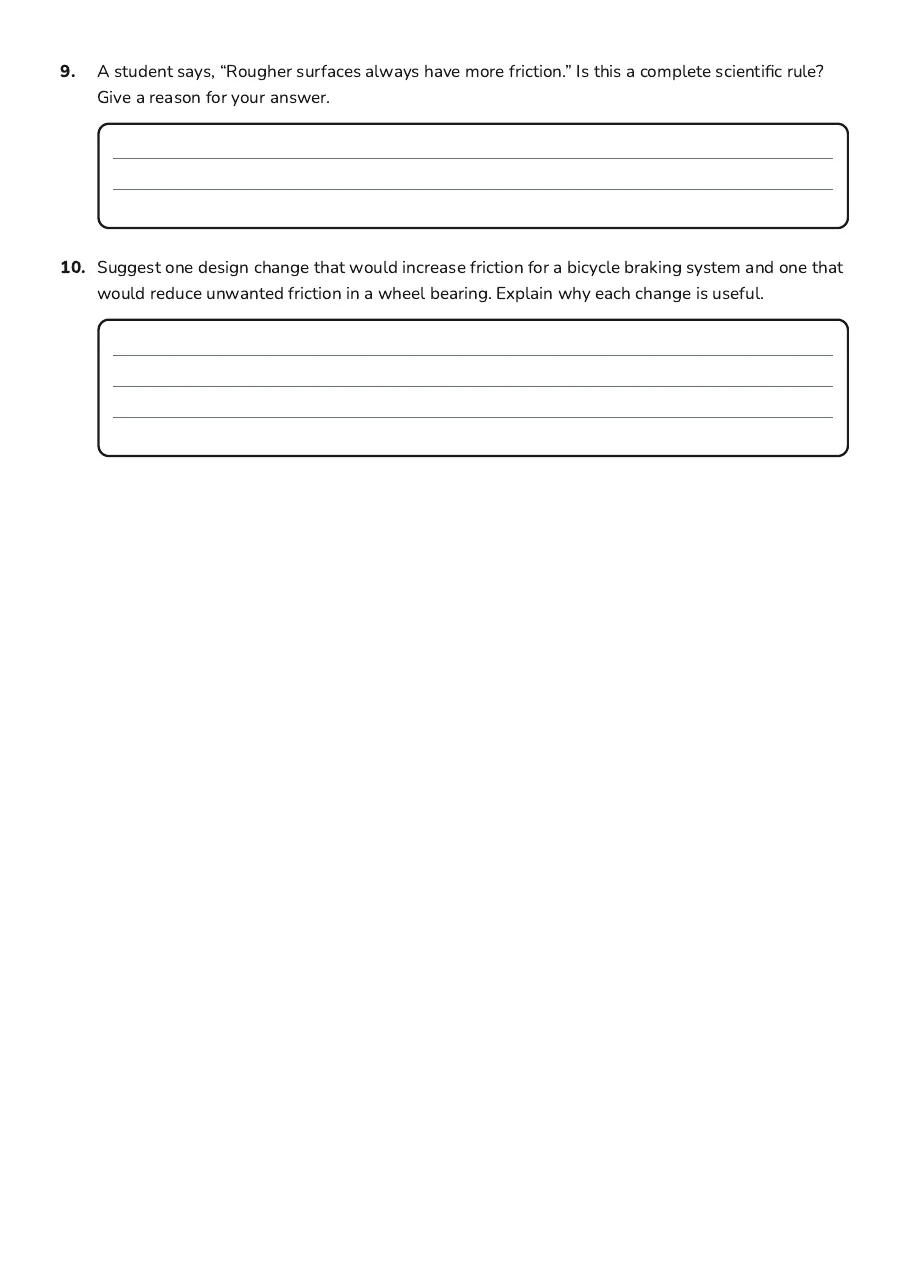
9.A student says, “Rougher surfaces always have more friction.” Is this a complete scientific rule? Give a reason for your answer.
10.Suggest one design change that would increase friction for a bicycle braking system and one that would reduce unwanted friction in a wheel bearing. Explain why each change is useful.

3 printable pages

  • Investigating Friction, page 1 of 3: Part A — Build your friction toolkit

    Page 1

  • Investigating Friction, page 2 of 3: Part B — Investigate the trolley data

    Page 2

  • Investigating Friction, page 3 of 3: 9. A student says, “Rougher surfaces always have more friction.” Is this a complete…

    Page 3

About This Worksheet

Free in Kuraplan

Sign up free, grab the PDF, and customize it for your class.

Print-Ready

Formatted for standard paper. Clean layout, easy to read.

AI-Generated

Created with Kuraplan's AI, designed for real classroom use.

For Teachers & Parents

Use in classrooms, for homework, tutoring, or homeschool.

Need a custom version of this worksheet?

Kuraplan's AI generates custom worksheets in seconds — differentiated for every learner, aligned to your curriculum.

Generate Custom Worksheets — Free
No credit card Curriculum-aligned Under 60 seconds