ScienceFreePrintable

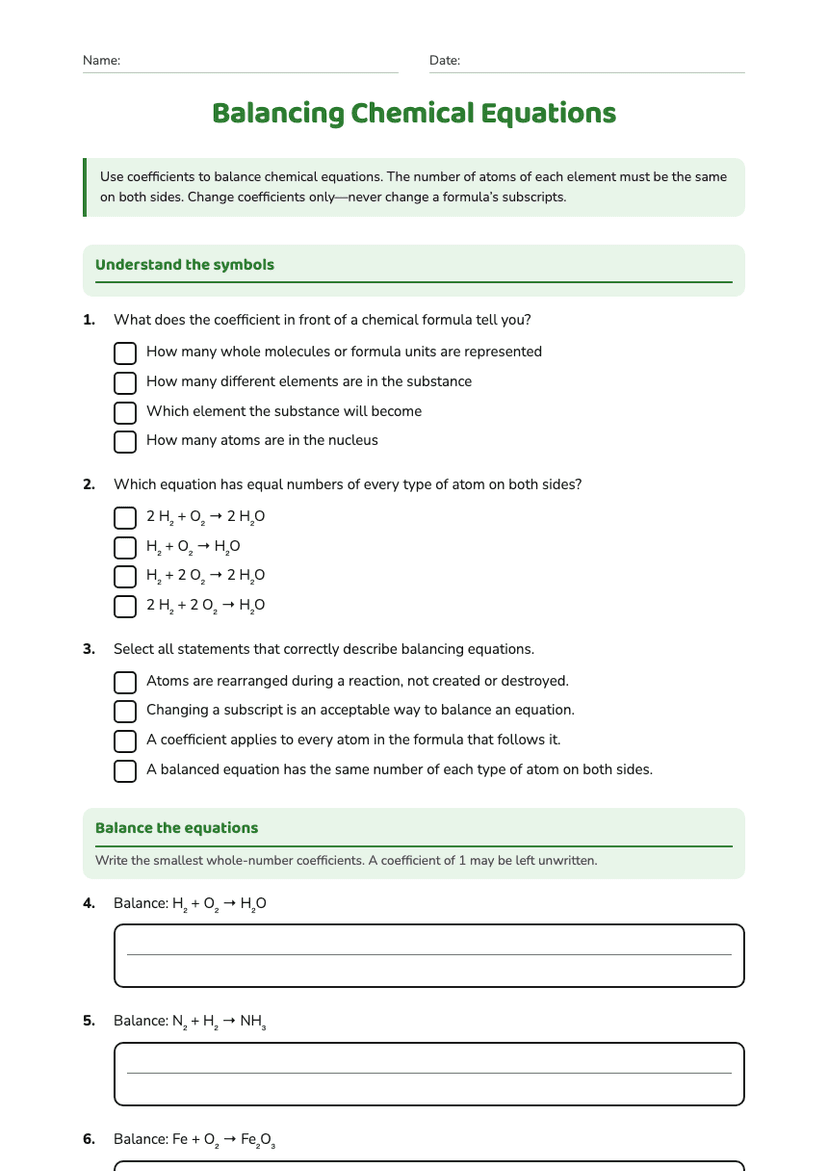
Balancing Chemical Equations

A free science worksheet ready for your classroom. Open in Kuraplan to grab the print-ready PDF, customize it for your students, or generate a fresh version in seconds.
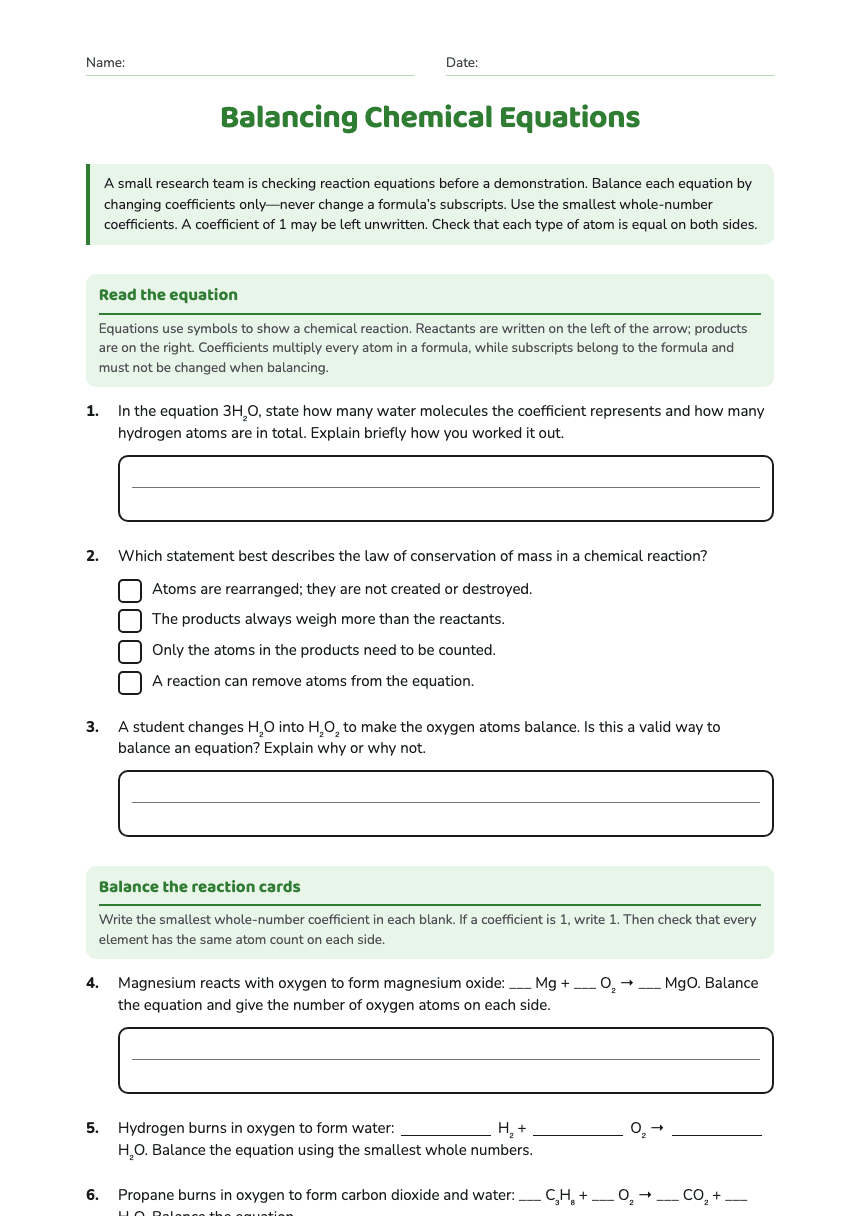
Balancing Chemical Equations worksheet preview
Name:Date:

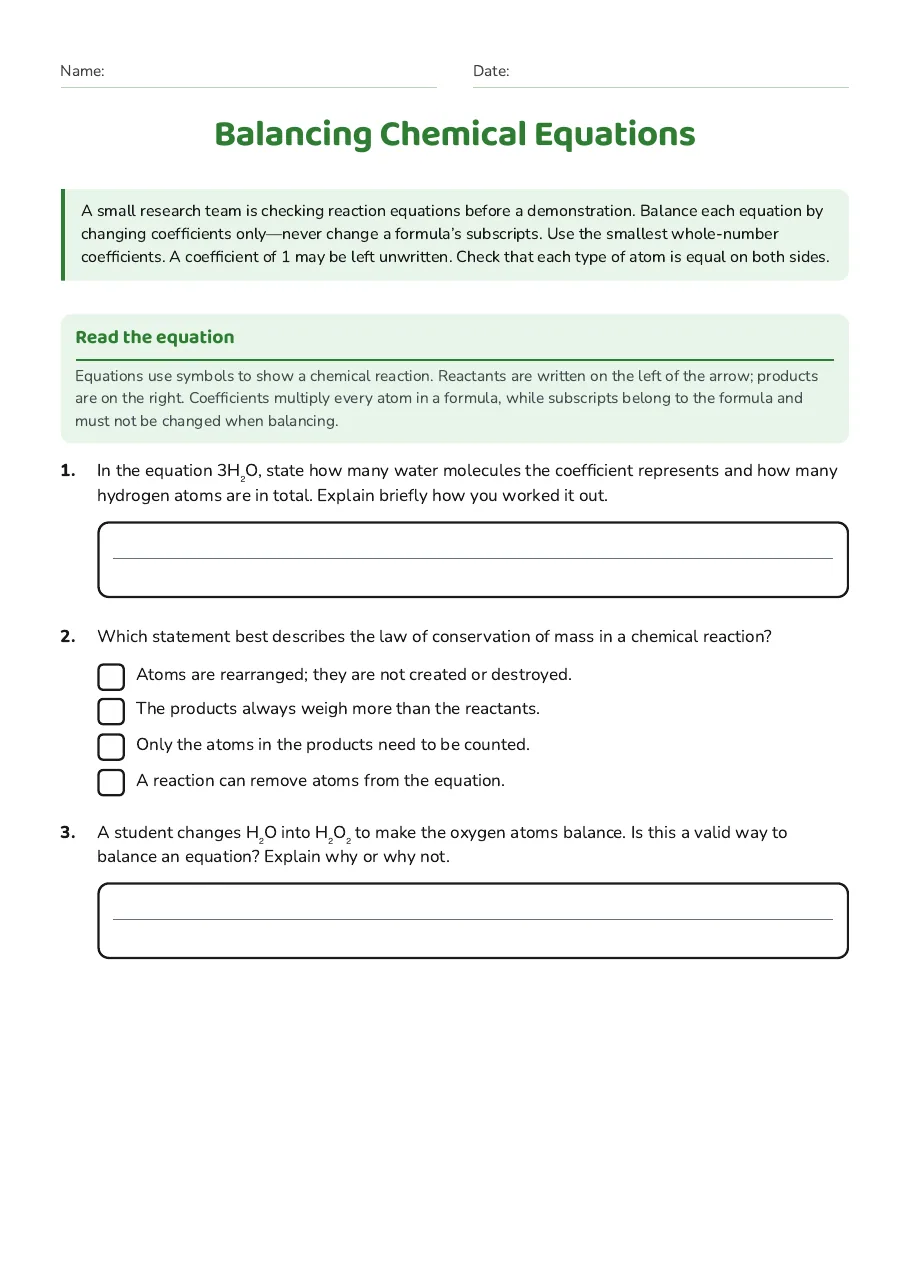
Balancing Chemical Equations

A small research team is checking reaction equations before a demonstration. Balance each equation by changing coefficients only—never change a formula’s subscripts. Use the smallest whole-number coefficients. A coefficient of 1 may be left unwritten. Check that each type of atom is equal on both sides.

Read the equation

Equations use symbols to show a chemical reaction. Reactants are written on the left of the arrow; products are on the right. Coefficients multiply every atom in a formula, while subscripts belong to the formula and must not be changed when balancing.

1.In the equation 3H₂O, state how many water molecules the coefficient represents and how many hydrogen atoms are in total. Explain briefly how you worked it out.
2.Which statement best describes the law of conservation of mass in a chemical reaction?
  • Atoms are rearranged; they are not created or destroyed.
  • The products always weigh more than the reactants.
  • Only the atoms in the products need to be counted.
  • A reaction can remove atoms from the equation.
3.A student changes H₂O into H₂O₂ to make the oxygen atoms balance. Is this a valid way to balance an equation? Explain why or why not.

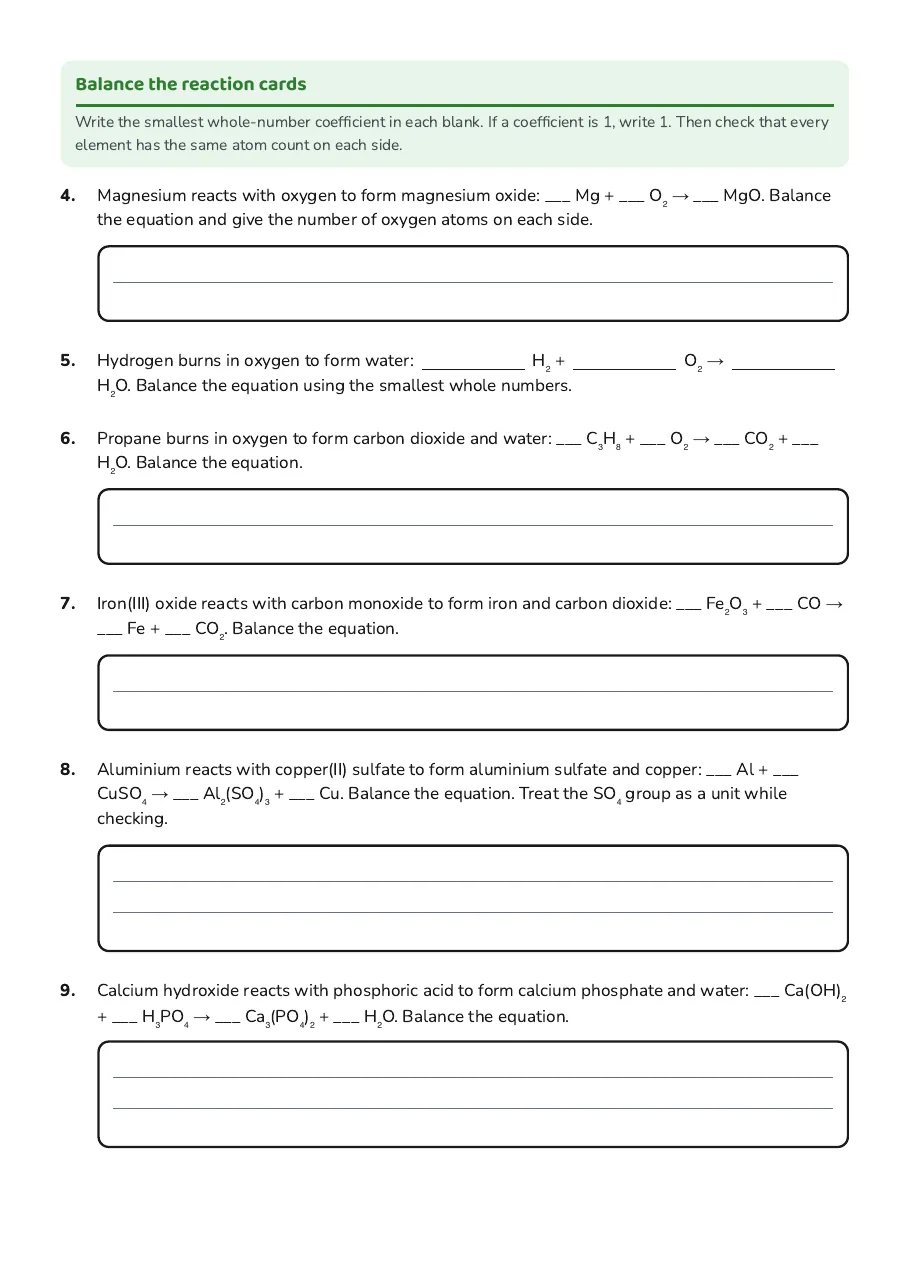
Balance the reaction cards

Write the smallest whole-number coefficient in each blank. If a coefficient is 1, write 1. Then check that every element has the same atom count on each side.

4.Magnesium reacts with oxygen to form magnesium oxide: ___ Mg + ___ O₂ → ___ MgO. Balance the equation and give the number of oxygen atoms on each side.
5.Hydrogen burns in oxygen to form water: H₂ + O₂ → H₂O. Balance the equation using the smallest whole numbers.
6.Propane burns in oxygen to form carbon dioxide and water: ___ C₃H₈ + ___ O₂ → ___ CO₂ + ___ H₂O. Balance the equation.
7.Iron(III) oxide reacts with carbon monoxide to form iron and carbon dioxide: ___ Fe₂O₃ + ___ CO → ___ Fe + ___ CO₂. Balance the equation.
8.Aluminium reacts with copper(II) sulfate to form aluminium sulfate and copper: ___ Al + ___ CuSO₄ → ___ Al₂(SO₄)₃ + ___ Cu. Balance the equation. Treat the SO₄ group as a unit while checking.
9.Calcium hydroxide reacts with phosphoric acid to form calcium phosphate and water: ___ Ca(OH)₂ + ___ H₃PO₄ → ___ Ca₃(PO₄)₂ + ___ H₂O. Balance the equation.

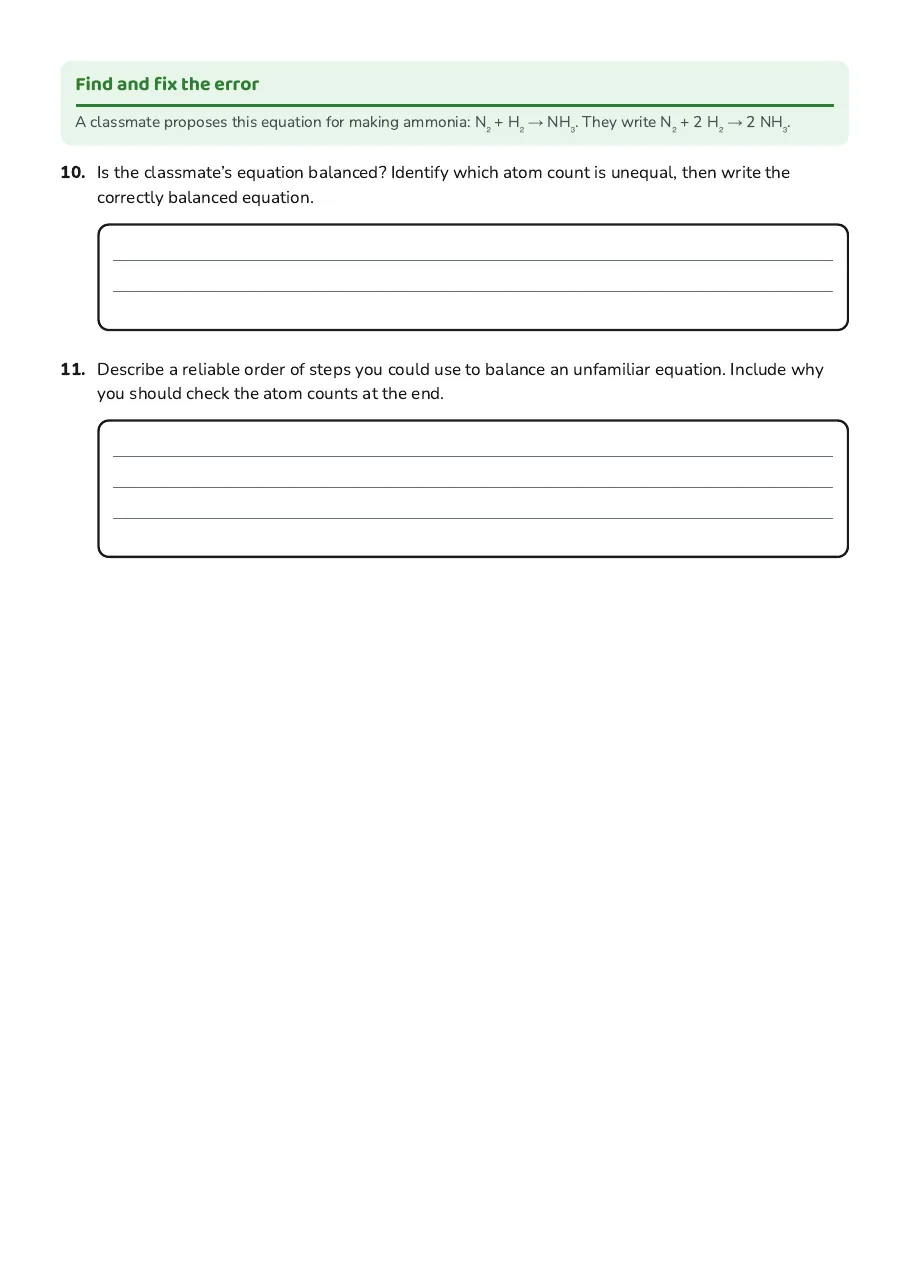
Find and fix the error

A classmate proposes this equation for making ammonia: N₂ + H₂ → NH₃. They write N₂ + 2 H₂ → 2 NH₃.

10.Is the classmate’s equation balanced? Identify which atom count is unequal, then write the correctly balanced equation.
11.Describe a reliable order of steps you could use to balance an unfamiliar equation. Include why you should check the atom counts at the end.

3 printable pages

  • Balancing Chemical Equations, page 1 of 3: Read the equation

    Page 1

  • Balancing Chemical Equations, page 2 of 3: Balance the reaction cards

    Page 2

  • Balancing Chemical Equations, page 3 of 3: Find and fix the error

    Page 3

About This Worksheet

Free in Kuraplan

Sign up free, grab the PDF, and customize it for your class.

Print-Ready

Formatted for standard paper. Clean layout, easy to read.

AI-Generated

Created with Kuraplan's AI, designed for real classroom use.

For Teachers & Parents

Use in classrooms, for homework, tutoring, or homeschool.

Need a custom version of this worksheet?

Kuraplan's AI generates custom worksheets in seconds — differentiated for every learner, aligned to your curriculum.

Generate Custom Worksheets — Free
No credit card Curriculum-aligned Under 60 seconds