Ladybug Life Cycle Worksheet
A free science worksheet ready for your classroom. Open in Kuraplan to grab the print-ready PDF, customize it for your students, or generate a fresh version in seconds.

Ladybug Life Cycle Worksheet
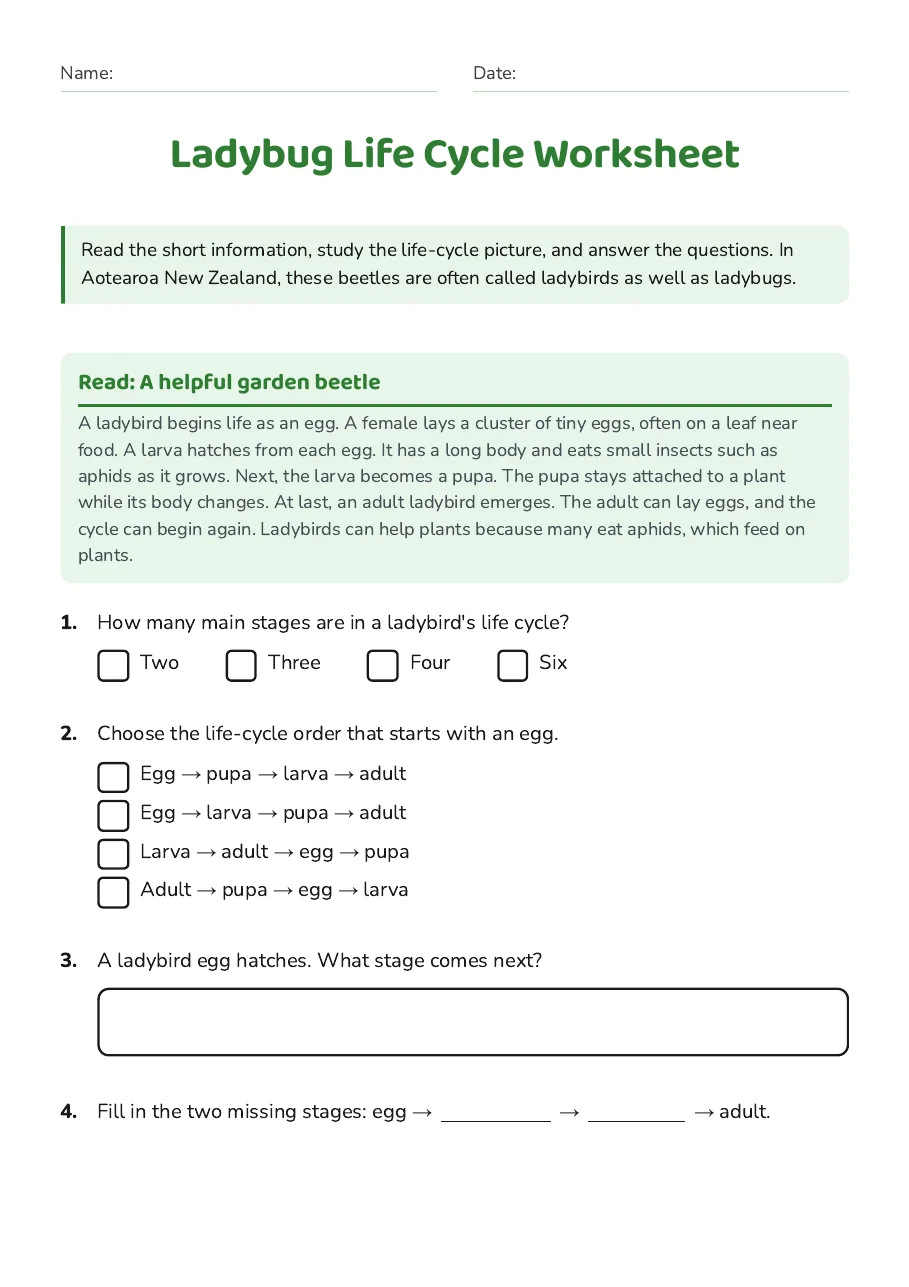
Read: A helpful garden beetle
A ladybird begins life as an egg. A female lays a cluster of tiny eggs, often on a leaf near food. A larva hatches from each egg. It has a long body and eats small insects such as aphids as it grows. Next, the larva becomes a pupa. The pupa stays attached to a plant while its body changes. At last, an adult ladybird emerges. The adult can lay eggs, and the cycle can begin again. Ladybirds can help plants because many eat aphids, which feed on plants.
- Two
- Three
- Four
- Six
- Egg → pupa → larva → adult
- Egg → larva → pupa → adult
- Larva → adult → egg → pupa
- Adult → pupa → egg → larva
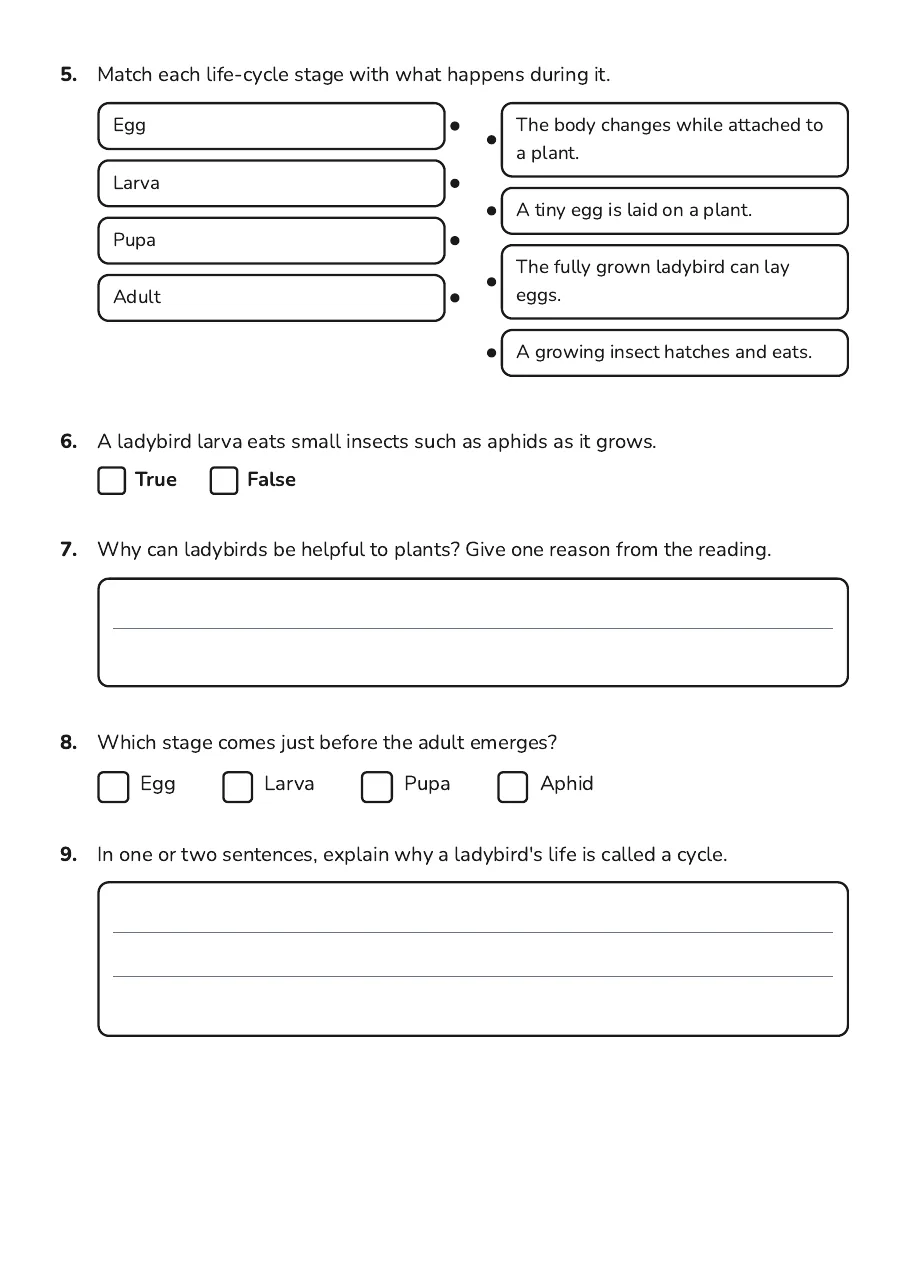
- Egg
- Larva
- Pupa
- Adult
- The body changes while attached to a plant.
- A tiny egg is laid on a plant.
- The fully grown ladybird can lay eggs.
- A growing insect hatches and eats.
- Egg
- Larva
- Pupa
- Aphid
3 printable pages
Page 1
Page 2

Page 3
About This Worksheet
Free in Kuraplan
Sign up free, grab the PDF, and customize it for your class.
Print-Ready
Formatted for standard paper. Clean layout, easy to read.
AI-Generated
Created with Kuraplan's AI, designed for real classroom use.
For Teachers & Parents
Use in classrooms, for homework, tutoring, or homeschool.
Need a custom version of this worksheet?
Kuraplan's AI generates custom worksheets in seconds — differentiated for every learner, aligned to your curriculum.
Generate Custom Worksheets — Free