Social StudiesFreePrintable

LBJ's Civil Rights Fight

A free social studies worksheet ready for your classroom. Open in Kuraplan to grab the print-ready PDF, customize it for your students, or generate a fresh version in seconds.
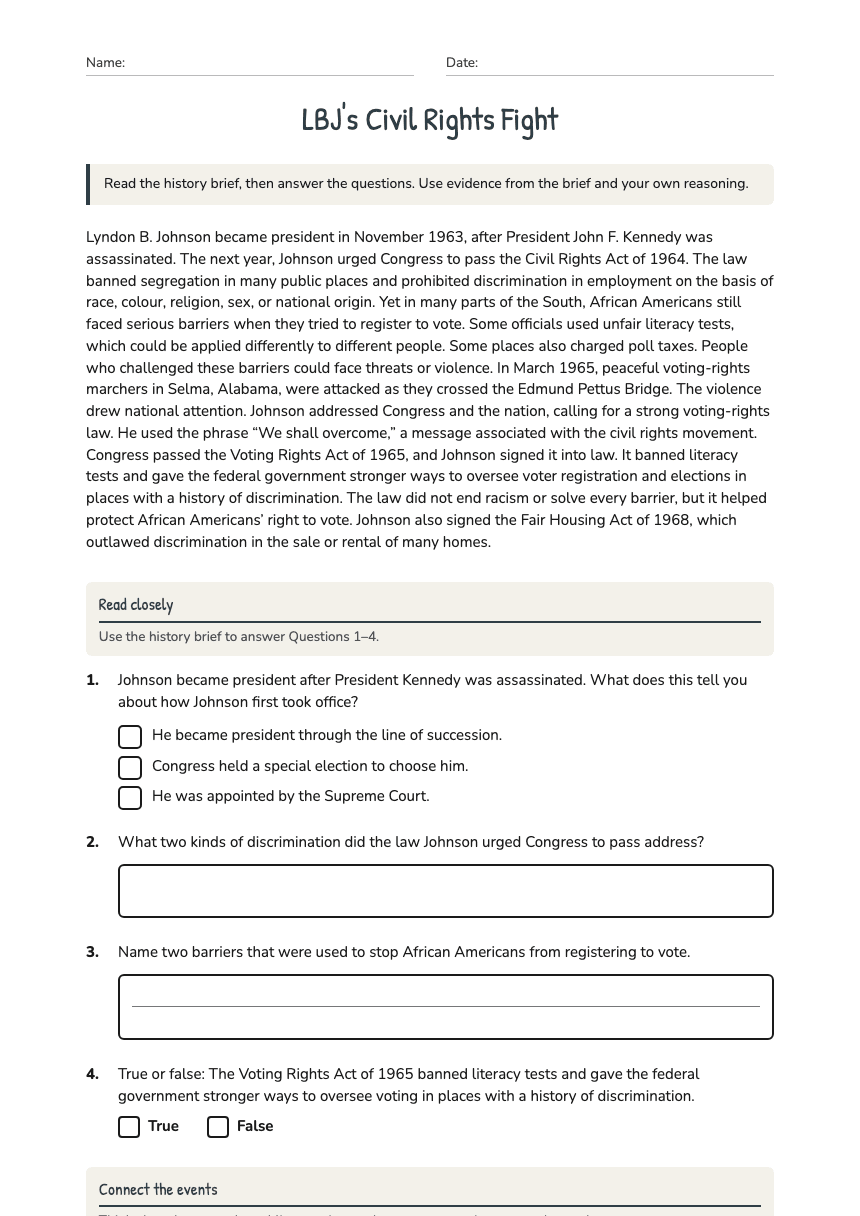
LBJ's Civil Rights Fight worksheet preview
Name:Date:

LBJ's Civil Rights Fight

Read the history brief, then answer the questions. Use evidence from the brief and your own reasoning.
Lyndon B. Johnson became president in November 1963, after President John F. Kennedy was assassinated. The next year, Johnson urged Congress to pass the Civil Rights Act of 1964. The law banned segregation in many public places and prohibited discrimination in employment on the basis of race, colour, religion, sex, or national origin. Yet in many parts of the South, African Americans still faced serious barriers when they tried to register to vote. Some officials used unfair literacy tests, which could be applied differently to different people. Some places also charged poll taxes. People who challenged these barriers could face threats or violence. In March 1965, peaceful voting-rights marchers in Selma, Alabama, were attacked as they crossed the Edmund Pettus Bridge. The violence drew national attention. Johnson addressed Congress and the nation, calling for a strong voting-rights law. He used the phrase “We shall overcome,” a message associated with the civil rights movement. Congress passed the Voting Rights Act of 1965, and Johnson signed it into law. It banned literacy tests and gave the federal government stronger ways to oversee voter registration and elections in places with a history of discrimination. The law did not end racism or solve every barrier, but it helped protect African Americans’ right to vote. Johnson also signed the Fair Housing Act of 1968, which outlawed discrimination in the sale or rental of many homes.

Read closely

Use the history brief to answer Questions 1–4.

1.Johnson became president after President Kennedy was assassinated. What does this tell you about how Johnson first took office?
  • He became president through the line of succession.
  • Congress held a special election to choose him.
  • He was appointed by the Supreme Court.
2.What two kinds of discrimination did the law Johnson urged Congress to pass address?
3.Name two barriers that were used to stop African Americans from registering to vote.
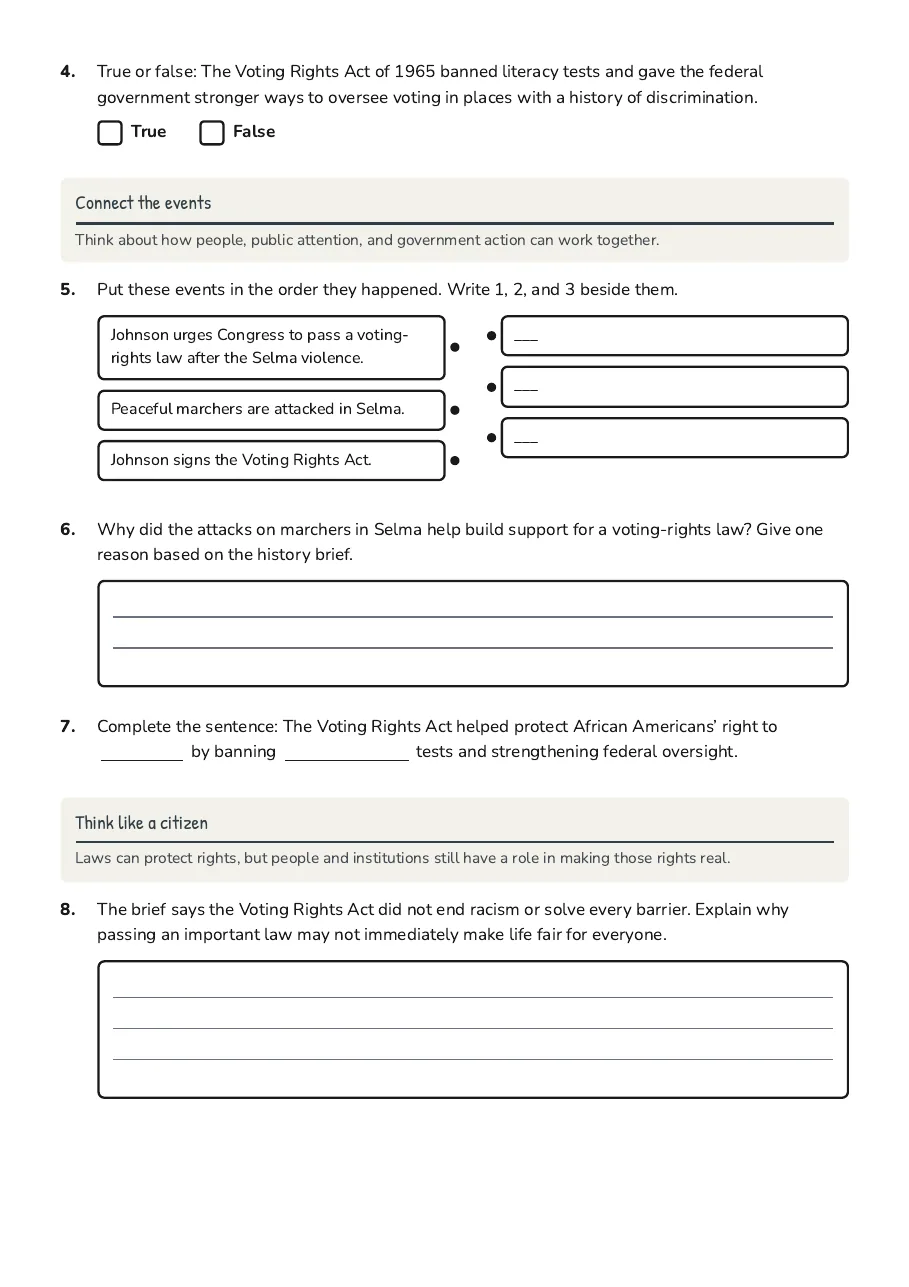
4.True or false: The Voting Rights Act of 1965 banned literacy tests and gave the federal government stronger ways to oversee voting in places with a history of discrimination.
TrueFalse

Connect the events

Think about how people, public attention, and government action can work together.

5.Put these events in the order they happened. Write 1, 2, and 3 beside them.
  • Johnson urges Congress to pass a voting-rights law after the Selma violence.
  • Peaceful marchers are attacked in Selma.
  • Johnson signs the Voting Rights Act.
  • ___
  • ___
  • ___
6.Why did the attacks on marchers in Selma help build support for a voting-rights law? Give one reason based on the history brief.
7.Complete the sentence: The Voting Rights Act helped protect African Americans’ right to by banning tests and strengthening federal oversight.

Think like a citizen

Laws can protect rights, but people and institutions still have a role in making those rights real.

8.The brief says the Voting Rights Act did not end racism or solve every barrier. Explain why passing an important law may not immediately make life fair for everyone.
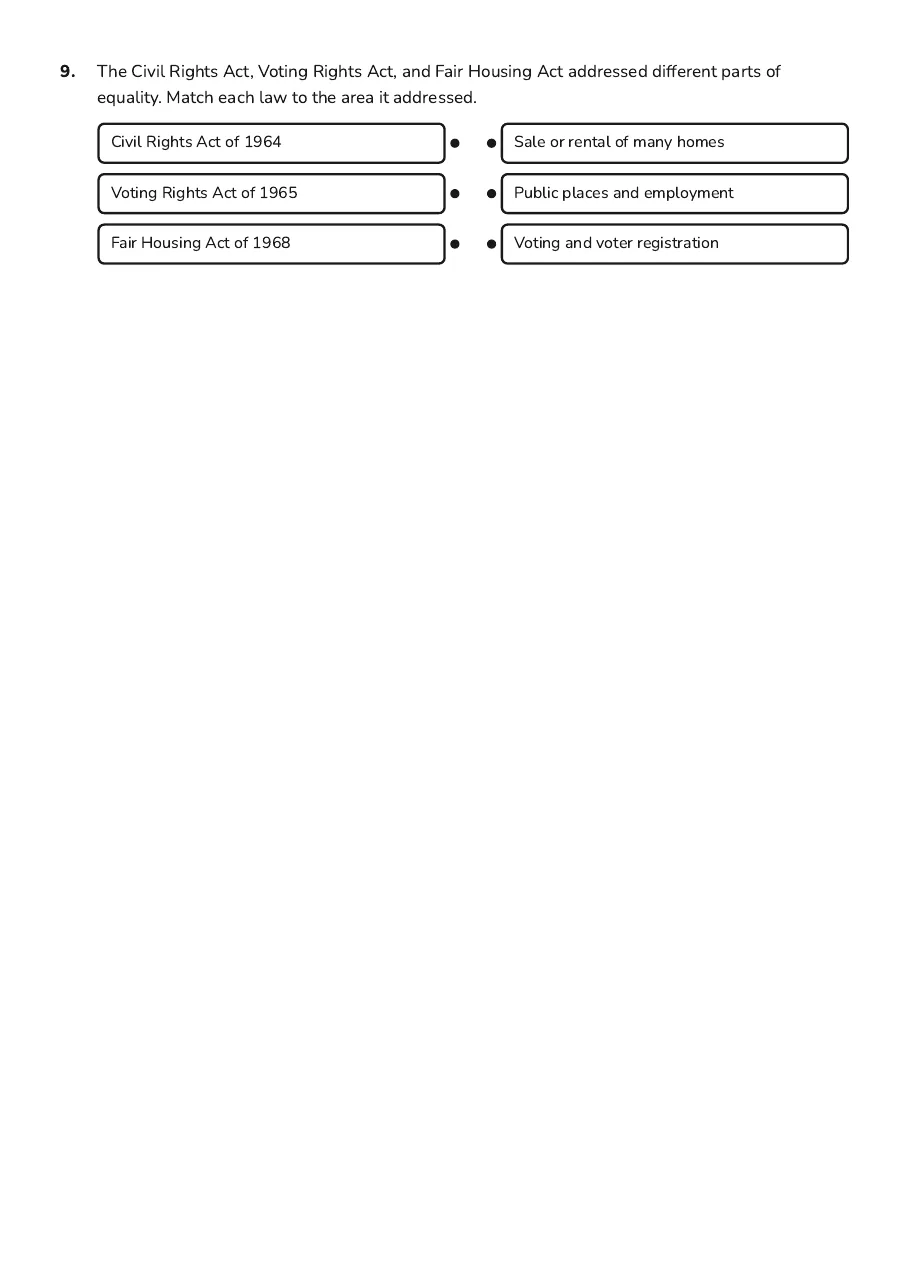
9.The Civil Rights Act, Voting Rights Act, and Fair Housing Act addressed different parts of equality. Match each law to the area it addressed.
  • Civil Rights Act of 1964
  • Voting Rights Act of 1965
  • Fair Housing Act of 1968
  • Sale or rental of many homes
  • Public places and employment
  • Voting and voter registration

3 printable pages
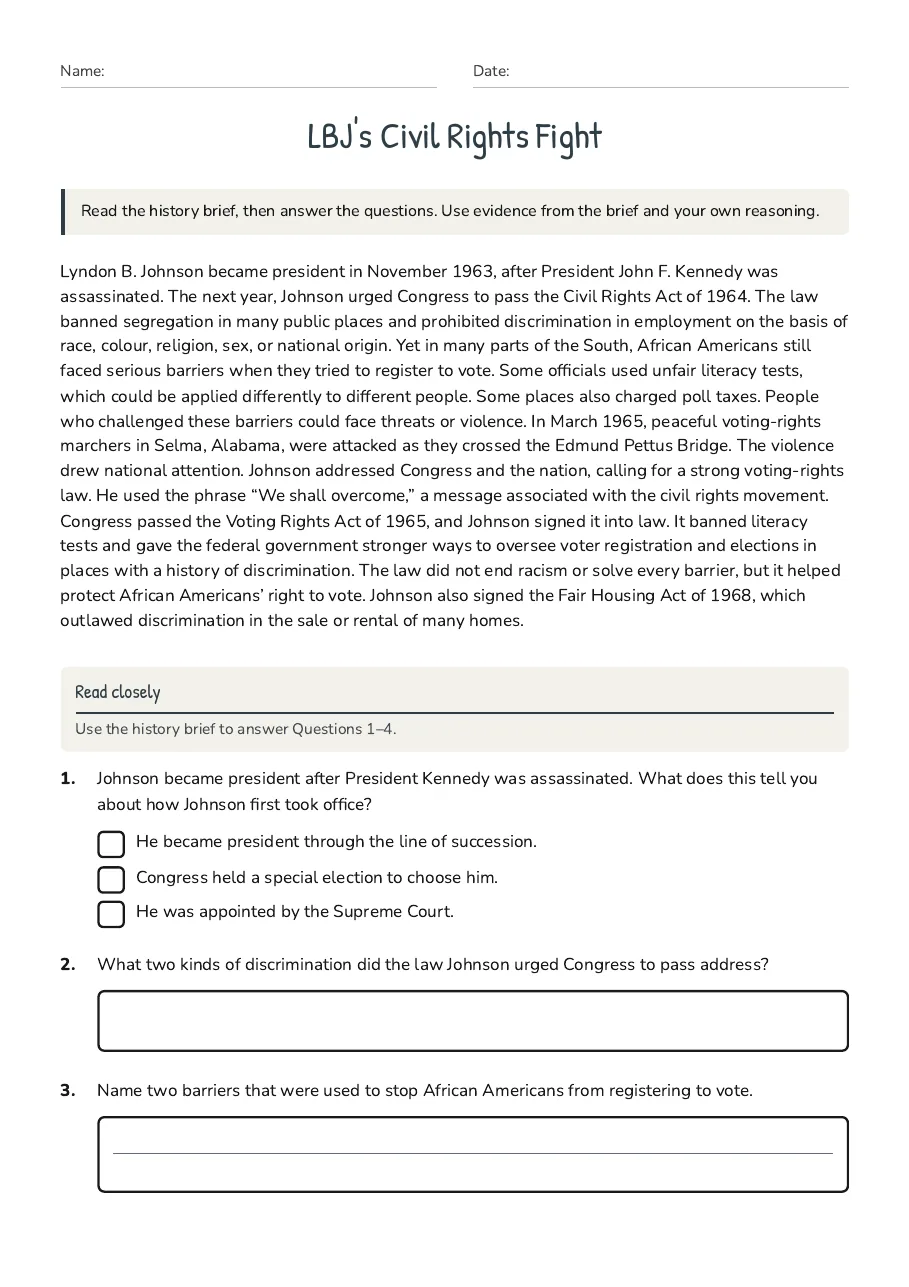
  • LBJ's Civil Rights Fight, page 1 of 3: Read closely

    Page 1

  • LBJ's Civil Rights Fight, page 2 of 3: Connect the events, Think like a citizen

    Page 2

  • LBJ's Civil Rights Fight, page 3 of 3: 9. The Civil Rights Act, Voting Rights Act, and Fair Housing Act addressed different…

    Page 3

About This Worksheet

Free in Kuraplan

Sign up free, grab the PDF, and customize it for your class.

Print-Ready

Formatted for standard paper. Clean layout, easy to read.

AI-Generated

Created with Kuraplan's AI, designed for real classroom use.

For Teachers & Parents

Use in classrooms, for homework, tutoring, or homeschool.

Need a custom version of this worksheet?

Kuraplan's AI generates custom worksheets in seconds — differentiated for every learner, aligned to your curriculum.

Generate Custom Worksheets — Free
No credit card Curriculum-aligned Under 60 seconds