Literacy Foundation Discussion Worksheet
A free english (ela) worksheet ready for your classroom. Open in Kuraplan to grab the print-ready PDF, customize it for your students, or generate a fresh version in seconds.
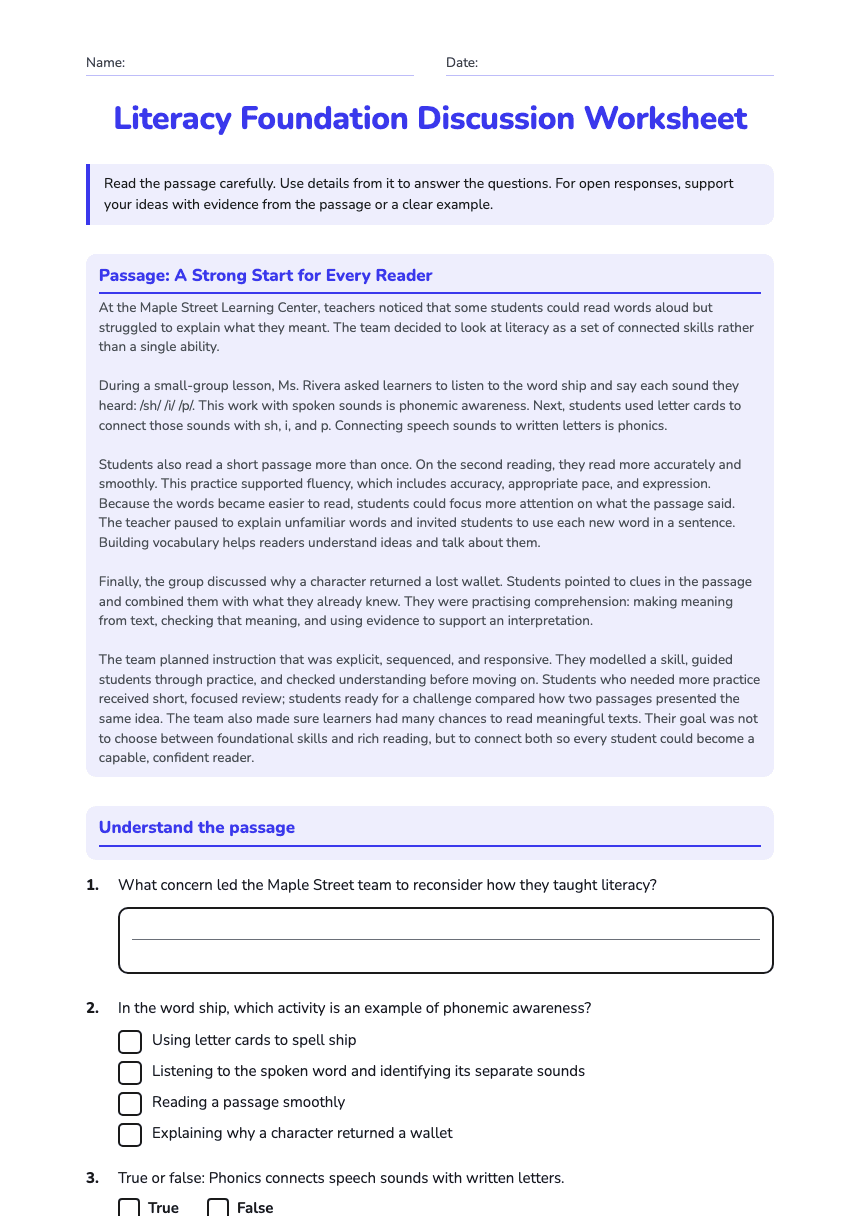
Literacy Foundation Discussion Worksheet
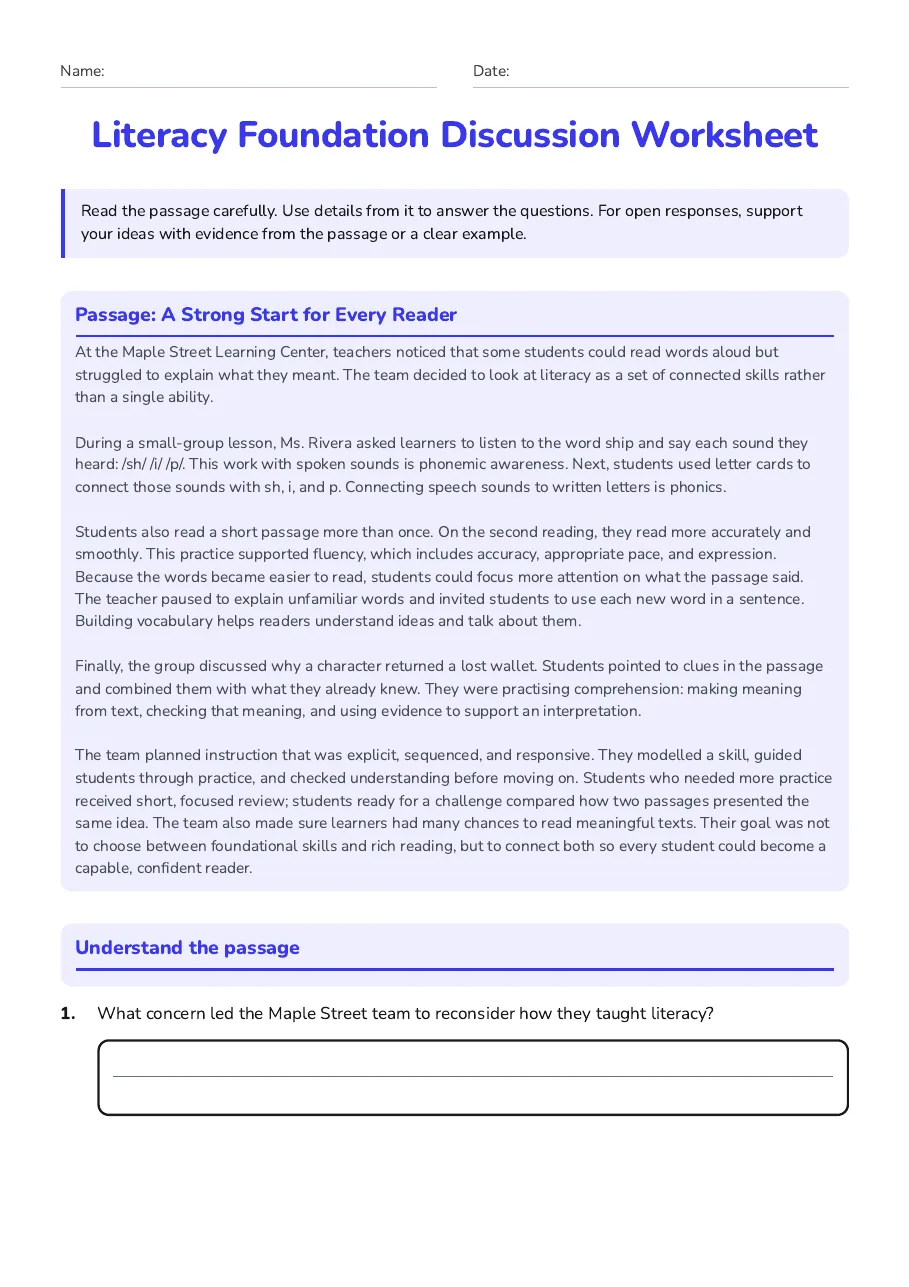
Passage: A Strong Start for Every Reader
At the Maple Street Learning Center, teachers noticed that some students could read words aloud but struggled to explain what they meant. The team decided to look at literacy as a set of connected skills rather than a single ability. During a small-group lesson, Ms. Rivera asked learners to listen to the word ship and say each sound they heard: /sh/ /i/ /p/. This work with spoken sounds is phonemic awareness. Next, students used letter cards to connect those sounds with sh, i, and p. Connecting speech sounds to written letters is phonics. Students also read a short passage more than once. On the second reading, they read more accurately and smoothly. This practice supported fluency, which includes accuracy, appropriate pace, and expression. Because the words became easier to read, students could focus more attention on what the passage said. The teacher paused to explain unfamiliar words and invited students to use each new word in a sentence. Building vocabulary helps readers understand ideas and talk about them. Finally, the group discussed why a character returned a lost wallet. Students pointed to clues in the passage and combined them with what they already knew. They were practising comprehension: making meaning from text, checking that meaning, and using evidence to support an interpretation. The team planned instruction that was explicit, sequenced, and responsive. They modelled a skill, guided students through practice, and checked understanding before moving on. Students who needed more practice received short, focused review; students ready for a challenge compared how two passages presented the same idea. The team also made sure learners had many chances to read meaningful texts. Their goal was not to choose between foundational skills and rich reading, but to connect both so every student could become a capable, confident reader.
Understand the passage
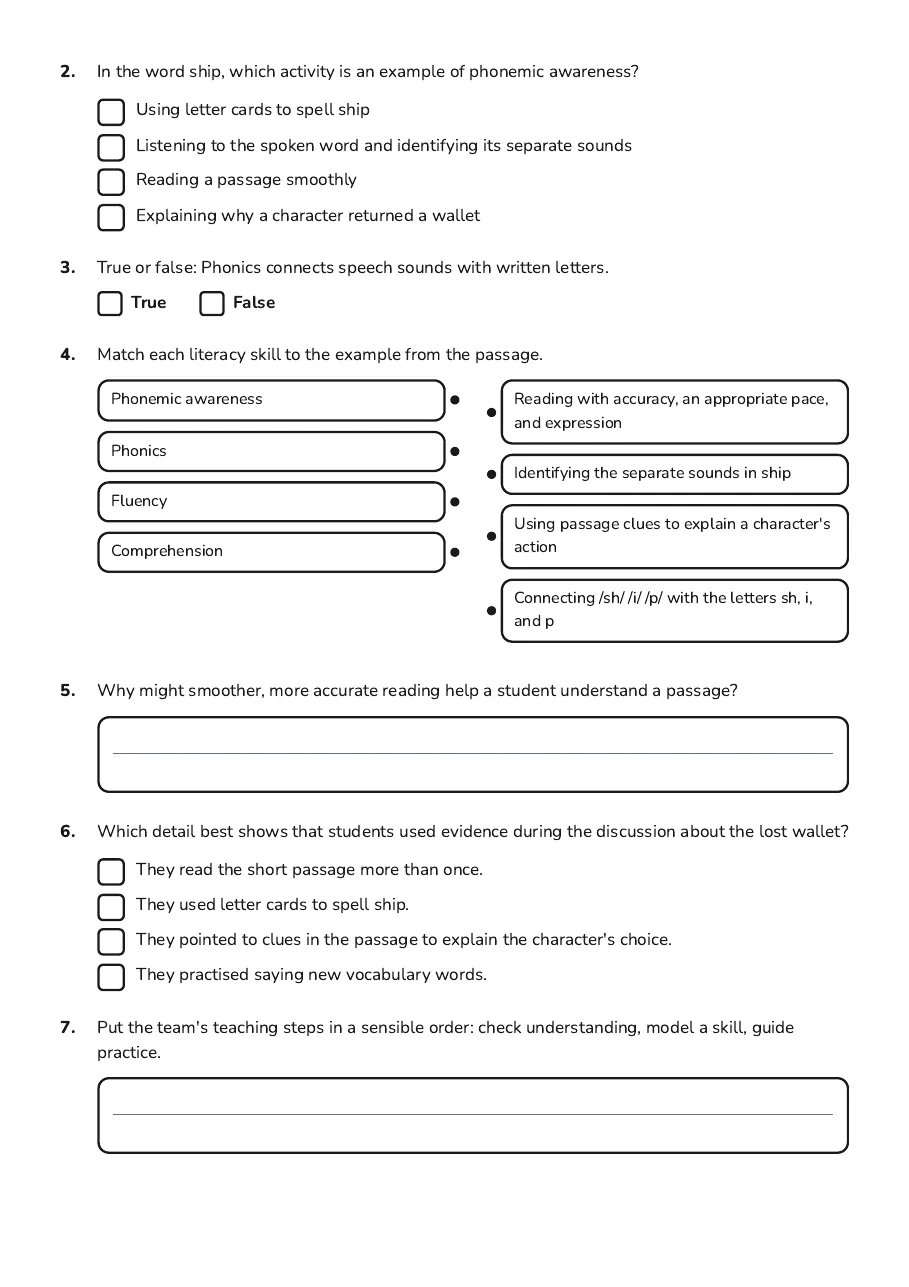
- Using letter cards to spell ship
- Listening to the spoken word and identifying its separate sounds
- Reading a passage smoothly
- Explaining why a character returned a wallet
- Phonemic awareness
- Phonics
- Fluency
- Comprehension
- Reading with accuracy, an appropriate pace, and expression
- Identifying the separate sounds in ship
- Using passage clues to explain a character's action
- Connecting /sh/ /i/ /p/ with the letters sh, i, and p
- They read the short passage more than once.
- They used letter cards to spell ship.
- They pointed to clues in the passage to explain the character's choice.
- They practised saying new vocabulary words.
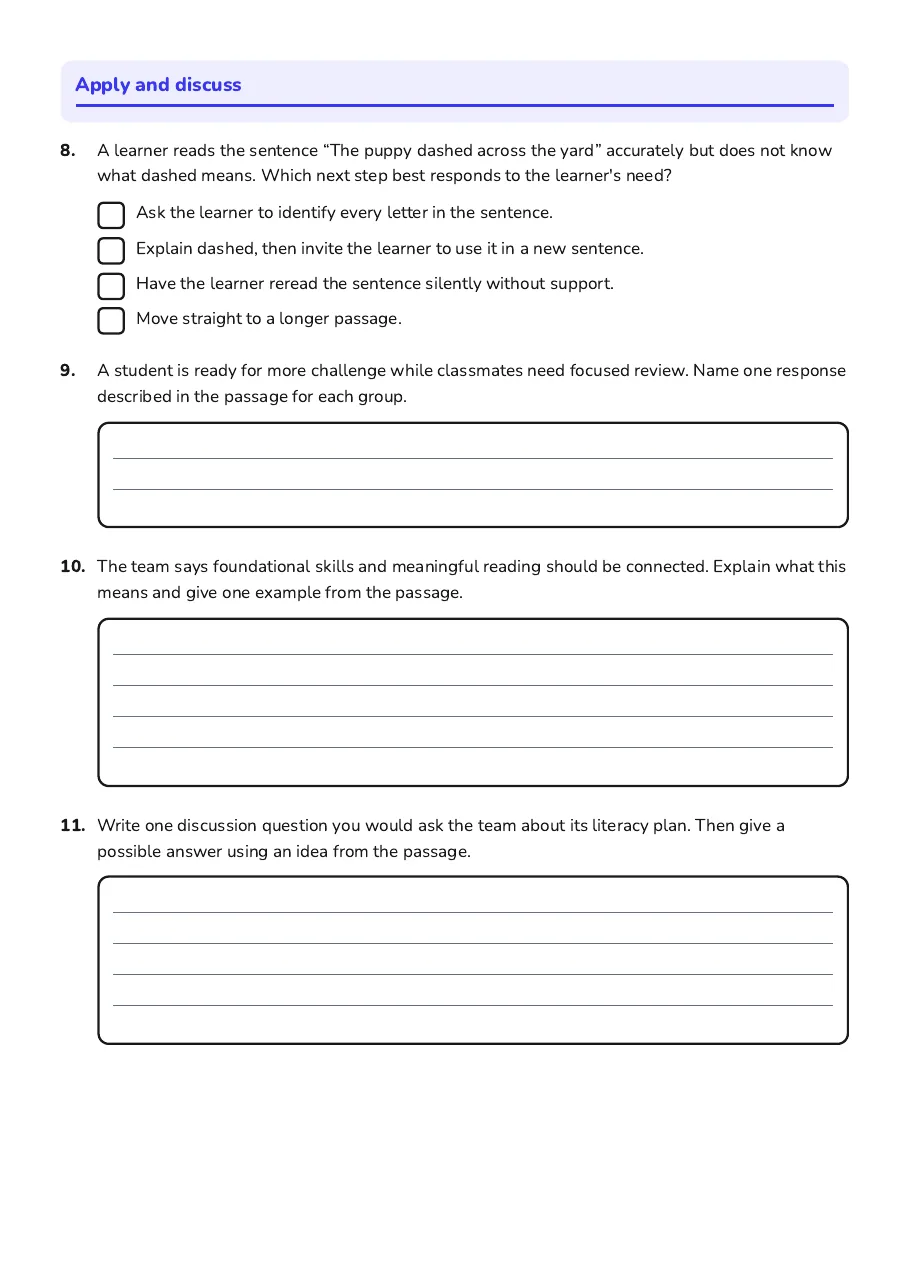
Apply and discuss
- Ask the learner to identify every letter in the sentence.
- Explain dashed, then invite the learner to use it in a new sentence.
- Have the learner reread the sentence silently without support.
- Move straight to a longer passage.
3 printable pages
Page 1
Page 2
Page 3
About This Worksheet
Free in Kuraplan
Sign up free, grab the PDF, and customize it for your class.
Print-Ready
Formatted for standard paper. Clean layout, easy to read.
AI-Generated
Created with Kuraplan's AI, designed for real classroom use.
For Teachers & Parents
Use in classrooms, for homework, tutoring, or homeschool.
Need a custom version of this worksheet?
Kuraplan's AI generates custom worksheets in seconds — differentiated for every learner, aligned to your curriculum.
Generate Custom Worksheets — Free