English (ELA)FreePrintable
Literary Text Summarizing Skills
A free english (ela) worksheet ready for your classroom. Open in Kuraplan to grab the print-ready PDF, customize it for your students, or generate a fresh version in seconds.
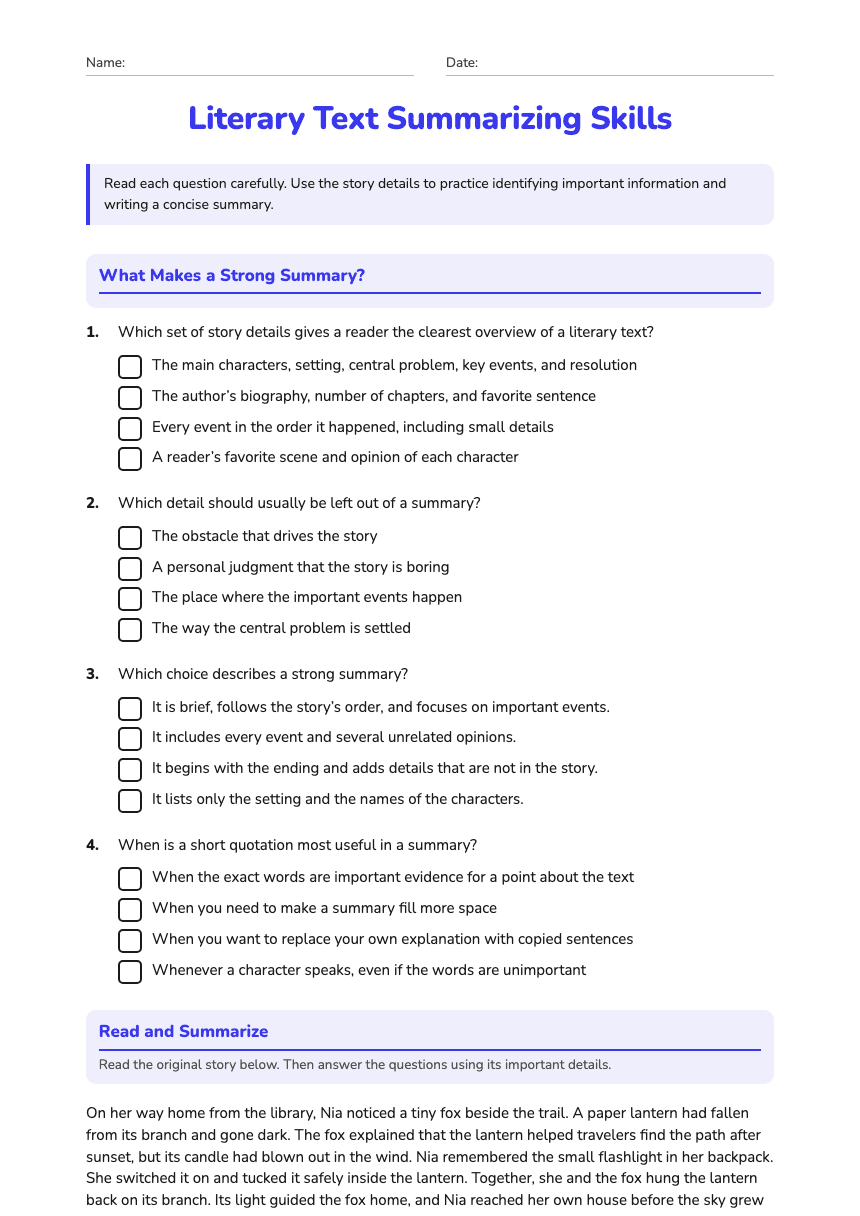
Name:Date:
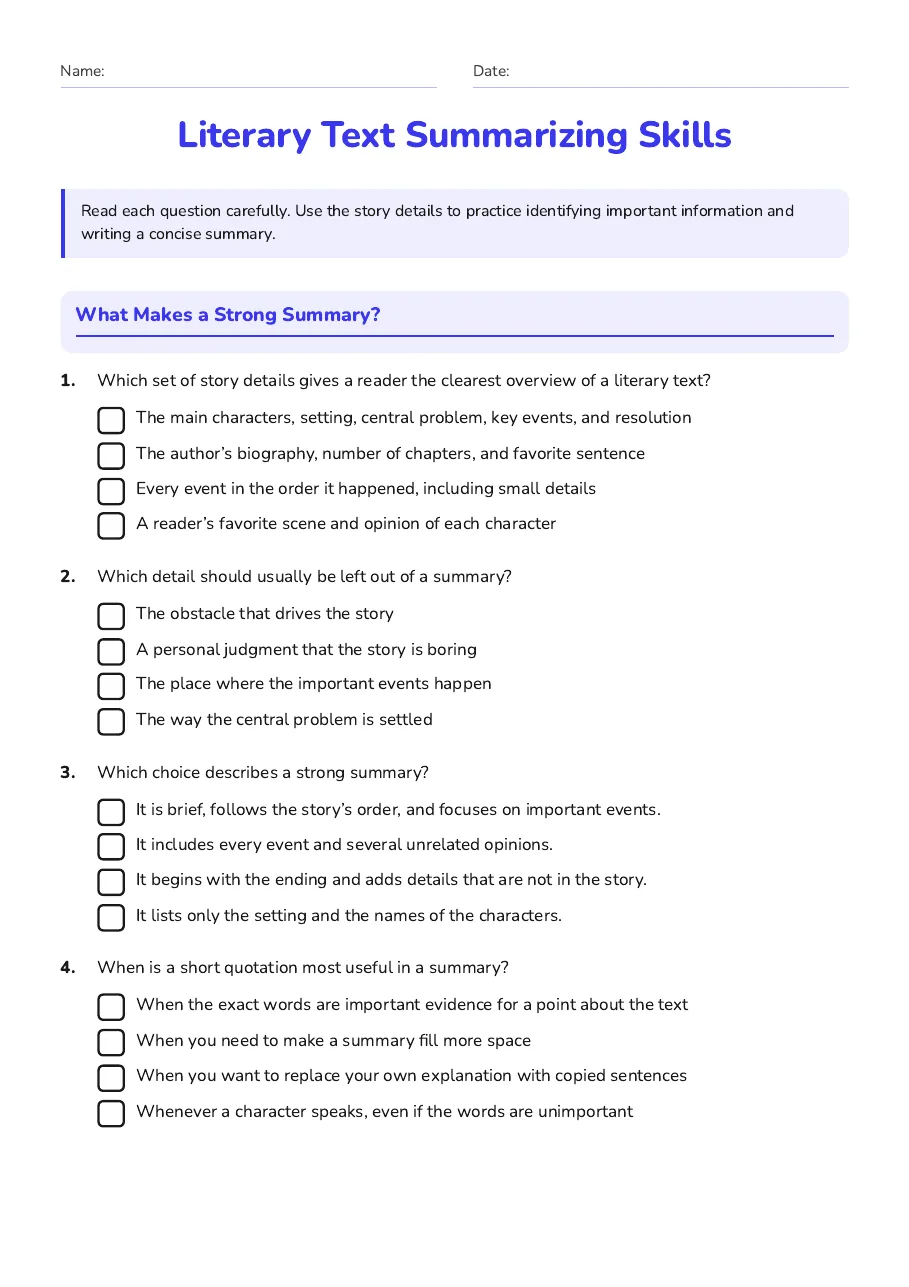
Literary Text Summarizing Skills
Read each question carefully. Use the story details to practice identifying important information and writing a concise summary.
What Makes a Strong Summary?
1.Which set of story details gives a reader the clearest overview of a literary text?
- The main characters, setting, central problem, key events, and resolution
- The author’s biography, number of chapters, and favorite sentence
- Every event in the order it happened, including small details
- A reader’s favorite scene and opinion of each character
2.Which detail should usually be left out of a summary?
- The obstacle that drives the story
- A personal judgment that the story is boring
- The place where the important events happen
- The way the central problem is settled
3.Which choice describes a strong summary?
- It is brief, follows the story’s order, and focuses on important events.
- It includes every event and several unrelated opinions.
- It begins with the ending and adds details that are not in the story.
- It lists only the setting and the names of the characters.
4.When is a short quotation most useful in a summary?
- When the exact words are important evidence for a point about the text
- When you need to make a summary fill more space
- When you want to replace your own explanation with copied sentences
- Whenever a character speaks, even if the words are unimportant
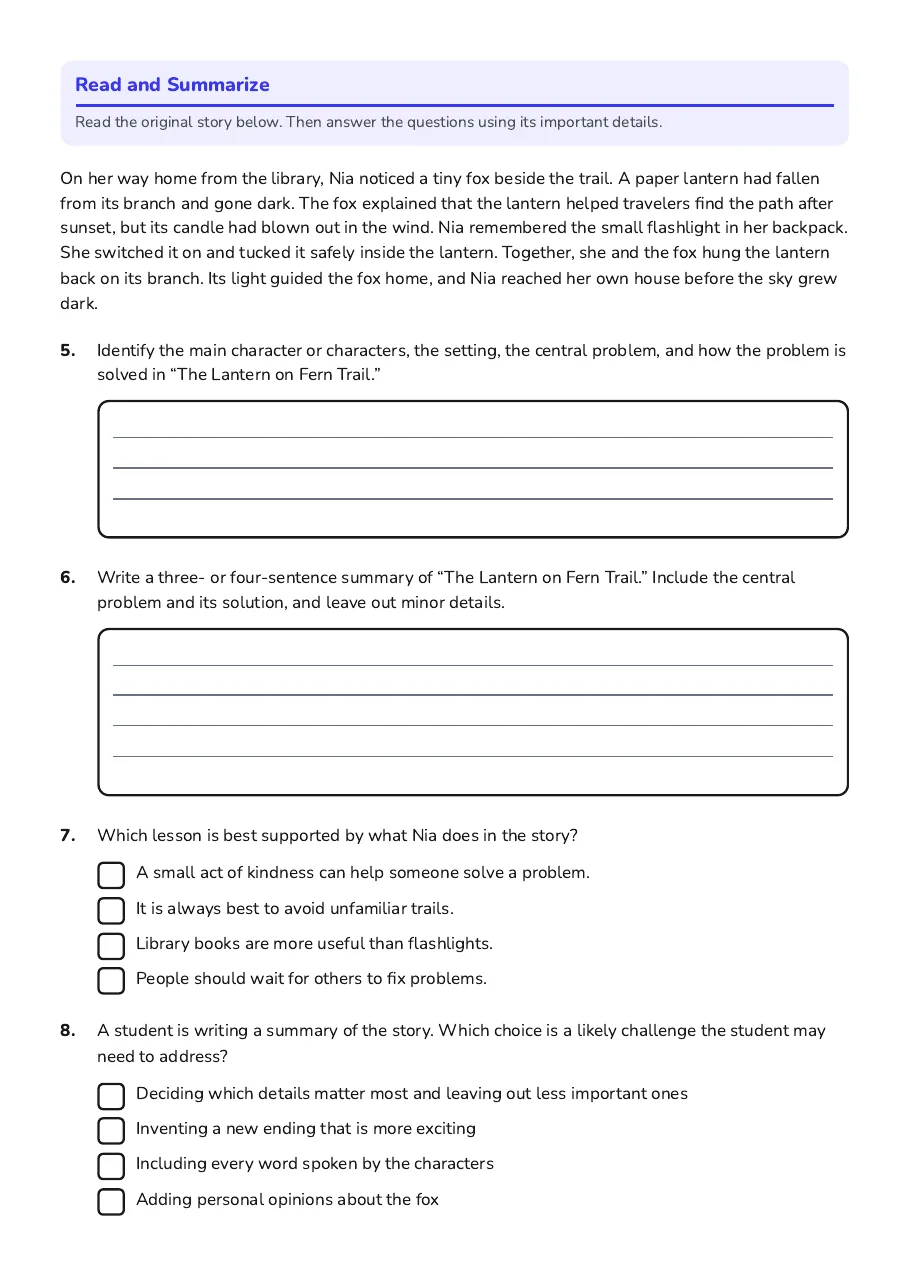
Read and Summarize
Read the original story below. Then answer the questions using its important details.
On her way home from the library, Nia noticed a tiny fox beside the trail. A paper lantern had fallen from its branch and gone dark. The fox explained that the lantern helped travelers find the path after sunset, but its candle had blown out in the wind. Nia remembered the small flashlight in her backpack. She switched it on and tucked it safely inside the lantern. Together, she and the fox hung the lantern back on its branch. Its light guided the fox home, and Nia reached her own house before the sky grew dark.
5.Identify the main character or characters, the setting, the central problem, and how the problem is solved in “The Lantern on Fern Trail.”
6.Write a three- or four-sentence summary of “The Lantern on Fern Trail.” Include the central problem and its solution, and leave out minor details.
7.Which lesson is best supported by what Nia does in the story?
- A small act of kindness can help someone solve a problem.
- It is always best to avoid unfamiliar trails.
- Library books are more useful than flashlights.
- People should wait for others to fix problems.
8.A student is writing a summary of the story. Which choice is a likely challenge the student may need to address?
- Deciding which details matter most and leaving out less important ones
- Inventing a new ending that is more exciting
- Including every word spoken by the characters
- Adding personal opinions about the fox
2 printable pages
Page 1
Page 2
About This Worksheet
Free in Kuraplan
Sign up free, grab the PDF, and customize it for your class.
Print-Ready
Formatted for standard paper. Clean layout, easy to read.
AI-Generated
Created with Kuraplan's AI, designed for real classroom use.
For Teachers & Parents
Use in classrooms, for homework, tutoring, or homeschool.
Need a custom version of this worksheet?
Kuraplan's AI generates custom worksheets in seconds — differentiated for every learner, aligned to your curriculum.
Generate Custom Worksheets — Free No credit card Curriculum-aligned Under 60 seconds