Major Wars in History
A free social studies worksheet ready for your classroom. Open in Kuraplan to grab the print-ready PDF, customize it for your students, or generate a fresh version in seconds.
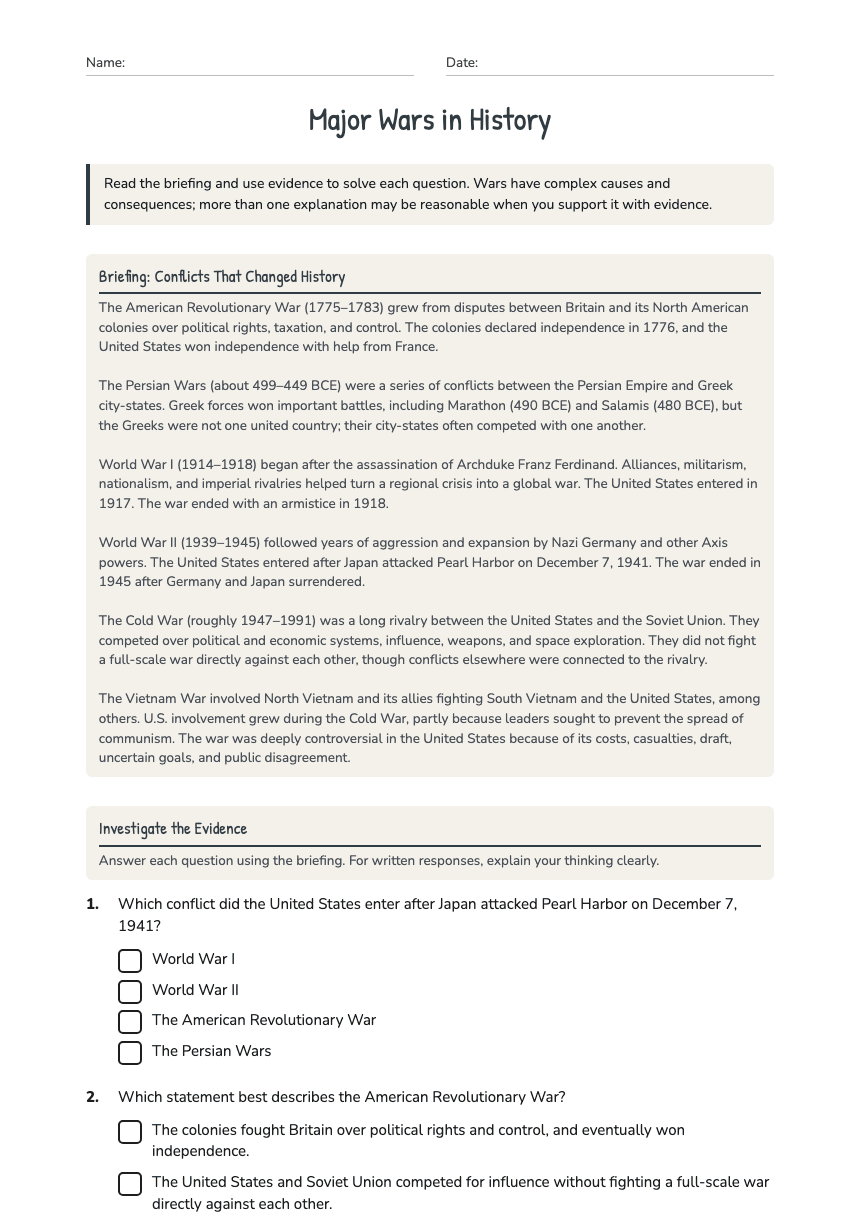
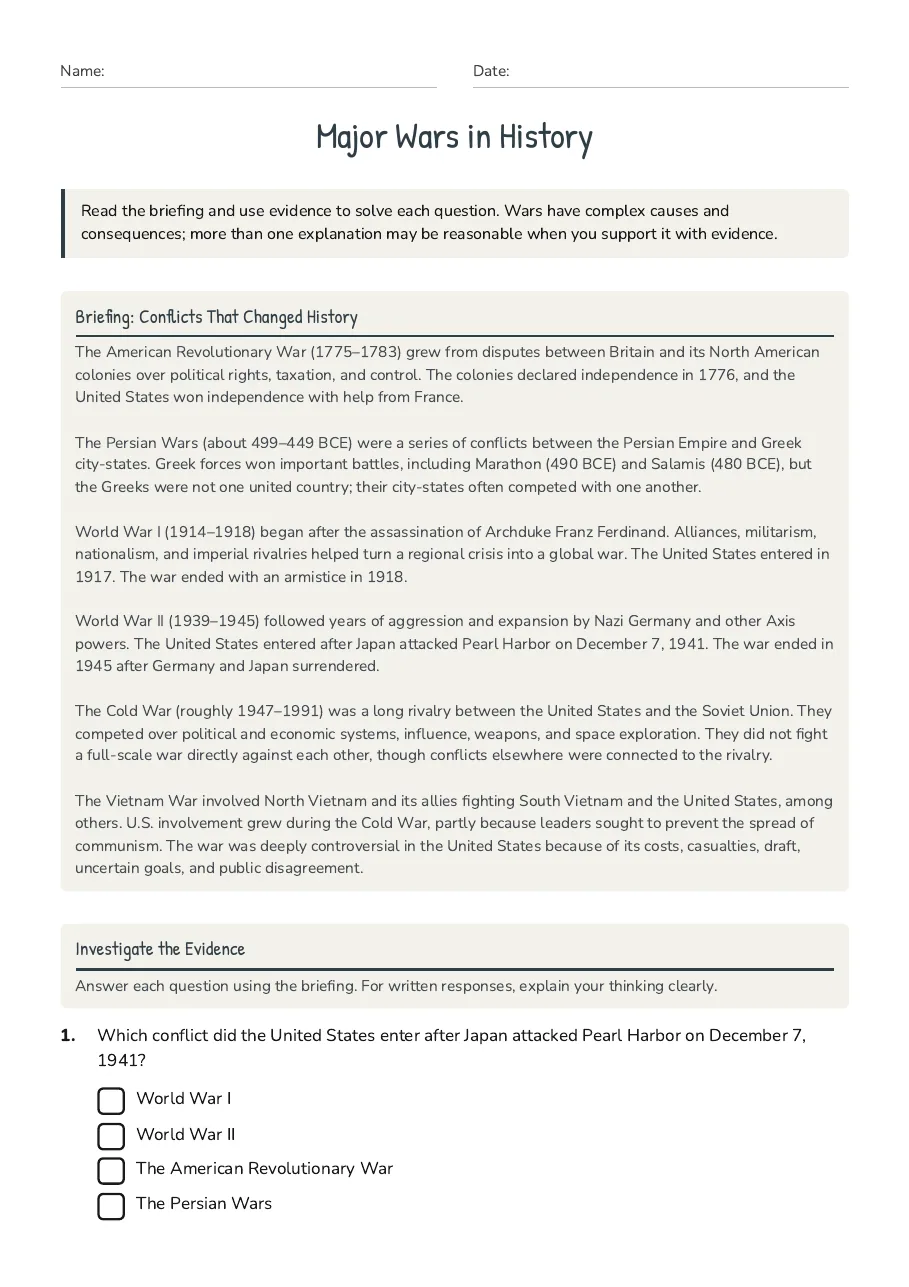
Major Wars in History
Briefing: Conflicts That Changed History
The American Revolutionary War (1775–1783) grew from disputes between Britain and its North American colonies over political rights, taxation, and control. The colonies declared independence in 1776, and the United States won independence with help from France. The Persian Wars (about 499–449 BCE) were a series of conflicts between the Persian Empire and Greek city-states. Greek forces won important battles, including Marathon (490 BCE) and Salamis (480 BCE), but the Greeks were not one united country; their city-states often competed with one another. World War I (1914–1918) began after the assassination of Archduke Franz Ferdinand. Alliances, militarism, nationalism, and imperial rivalries helped turn a regional crisis into a global war. The United States entered in 1917. The war ended with an armistice in 1918. World War II (1939–1945) followed years of aggression and expansion by Nazi Germany and other Axis powers. The United States entered after Japan attacked Pearl Harbor on December 7, 1941. The war ended in 1945 after Germany and Japan surrendered. The Cold War (roughly 1947–1991) was a long rivalry between the United States and the Soviet Union. They competed over political and economic systems, influence, weapons, and space exploration. They did not fight a full-scale war directly against each other, though conflicts elsewhere were connected to the rivalry. The Vietnam War involved North Vietnam and its allies fighting South Vietnam and the United States, among others. U.S. involvement grew during the Cold War, partly because leaders sought to prevent the spread of communism. The war was deeply controversial in the United States because of its costs, casualties, draft, uncertain goals, and public disagreement.
Investigate the Evidence
Answer each question using the briefing. For written responses, explain your thinking clearly.
- World War I
- World War II
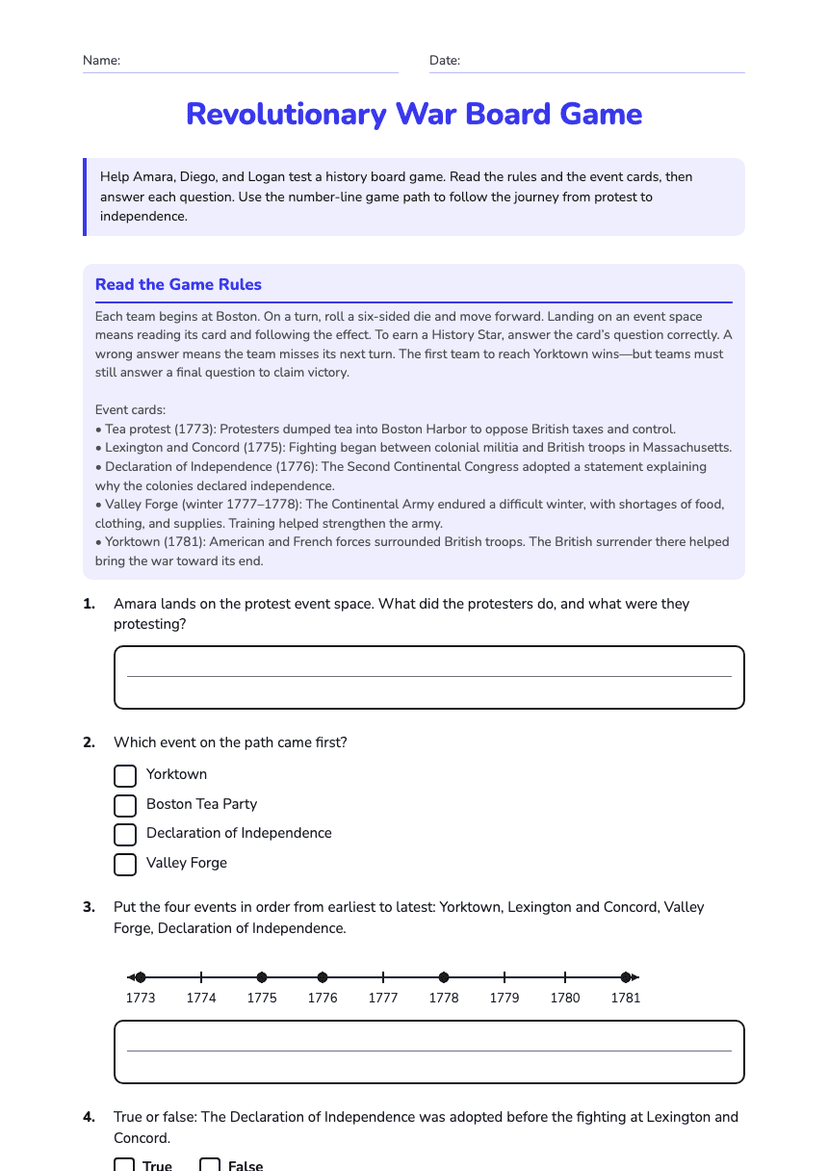
- The American Revolutionary War
- The Persian Wars
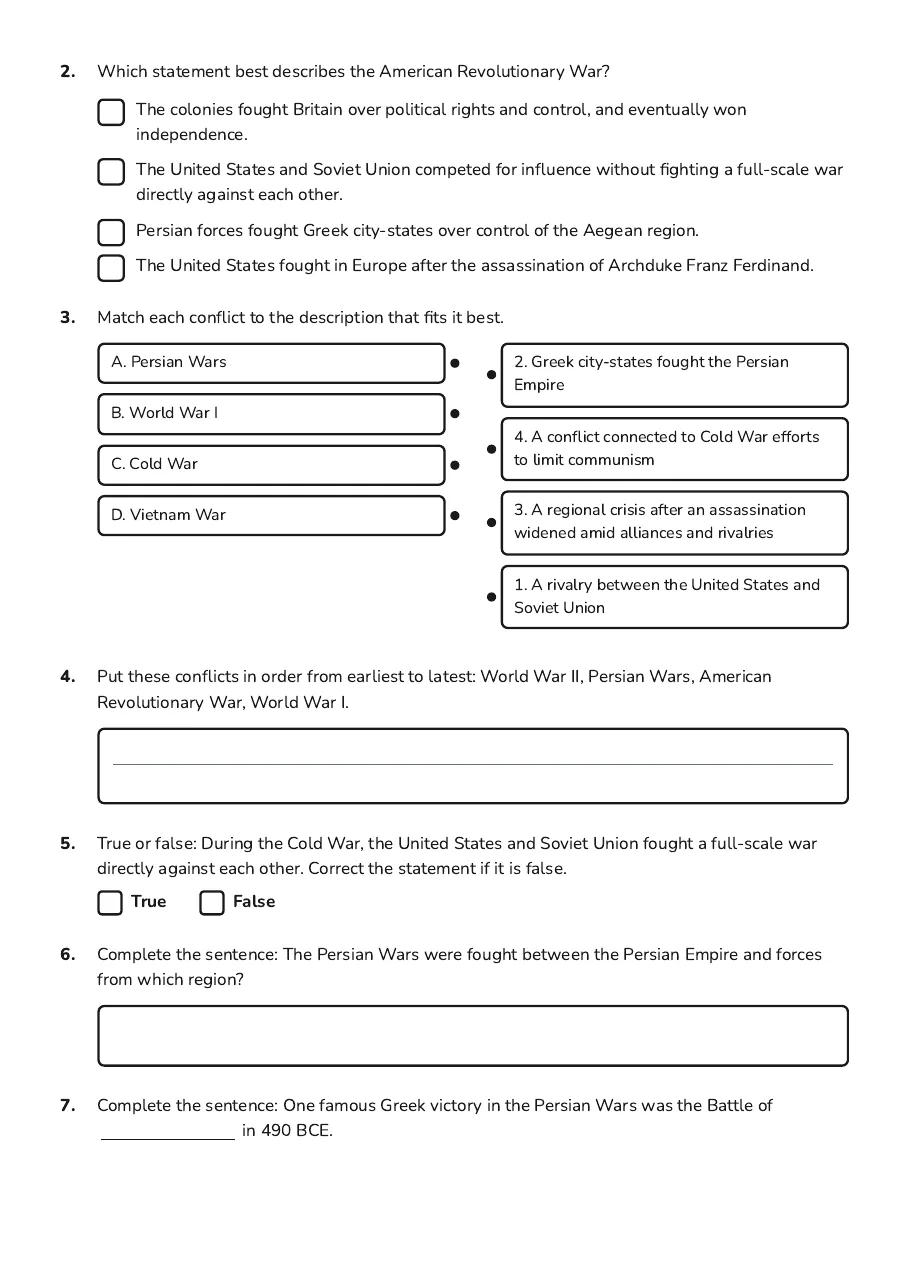
- The colonies fought Britain over political rights and control, and eventually won independence.
- The United States and Soviet Union competed for influence without fighting a full-scale war directly against each other.
- Persian forces fought Greek city-states over control of the Aegean region.
- The United States fought in Europe after the assassination of Archduke Franz Ferdinand.
- A. Persian Wars
- B. World War I
- C. Cold War
- D. Vietnam War
- 2. Greek city-states fought the Persian Empire
- 4. A conflict connected to Cold War efforts to limit communism
- 3. A regional crisis after an assassination widened amid alliances and rivalries
- 1. A rivalry between the United States and Soviet Union
3 printable pages
Page 1
Page 2
Page 3
About This Worksheet
Free in Kuraplan
Sign up free, grab the PDF, and customize it for your class.
Print-Ready
Formatted for standard paper. Clean layout, easy to read.
AI-Generated
Created with Kuraplan's AI, designed for real classroom use.
For Teachers & Parents
Use in classrooms, for homework, tutoring, or homeschool.
Need a custom version of this worksheet?
Kuraplan's AI generates custom worksheets in seconds — differentiated for every learner, aligned to your curriculum.
Generate Custom Worksheets — Free