Martin Luther King Jr. Legacy
A free english (ela) worksheet ready for your classroom. Open in Kuraplan to grab the print-ready PDF, customize it for your students, or generate a fresh version in seconds.

Martin Luther King Jr. Legacy
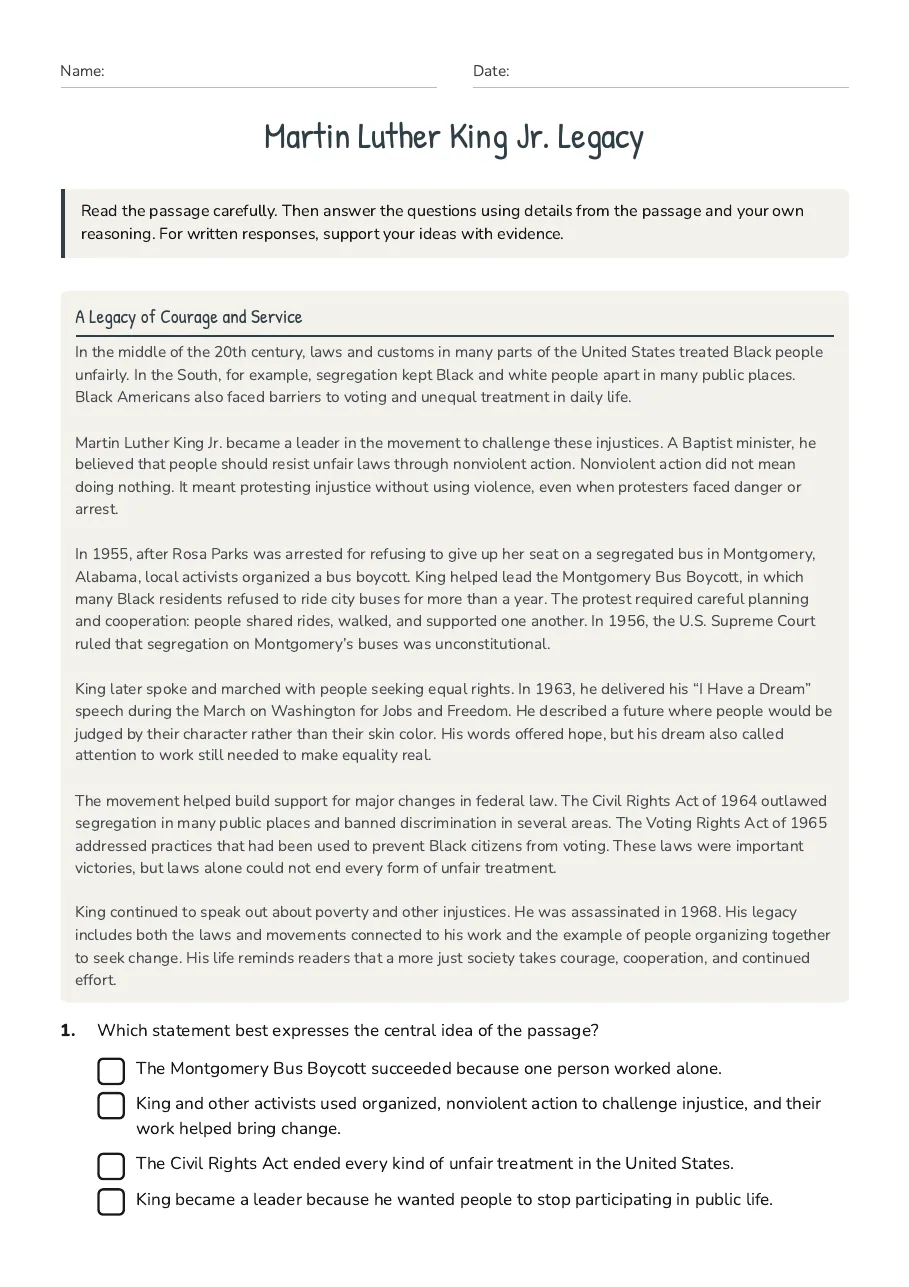
A Legacy of Courage and Service
In the middle of the 20th century, laws and customs in many parts of the United States treated Black people unfairly. In the South, for example, segregation kept Black and white people apart in many public places. Black Americans also faced barriers to voting and unequal treatment in daily life. Martin Luther King Jr. became a leader in the movement to challenge these injustices. A Baptist minister, he believed that people should resist unfair laws through nonviolent action. Nonviolent action did not mean doing nothing. It meant protesting injustice without using violence, even when protesters faced danger or arrest. In 1955, after Rosa Parks was arrested for refusing to give up her seat on a segregated bus in Montgomery, Alabama, local activists organized a bus boycott. King helped lead the Montgomery Bus Boycott, in which many Black residents refused to ride city buses for more than a year. The protest required careful planning and cooperation: people shared rides, walked, and supported one another. In 1956, the U.S. Supreme Court ruled that segregation on Montgomery’s buses was unconstitutional. King later spoke and marched with people seeking equal rights. In 1963, he delivered his “I Have a Dream” speech during the March on Washington for Jobs and Freedom. He described a future where people would be judged by their character rather than their skin color. His words offered hope, but his dream also called attention to work still needed to make equality real. The movement helped build support for major changes in federal law. The Civil Rights Act of 1964 outlawed segregation in many public places and banned discrimination in several areas. The Voting Rights Act of 1965 addressed practices that had been used to prevent Black citizens from voting. These laws were important victories, but laws alone could not end every form of unfair treatment. King continued to speak out about poverty and other injustices. He was assassinated in 1968. His legacy includes both the laws and movements connected to his work and the example of people organizing together to seek change. His life reminds readers that a more just society takes courage, cooperation, and continued effort.
- The Montgomery Bus Boycott succeeded because one person worked alone.
- King and other activists used organized, nonviolent action to challenge injustice, and their work helped bring change.
- The Civil Rights Act ended every kind of unfair treatment in the United States.
- King became a leader because he wanted people to stop participating in public life.
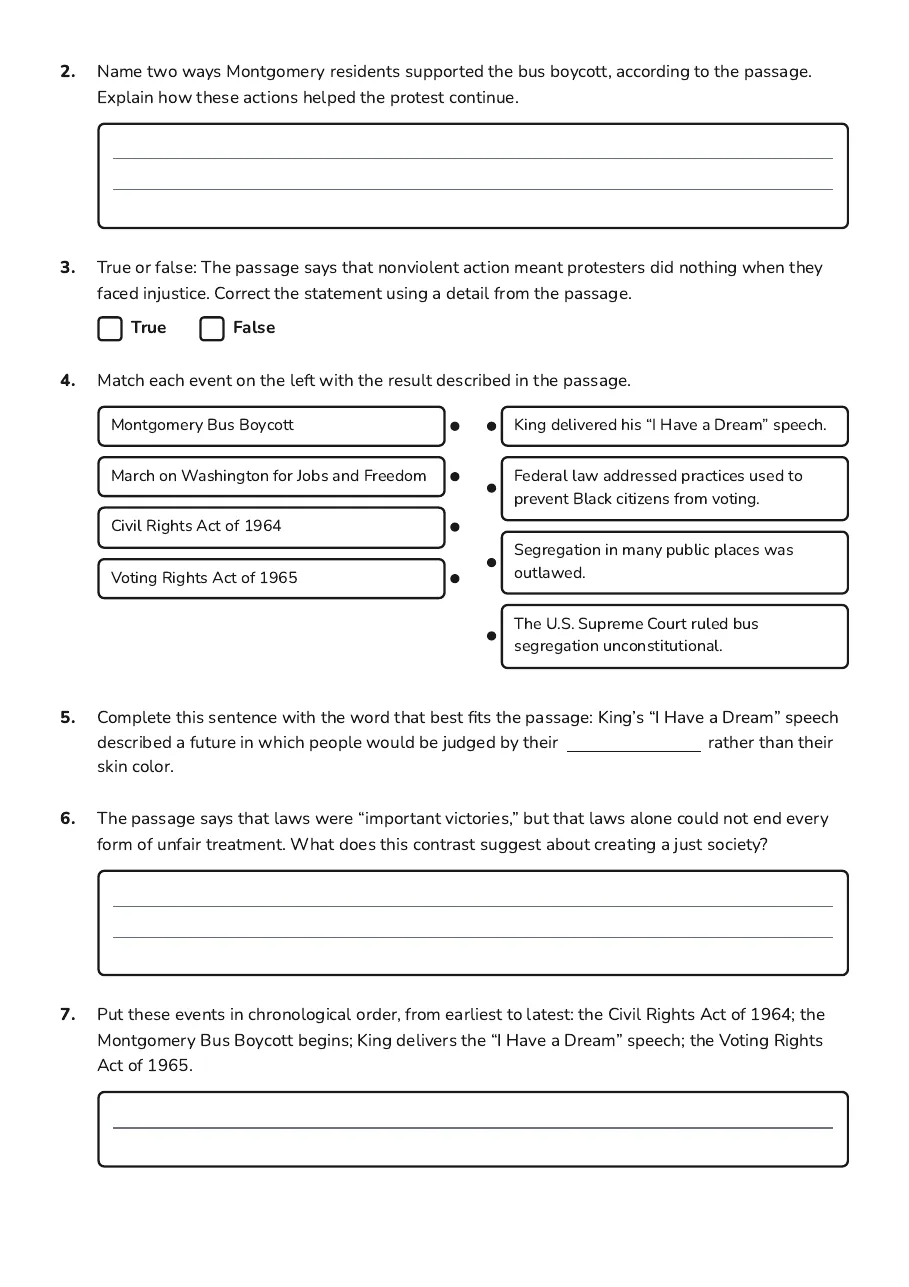
- Montgomery Bus Boycott
- March on Washington for Jobs and Freedom
- Civil Rights Act of 1964
- Voting Rights Act of 1965
- King delivered his “I Have a Dream” speech.
- Federal law addressed practices used to prevent Black citizens from voting.
- Segregation in many public places was outlawed.
- The U.S. Supreme Court ruled bus segregation unconstitutional.
3 printable pages
Page 1
Page 2

Page 3
About This Worksheet
Free in Kuraplan
Sign up free, grab the PDF, and customize it for your class.
Print-Ready
Formatted for standard paper. Clean layout, easy to read.
AI-Generated
Created with Kuraplan's AI, designed for real classroom use.
For Teachers & Parents
Use in classrooms, for homework, tutoring, or homeschool.
Need a custom version of this worksheet?
Kuraplan's AI generates custom worksheets in seconds — differentiated for every learner, aligned to your curriculum.
Generate Custom Worksheets — Free