Matter Changes Exploration Answer Key
A free science worksheet ready for your classroom. Open in Kuraplan to grab the print-ready PDF, customize it for your students, or generate a fresh version in seconds.
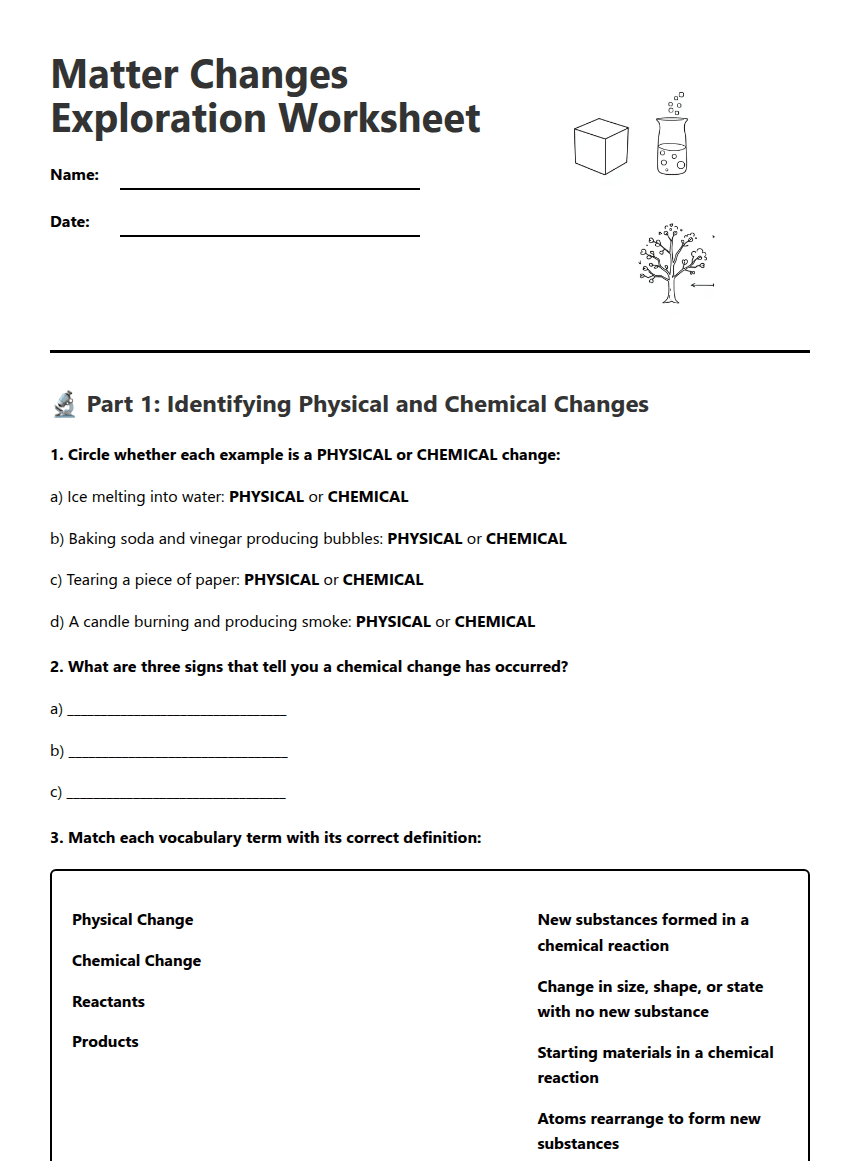
Matter Changes Exploration Worksheet - Answer Key
🔬 Part 1: Answer Key
a) Ice melting into water: PHYSICAL
b) Baking soda and vinegar producing bubbles: CHEMICAL
c) Tearing a piece of paper: PHYSICAL
d) A candle burning and producing smoke: CHEMICAL
a) Color change
b) Gas production (bubbling)
c) Temperature change
Also acceptable: odor/smell change, formation of a precipitate, light production
Physical Change → Change in size, shape, or state with no new substance
Chemical Change → Atoms rearrange to form new substances
Reactants → Starting materials in a chemical reaction
Products → New substances formed in a chemical reaction
🧪 Part 2: Answer Key
In a physical change, the atoms and molecules stay the same, and the change is usually reversible. In a chemical change, a new substance is formed.
📖 Part 3: Answer Key
Cause: Plastics are the result of chemical changes
Effect: They don't break down easily in nature, causing environmental concerns
Also acceptable: Cause - Chemical processes transform natural resources; Effect - New substances with different properties are created
About This Worksheet
Free in Kuraplan
Sign up free, grab the PDF, and customize it for your class.
Print-Ready
Formatted for standard paper. Clean layout, easy to read.
AI-Generated
Created with Kuraplan's AI, designed for real classroom use.
For Teachers & Parents
Use in classrooms, for homework, tutoring, or homeschool.
Need a custom version of this worksheet?
Kuraplan's AI generates custom worksheets in seconds — differentiated for every learner, aligned to your curriculum.
Generate Custom Worksheets — FreeMore Science Worksheets
Matter and Energy Fun Lab
Free
Matter Pathway Investigation
Free
Mixture Separation Investigation
Free
Fireworks in a Jar: Density and Mixtures
Free
Matter Changes and Mixtures
Free
Physical and Chemical Changes
Free
Matter and Particles Investigation
Free