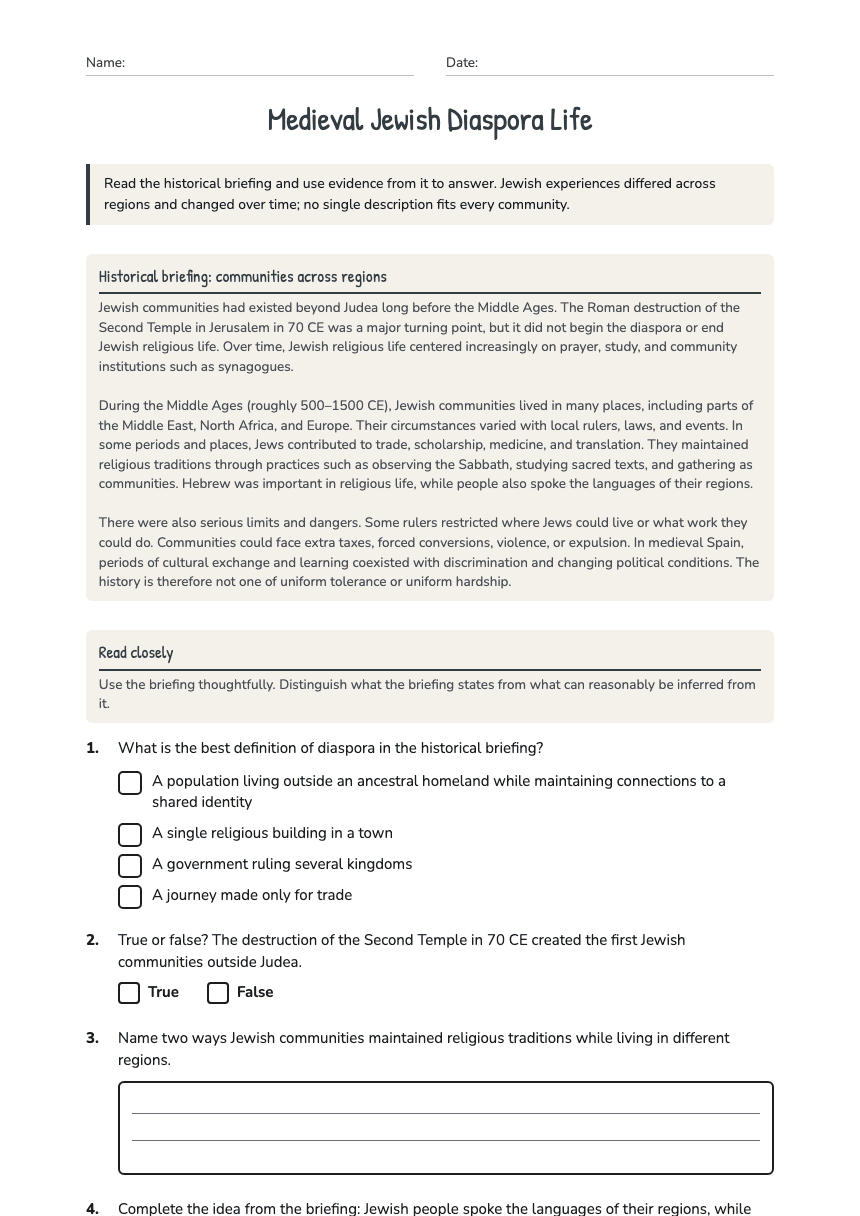
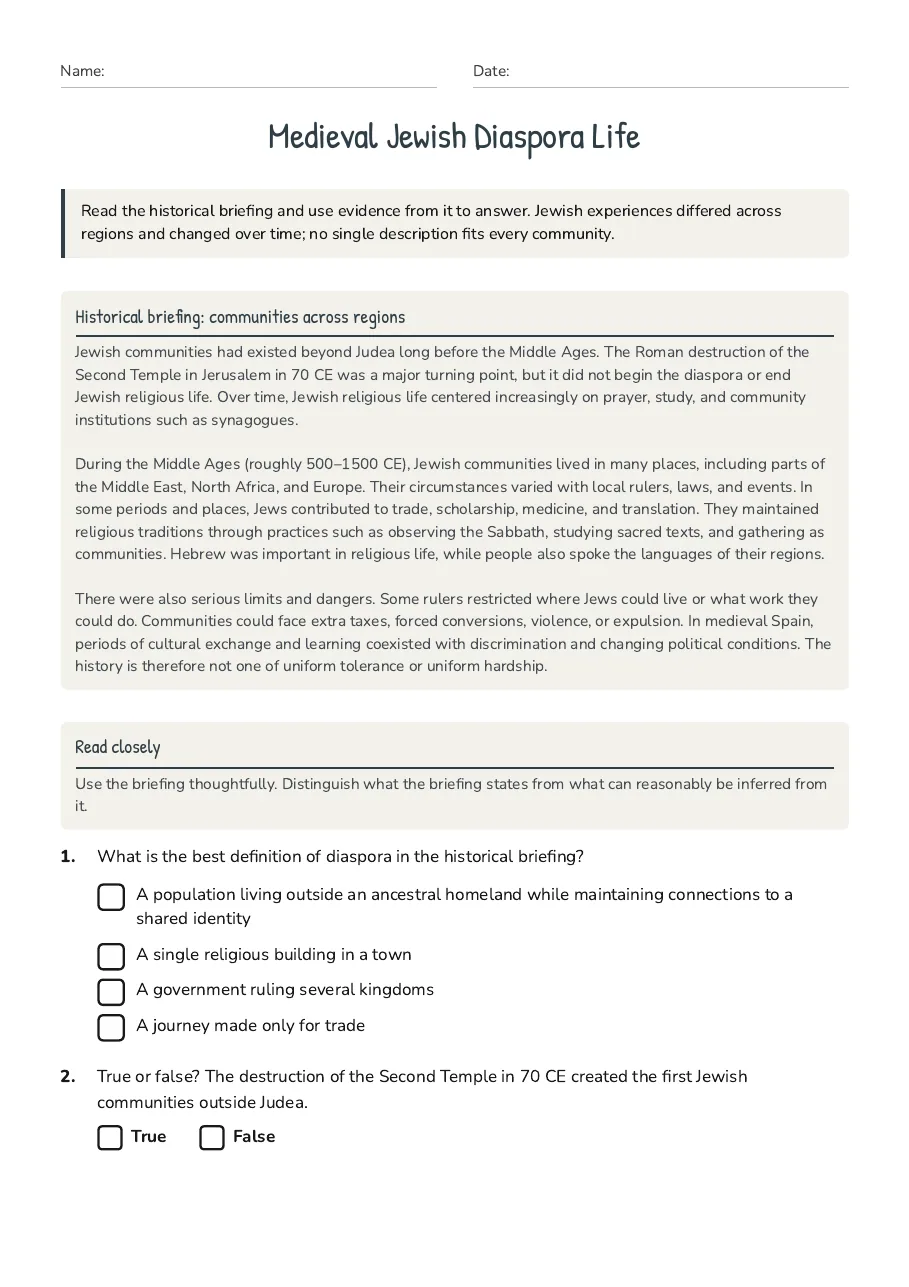
Medieval Jewish Diaspora Life
A free social studies worksheet ready for your classroom. Open in Kuraplan to grab the print-ready PDF, customize it for your students, or generate a fresh version in seconds.
Medieval Jewish Diaspora Life
Historical briefing: communities across regions
Jewish communities had existed beyond Judea long before the Middle Ages. The Roman destruction of the Second Temple in Jerusalem in 70 CE was a major turning point, but it did not begin the diaspora or end Jewish religious life. Over time, Jewish religious life centered increasingly on prayer, study, and community institutions such as synagogues. During the Middle Ages (roughly 500–1500 CE), Jewish communities lived in many places, including parts of the Middle East, North Africa, and Europe. Their circumstances varied with local rulers, laws, and events. In some periods and places, Jews contributed to trade, scholarship, medicine, and translation. They maintained religious traditions through practices such as observing the Sabbath, studying sacred texts, and gathering as communities. Hebrew was important in religious life, while people also spoke the languages of their regions. There were also serious limits and dangers. Some rulers restricted where Jews could live or what work they could do. Communities could face extra taxes, forced conversions, violence, or expulsion. In medieval Spain, periods of cultural exchange and learning coexisted with discrimination and changing political conditions. The history is therefore not one of uniform tolerance or uniform hardship.
Read closely
Use the briefing thoughtfully. Distinguish what the briefing states from what can reasonably be inferred from it.
- A population living outside an ancestral homeland while maintaining connections to a shared identity
- A single religious building in a town
- A government ruling several kingdoms
- A journey made only for trade
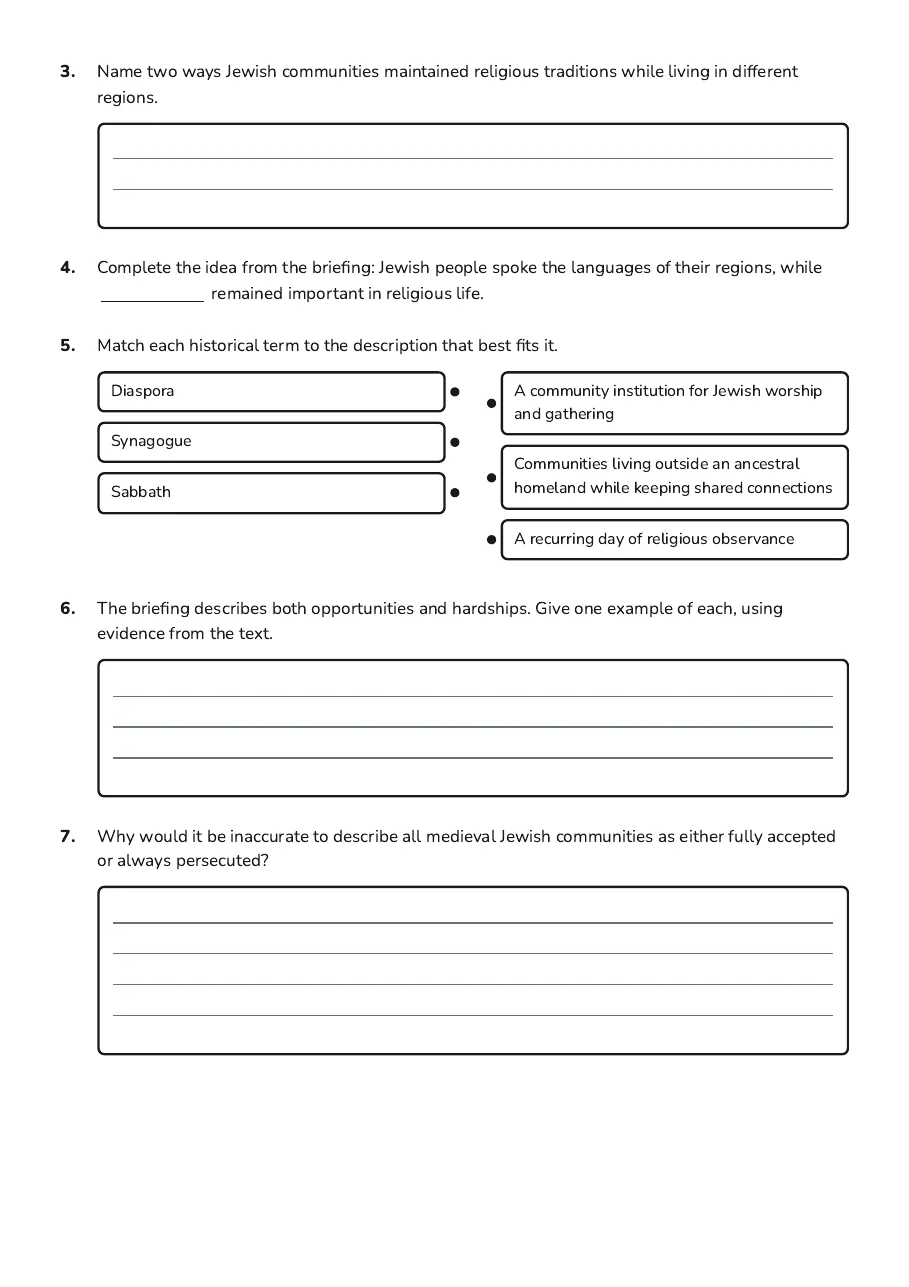
- Diaspora
- Synagogue
- Sabbath
- A community institution for Jewish worship and gathering
- Communities living outside an ancestral homeland while keeping shared connections
- A recurring day of religious observance
3 printable pages
Page 1
Page 2
Page 3
About This Worksheet
Free in Kuraplan
Sign up free, grab the PDF, and customize it for your class.
Print-Ready
Formatted for standard paper. Clean layout, easy to read.
AI-Generated
Created with Kuraplan's AI, designed for real classroom use.
For Teachers & Parents
Use in classrooms, for homework, tutoring, or homeschool.
Need a custom version of this worksheet?
Kuraplan's AI generates custom worksheets in seconds — differentiated for every learner, aligned to your curriculum.
Generate Custom Worksheets — Free