ScienceFreePrintable

Melting Point Investigation Lab

A free science worksheet ready for your classroom. Open in Kuraplan to grab the print-ready PDF, customize it for your students, or generate a fresh version in seconds.
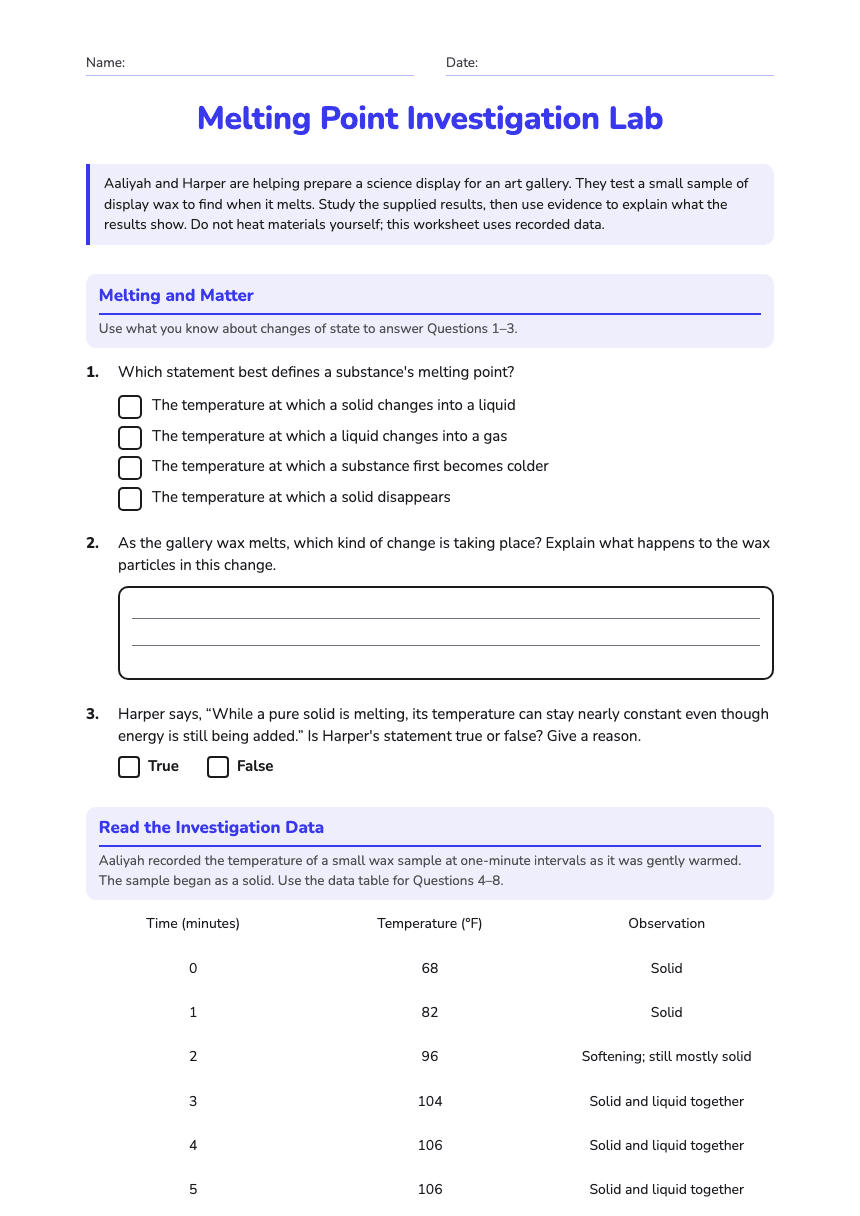
Melting Point Investigation Lab worksheet preview
Name:Date:

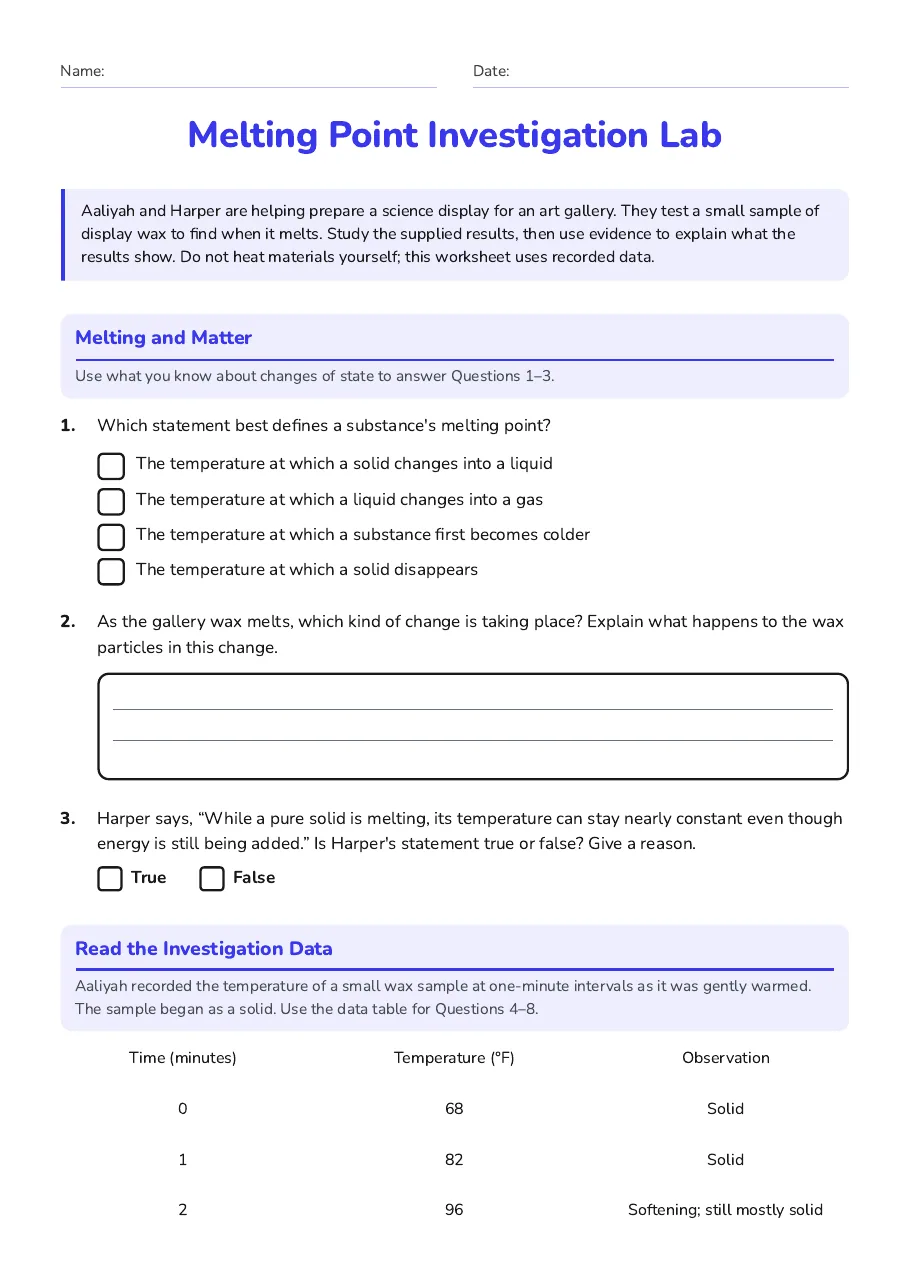
Melting Point Investigation Lab

Aaliyah and Harper are helping prepare a science display for an art gallery. They test a small sample of display wax to find when it melts. Study the supplied results, then use evidence to explain what the results show. Do not heat materials yourself; this worksheet uses recorded data.

Melting and Matter

Use what you know about changes of state to answer Questions 1–3.

1.Which statement best defines a substance's melting point?
  • The temperature at which a solid changes into a liquid
  • The temperature at which a liquid changes into a gas
  • The temperature at which a substance first becomes colder
  • The temperature at which a solid disappears
2.As the gallery wax melts, which kind of change is taking place? Explain what happens to the wax particles in this change.
3.Harper says, “While a pure solid is melting, its temperature can stay nearly constant even though energy is still being added.” Is Harper's statement true or false? Give a reason.
TrueFalse

Read the Investigation Data

Aaliyah recorded the temperature of a small wax sample at one-minute intervals as it was gently warmed. The sample began as a solid. Use the data table for Questions 4–8.

Time (minutes)

Temperature (°F)

Observation

0

68

Solid

1

82

Solid

2

96

Softening; still mostly solid

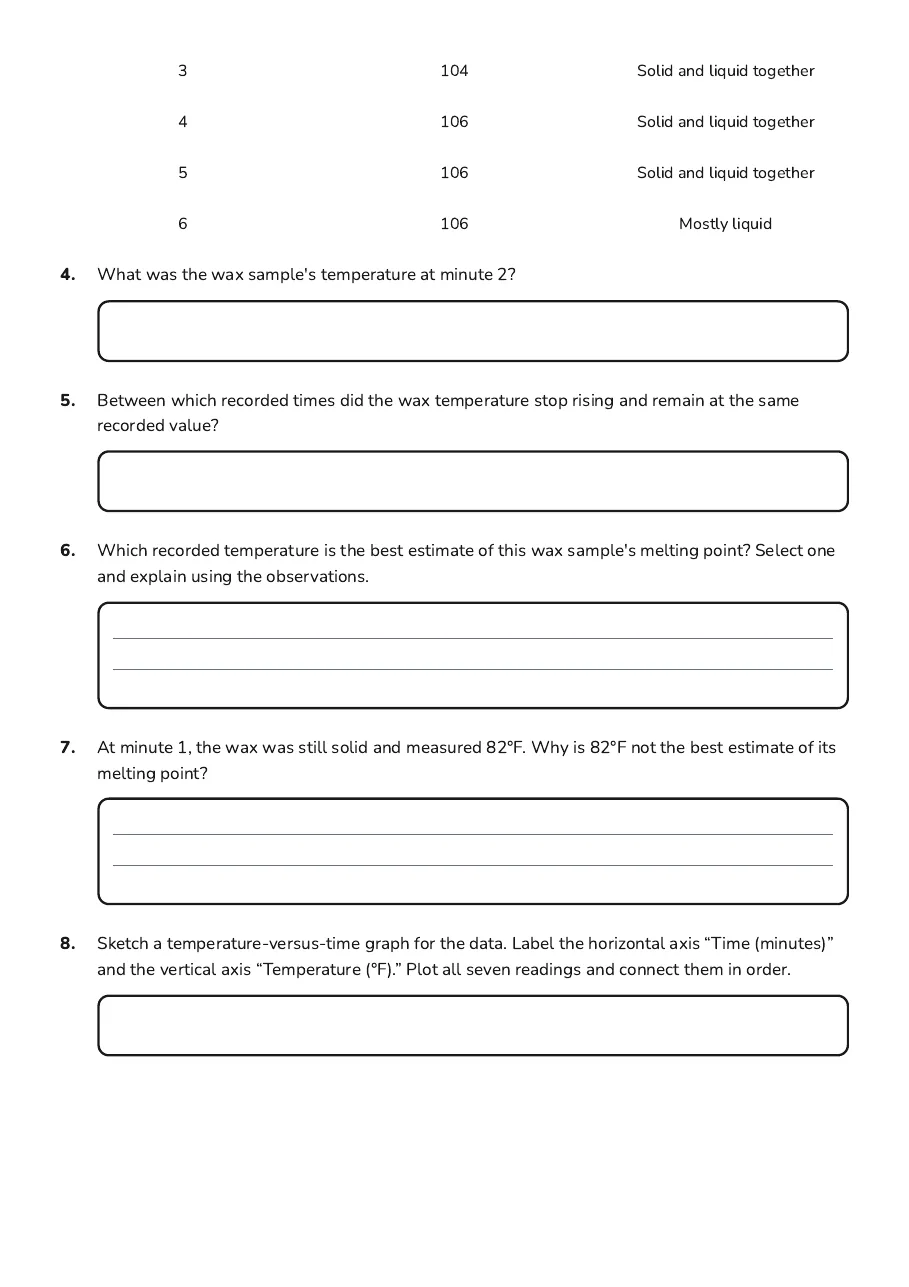
3

104

Solid and liquid together

4

106

Solid and liquid together

5

106

Solid and liquid together

6

106

Mostly liquid

4.What was the wax sample's temperature at minute 2?
5.Between which recorded times did the wax temperature stop rising and remain at the same recorded value?
6.Which recorded temperature is the best estimate of this wax sample's melting point? Select one and explain using the observations.
7.At minute 1, the wax was still solid and measured 82°F. Why is 82°F not the best estimate of its melting point?
8.Sketch a temperature-versus-time graph for the data. Label the horizontal axis “Time (minutes)” and the vertical axis “Temperature (°F).” Plot all seven readings and connect them in order.

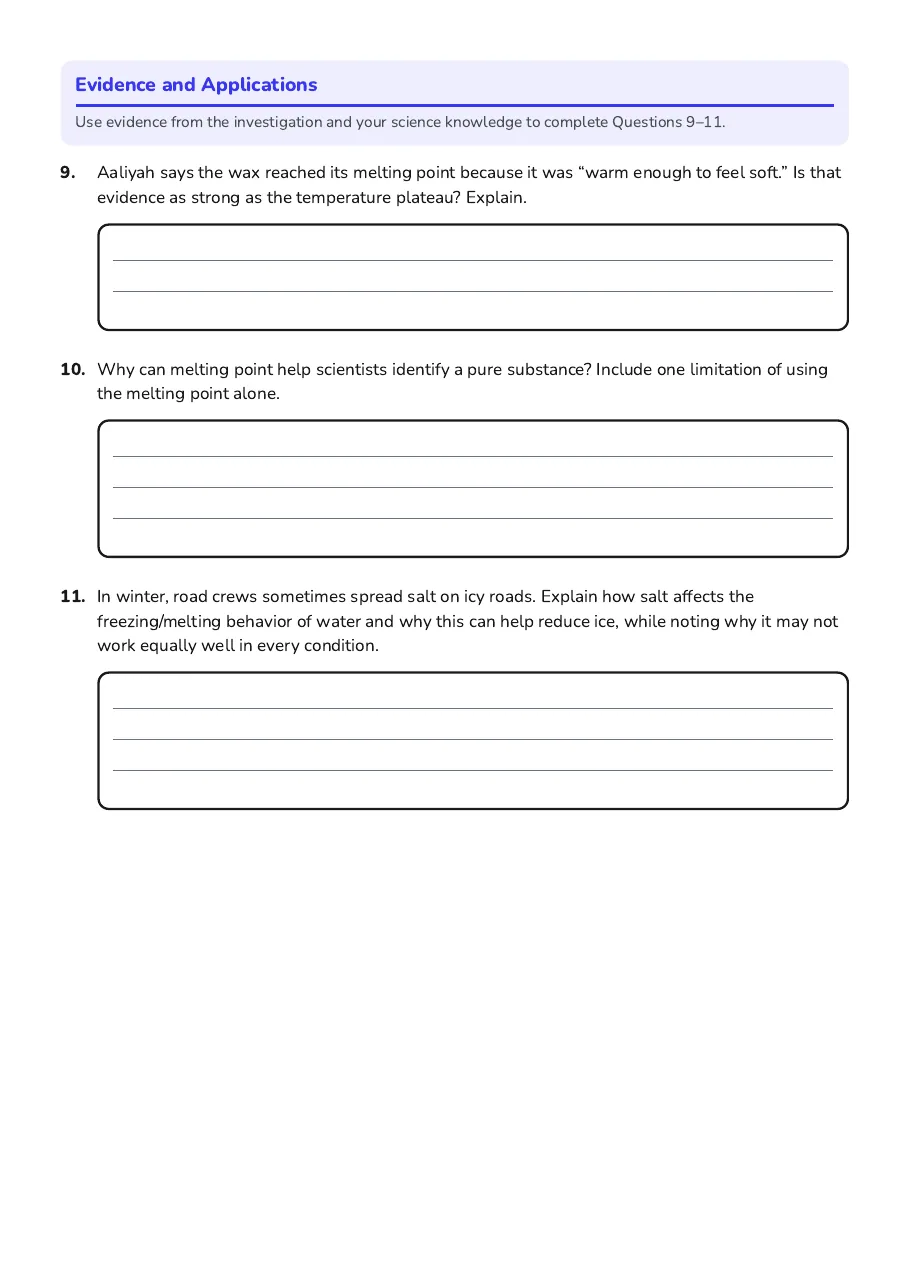
Evidence and Applications

Use evidence from the investigation and your science knowledge to complete Questions 9–11.

9.Aaliyah says the wax reached its melting point because it was “warm enough to feel soft.” Is that evidence as strong as the temperature plateau? Explain.
10.Why can melting point help scientists identify a pure substance? Include one limitation of using the melting point alone.
11.In winter, road crews sometimes spread salt on icy roads. Explain how salt affects the freezing/melting behavior of water and why this can help reduce ice, while noting why it may not work equally well in every condition.

3 printable pages

  • Melting Point Investigation Lab, page 1 of 3: Melting and Matter, Read the Investigation Data

    Page 1

  • Melting Point Investigation Lab, page 2 of 3: 3 104 Solid and liquid together

    Page 2

  • Melting Point Investigation Lab, page 3 of 3: Evidence and Applications

    Page 3

About This Worksheet

Free in Kuraplan

Sign up free, grab the PDF, and customize it for your class.

Print-Ready

Formatted for standard paper. Clean layout, easy to read.

AI-Generated

Created with Kuraplan's AI, designed for real classroom use.

For Teachers & Parents

Use in classrooms, for homework, tutoring, or homeschool.

Need a custom version of this worksheet?

Kuraplan's AI generates custom worksheets in seconds — differentiated for every learner, aligned to your curriculum.

Generate Custom Worksheets — Free
No credit card Curriculum-aligned Under 60 seconds