ScienceFreePrintable

Reflection Practice

A free science worksheet ready for your classroom. Open in Kuraplan to grab the print-ready PDF, customize it for your students, or generate a fresh version in seconds.
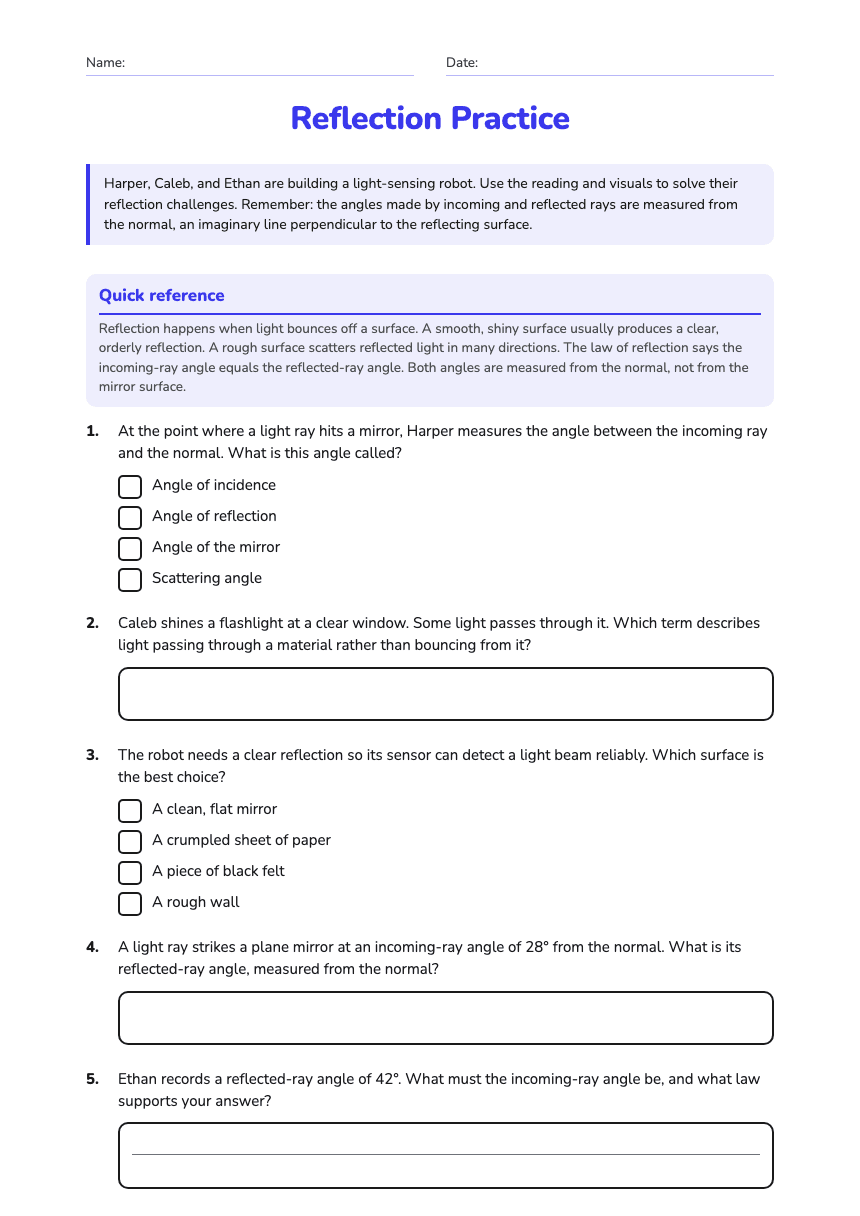
Reflection Practice worksheet preview
Name:Date:

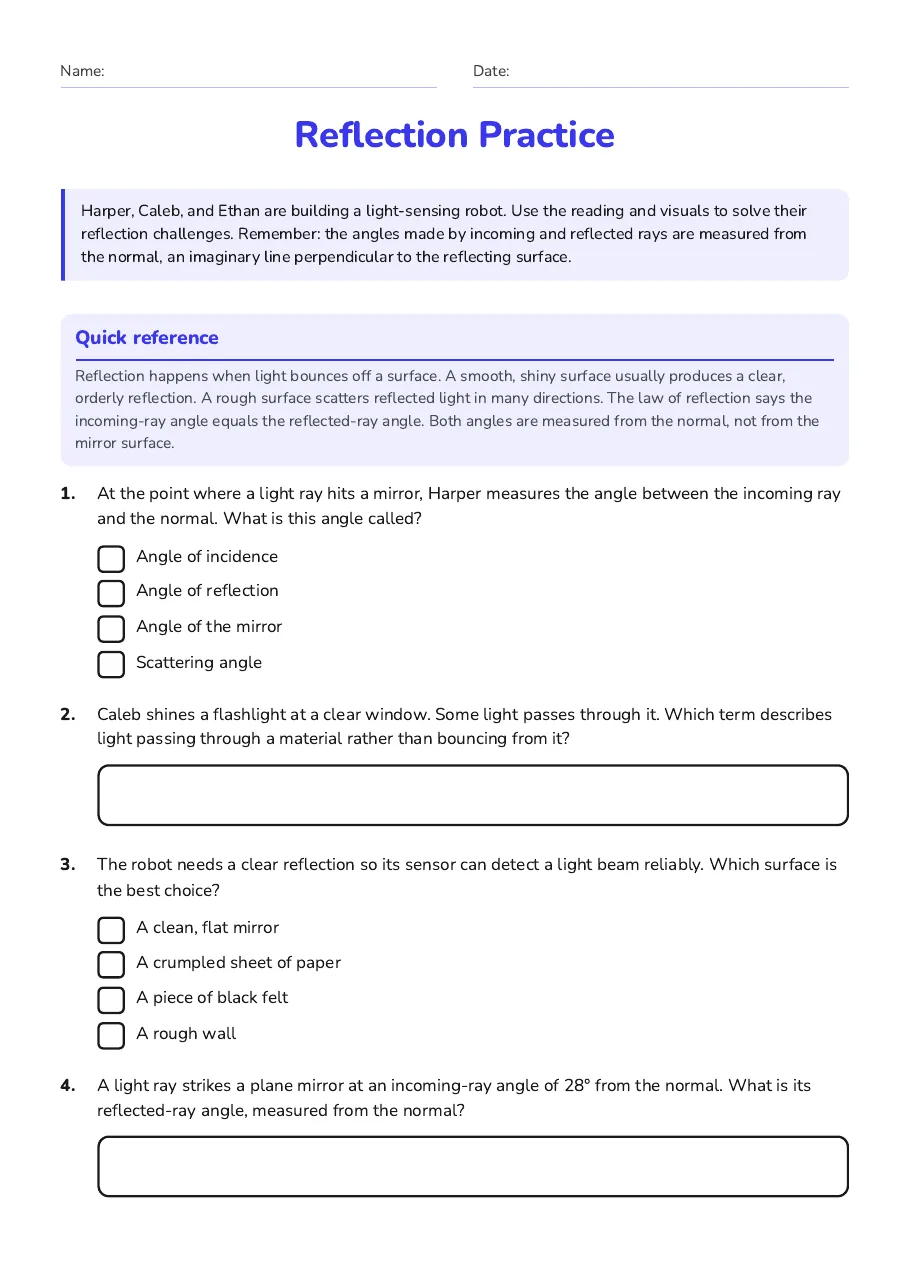
Reflection Practice

Harper, Caleb, and Ethan are building a light-sensing robot. Use the reading and visuals to solve their reflection challenges. Remember: the angles made by incoming and reflected rays are measured from the normal, an imaginary line perpendicular to the reflecting surface.

Quick reference

Reflection happens when light bounces off a surface. A smooth, shiny surface usually produces a clear, orderly reflection. A rough surface scatters reflected light in many directions. The law of reflection says the incoming-ray angle equals the reflected-ray angle. Both angles are measured from the normal, not from the mirror surface.

1.At the point where a light ray hits a mirror, Harper measures the angle between the incoming ray and the normal. What is this angle called?
  • Angle of incidence
  • Angle of reflection
  • Angle of the mirror
  • Scattering angle
2.Caleb shines a flashlight at a clear window. Some light passes through it. Which term describes light passing through a material rather than bouncing from it?
3.The robot needs a clear reflection so its sensor can detect a light beam reliably. Which surface is the best choice?
  • A clean, flat mirror
  • A crumpled sheet of paper
  • A piece of black felt
  • A rough wall
4.A light ray strikes a plane mirror at an incoming-ray angle of 28° from the normal. What is its reflected-ray angle, measured from the normal?
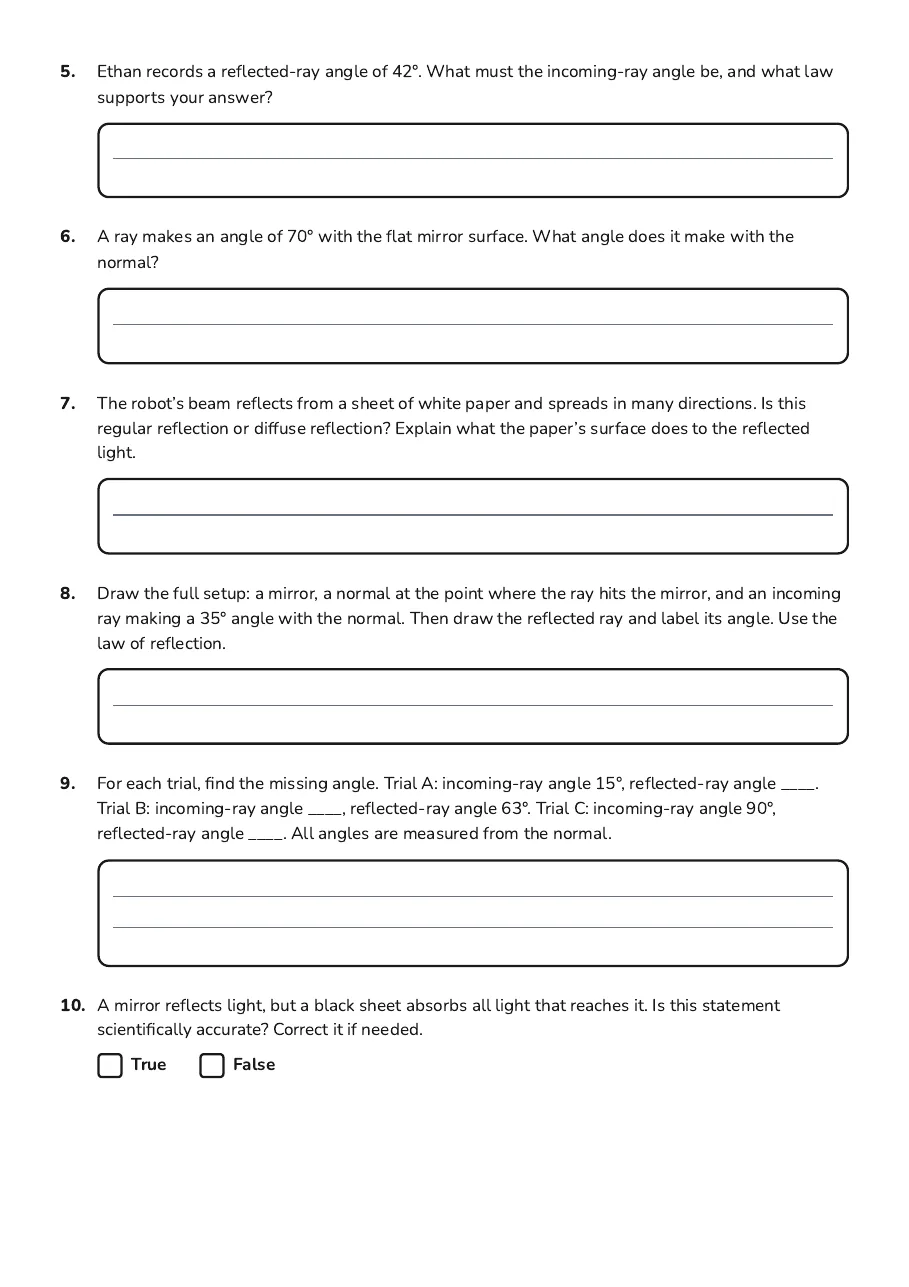
5.Ethan records a reflected-ray angle of 42°. What must the incoming-ray angle be, and what law supports your answer?
6.A ray makes an angle of 70° with the flat mirror surface. What angle does it make with the normal?
7.The robot’s beam reflects from a sheet of white paper and spreads in many directions. Is this regular reflection or diffuse reflection? Explain what the paper’s surface does to the reflected light.
8.Draw the full setup: a mirror, a normal at the point where the ray hits the mirror, and an incoming ray making a 35° angle with the normal. Then draw the reflected ray and label its angle. Use the law of reflection.
9.For each trial, find the missing angle. Trial A: incoming-ray angle 15°, reflected-ray angle ____. Trial B: incoming-ray angle ____, reflected-ray angle 63°. Trial C: incoming-ray angle 90°, reflected-ray angle ____. All angles are measured from the normal.
10.A mirror reflects light, but a black sheet absorbs all light that reaches it. Is this statement scientifically accurate? Correct it if needed.
TrueFalse
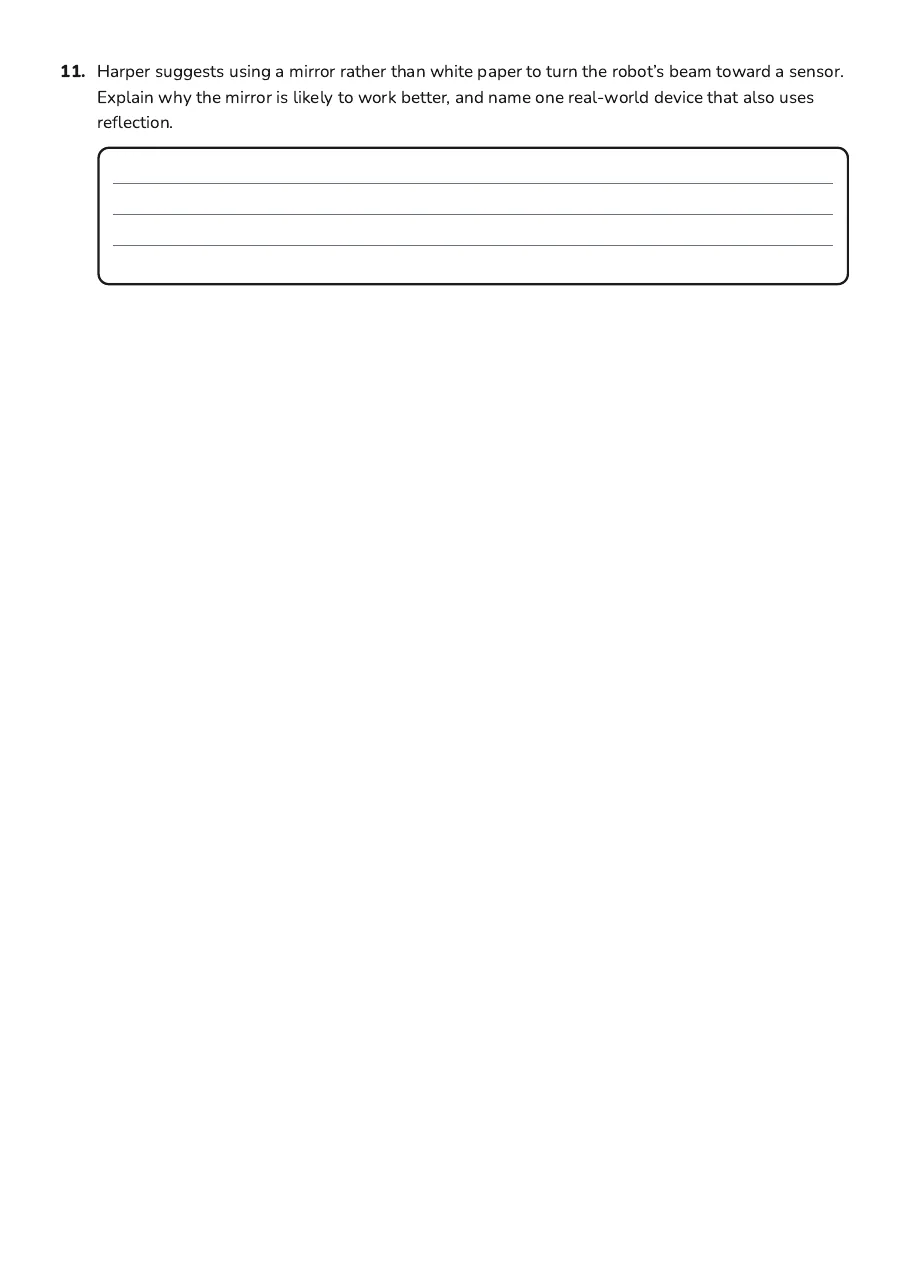
11.Harper suggests using a mirror rather than white paper to turn the robot’s beam toward a sensor. Explain why the mirror is likely to work better, and name one real-world device that also uses reflection.

3 printable pages

  • Reflection Practice, page 1 of 3: Quick reference

    Page 1

  • Reflection Practice, page 2 of 3: 5. Ethan records a reflected-ray angle of 42°. What must the incoming-ray angle be, and…

    Page 2

  • Reflection Practice, page 3 of 3: 11. Harper suggests using a mirror rather than white paper to turn the robot’s beam…

    Page 3

About This Worksheet

Free in Kuraplan

Sign up free, grab the PDF, and customize it for your class.

Print-Ready

Formatted for standard paper. Clean layout, easy to read.

AI-Generated

Created with Kuraplan's AI, designed for real classroom use.

For Teachers & Parents

Use in classrooms, for homework, tutoring, or homeschool.

Need a custom version of this worksheet?

Kuraplan's AI generates custom worksheets in seconds — differentiated for every learner, aligned to your curriculum.

Generate Custom Worksheets — Free
No credit card Curriculum-aligned Under 60 seconds