Native Title Success Checklist
A free social sciences worksheet ready for your classroom. Open in Kuraplan to grab the print-ready PDF, customize it for your students, or generate a fresh version in seconds.
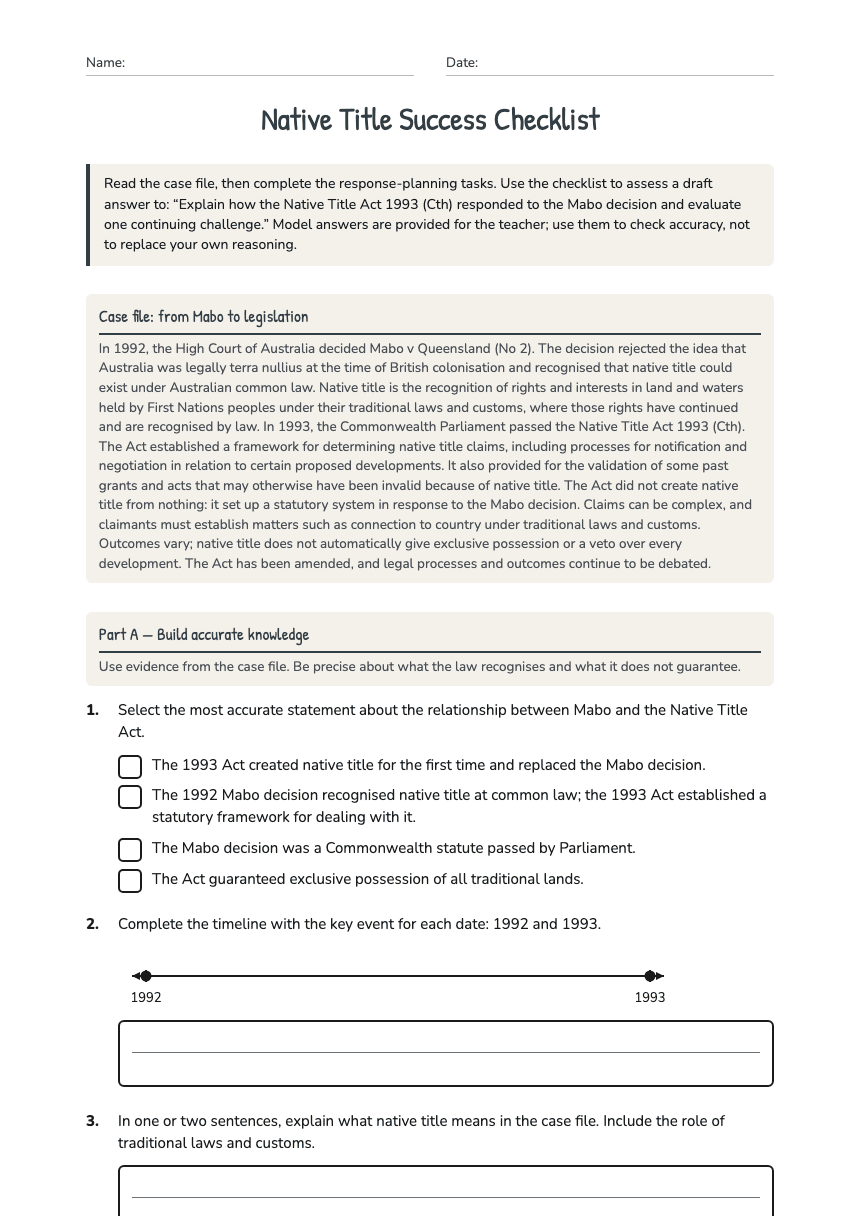
Native Title Success Checklist
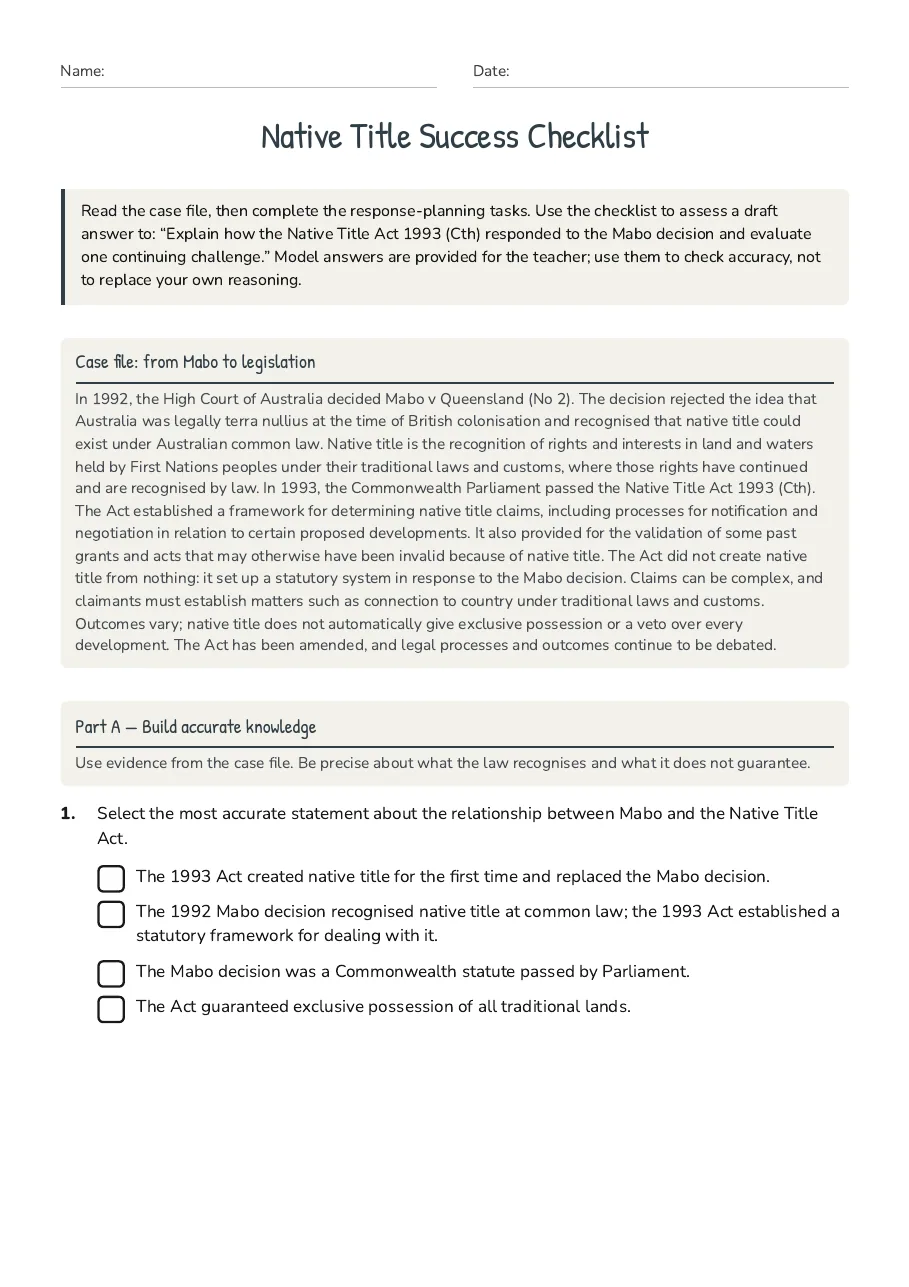
Case file: from Mabo to legislation
In 1992, the High Court of Australia decided Mabo v Queensland (No 2). The decision rejected the idea that Australia was legally terra nullius at the time of British colonisation and recognised that native title could exist under Australian common law. Native title is the recognition of rights and interests in land and waters held by First Nations peoples under their traditional laws and customs, where those rights have continued and are recognised by law. In 1993, the Commonwealth Parliament passed the Native Title Act 1993 (Cth). The Act established a framework for determining native title claims, including processes for notification and negotiation in relation to certain proposed developments. It also provided for the validation of some past grants and acts that may otherwise have been invalid because of native title. The Act did not create native title from nothing: it set up a statutory system in response to the Mabo decision. Claims can be complex, and claimants must establish matters such as connection to country under traditional laws and customs. Outcomes vary; native title does not automatically give exclusive possession or a veto over every development. The Act has been amended, and legal processes and outcomes continue to be debated.
Part A — Build accurate knowledge
Use evidence from the case file. Be precise about what the law recognises and what it does not guarantee.
- The 1993 Act created native title for the first time and replaced the Mabo decision.
- The 1992 Mabo decision recognised native title at common law; the 1993 Act established a statutory framework for dealing with it.
- The Mabo decision was a Commonwealth statute passed by Parliament.
- The Act guaranteed exclusive possession of all traditional lands.
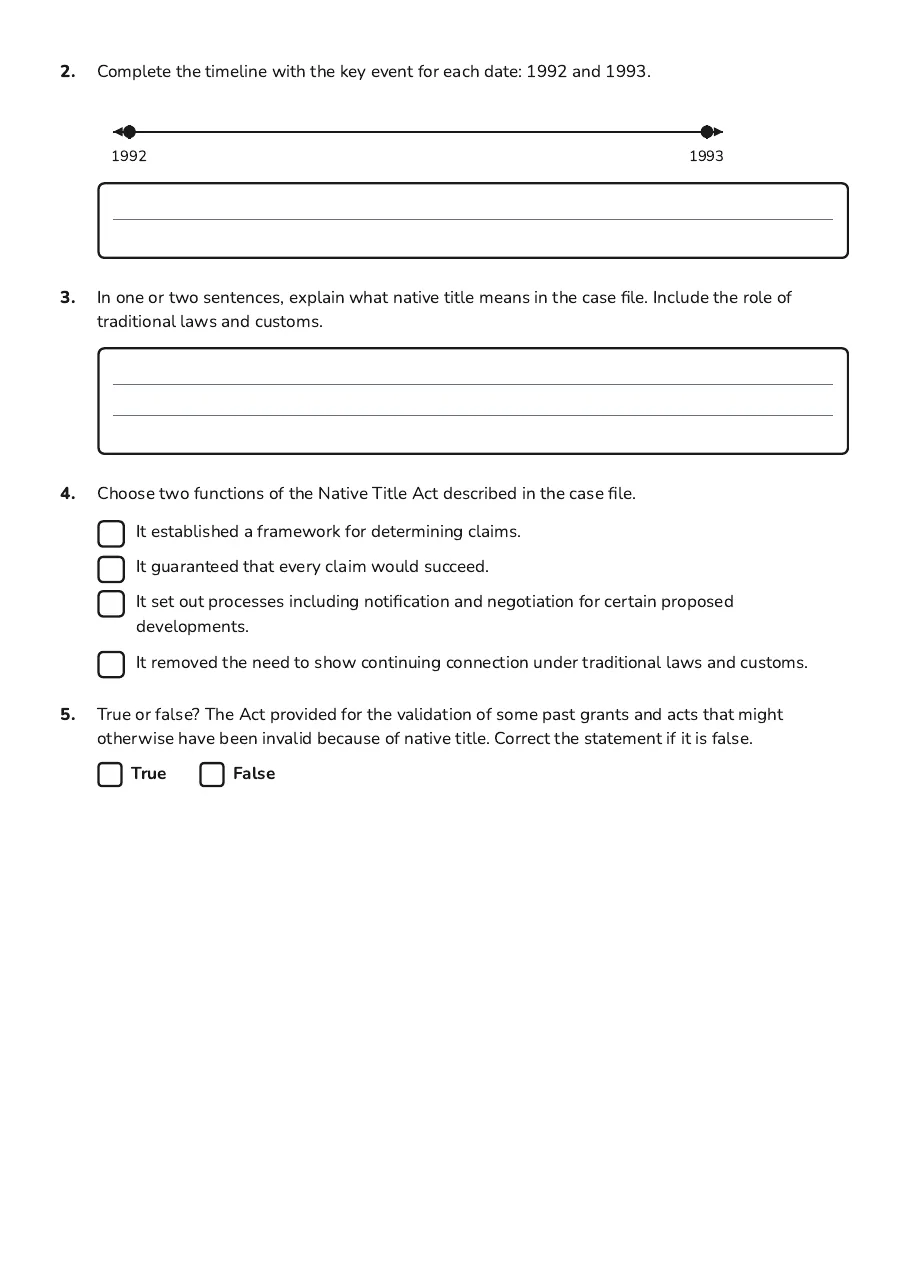
- It established a framework for determining claims.
- It guaranteed that every claim would succeed.
- It set out processes including notification and negotiation for certain proposed developments.
- It removed the need to show continuing connection under traditional laws and customs.
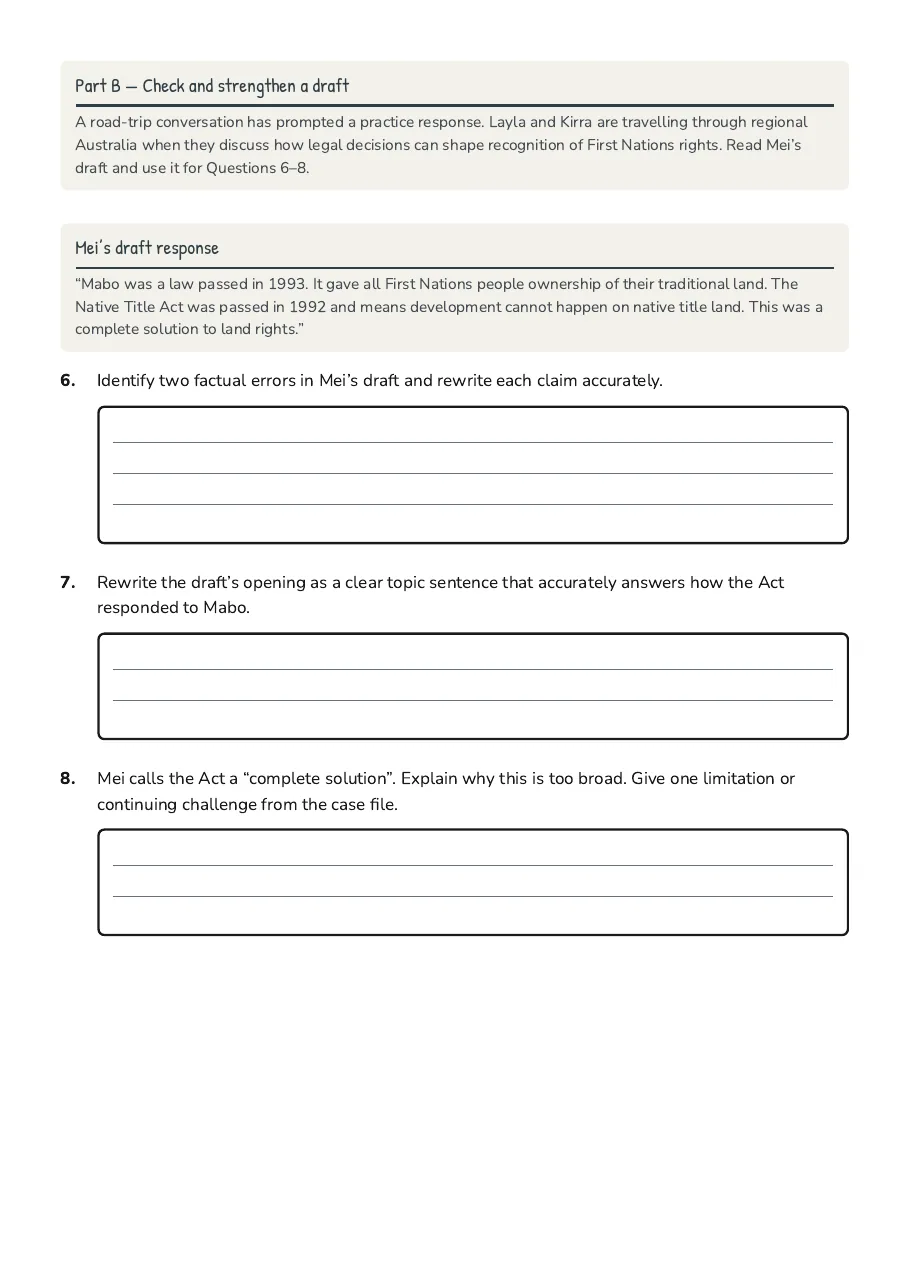
Part B — Check and strengthen a draft
A road-trip conversation has prompted a practice response. Layla and Kirra are travelling through regional Australia when they discuss how legal decisions can shape recognition of First Nations rights. Read Mei’s draft and use it for Questions 6–8.
Mei’s draft response
“Mabo was a law passed in 1993. It gave all First Nations people ownership of their traditional land. The Native Title Act was passed in 1992 and means development cannot happen on native title land. This was a complete solution to land rights.”
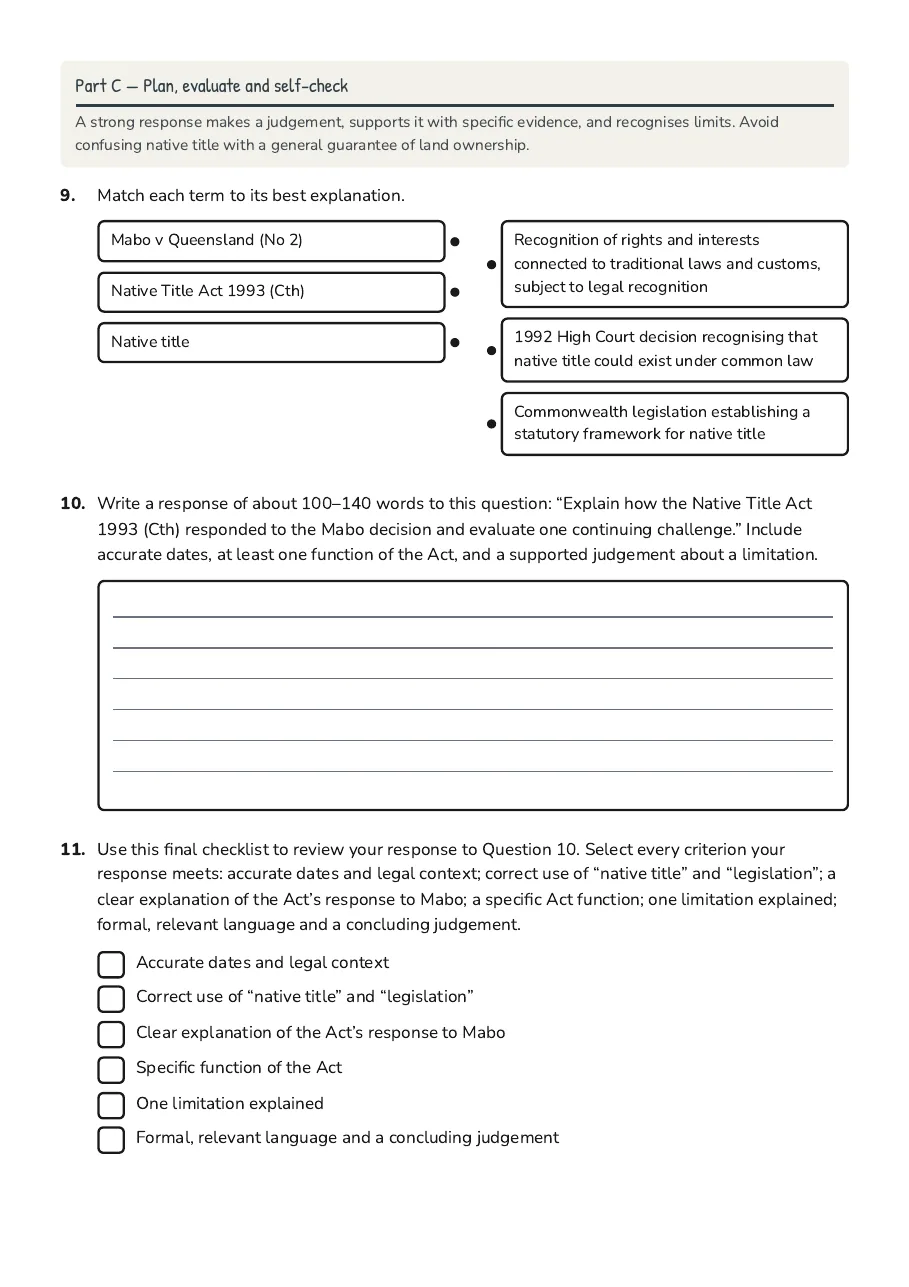
Part C — Plan, evaluate and self-check
A strong response makes a judgement, supports it with specific evidence, and recognises limits. Avoid confusing native title with a general guarantee of land ownership.
- Mabo v Queensland (No 2)
- Native Title Act 1993 (Cth)
- Native title
- Recognition of rights and interests connected to traditional laws and customs, subject to legal recognition
- 1992 High Court decision recognising that native title could exist under common law
- Commonwealth legislation establishing a statutory framework for native title
- Accurate dates and legal context
- Correct use of “native title” and “legislation”
- Clear explanation of the Act’s response to Mabo
- Specific function of the Act
- One limitation explained
- Formal, relevant language and a concluding judgement
4 printable pages
Page 1
Page 2
Page 3
Page 4
About This Worksheet
Free in Kuraplan
Sign up free, grab the PDF, and customize it for your class.
Print-Ready
Formatted for standard paper. Clean layout, easy to read.
AI-Generated
Created with Kuraplan's AI, designed for real classroom use.
For Teachers & Parents
Use in classrooms, for homework, tutoring, or homeschool.
Need a custom version of this worksheet?
Kuraplan's AI generates custom worksheets in seconds — differentiated for every learner, aligned to your curriculum.
Generate Custom Worksheets — FreeMore Social Sciences Worksheets
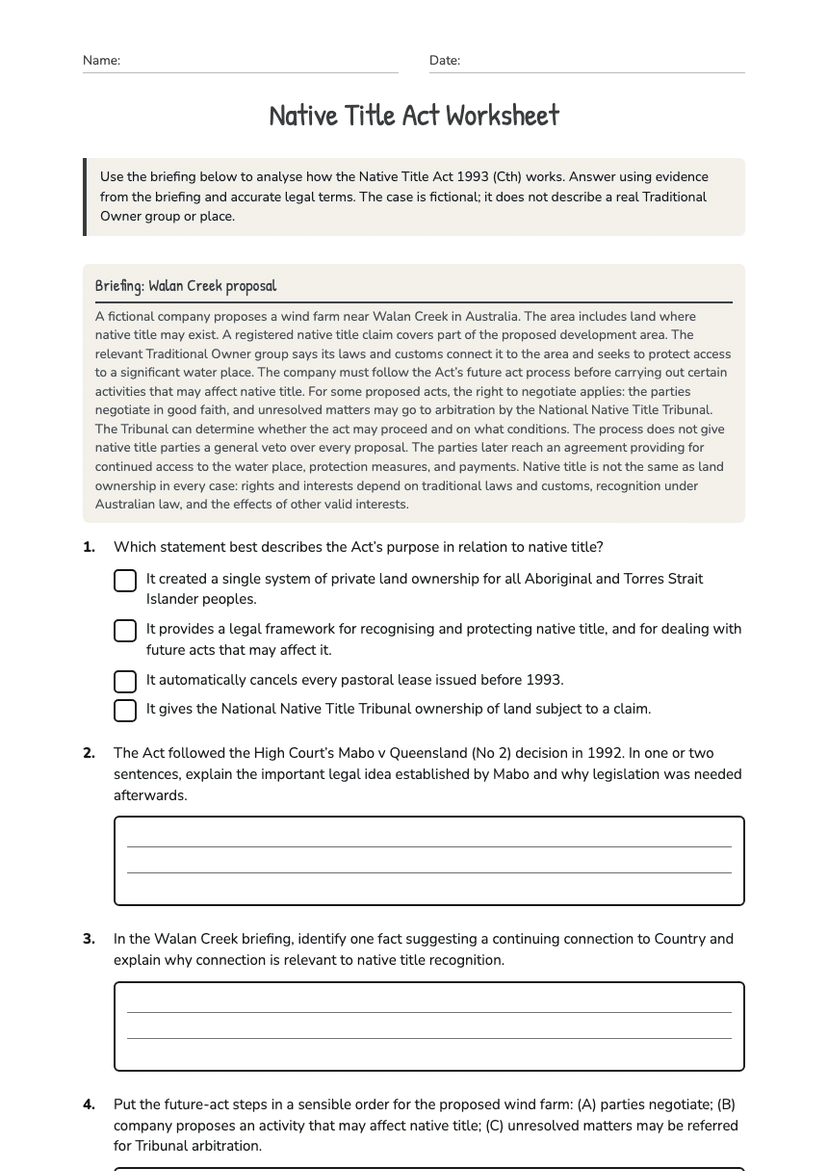
Native Title Act Worksheet
Free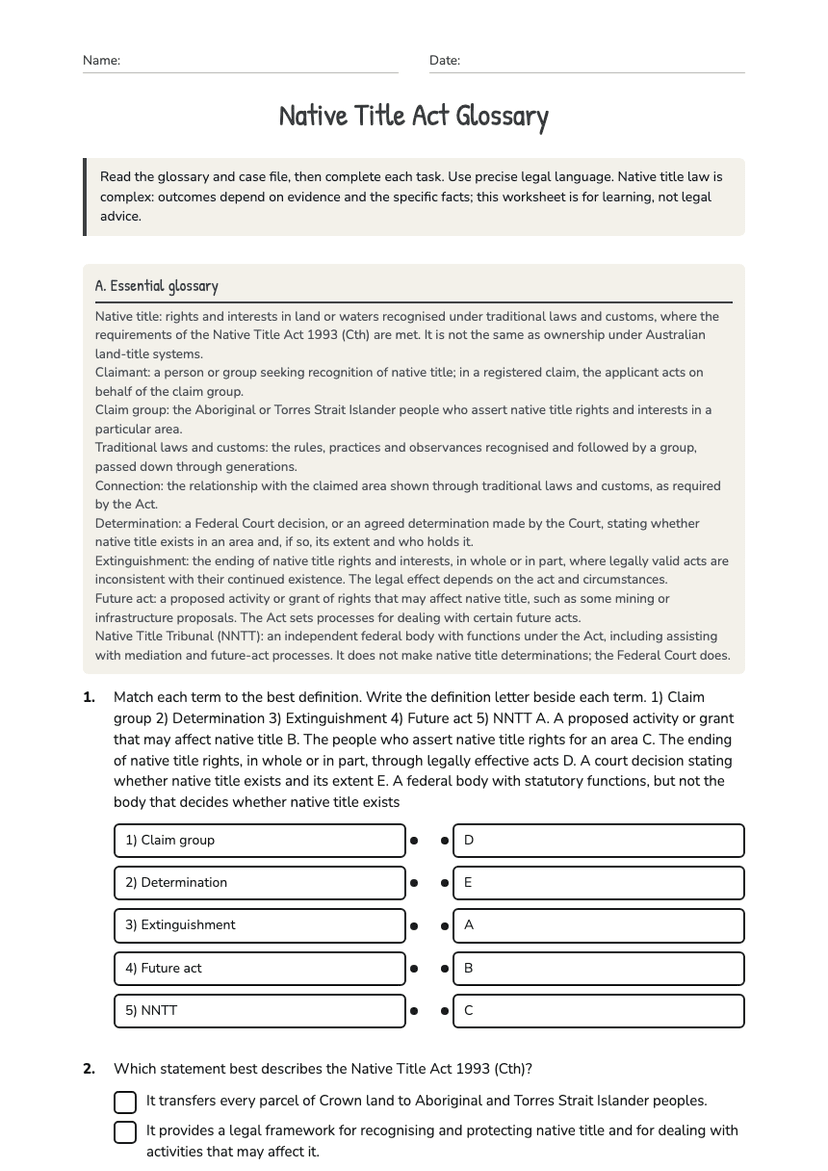
Native Title Act Glossary
Free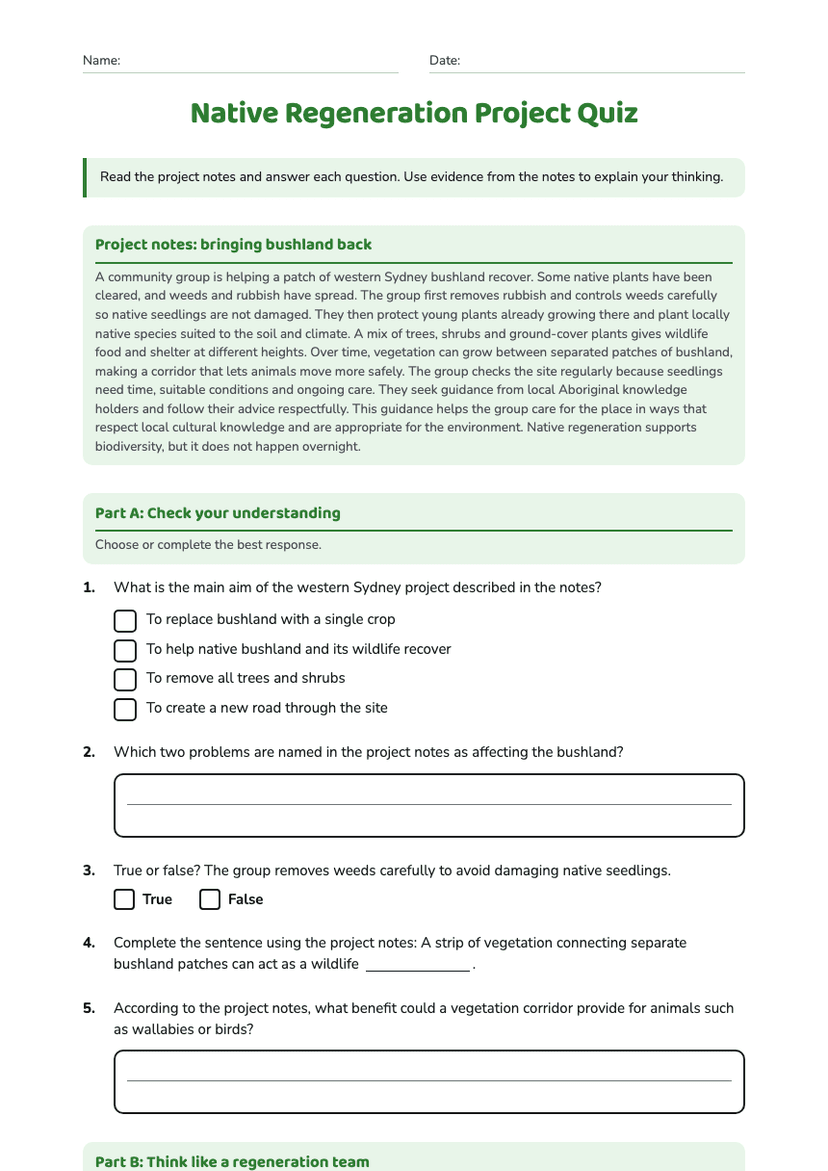
Native Regeneration Project Quiz
Free
Imaginative Texts Features
Free
Exploring Imaginative Texts
Free
Imaginative Narrative Introduction
Free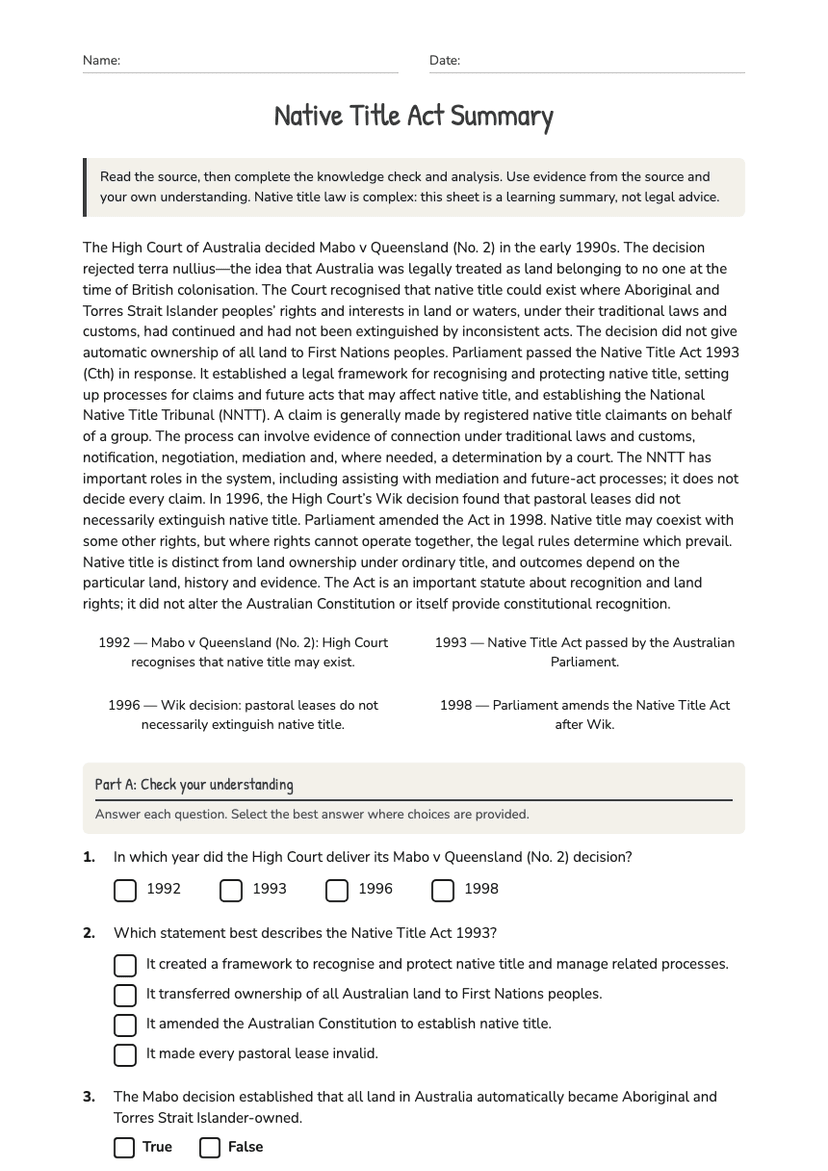
Native Title Act Summary
Free