ScienceFreePrintable

Newton's Laws of Motion

A free science worksheet ready for your classroom. Open in Kuraplan to grab the print-ready PDF, customize it for your students, or generate a fresh version in seconds.
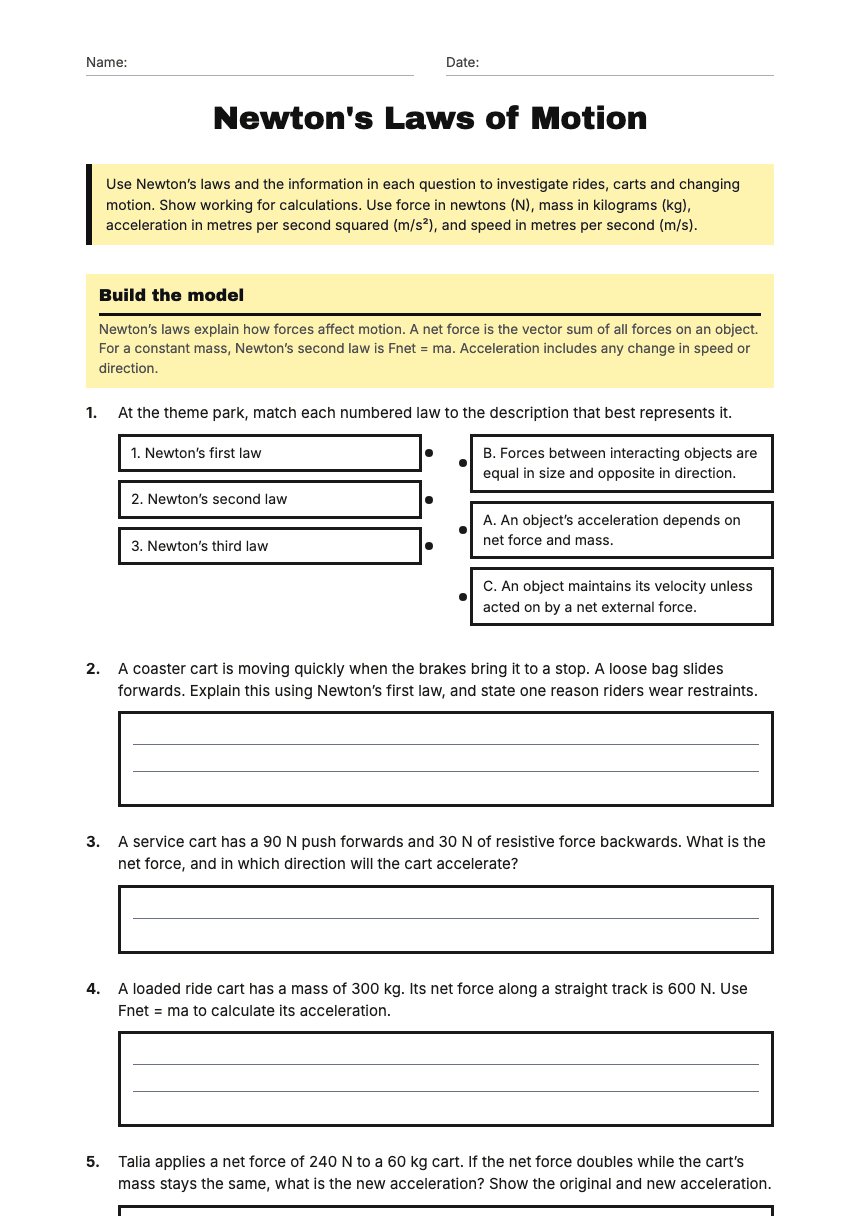
Newton's Laws of Motion worksheet preview
Name:Date:

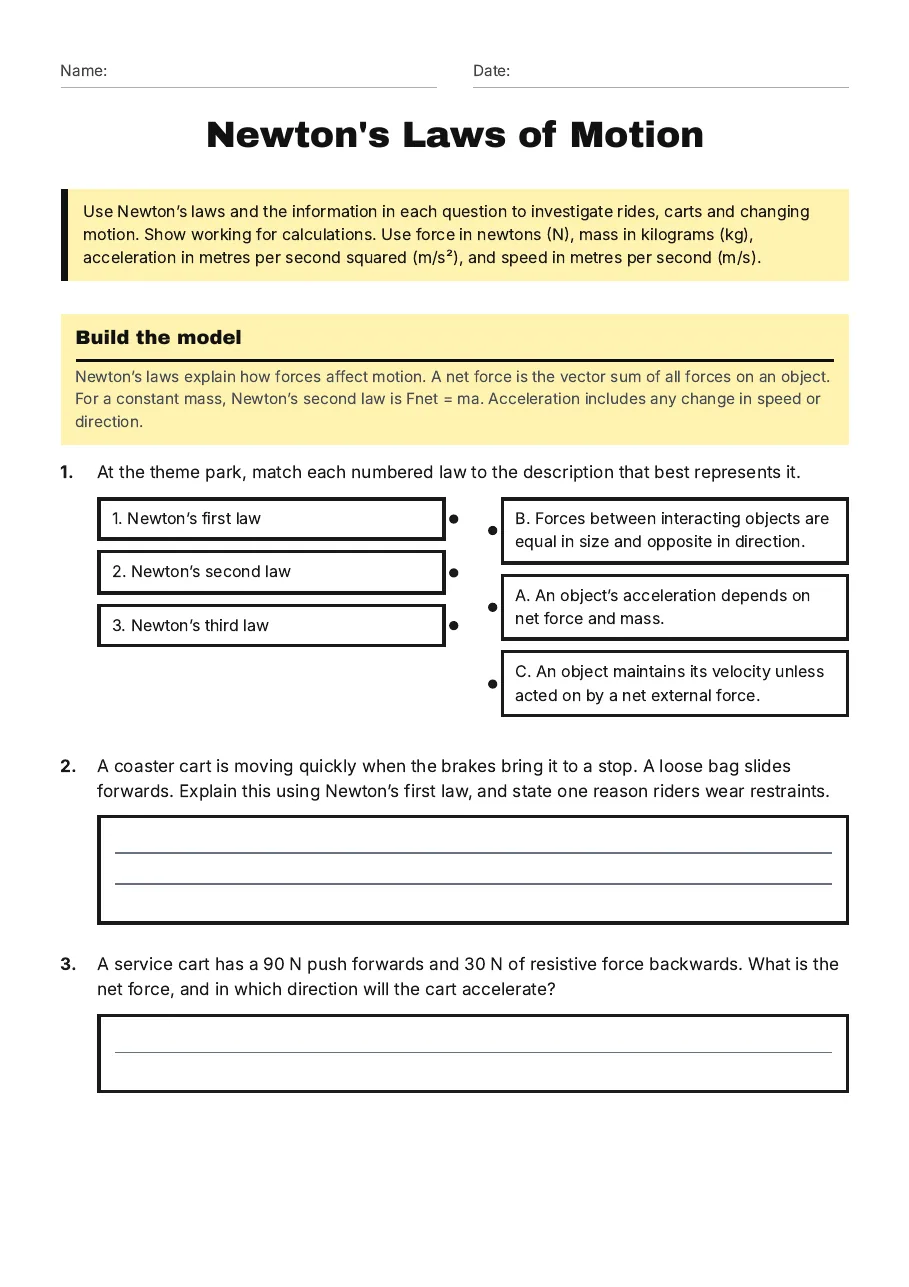
Newton's Laws of Motion

Use Newton’s laws and the information in each question to investigate rides, carts and changing motion. Show working for calculations. Use force in newtons (N), mass in kilograms (kg), acceleration in metres per second squared (m/s²), and speed in metres per second (m/s).

Build the model

Newton’s laws explain how forces affect motion. A net force is the vector sum of all forces on an object. For a constant mass, Newton’s second law is Fnet = ma. Acceleration includes any change in speed or direction.

1.At the theme park, match each numbered law to the description that best represents it.
  • 1. Newton’s first law
  • 2. Newton’s second law
  • 3. Newton’s third law
  • B. Forces between interacting objects are equal in size and opposite in direction.
  • A. An object’s acceleration depends on net force and mass.
  • C. An object maintains its velocity unless acted on by a net external force.
2.A coaster cart is moving quickly when the brakes bring it to a stop. A loose bag slides forwards. Explain this using Newton’s first law, and state one reason riders wear restraints.
3.A service cart has a 90 N push forwards and 30 N of resistive force backwards. What is the net force, and in which direction will the cart accelerate?
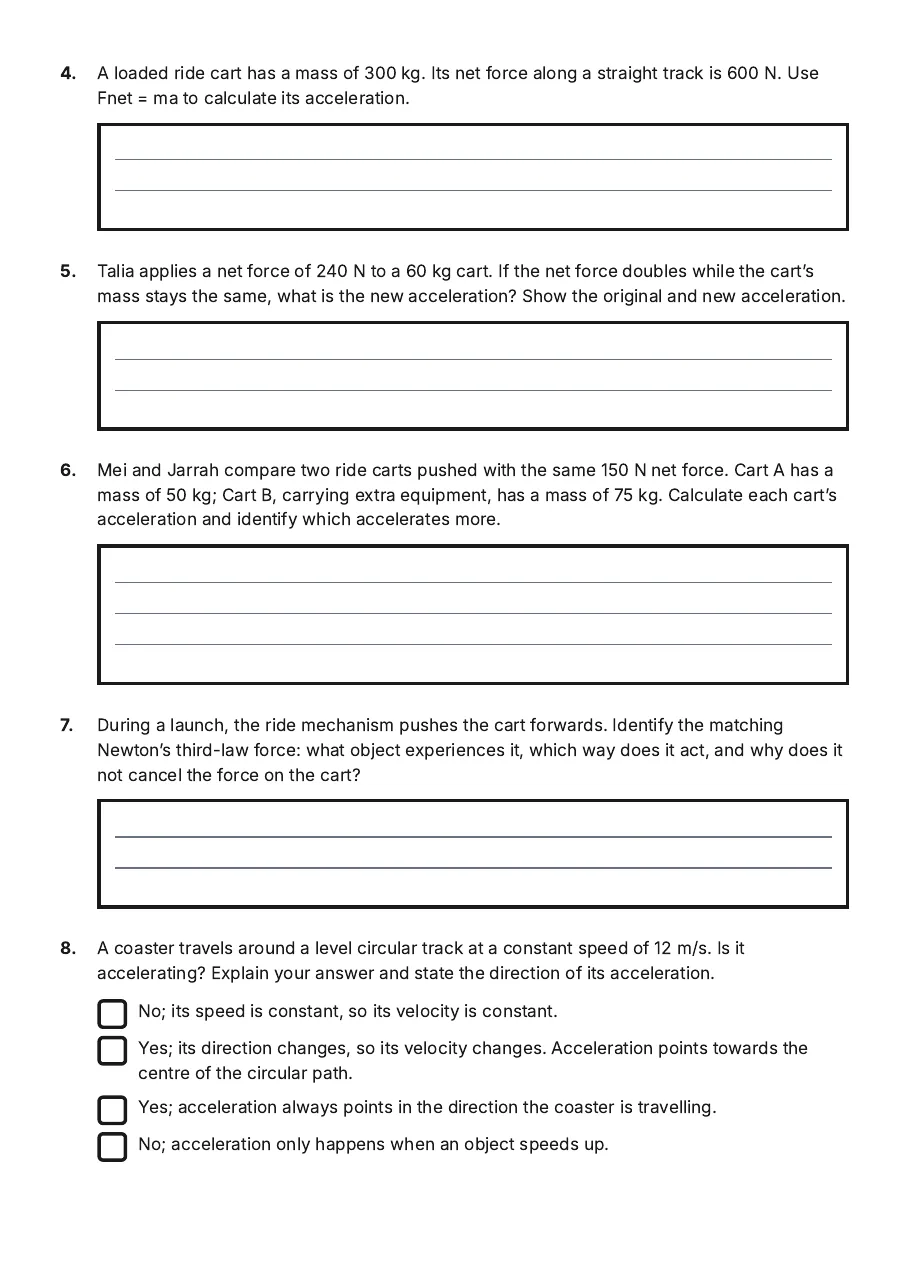
4.A loaded ride cart has a mass of 300 kg. Its net force along a straight track is 600 N. Use Fnet = ma to calculate its acceleration.
5.Talia applies a net force of 240 N to a 60 kg cart. If the net force doubles while the cart’s mass stays the same, what is the new acceleration? Show the original and new acceleration.
6.Mei and Jarrah compare two ride carts pushed with the same 150 N net force. Cart A has a mass of 50 kg; Cart B, carrying extra equipment, has a mass of 75 kg. Calculate each cart’s acceleration and identify which accelerates more.
7.During a launch, the ride mechanism pushes the cart forwards. Identify the matching Newton’s third-law force: what object experiences it, which way does it act, and why does it not cancel the force on the cart?
8.A coaster travels around a level circular track at a constant speed of 12 m/s. Is it accelerating? Explain your answer and state the direction of its acceleration.
  • No; its speed is constant, so its velocity is constant.
  • Yes; its direction changes, so its velocity changes. Acceleration points towards the centre of the circular path.
  • Yes; acceleration always points in the direction the coaster is travelling.
  • No; acceleration only happens when an object speeds up.
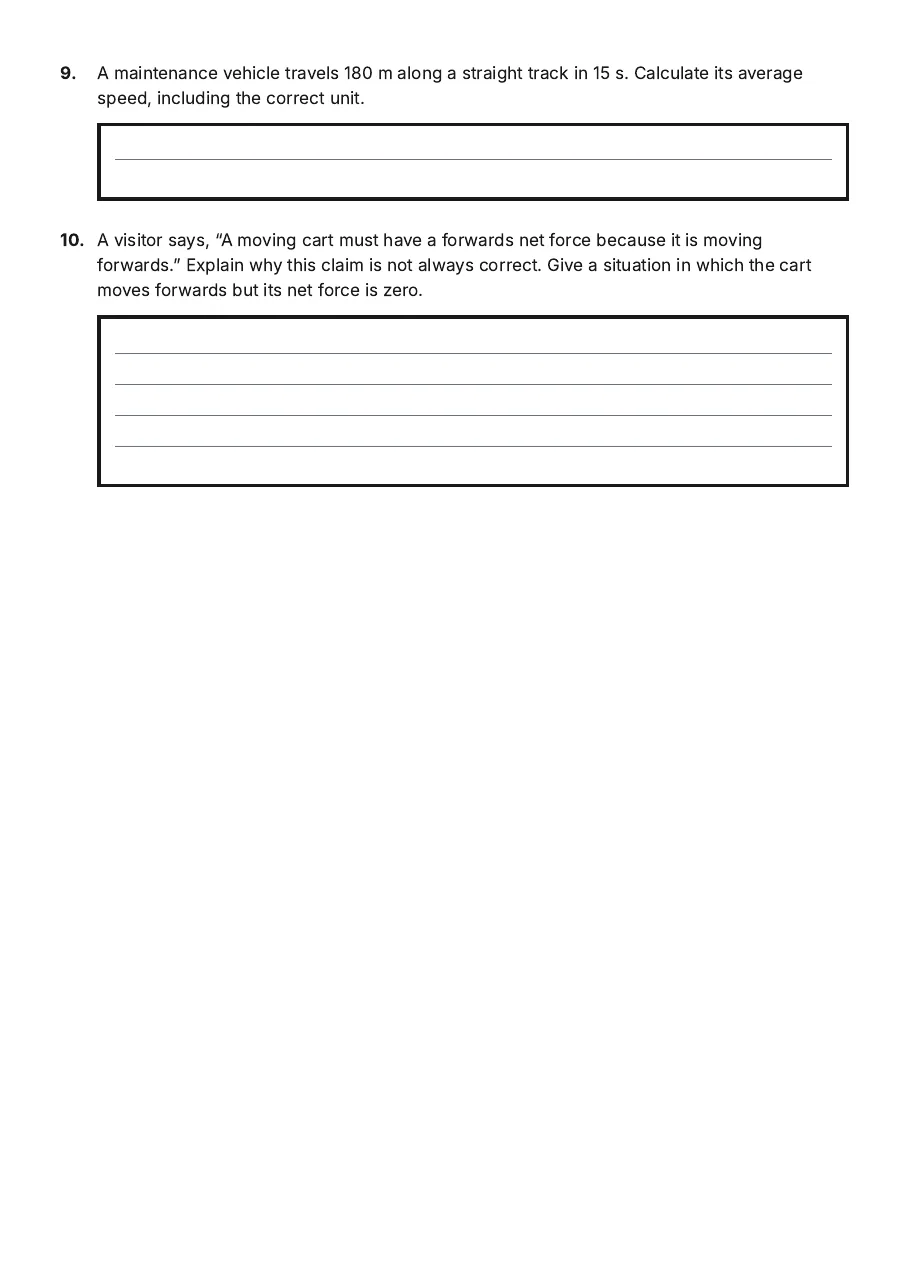
9.A maintenance vehicle travels 180 m along a straight track in 15 s. Calculate its average speed, including the correct unit.
10.A visitor says, “A moving cart must have a forwards net force because it is moving forwards.” Explain why this claim is not always correct. Give a situation in which the cart moves forwards but its net force is zero.

3 printable pages

  • Newton's Laws of Motion, page 1 of 3: Build the model

    Page 1

  • Newton's Laws of Motion, page 2 of 3: 4. A loaded ride cart has a mass of 300 kg. Its net force along a straight track is 600…

    Page 2

  • Newton's Laws of Motion, page 3 of 3: 9. A maintenance vehicle travels 180 m along a straight track in 15 s. Calculate its…

    Page 3

About This Worksheet

Free in Kuraplan

Sign up free, grab the PDF, and customize it for your class.

Print-Ready

Formatted for standard paper. Clean layout, easy to read.

AI-Generated

Created with Kuraplan's AI, designed for real classroom use.

For Teachers & Parents

Use in classrooms, for homework, tutoring, or homeschool.

Need a custom version of this worksheet?

Kuraplan's AI generates custom worksheets in seconds — differentiated for every learner, aligned to your curriculum.

Generate Custom Worksheets — Free
No credit card Curriculum-aligned Under 60 seconds