ScienceFreePrintable
Organism Classification Model Building
A free science worksheet ready for your classroom. Open in Kuraplan to grab the print-ready PDF, customize it for your students, or generate a fresh version in seconds.
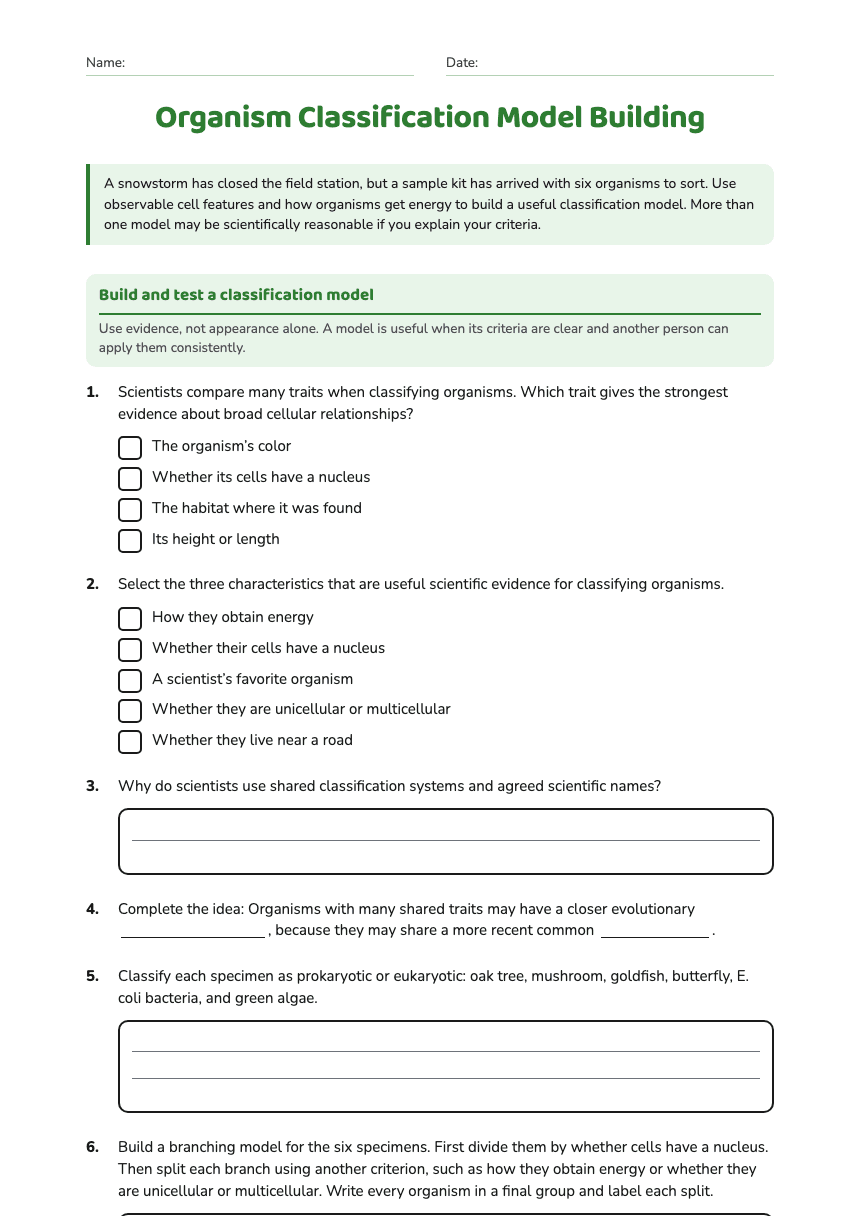
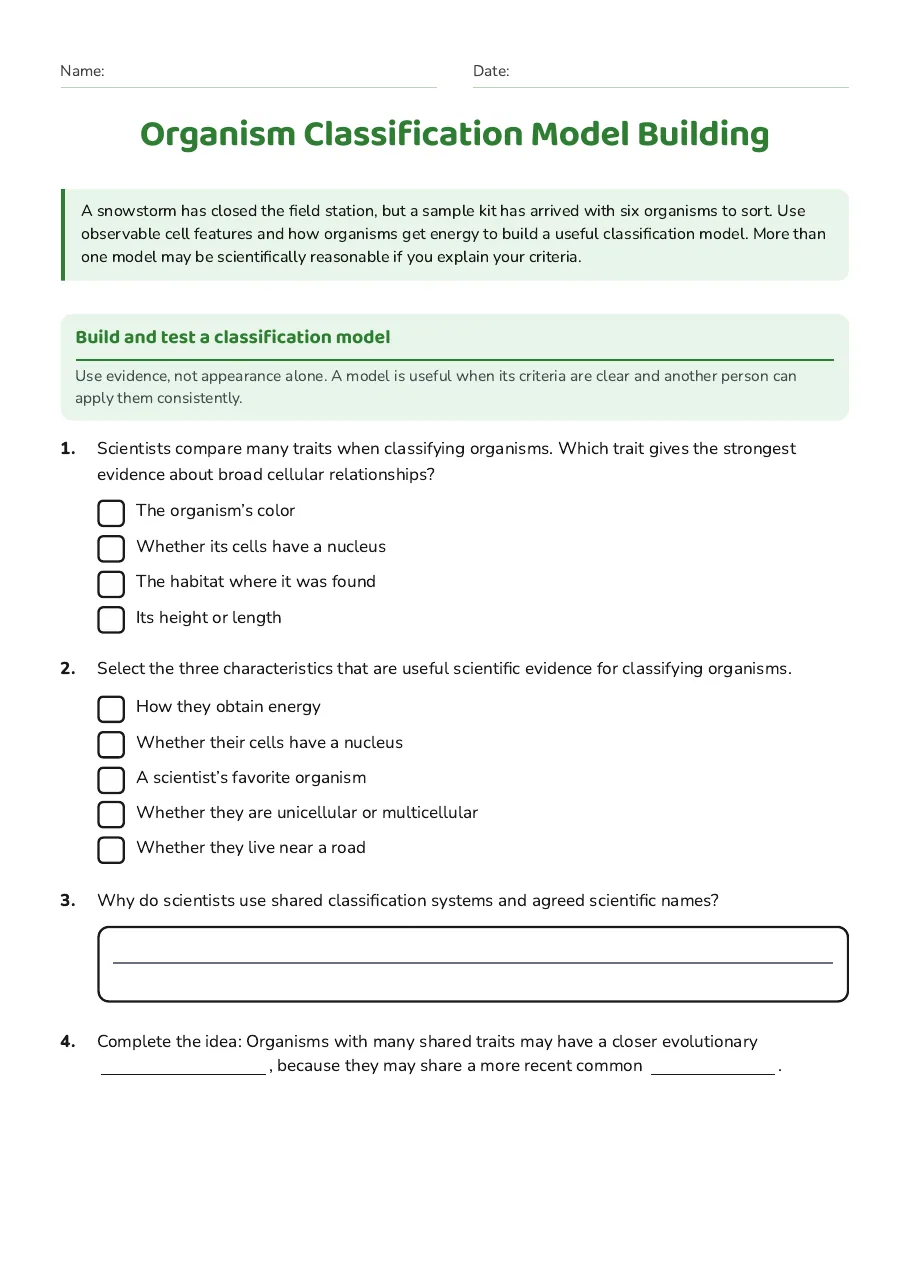
Name:Date:
Organism Classification Model Building
A snowstorm has closed the field station, but a sample kit has arrived with six organisms to sort. Use observable cell features and how organisms get energy to build a useful classification model. More than one model may be scientifically reasonable if you explain your criteria.
Build and test a classification model
Use evidence, not appearance alone. A model is useful when its criteria are clear and another person can apply them consistently.
1.Scientists compare many traits when classifying organisms. Which trait gives the strongest evidence about broad cellular relationships?
- The organism’s color
- Whether its cells have a nucleus
- The habitat where it was found
- Its height or length
2.Select the three characteristics that are useful scientific evidence for classifying organisms.
- How they obtain energy
- Whether their cells have a nucleus
- A scientist’s favorite organism
- Whether they are unicellular or multicellular
- Whether they live near a road
3.Why do scientists use shared classification systems and agreed scientific names?
4.Complete the idea: Organisms with many shared traits may have a closer evolutionary , because they may share a more recent common .
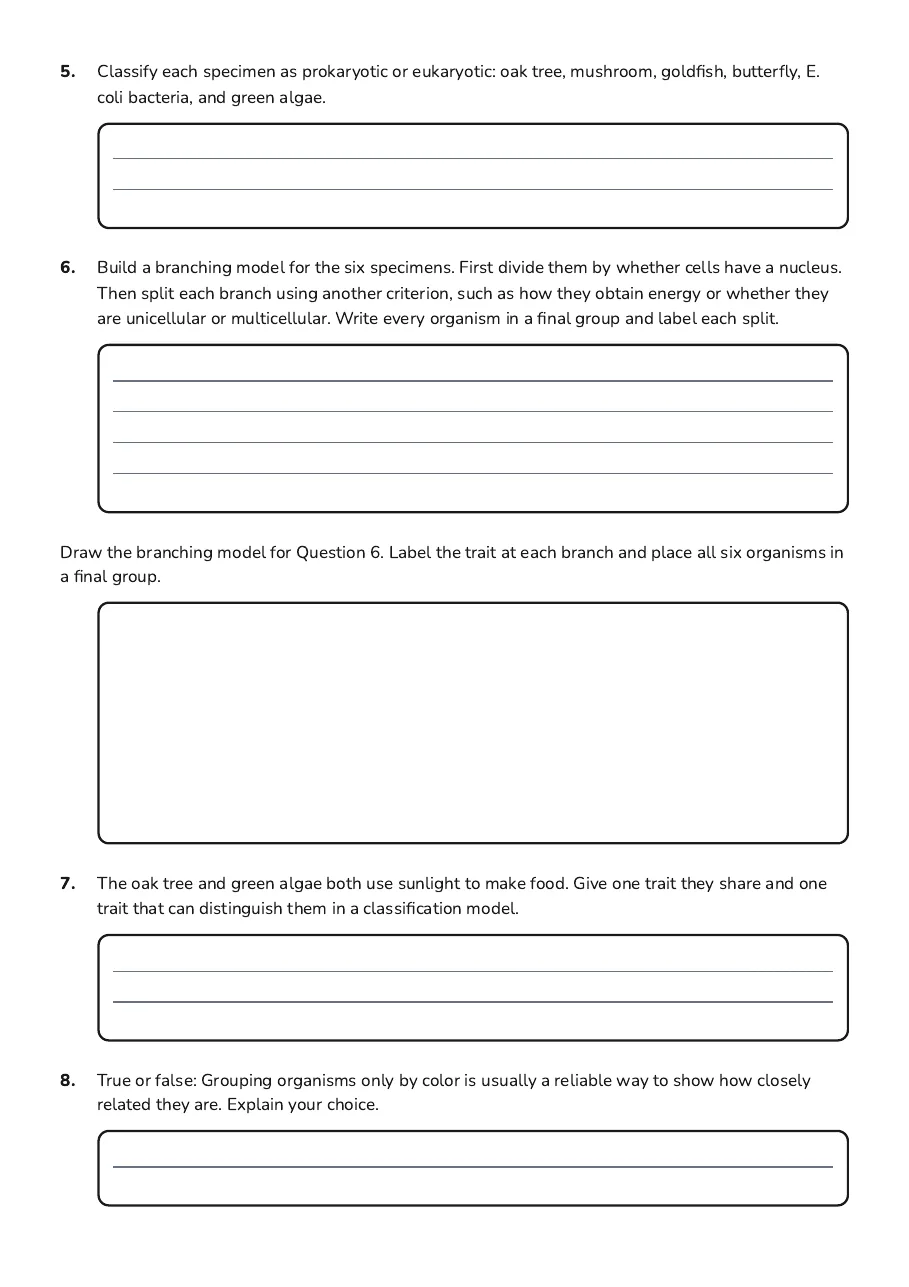
5.Classify each specimen as prokaryotic or eukaryotic: oak tree, mushroom, goldfish, butterfly, E. coli bacteria, and green algae.
6.Build a branching model for the six specimens. First divide them by whether cells have a nucleus. Then split each branch using another criterion, such as how they obtain energy or whether they are unicellular or multicellular. Write every organism in a final group and label each split.
Draw the branching model for Question 6. Label the trait at each branch and place all six organisms in a final group.
7.The oak tree and green algae both use sunlight to make food. Give one trait they share and one trait that can distinguish them in a classification model.
8.True or false: Grouping organisms only by color is usually a reliable way to show how closely related they are. Explain your choice.
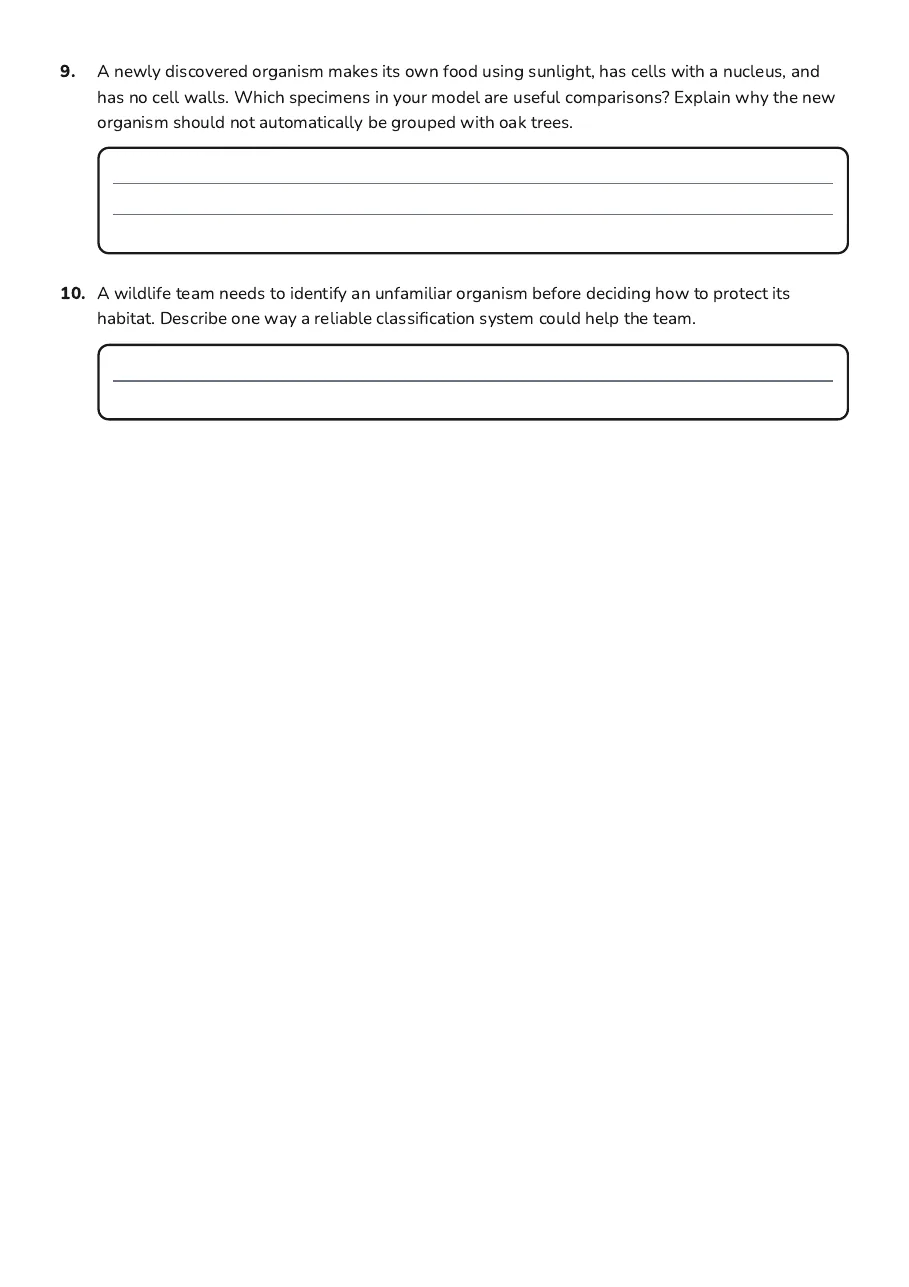
9.A newly discovered organism makes its own food using sunlight, has cells with a nucleus, and has no cell walls. Which specimens in your model are useful comparisons? Explain why the new organism should not automatically be grouped with oak trees.
10.A wildlife team needs to identify an unfamiliar organism before deciding how to protect its habitat. Describe one way a reliable classification system could help the team.
3 printable pages
Page 1
Page 2
Page 3
About This Worksheet
Free in Kuraplan
Sign up free, grab the PDF, and customize it for your class.
Print-Ready
Formatted for standard paper. Clean layout, easy to read.
AI-Generated
Created with Kuraplan's AI, designed for real classroom use.
For Teachers & Parents
Use in classrooms, for homework, tutoring, or homeschool.
Need a custom version of this worksheet?
Kuraplan's AI generates custom worksheets in seconds — differentiated for every learner, aligned to your curriculum.
Generate Custom Worksheets — Free No credit card Curriculum-aligned Under 60 seconds
More Science Worksheets
7th Grade
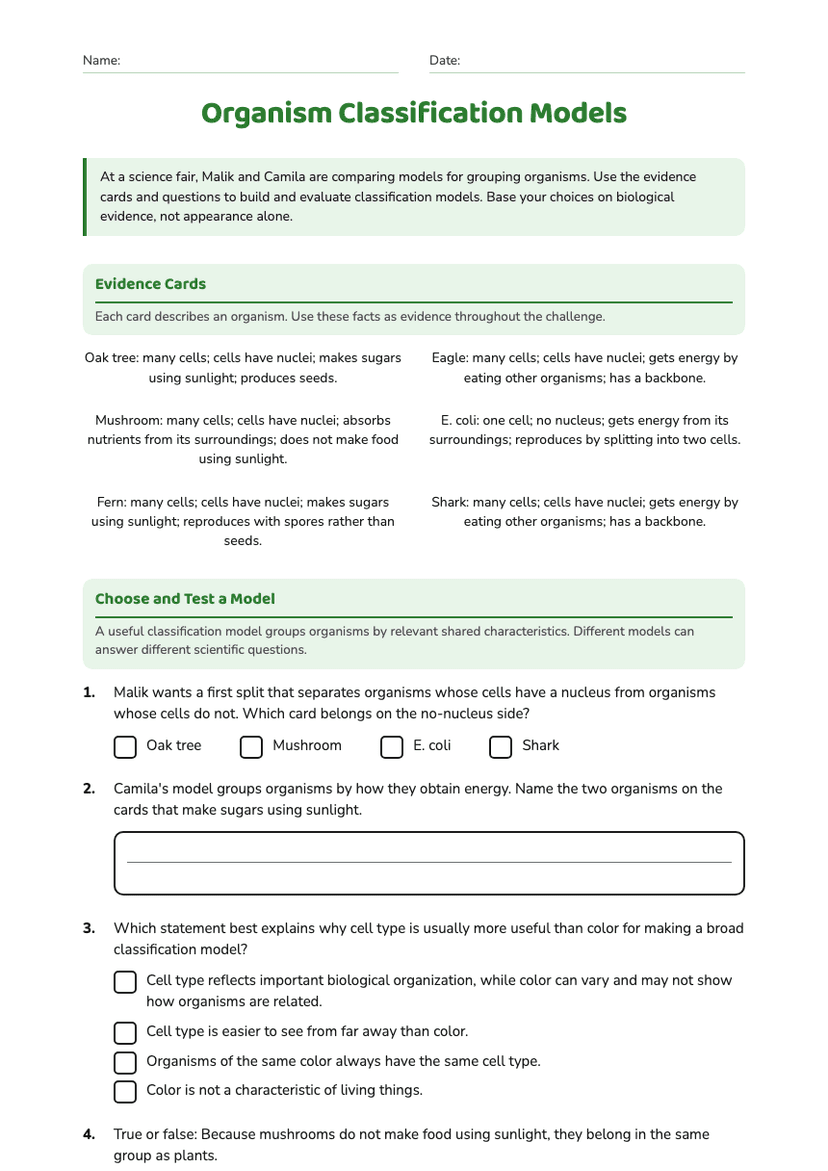
Organism Classification Models
Free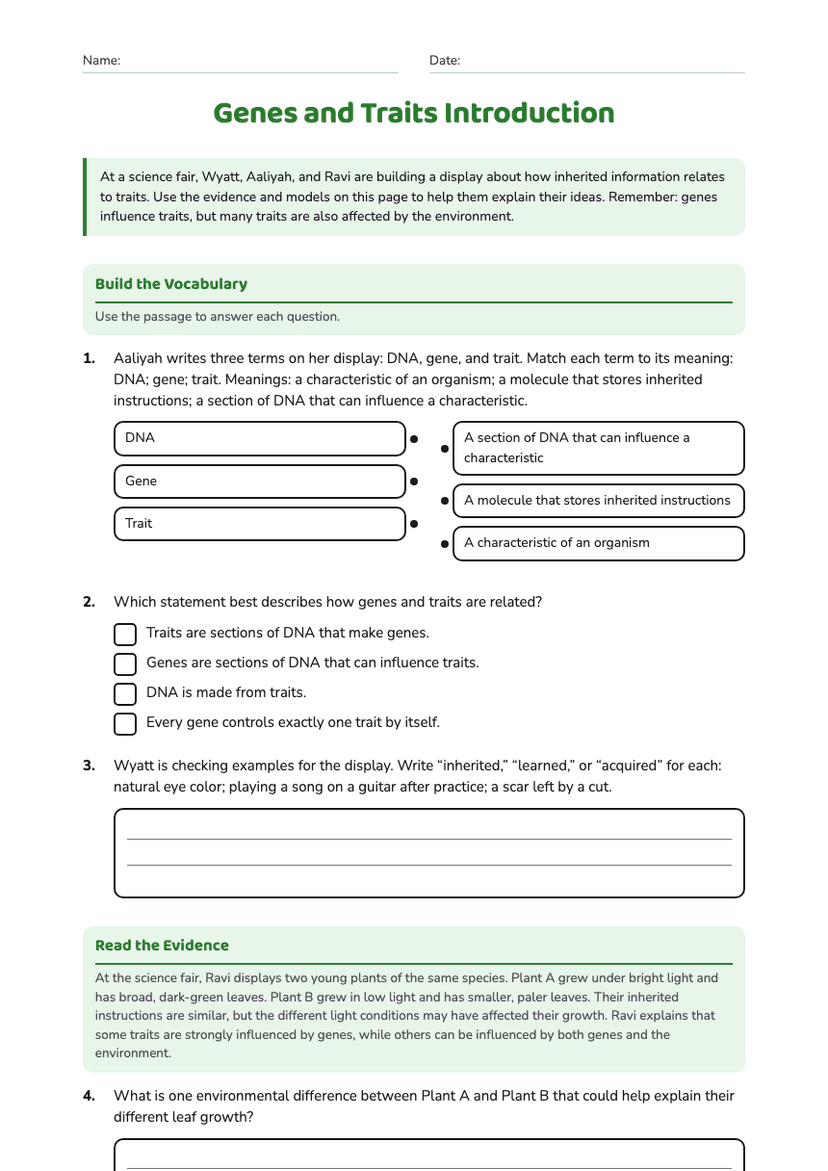
7th Grade
Genes and Traits Introduction
Free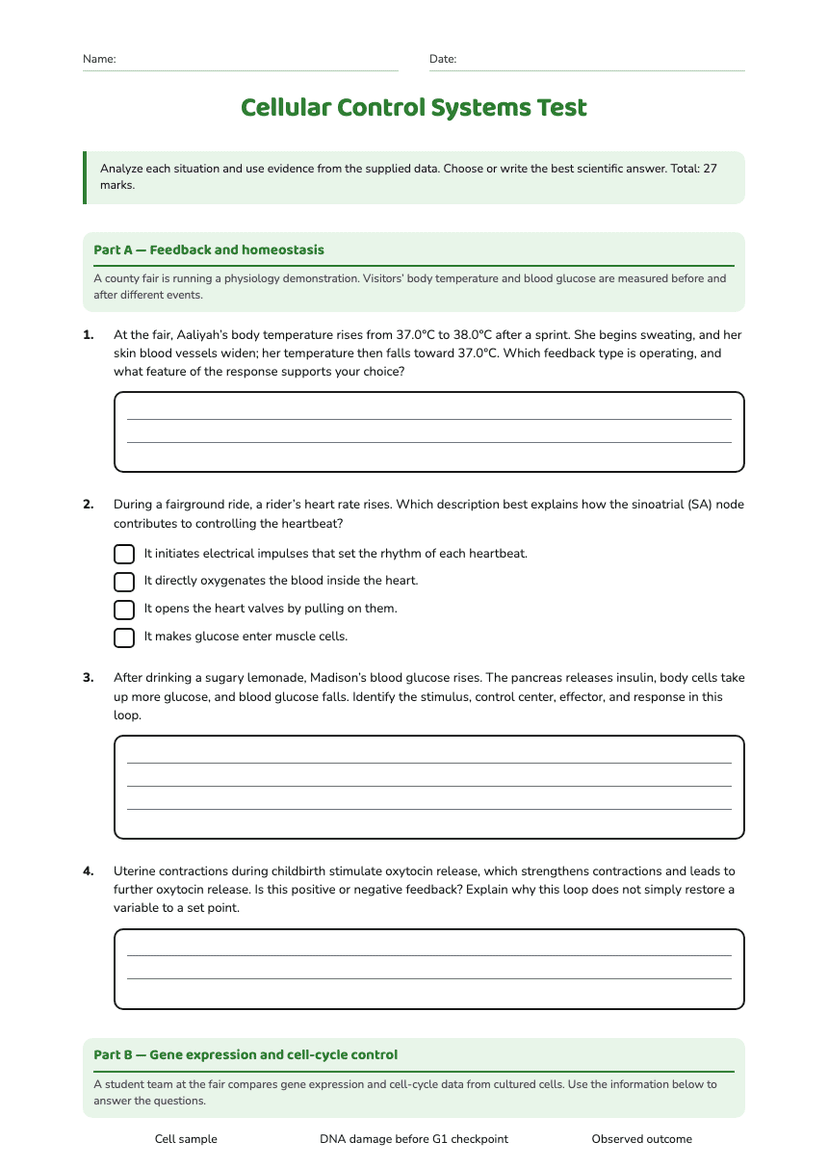
12th Grade
Cellular Control Systems Test
Free
7th Grade
Biological Organization Models
Free
2nd Grade
Plant Life Cycle Worksheet
Free
7th Grade
Reproduction Models Worksheet
Free
7th Grade
Genes and Chromosome Inheritance
Free