FreePrintable

Personal Narrative Writing

A free, printable general worksheet ready for your classroom. Download instantly, print, and hand out to your students — no account needed.

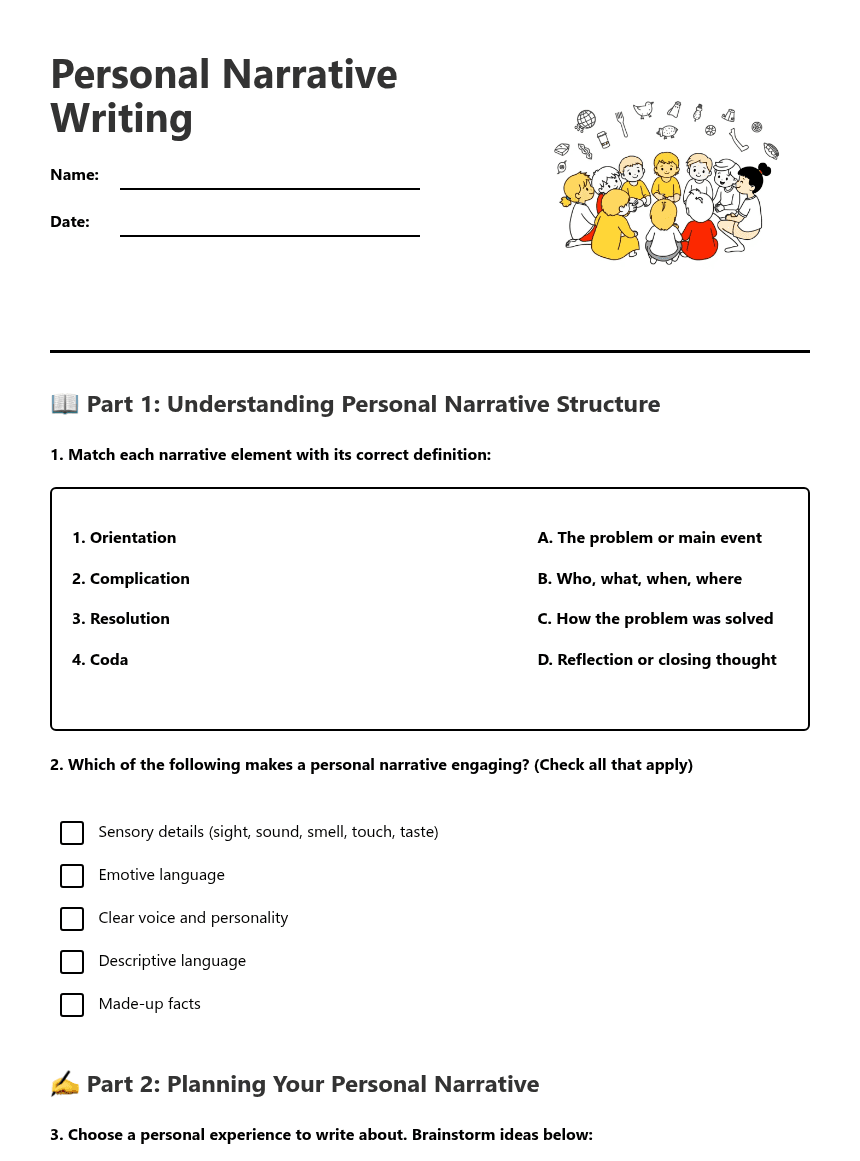
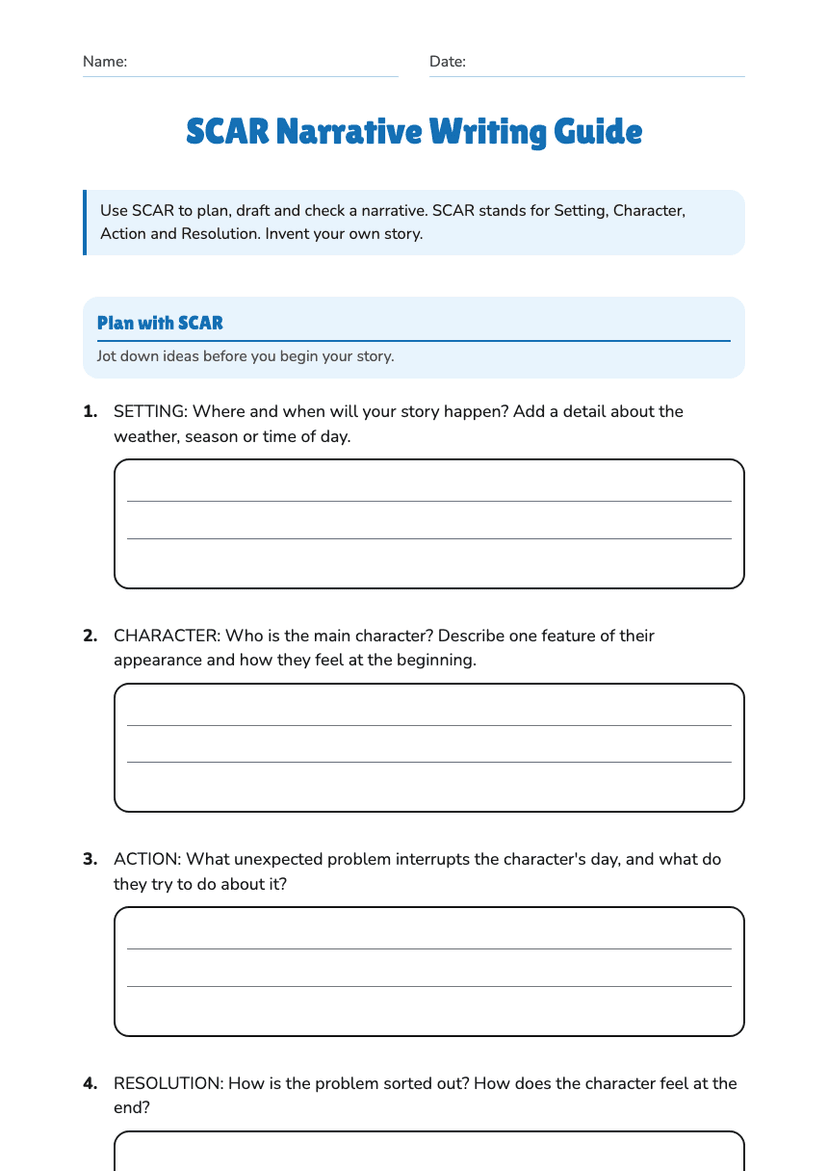
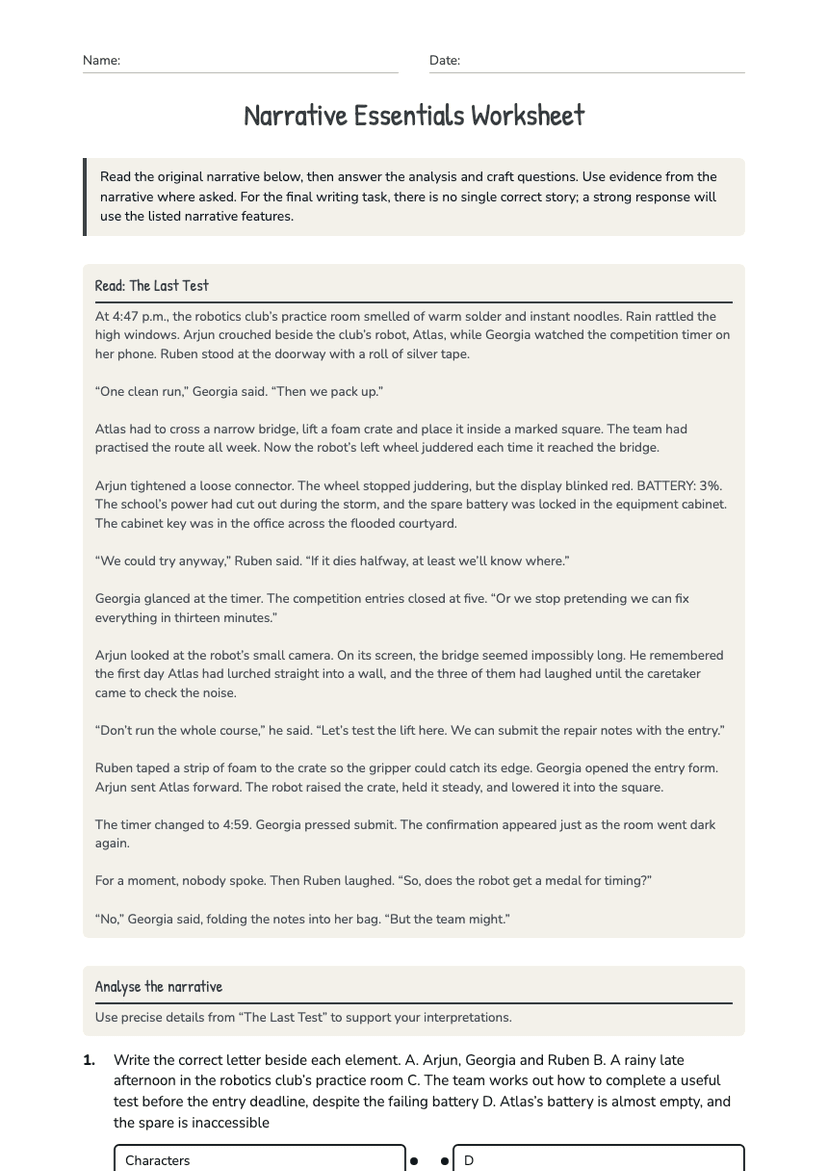
Personal Narrative Writing worksheet preview
Personal Narrative Writing

Personal Narrative Writing

Student writing in a journal

📖 Part 1: Understanding Personal Narrative Structure

1. Match each narrative element with its correct definition:
1. Orientation
2. Complication
3. Resolution
4. Coda
A. The problem or main event
B. Who, what, when, where
C. How the problem was solved
D. Reflection or closing thought
2. Which of the following makes a personal narrative engaging? (Check all that apply)

Sensory details (sight, sound, smell, touch, taste)

Emotive language

Clear voice and personality

Descriptive language

Made-up facts

✍️ Part 2: Planning Your Personal Narrative

3. Choose a personal experience to write about. Brainstorm ideas below:
4. Complete the narrative planning template for your chosen experience:

Orientation (Who? What? When? Where?):

Complication (What was the problem or main event?):

Resolution (How was it resolved?):

Coda (What did you learn or how do you feel about it now?):

🎨 Part 3: Adding Voice and Descriptive Language

5. Rewrite these basic sentences using more descriptive and emotive language:

Basic: "I was nervous."

Descriptive: ________________________________

Basic: "The room was quiet."

Descriptive: ________________________________

Basic: "I felt happy."

Descriptive: ________________________________

6. Add sensory details to make this sentence more engaging:

Original: "I walked into the kitchen."

📝 Part 4: Writing Your Personal Narrative

7. Using your planning template from Part 2, write your complete personal narrative below. Remember to include:

• All four structural elements (orientation, complication, resolution, coda)

• Descriptive and emotive language

• Your personal voice

• Sensory details

✅ Part 5: Self-Editing Checklist

8. Use this checklist to edit your personal narrative. Tick each box when complete:

My narrative has a clear orientation (who, what, when, where)

I have included a complication (problem or main event)

I have shown how the situation was resolved

I have included a coda (reflection or closing thought)

I have used descriptive and emotive language

I have included sensory details

My writing sounds like my voice

I have checked for correct spelling

I have checked for correct punctuation

I have used complete sentences

I have used consistent verb tense

9. After editing, what is one thing you would like to improve about your narrative?

🏠 Part 6: Homework Extension

10. For homework, rewrite your personal narrative incorporating any feedback received. Add at least one additional sensory detail to make your story even more engaging.

Additional sensory detail I will add:

How this detail will improve my narrative:

About This Worksheet

Free Download

No sign-up, no email, no paywall. Just download and print.

Print-Ready

Formatted for standard paper. Clean layout, easy to read.

AI-Generated

Created with Kuraplan's AI, designed for real classroom use.

For Teachers & Parents

Use in classrooms, for homework, tutoring, or homeschool.

Need a custom version of this worksheet?

Kuraplan's AI generates custom worksheets in seconds — differentiated for every learner, aligned to your curriculum.

Generate Custom Worksheets — Free
No credit card Curriculum-aligned Under 60 seconds