PEFreePrintable

Physiological Responses to Exercise

A free pe worksheet ready for your classroom. Open in Kuraplan to grab the print-ready PDF, customize it for your students, or generate a fresh version in seconds.
Physiological Responses to Exercise worksheet preview
Name:Date:

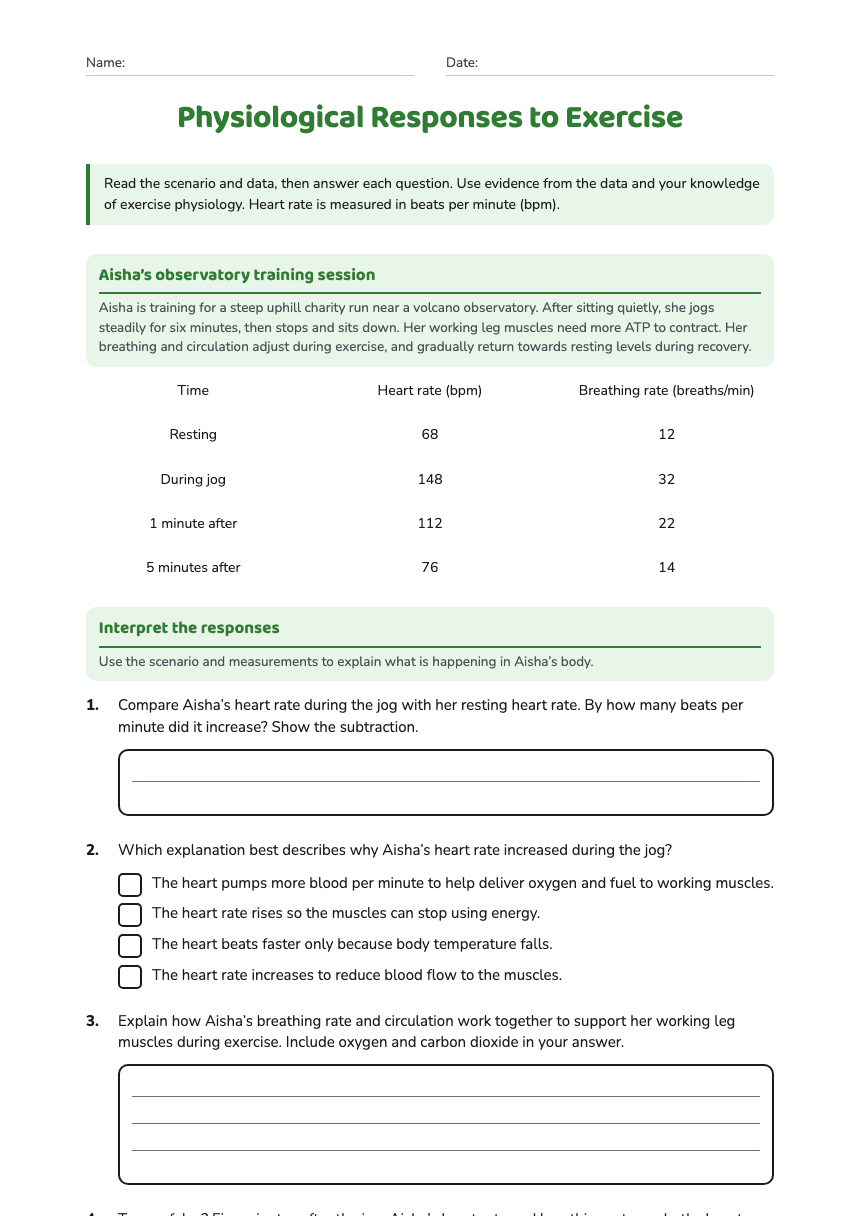
Physiological Responses to Exercise

Read the scenario and data, then answer each question. Use evidence from the data and your knowledge of exercise physiology. Heart rate is measured in beats per minute (bpm).

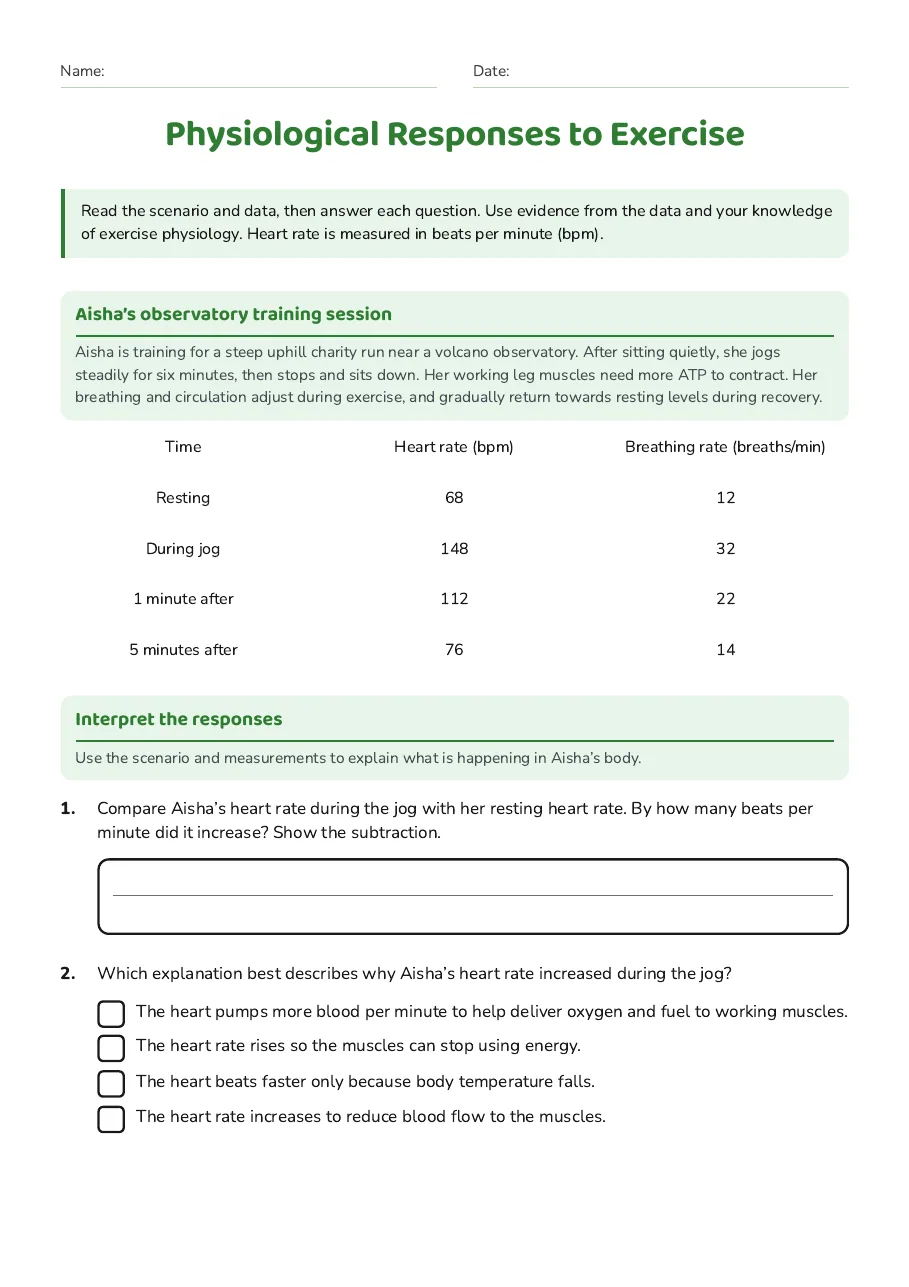
Aisha’s observatory training session

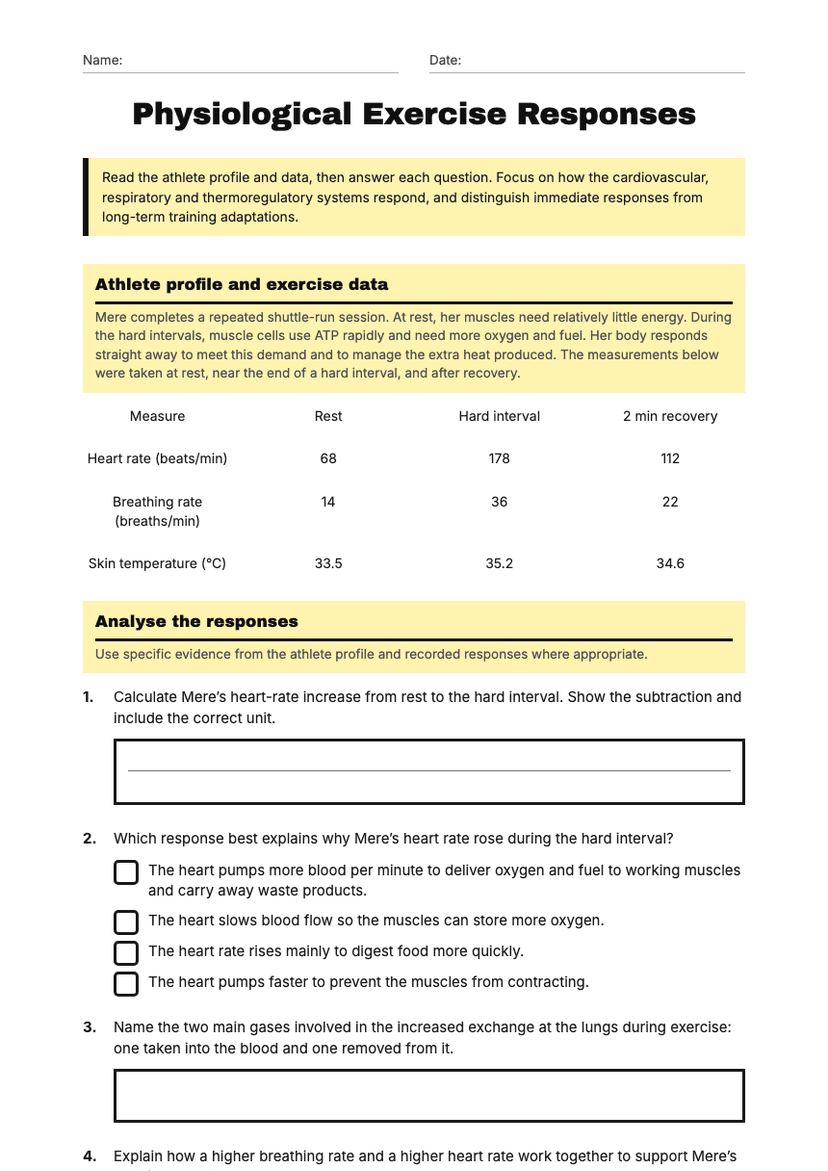
Aisha is training for a steep uphill charity run near a volcano observatory. After sitting quietly, she jogs steadily for six minutes, then stops and sits down. Her working leg muscles need more ATP to contract. Her breathing and circulation adjust during exercise, and gradually return towards resting levels during recovery.

Time

Heart rate (bpm)

Breathing rate (breaths/min)

Resting

68

12

During jog

148

32

1 minute after

112

22

5 minutes after

76

14

Interpret the responses

Use the scenario and measurements to explain what is happening in Aisha’s body.

1.Compare Aisha’s heart rate during the jog with her resting heart rate. By how many beats per minute did it increase? Show the subtraction.
2.Which explanation best describes why Aisha’s heart rate increased during the jog?
  • The heart pumps more blood per minute to help deliver oxygen and fuel to working muscles.
  • The heart rate rises so the muscles can stop using energy.
  • The heart beats faster only because body temperature falls.
  • The heart rate increases to reduce blood flow to the muscles.
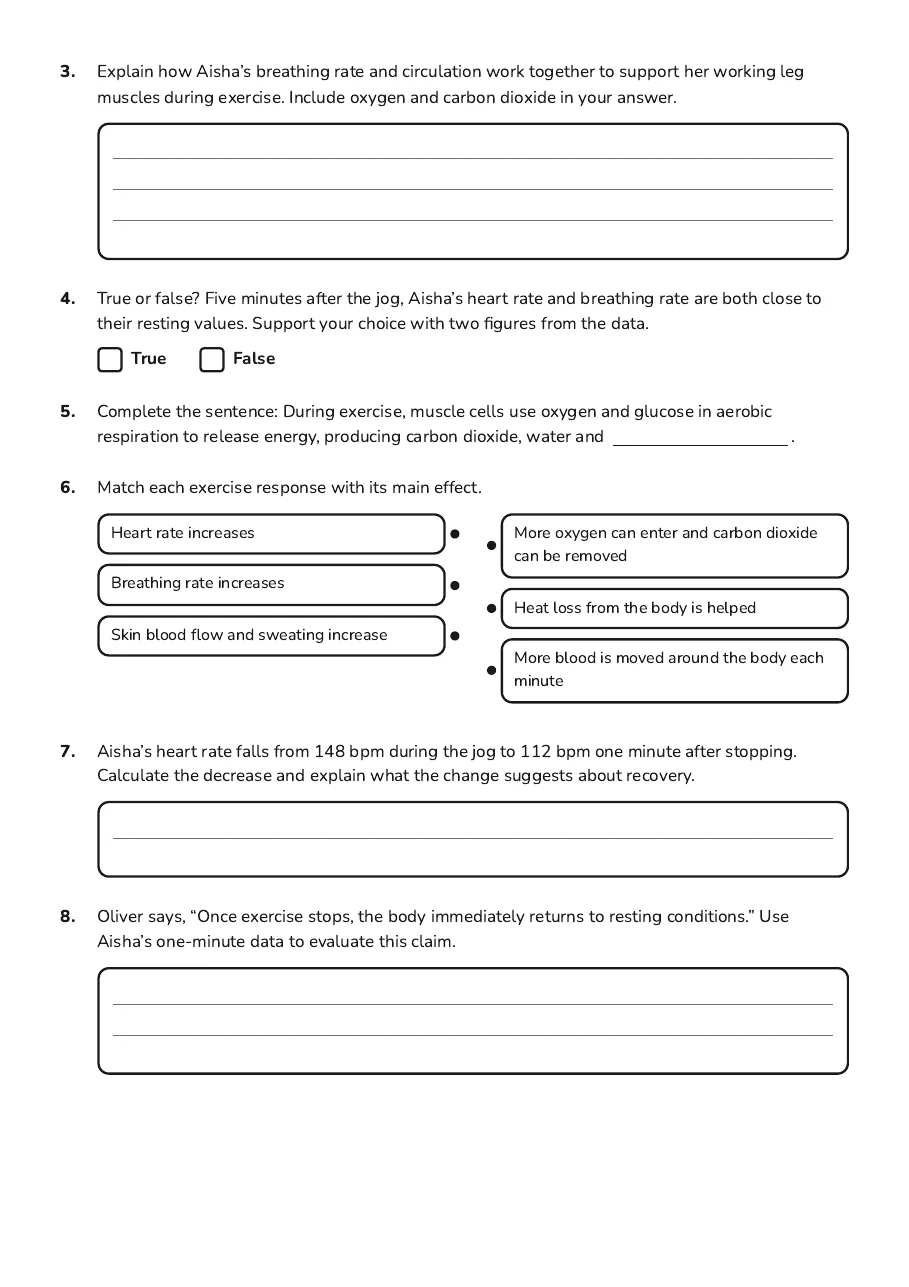
3.Explain how Aisha’s breathing rate and circulation work together to support her working leg muscles during exercise. Include oxygen and carbon dioxide in your answer.
4.True or false? Five minutes after the jog, Aisha’s heart rate and breathing rate are both close to their resting values. Support your choice with two figures from the data.
TrueFalse
5.Complete the sentence: During exercise, muscle cells use oxygen and glucose in aerobic respiration to release energy, producing carbon dioxide, water and .
6.Match each exercise response with its main effect.
  • Heart rate increases
  • Breathing rate increases
  • Skin blood flow and sweating increase
  • More oxygen can enter and carbon dioxide can be removed
  • Heat loss from the body is helped
  • More blood is moved around the body each minute
7.Aisha’s heart rate falls from 148 bpm during the jog to 112 bpm one minute after stopping. Calculate the decrease and explain what the change suggests about recovery.
8.Oliver says, “Once exercise stops, the body immediately returns to resting conditions.” Use Aisha’s one-minute data to evaluate this claim.
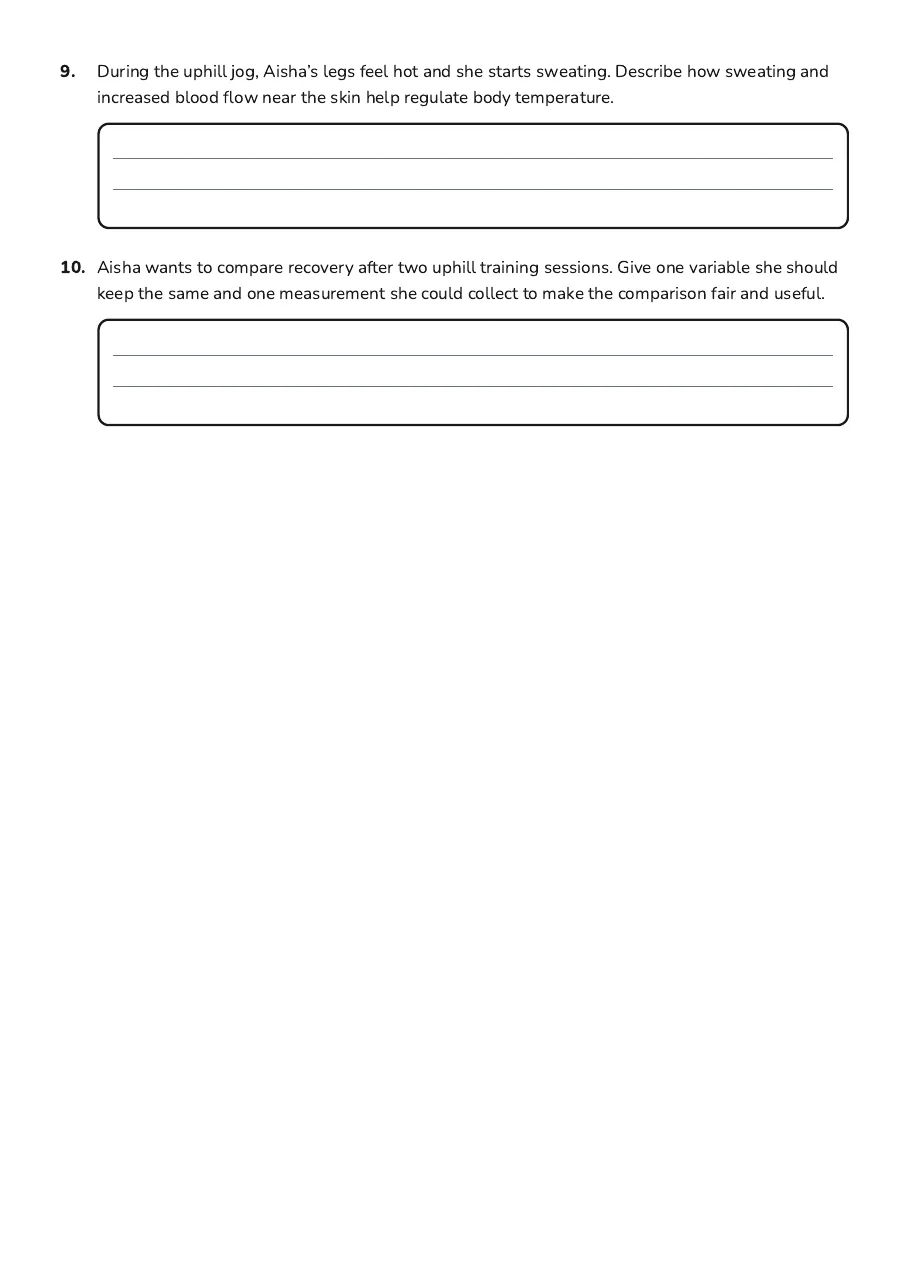
9.During the uphill jog, Aisha’s legs feel hot and she starts sweating. Describe how sweating and increased blood flow near the skin help regulate body temperature.
10.Aisha wants to compare recovery after two uphill training sessions. Give one variable she should keep the same and one measurement she could collect to make the comparison fair and useful.

3 printable pages

  • Physiological Responses to Exercise, page 1 of 3: Aisha’s observatory training session, Interpret the responses

    Page 1

  • Physiological Responses to Exercise, page 2 of 3: 3. Explain how Aisha’s breathing rate and circulation work together to support her…

    Page 2

  • Physiological Responses to Exercise, page 3 of 3: 9. During the uphill jog, Aisha’s legs feel hot and she starts sweating. Describe how…

    Page 3

About This Worksheet

Free in Kuraplan

Sign up free, grab the PDF, and customize it for your class.

Print-Ready

Formatted for standard paper. Clean layout, easy to read.

AI-Generated

Created with Kuraplan's AI, designed for real classroom use.

For Teachers & Parents

Use in classrooms, for homework, tutoring, or homeschool.

Need a custom version of this worksheet?

Kuraplan's AI generates custom worksheets in seconds — differentiated for every learner, aligned to your curriculum.

Generate Custom Worksheets — Free
No credit card Curriculum-aligned Under 60 seconds

Explore more free resources