Pirates and Privateers Analysis
A free english (ela) worksheet ready for your classroom. Open in Kuraplan to grab the print-ready PDF, customize it for your students, or generate a fresh version in seconds.
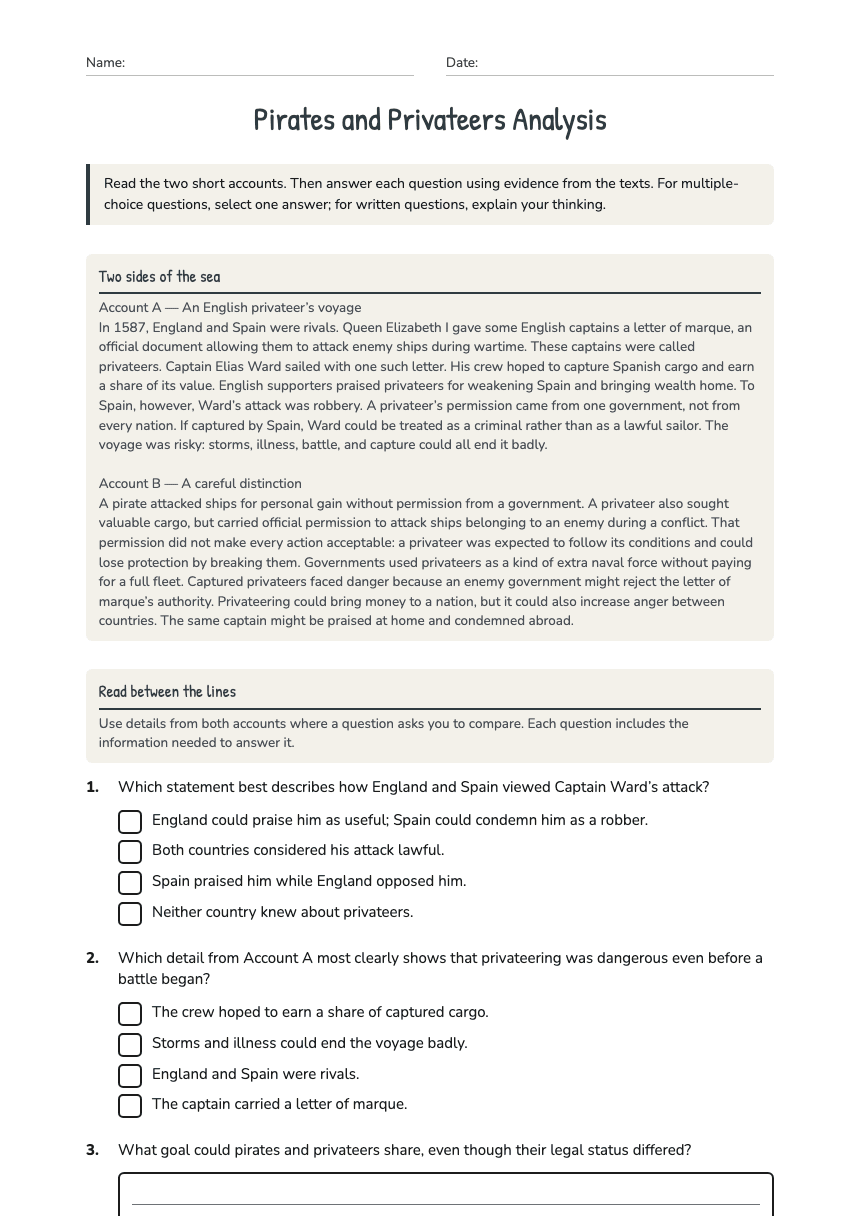
Pirates and Privateers Analysis
Two sides of the sea
Account A — An English privateer’s voyage In 1587, England and Spain were rivals. Queen Elizabeth I gave some English captains a letter of marque, an official document allowing them to attack enemy ships during wartime. These captains were called privateers. Captain Elias Ward sailed with one such letter. His crew hoped to capture Spanish cargo and earn a share of its value. English supporters praised privateers for weakening Spain and bringing wealth home. To Spain, however, Ward’s attack was robbery. A privateer’s permission came from one government, not from every nation. If captured by Spain, Ward could be treated as a criminal rather than as a lawful sailor. The voyage was risky: storms, illness, battle, and capture could all end it badly. Account B — A careful distinction A pirate attacked ships for personal gain without permission from a government. A privateer also sought valuable cargo, but carried official permission to attack ships belonging to an enemy during a conflict. That permission did not make every action acceptable: a privateer was expected to follow its conditions and could lose protection by breaking them. Governments used privateers as a kind of extra naval force without paying for a full fleet. Captured privateers faced danger because an enemy government might reject the letter of marque’s authority. Privateering could bring money to a nation, but it could also increase anger between countries. The same captain might be praised at home and condemned abroad.
Read between the lines
Use details from both accounts where a question asks you to compare. Each question includes the information needed to answer it.
- England could praise him as useful; Spain could condemn him as a robber.
- Both countries considered his attack lawful.
- Spain praised him while England opposed him.
- Neither country knew about privateers.
- The crew hoped to earn a share of captured cargo.
- Storms and illness could end the voyage badly.
- England and Spain were rivals.
- The captain carried a letter of marque.
- A pirate attacks without government permission; a privateer has official permission to attack enemy ships.
- A pirate sails only in wartime; a privateer sails only in peacetime.
- A privateer never seeks wealth; a pirate always works for a government.
- A pirate attacks only merchant ships; a privateer attacks only naval ships.
- An official document giving permission to attack enemy ships during wartime.
- A private map showing where treasure was hidden.
- A contract promising sailors a fixed salary.
- A note sent to warn a rival ship.
3 printable pages
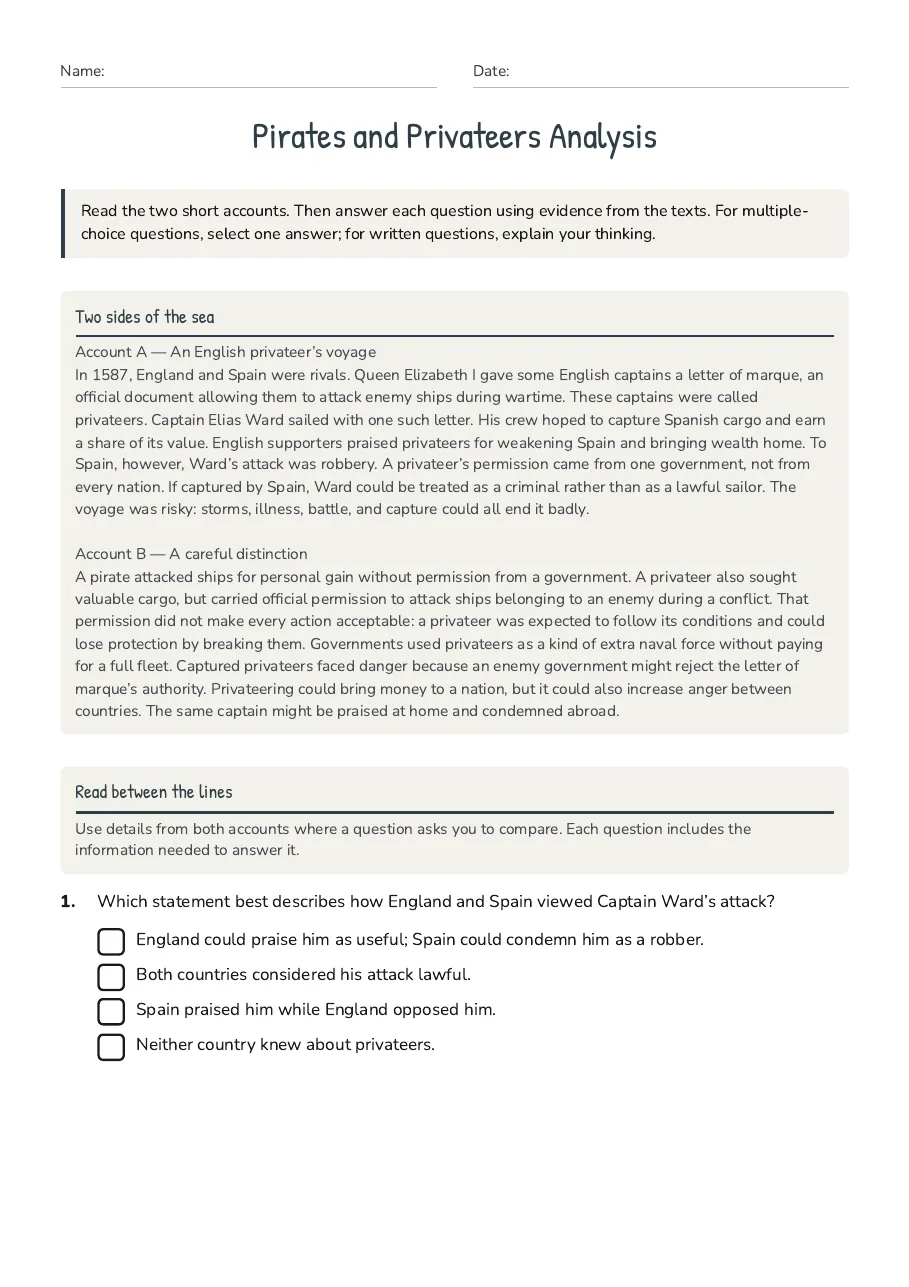
Page 1
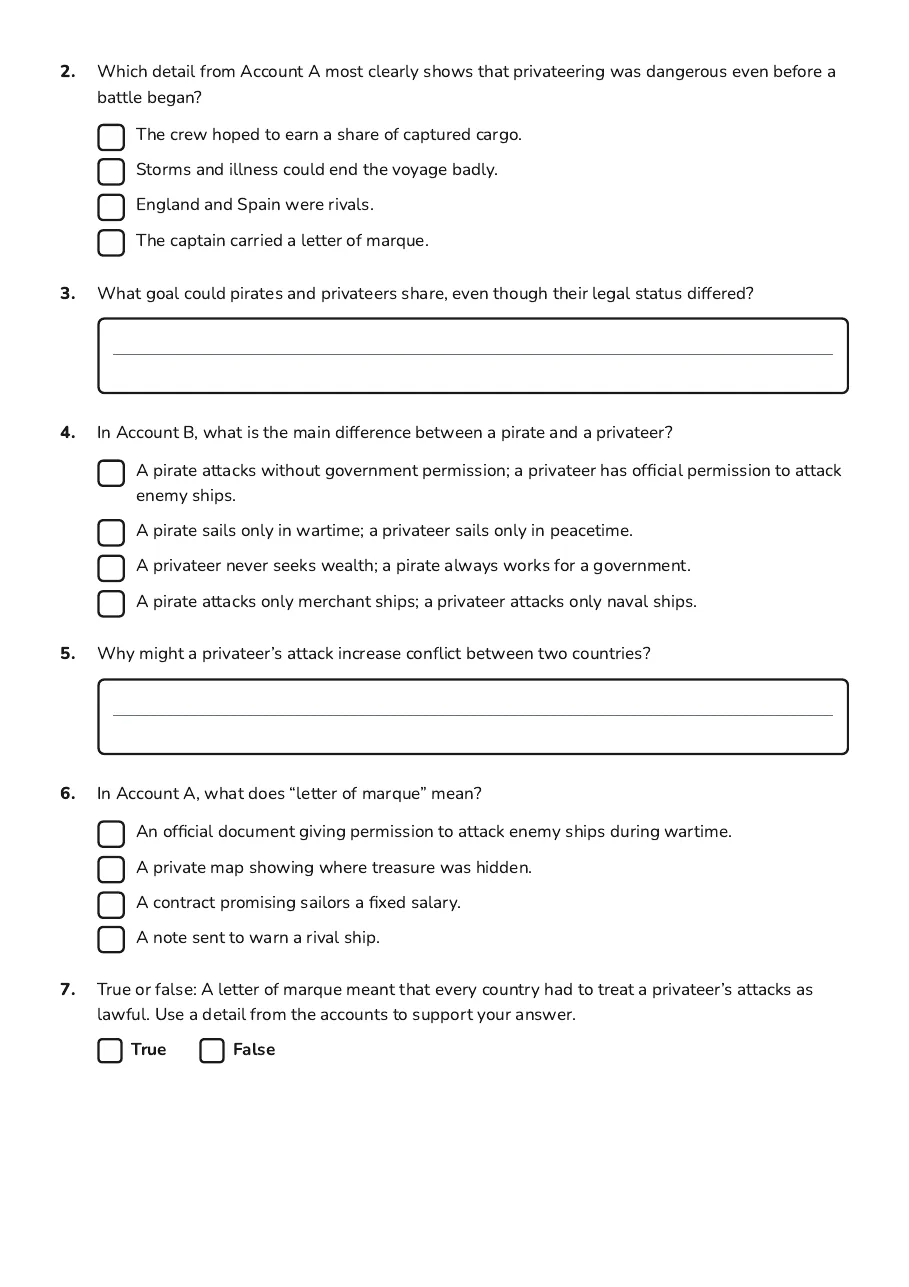
Page 2
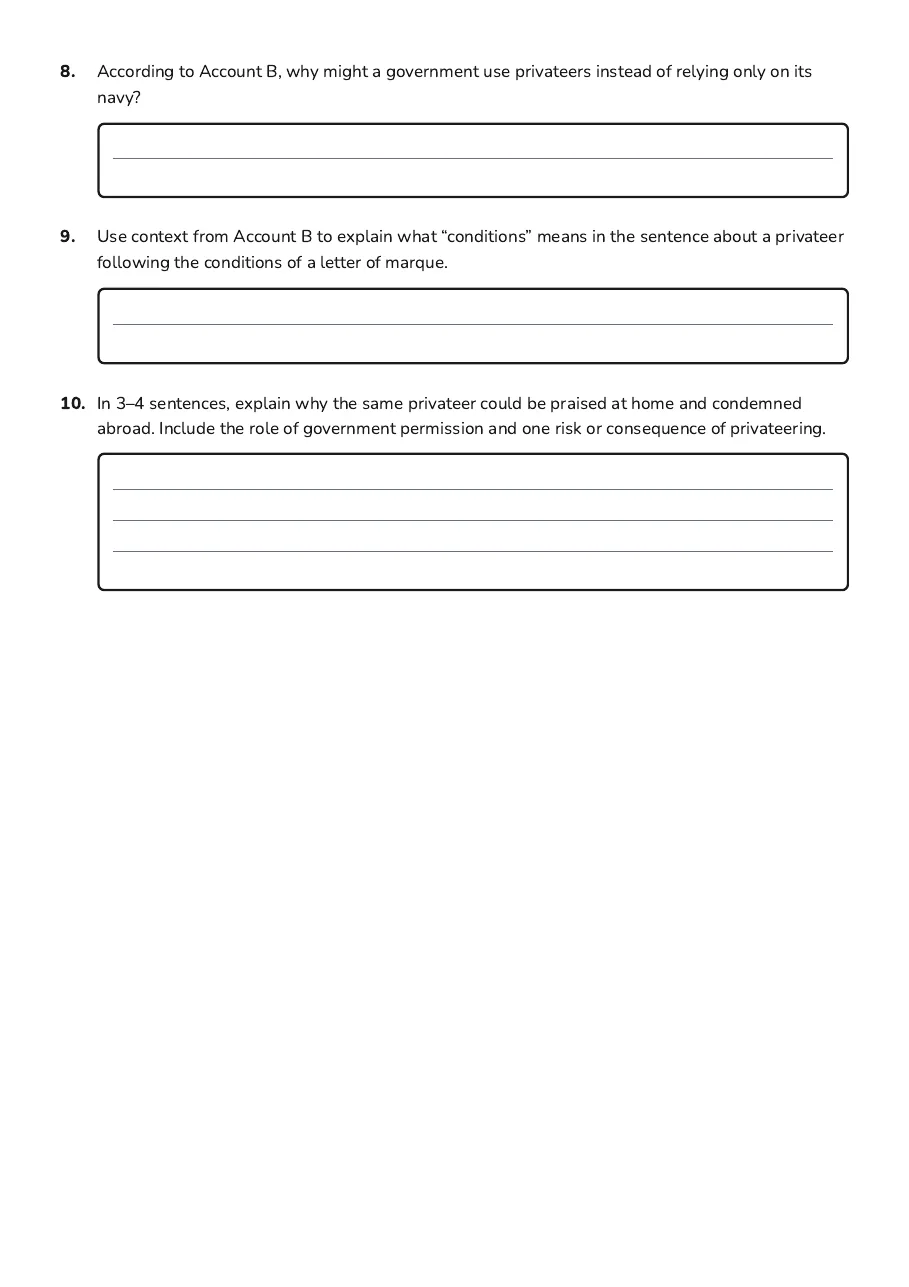
Page 3
About This Worksheet
Free in Kuraplan
Sign up free, grab the PDF, and customize it for your class.
Print-Ready
Formatted for standard paper. Clean layout, easy to read.
AI-Generated
Created with Kuraplan's AI, designed for real classroom use.
For Teachers & Parents
Use in classrooms, for homework, tutoring, or homeschool.
Need a custom version of this worksheet?
Kuraplan's AI generates custom worksheets in seconds — differentiated for every learner, aligned to your curriculum.
Generate Custom Worksheets — Free