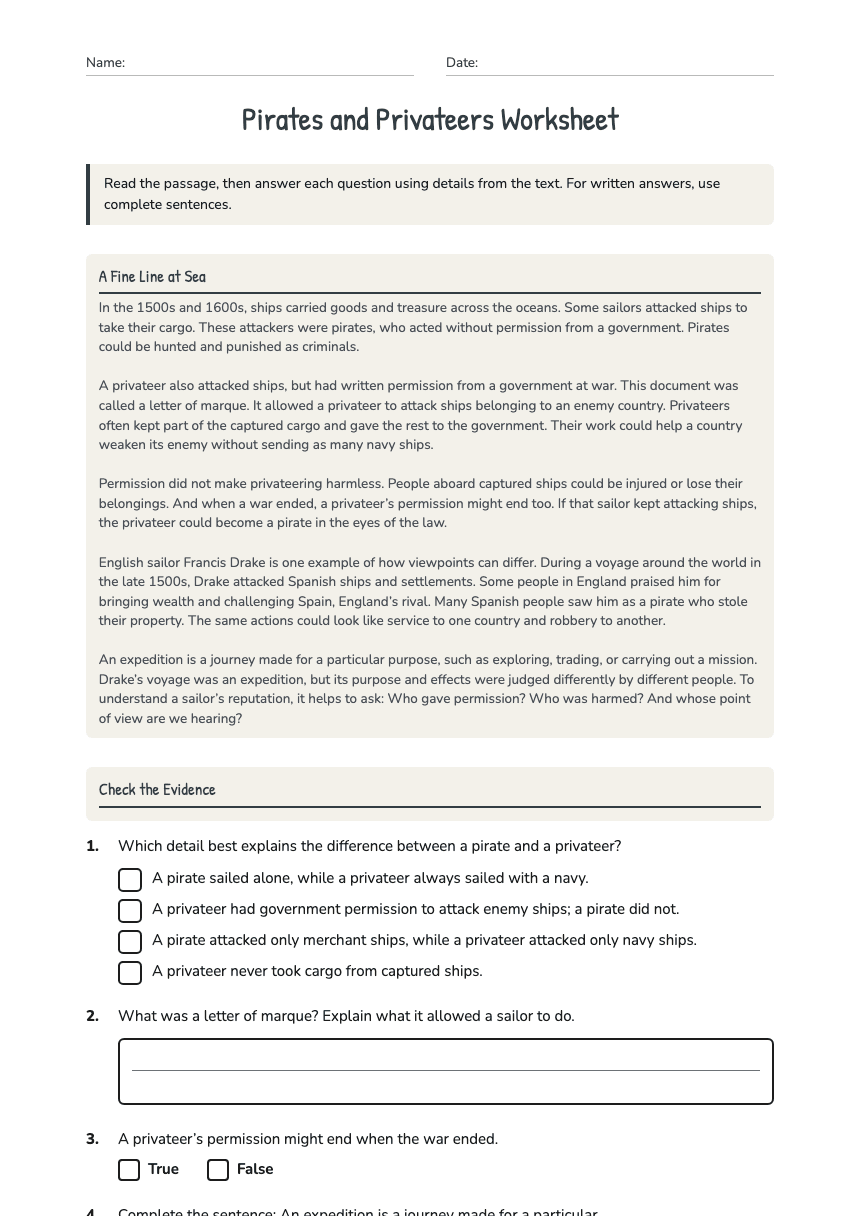
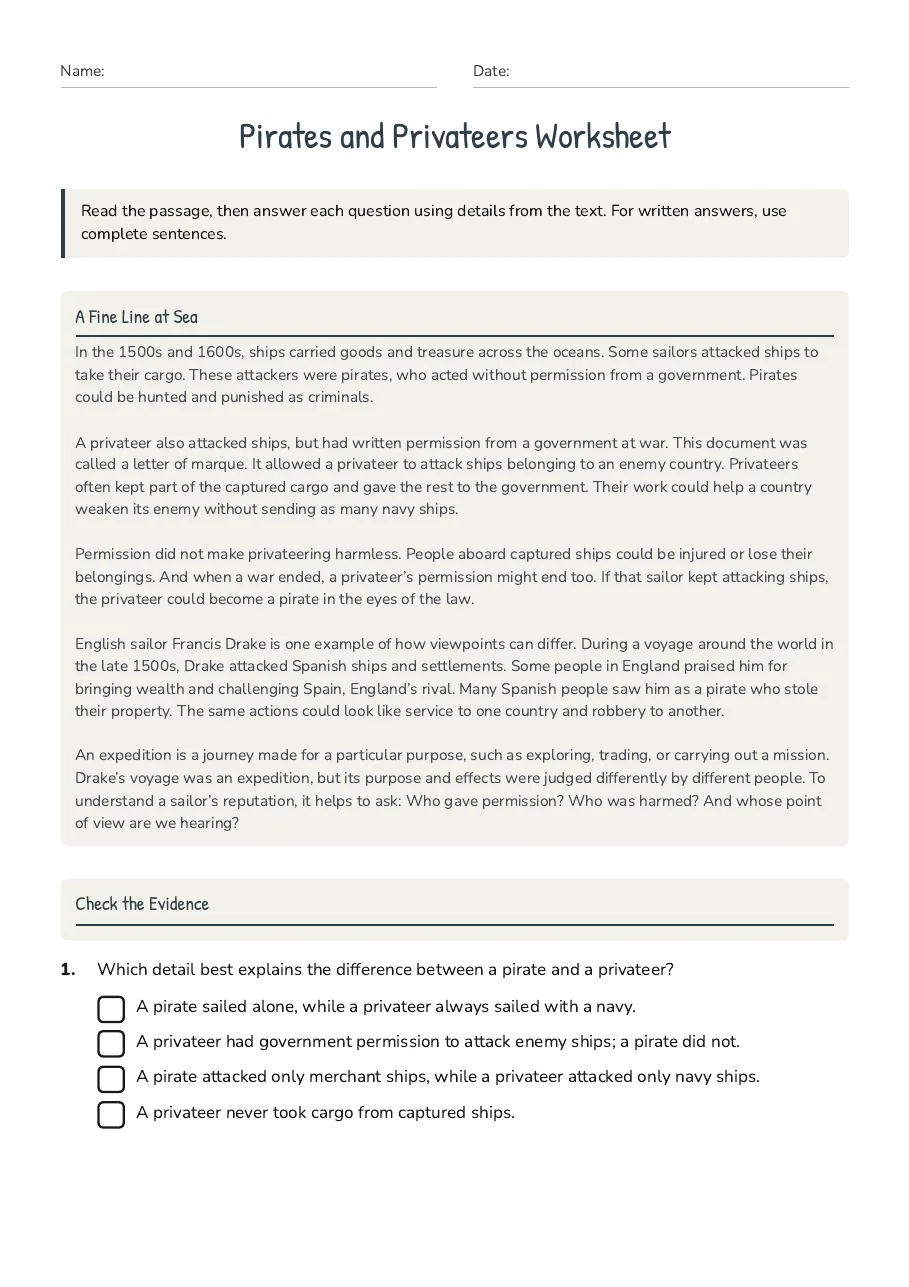
Pirates and Privateers Worksheet
A free english (ela) worksheet ready for your classroom. Open in Kuraplan to grab the print-ready PDF, customize it for your students, or generate a fresh version in seconds.
Pirates and Privateers Worksheet
A Fine Line at Sea
In the 1500s and 1600s, ships carried goods and treasure across the oceans. Some sailors attacked ships to take their cargo. These attackers were pirates, who acted without permission from a government. Pirates could be hunted and punished as criminals. A privateer also attacked ships, but had written permission from a government at war. This document was called a letter of marque. It allowed a privateer to attack ships belonging to an enemy country. Privateers often kept part of the captured cargo and gave the rest to the government. Their work could help a country weaken its enemy without sending as many navy ships. Permission did not make privateering harmless. People aboard captured ships could be injured or lose their belongings. And when a war ended, a privateer’s permission might end too. If that sailor kept attacking ships, the privateer could become a pirate in the eyes of the law. English sailor Francis Drake is one example of how viewpoints can differ. During a voyage around the world in the late 1500s, Drake attacked Spanish ships and settlements. Some people in England praised him for bringing wealth and challenging Spain, England’s rival. Many Spanish people saw him as a pirate who stole their property. The same actions could look like service to one country and robbery to another. An expedition is a journey made for a particular purpose, such as exploring, trading, or carrying out a mission. Drake’s voyage was an expedition, but its purpose and effects were judged differently by different people. To understand a sailor’s reputation, it helps to ask: Who gave permission? Who was harmed? And whose point of view are we hearing?
Check the Evidence
- A pirate sailed alone, while a privateer always sailed with a navy.
- A privateer had government permission to attack enemy ships; a pirate did not.
- A pirate attacked only merchant ships, while a privateer attacked only navy ships.
- A privateer never took cargo from captured ships.
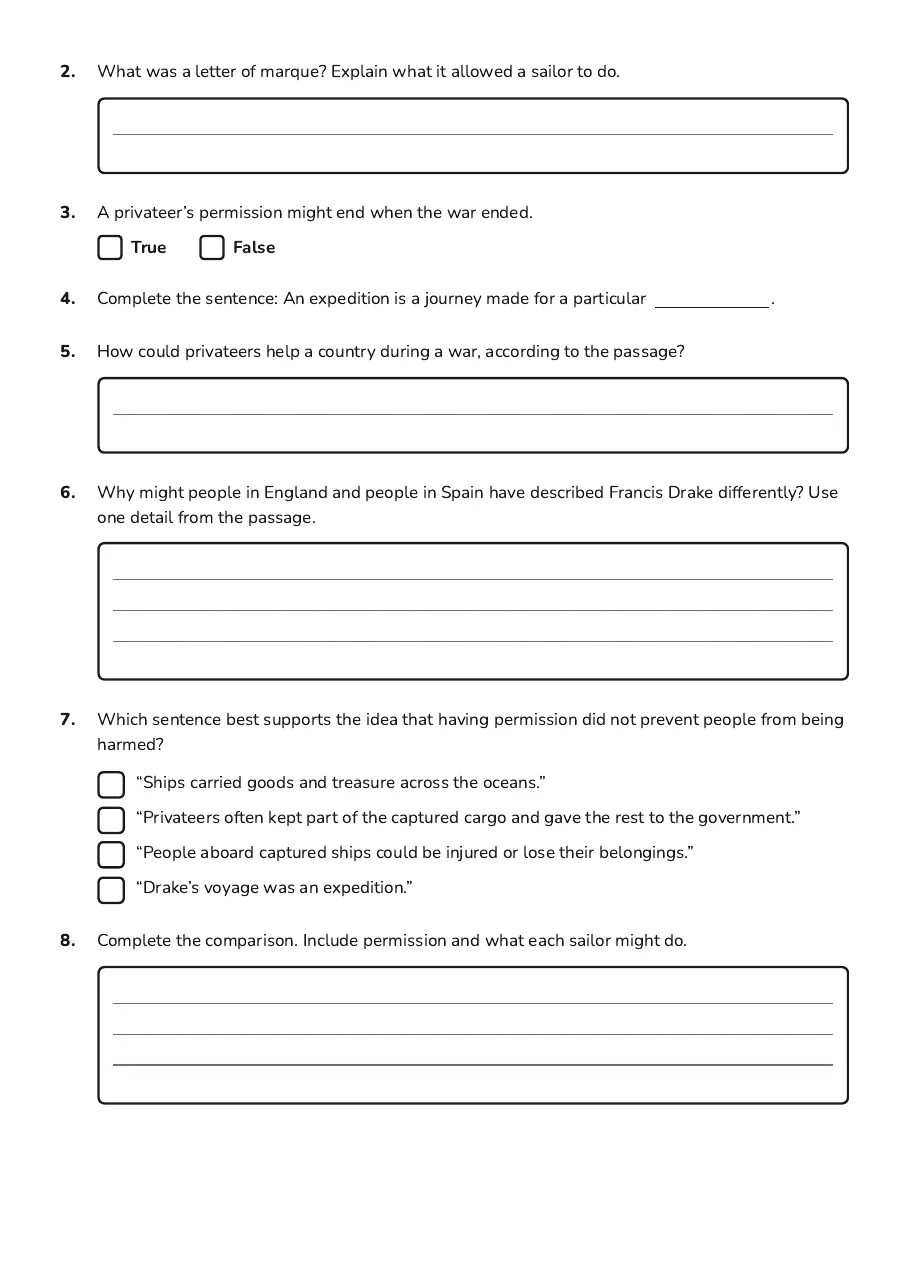
- “Ships carried goods and treasure across the oceans.”
- “Privateers often kept part of the captured cargo and gave the rest to the government.”
- “People aboard captured ships could be injured or lose their belongings.”
- “Drake’s voyage was an expedition.”
3 printable pages
Page 1
Page 2
Page 3
About This Worksheet
Free in Kuraplan
Sign up free, grab the PDF, and customize it for your class.
Print-Ready
Formatted for standard paper. Clean layout, easy to read.
AI-Generated
Created with Kuraplan's AI, designed for real classroom use.
For Teachers & Parents
Use in classrooms, for homework, tutoring, or homeschool.
Need a custom version of this worksheet?
Kuraplan's AI generates custom worksheets in seconds — differentiated for every learner, aligned to your curriculum.
Generate Custom Worksheets — Free