Renaissance Art and Inventions
A free social studies worksheet ready for your classroom. Open in Kuraplan to grab the print-ready PDF, customize it for your students, or generate a fresh version in seconds.
Renaissance Art and Inventions
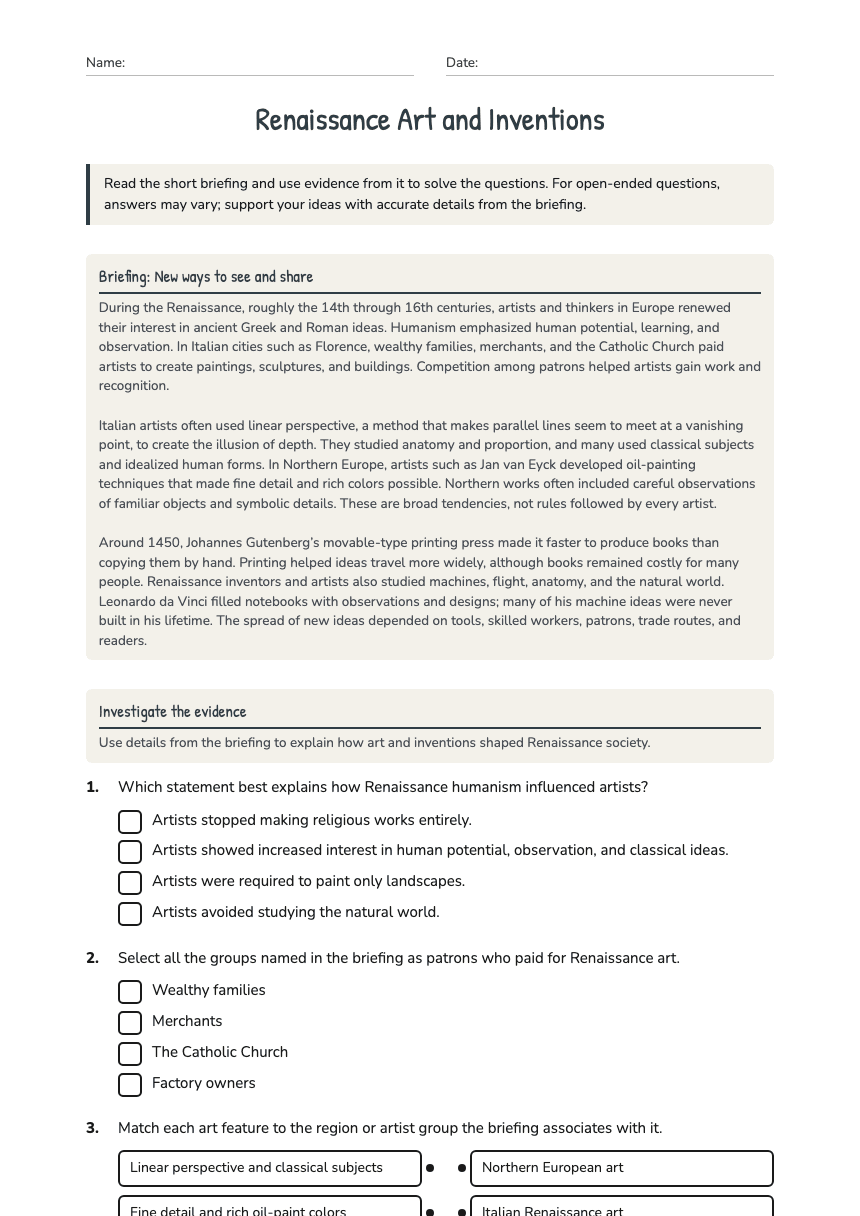
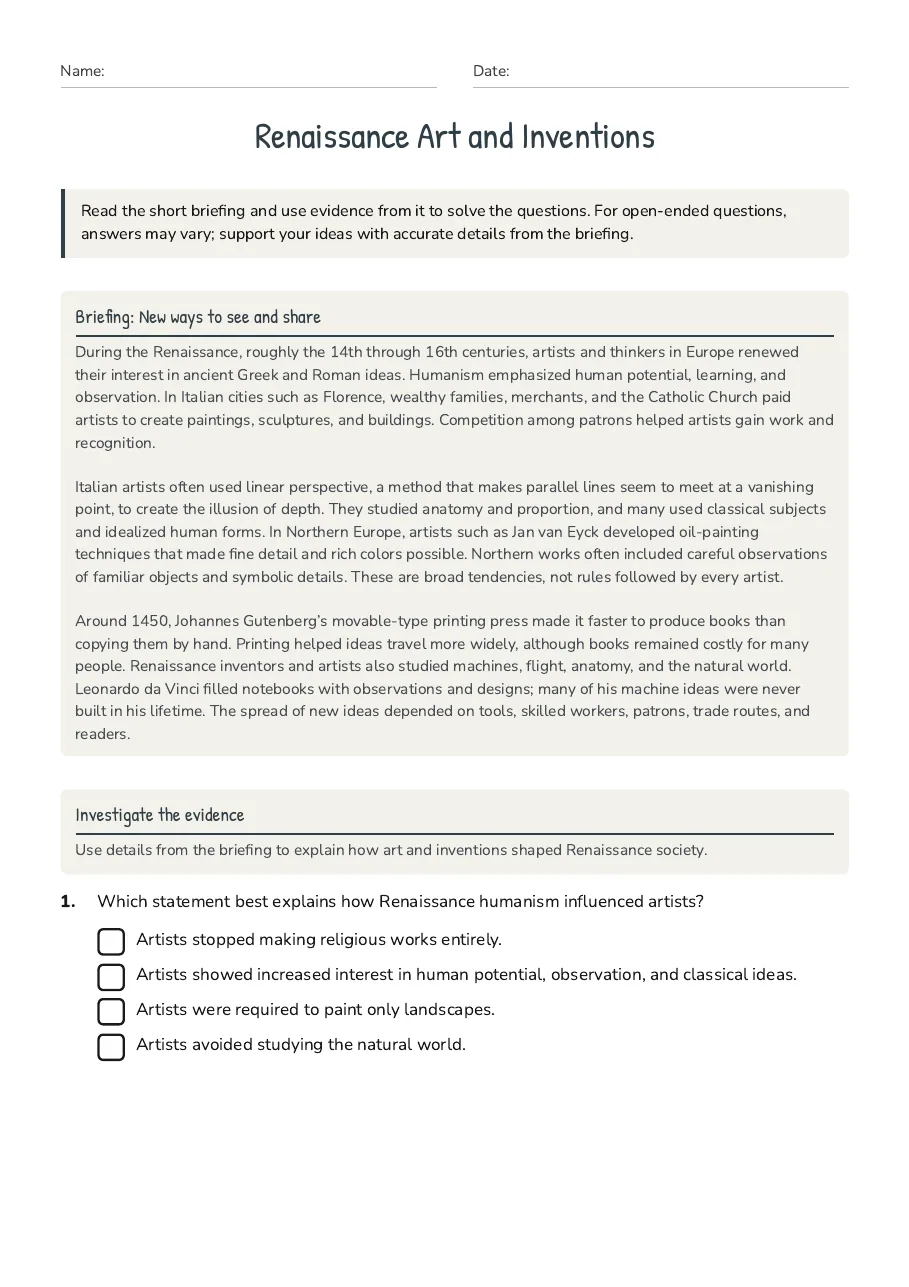
Briefing: New ways to see and share
During the Renaissance, roughly the 14th through 16th centuries, artists and thinkers in Europe renewed their interest in ancient Greek and Roman ideas. Humanism emphasized human potential, learning, and observation. In Italian cities such as Florence, wealthy families, merchants, and the Catholic Church paid artists to create paintings, sculptures, and buildings. Competition among patrons helped artists gain work and recognition. Italian artists often used linear perspective, a method that makes parallel lines seem to meet at a vanishing point, to create the illusion of depth. They studied anatomy and proportion, and many used classical subjects and idealized human forms. In Northern Europe, artists such as Jan van Eyck developed oil-painting techniques that made fine detail and rich colors possible. Northern works often included careful observations of familiar objects and symbolic details. These are broad tendencies, not rules followed by every artist. Around 1450, Johannes Gutenberg’s movable-type printing press made it faster to produce books than copying them by hand. Printing helped ideas travel more widely, although books remained costly for many people. Renaissance inventors and artists also studied machines, flight, anatomy, and the natural world. Leonardo da Vinci filled notebooks with observations and designs; many of his machine ideas were never built in his lifetime. The spread of new ideas depended on tools, skilled workers, patrons, trade routes, and readers.
Investigate the evidence
Use details from the briefing to explain how art and inventions shaped Renaissance society.
- Artists stopped making religious works entirely.
- Artists showed increased interest in human potential, observation, and classical ideas.
- Artists were required to paint only landscapes.
- Artists avoided studying the natural world.
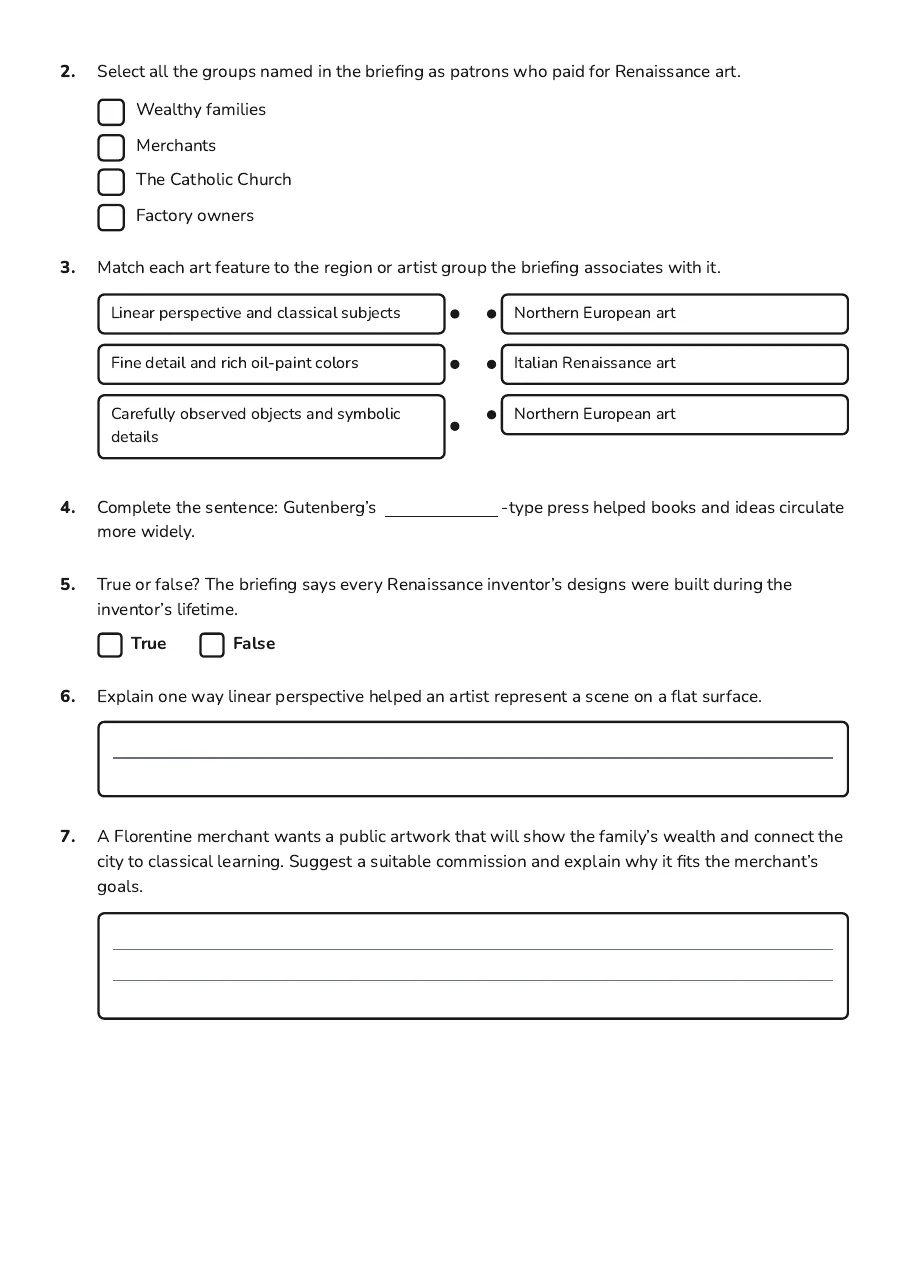
- Wealthy families
- Merchants
- The Catholic Church
- Factory owners
- Linear perspective and classical subjects
- Fine detail and rich oil-paint colors
- Carefully observed objects and symbolic details
- Northern European art
- Italian Renaissance art
- Northern European art
3 printable pages
Page 1
Page 2
Page 3
About This Worksheet
Free in Kuraplan
Sign up free, grab the PDF, and customize it for your class.
Print-Ready
Formatted for standard paper. Clean layout, easy to read.
AI-Generated
Created with Kuraplan's AI, designed for real classroom use.
For Teachers & Parents
Use in classrooms, for homework, tutoring, or homeschool.
Need a custom version of this worksheet?
Kuraplan's AI generates custom worksheets in seconds — differentiated for every learner, aligned to your curriculum.
Generate Custom Worksheets — Free