Rocky Shore Habitat Exploration
A free science worksheet ready for your classroom. Open in Kuraplan to grab the print-ready PDF, customize it for your students, or generate a fresh version in seconds.
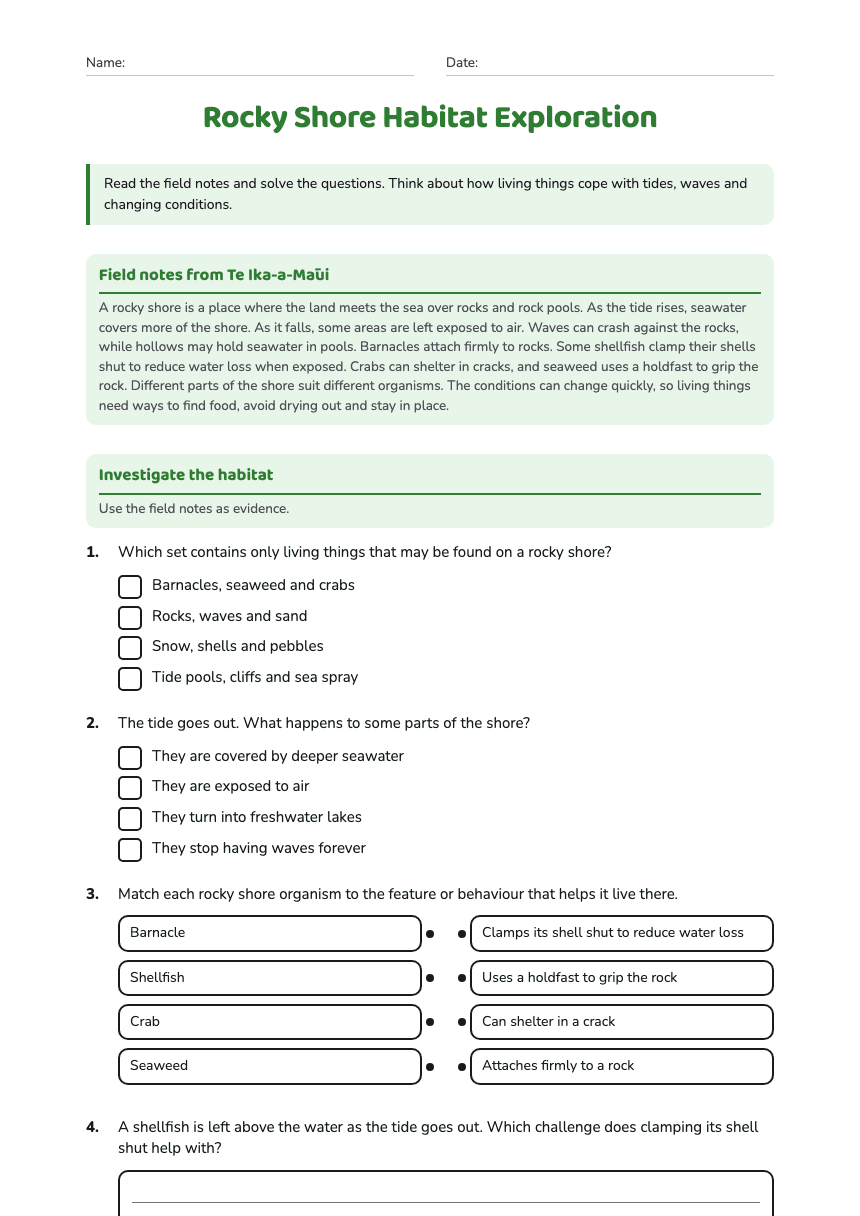
Rocky Shore Habitat Exploration
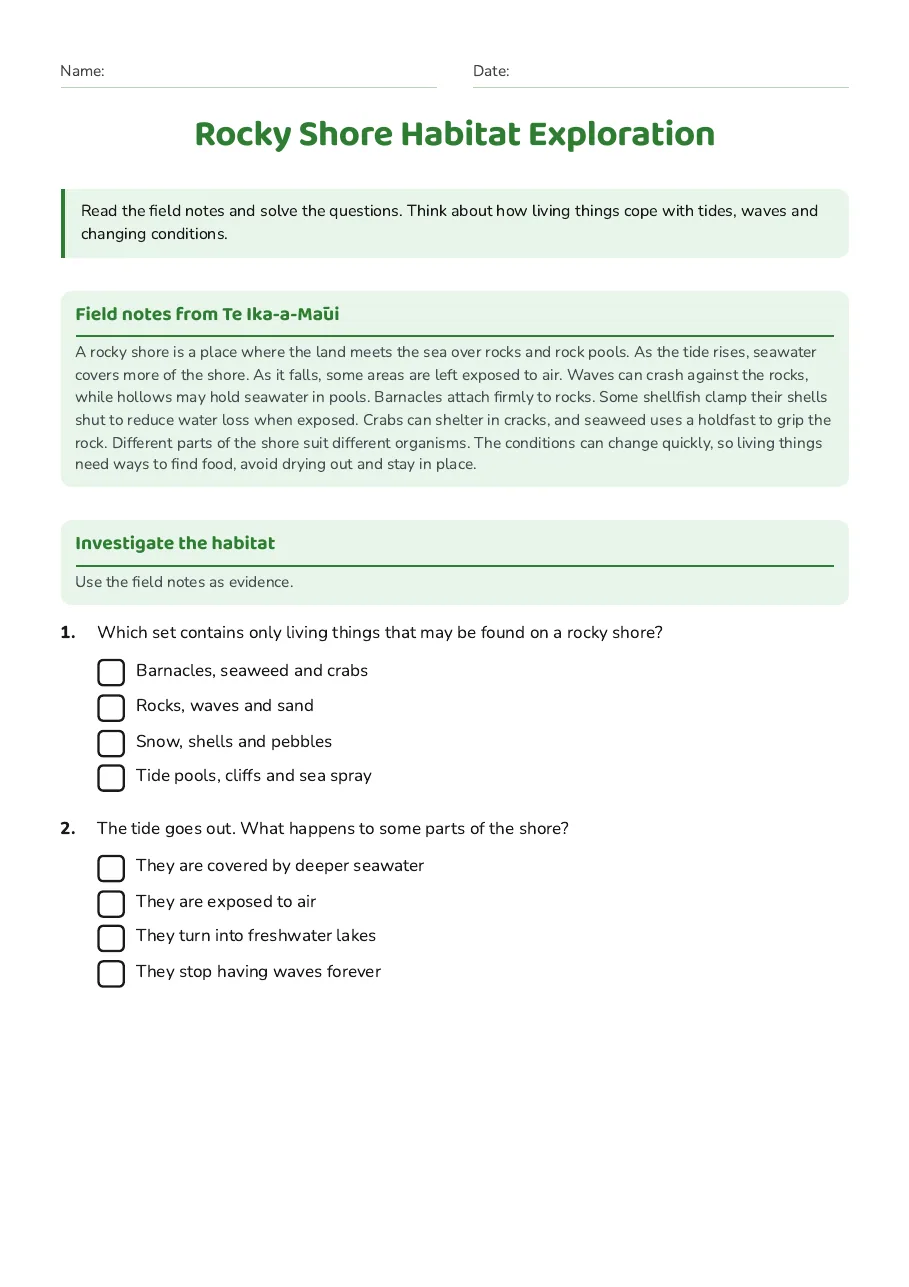
Field notes from Te Ika-a-Māui
A rocky shore is a place where the land meets the sea over rocks and rock pools. As the tide rises, seawater covers more of the shore. As it falls, some areas are left exposed to air. Waves can crash against the rocks, while hollows may hold seawater in pools. Barnacles attach firmly to rocks. Some shellfish clamp their shells shut to reduce water loss when exposed. Crabs can shelter in cracks, and seaweed uses a holdfast to grip the rock. Different parts of the shore suit different organisms. The conditions can change quickly, so living things need ways to find food, avoid drying out and stay in place.
Investigate the habitat
Use the field notes as evidence.
- Barnacles, seaweed and crabs
- Rocks, waves and sand
- Snow, shells and pebbles
- Tide pools, cliffs and sea spray
- They are covered by deeper seawater
- They are exposed to air
- They turn into freshwater lakes
- They stop having waves forever
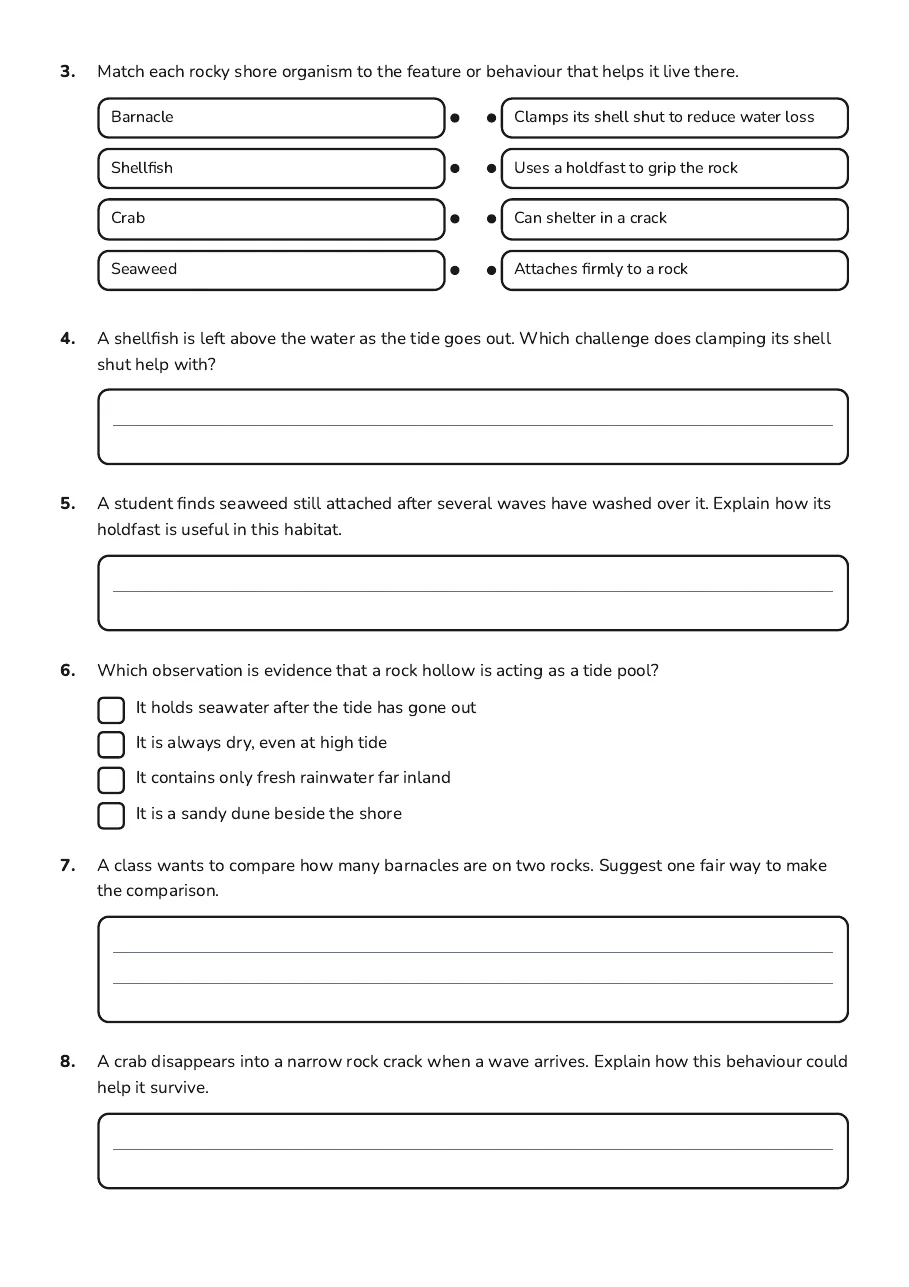
- Barnacle
- Shellfish
- Crab
- Seaweed
- Clamps its shell shut to reduce water loss
- Uses a holdfast to grip the rock
- Can shelter in a crack
- Attaches firmly to a rock
- It holds seawater after the tide has gone out
- It is always dry, even at high tide
- It contains only fresh rainwater far inland
- It is a sandy dune beside the shore
3 printable pages
Page 1
Page 2
Page 3
About This Worksheet
Free in Kuraplan
Sign up free, grab the PDF, and customize it for your class.
Print-Ready
Formatted for standard paper. Clean layout, easy to read.
AI-Generated
Created with Kuraplan's AI, designed for real classroom use.
For Teachers & Parents
Use in classrooms, for homework, tutoring, or homeschool.
Need a custom version of this worksheet?
Kuraplan's AI generates custom worksheets in seconds — differentiated for every learner, aligned to your curriculum.
Generate Custom Worksheets — Free