Roman Dictators Analysis
A free social studies worksheet ready for your classroom. Open in Kuraplan to grab the print-ready PDF, customize it for your students, or generate a fresh version in seconds.
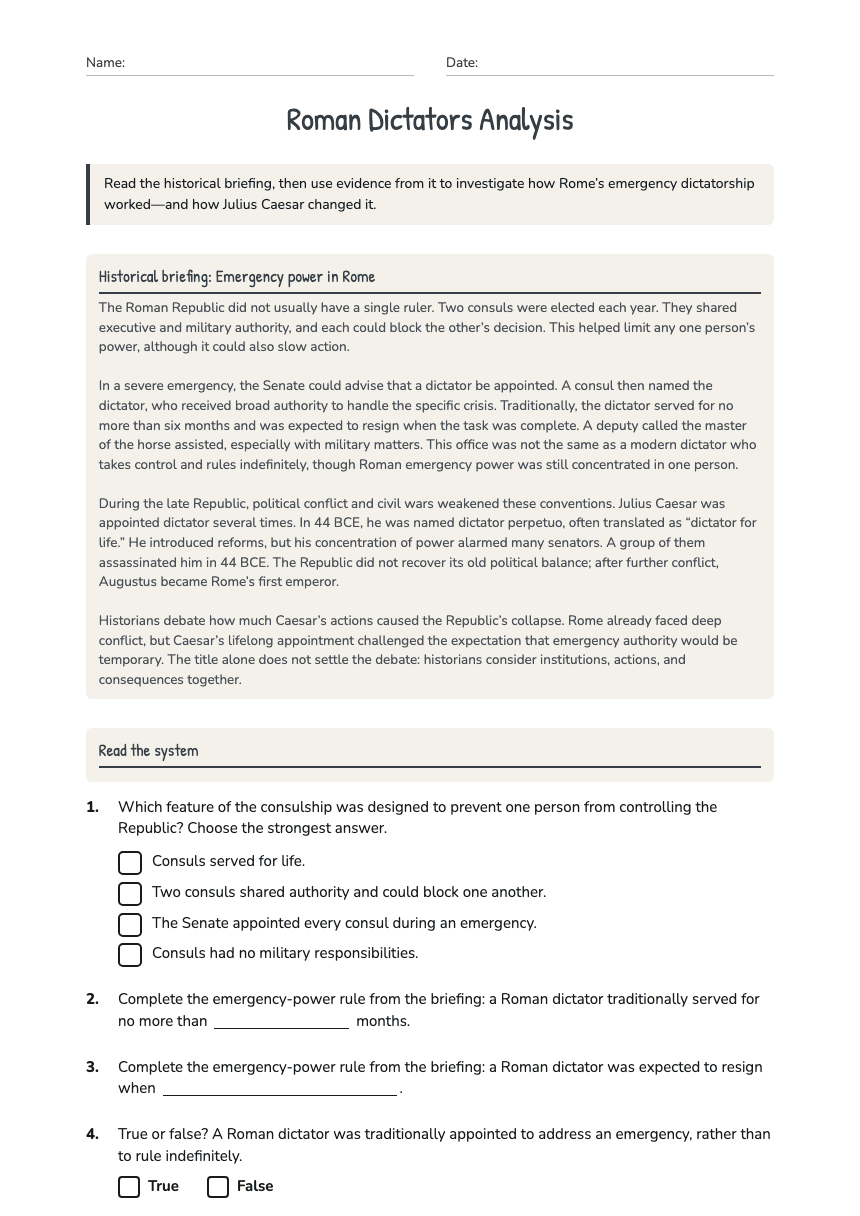
Roman Dictators Analysis
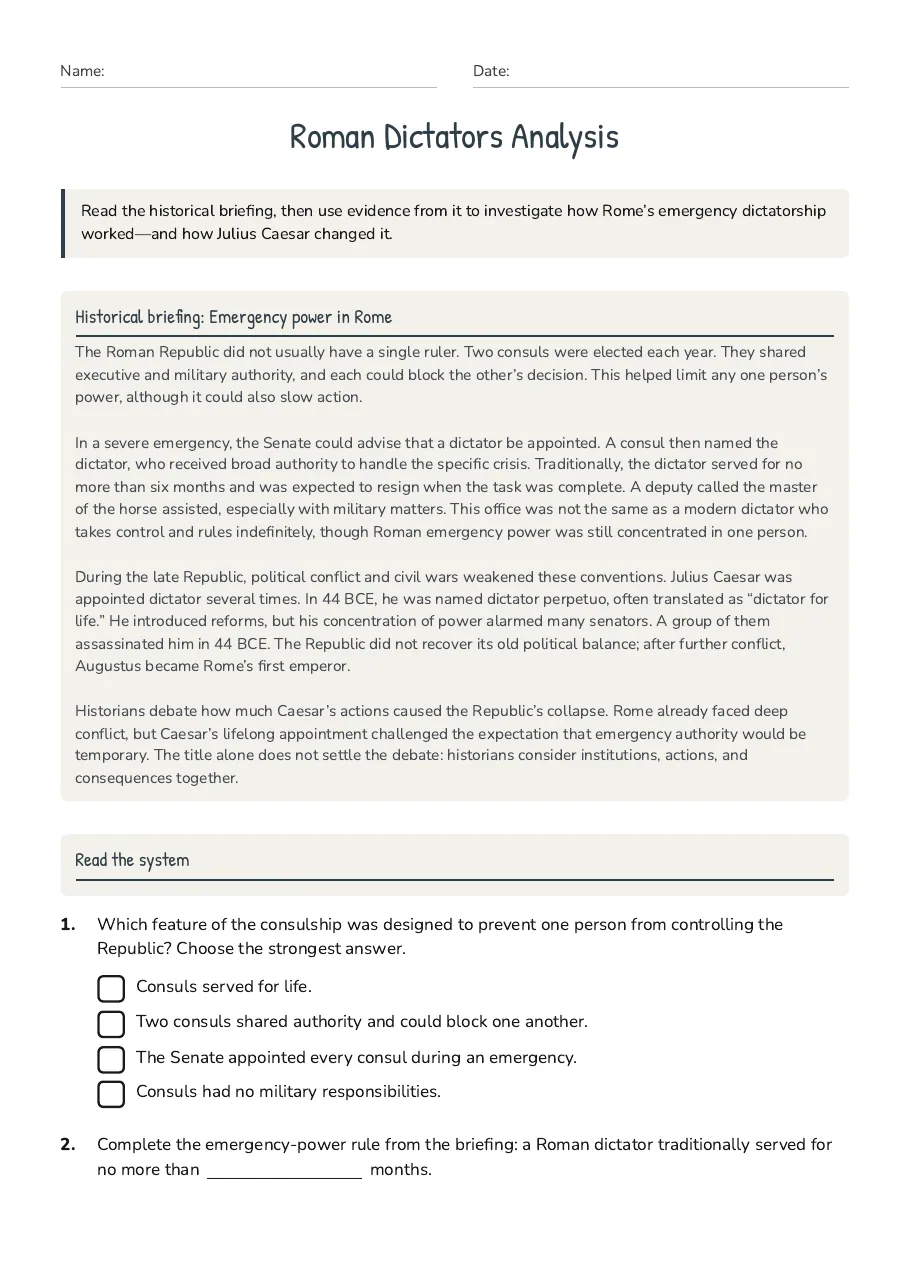
Historical briefing: Emergency power in Rome
The Roman Republic did not usually have a single ruler. Two consuls were elected each year. They shared executive and military authority, and each could block the other’s decision. This helped limit any one person’s power, although it could also slow action. In a severe emergency, the Senate could advise that a dictator be appointed. A consul then named the dictator, who received broad authority to handle the specific crisis. Traditionally, the dictator served for no more than six months and was expected to resign when the task was complete. A deputy called the master of the horse assisted, especially with military matters. This office was not the same as a modern dictator who takes control and rules indefinitely, though Roman emergency power was still concentrated in one person. During the late Republic, political conflict and civil wars weakened these conventions. Julius Caesar was appointed dictator several times. In 44 BCE, he was named dictator perpetuo, often translated as “dictator for life.” He introduced reforms, but his concentration of power alarmed many senators. A group of them assassinated him in 44 BCE. The Republic did not recover its old political balance; after further conflict, Augustus became Rome’s first emperor. Historians debate how much Caesar’s actions caused the Republic’s collapse. Rome already faced deep conflict, but Caesar’s lifelong appointment challenged the expectation that emergency authority would be temporary. The title alone does not settle the debate: historians consider institutions, actions, and consequences together.
Read the system
- Consuls served for life.
- Two consuls shared authority and could block one another.
- The Senate appointed every consul during an emergency.
- Consuls had no military responsibilities.
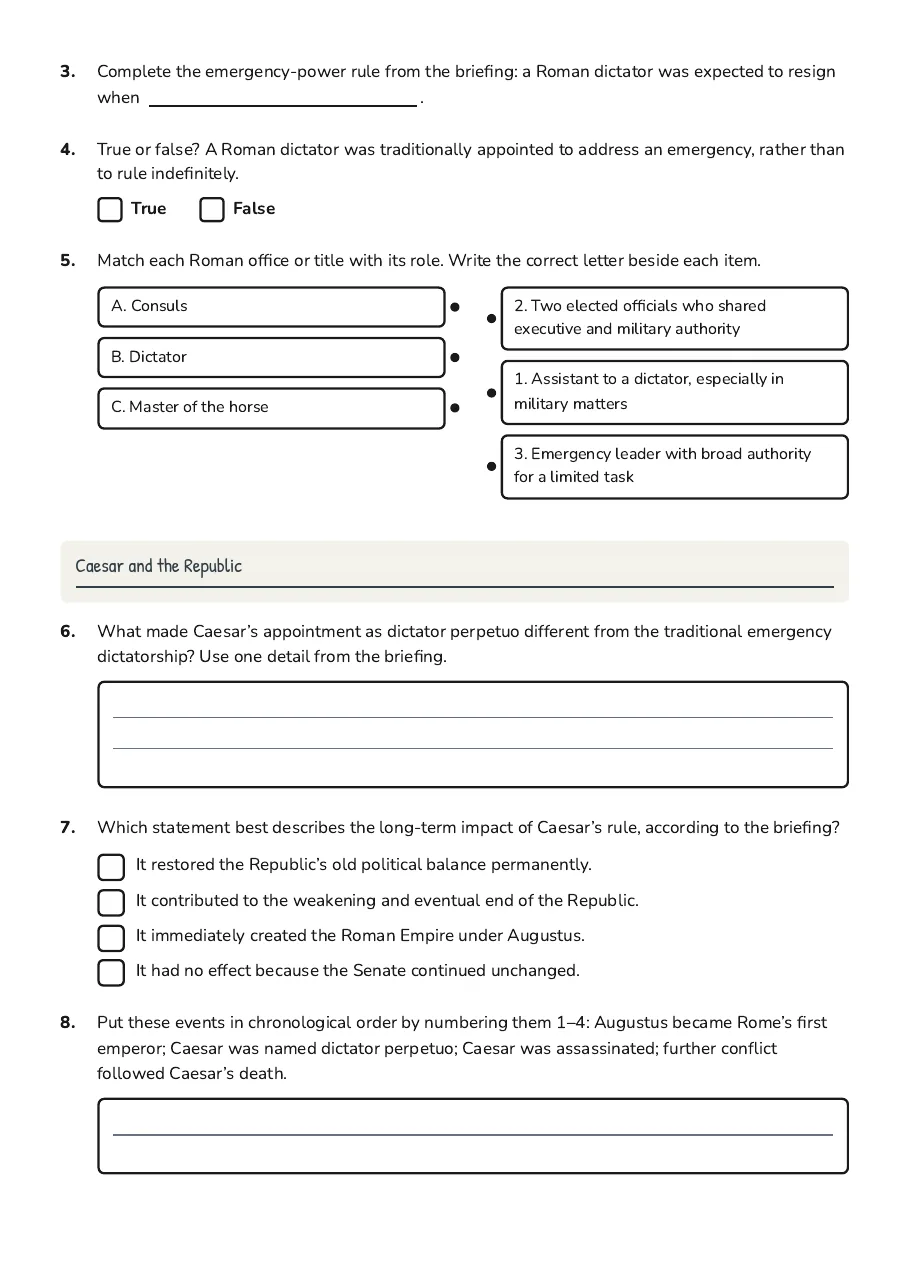
- A. Consuls
- B. Dictator
- C. Master of the horse
- 2. Two elected officials who shared executive and military authority
- 1. Assistant to a dictator, especially in military matters
- 3. Emergency leader with broad authority for a limited task
Caesar and the Republic
- It restored the Republic’s old political balance permanently.
- It contributed to the weakening and eventual end of the Republic.
- It immediately created the Roman Empire under Augustus.
- It had no effect because the Senate continued unchanged.
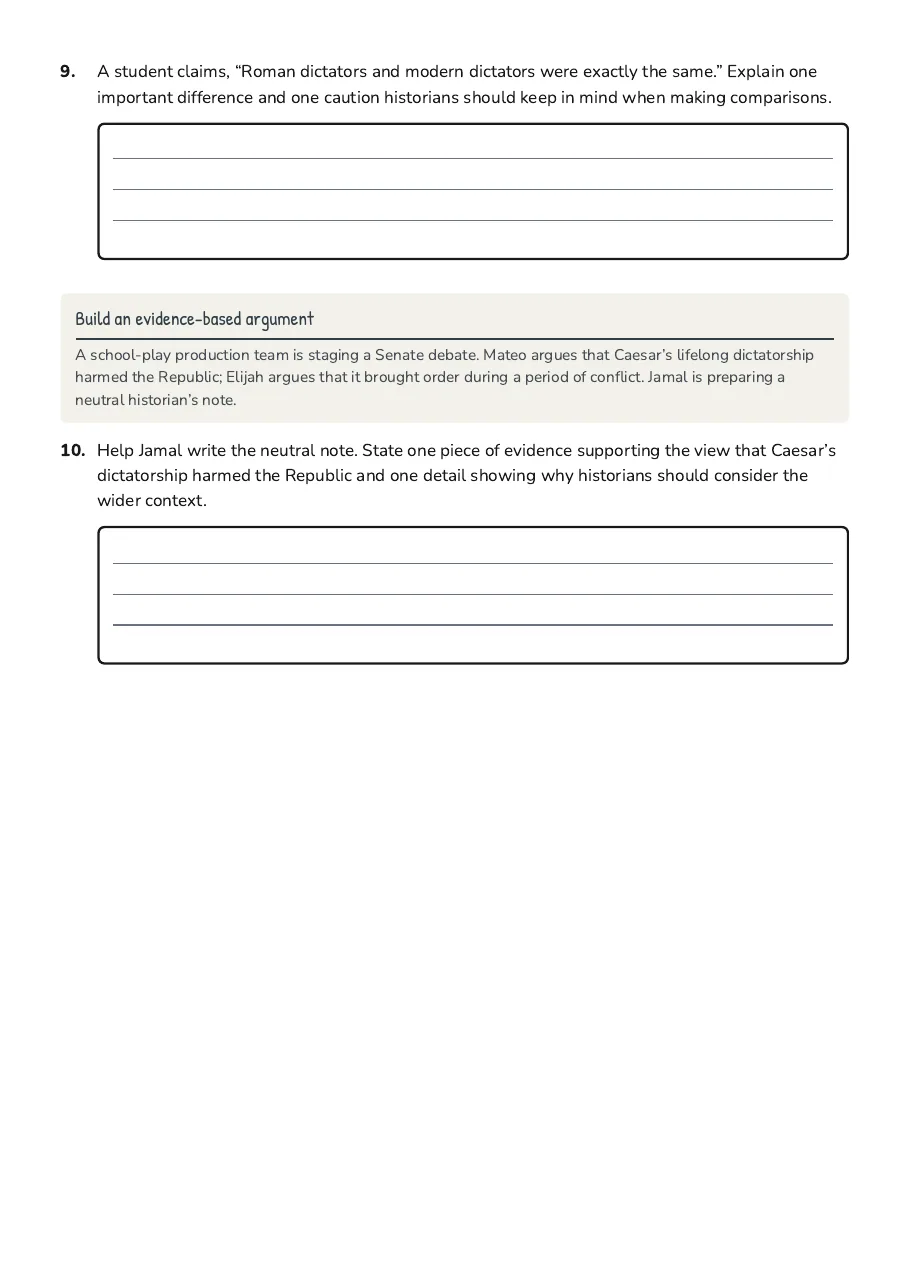
Build an evidence-based argument
A school-play production team is staging a Senate debate. Mateo argues that Caesar’s lifelong dictatorship harmed the Republic; Elijah argues that it brought order during a period of conflict. Jamal is preparing a neutral historian’s note.
3 printable pages
Page 1
Page 2
Page 3
About This Worksheet
Free in Kuraplan
Sign up free, grab the PDF, and customize it for your class.
Print-Ready
Formatted for standard paper. Clean layout, easy to read.
AI-Generated
Created with Kuraplan's AI, designed for real classroom use.
For Teachers & Parents
Use in classrooms, for homework, tutoring, or homeschool.
Need a custom version of this worksheet?
Kuraplan's AI generates custom worksheets in seconds — differentiated for every learner, aligned to your curriculum.
Generate Custom Worksheets — Free