Slavery and Industrial Revolution
A free social studies worksheet ready for your classroom. Open in Kuraplan to grab the print-ready PDF, customize it for your students, or generate a fresh version in seconds.
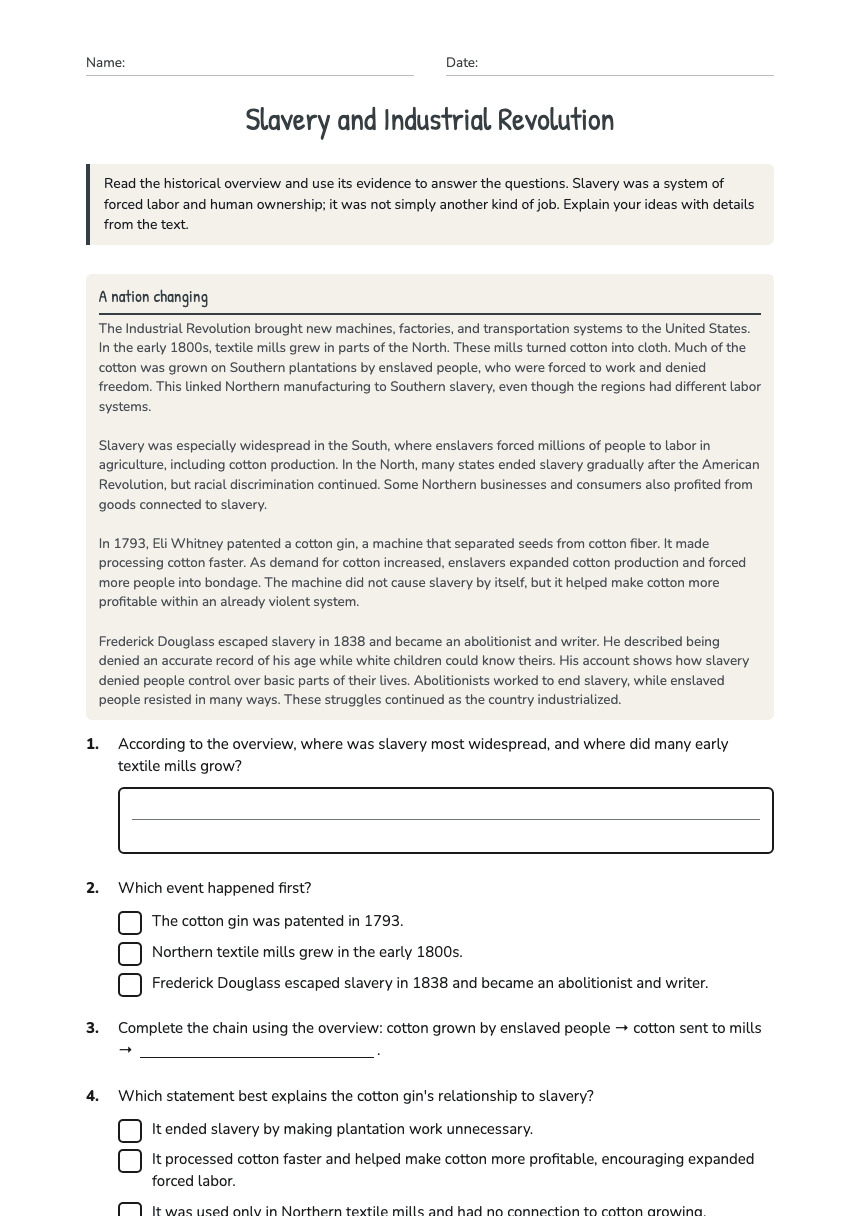
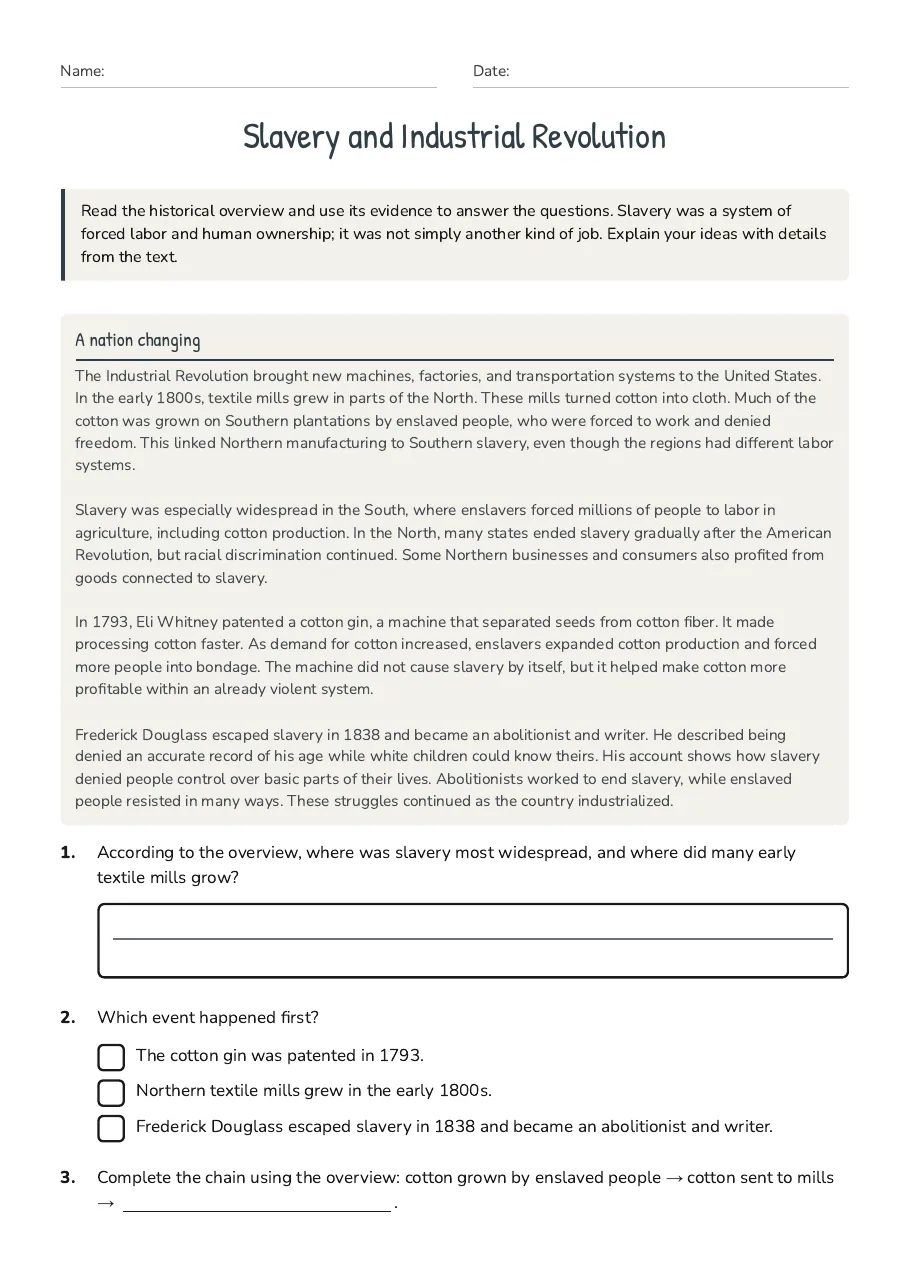
Slavery and Industrial Revolution
A nation changing
The Industrial Revolution brought new machines, factories, and transportation systems to the United States. In the early 1800s, textile mills grew in parts of the North. These mills turned cotton into cloth. Much of the cotton was grown on Southern plantations by enslaved people, who were forced to work and denied freedom. This linked Northern manufacturing to Southern slavery, even though the regions had different labor systems. Slavery was especially widespread in the South, where enslavers forced millions of people to labor in agriculture, including cotton production. In the North, many states ended slavery gradually after the American Revolution, but racial discrimination continued. Some Northern businesses and consumers also profited from goods connected to slavery. In 1793, Eli Whitney patented a cotton gin, a machine that separated seeds from cotton fiber. It made processing cotton faster. As demand for cotton increased, enslavers expanded cotton production and forced more people into bondage. The machine did not cause slavery by itself, but it helped make cotton more profitable within an already violent system. Frederick Douglass escaped slavery in 1838 and became an abolitionist and writer. He described being denied an accurate record of his age while white children could know theirs. His account shows how slavery denied people control over basic parts of their lives. Abolitionists worked to end slavery, while enslaved people resisted in many ways. These struggles continued as the country industrialized.
- The cotton gin was patented in 1793.
- Northern textile mills grew in the early 1800s.
- Frederick Douglass escaped slavery in 1838 and became an abolitionist and writer.
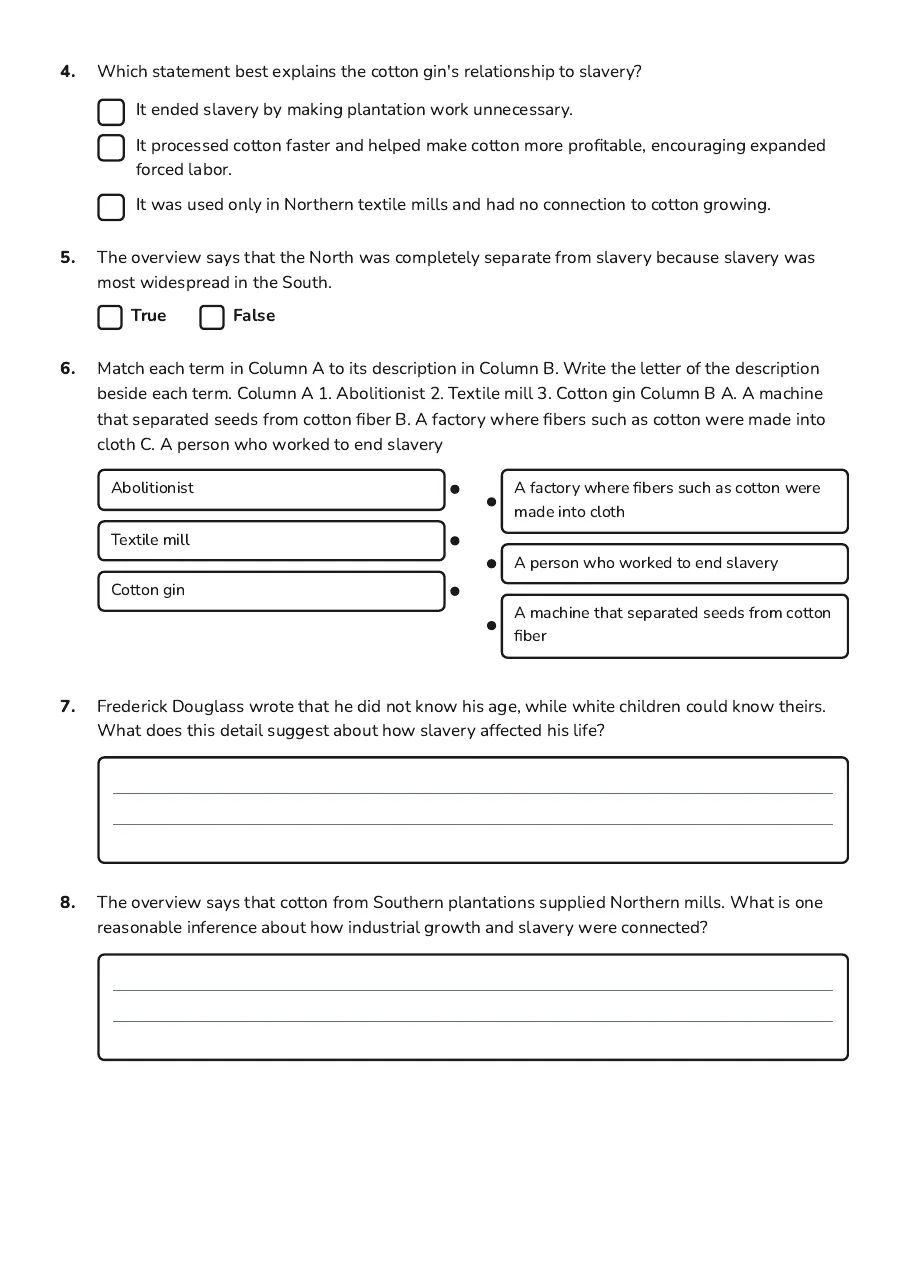
- It ended slavery by making plantation work unnecessary.
- It processed cotton faster and helped make cotton more profitable, encouraging expanded forced labor.
- It was used only in Northern textile mills and had no connection to cotton growing.
- Abolitionist
- Textile mill
- Cotton gin
- A factory where fibers such as cotton were made into cloth
- A person who worked to end slavery
- A machine that separated seeds from cotton fiber
- The Industrial Revolution ended slavery as soon as factories opened.
- Industrialization and slavery developed at the same time and were economically connected in some ways.
- Every person in the North supported slavery, and every person in the South opposed it.
3 printable pages
Page 1
Page 2

Page 3
About This Worksheet
Free in Kuraplan
Sign up free, grab the PDF, and customize it for your class.
Print-Ready
Formatted for standard paper. Clean layout, easy to read.
AI-Generated
Created with Kuraplan's AI, designed for real classroom use.
For Teachers & Parents
Use in classrooms, for homework, tutoring, or homeschool.
Need a custom version of this worksheet?
Kuraplan's AI generates custom worksheets in seconds — differentiated for every learner, aligned to your curriculum.
Generate Custom Worksheets — Free