ScienceFreePrintable

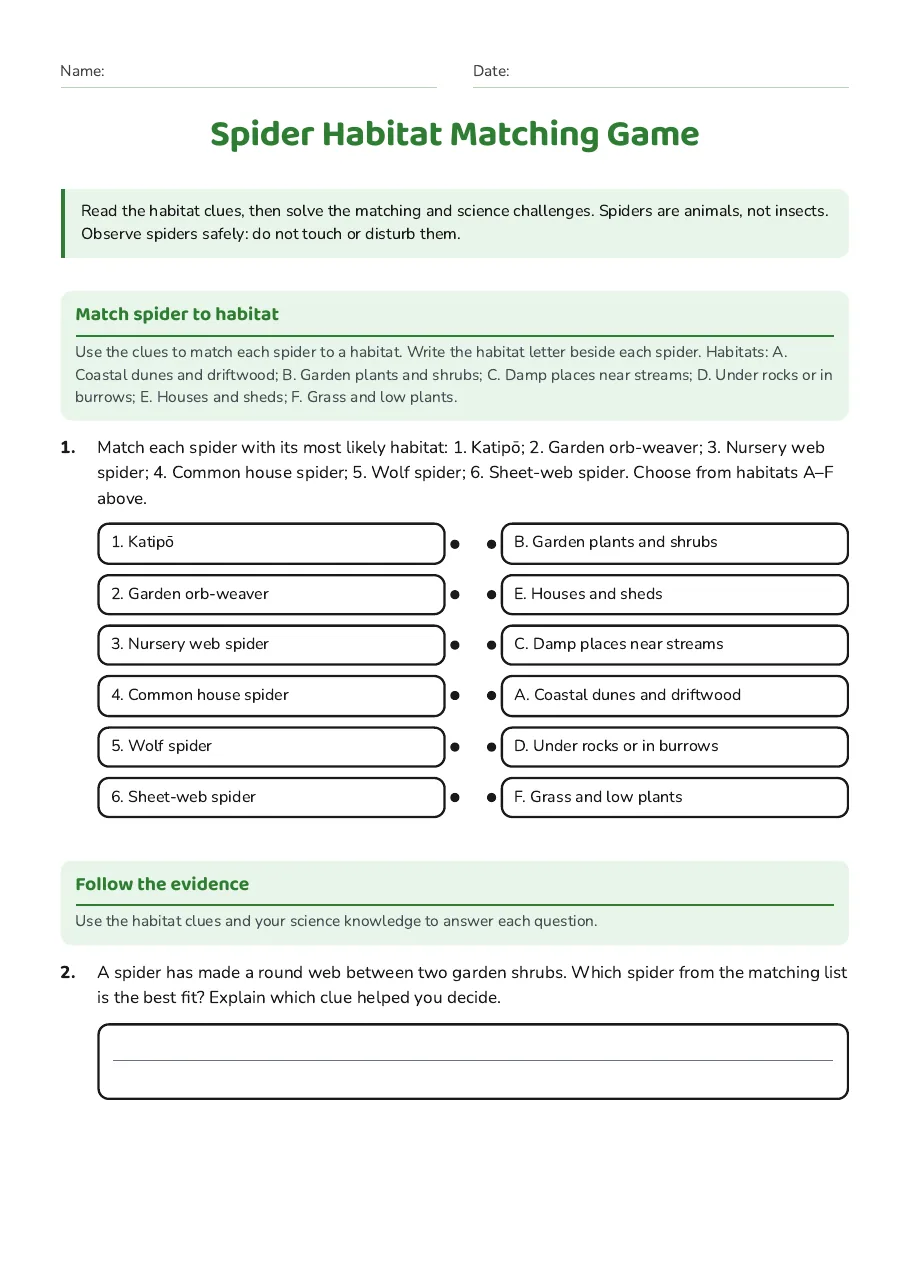
Spider Habitat Matching Game

A free science worksheet ready for your classroom. Open in Kuraplan to grab the print-ready PDF, customize it for your students, or generate a fresh version in seconds.
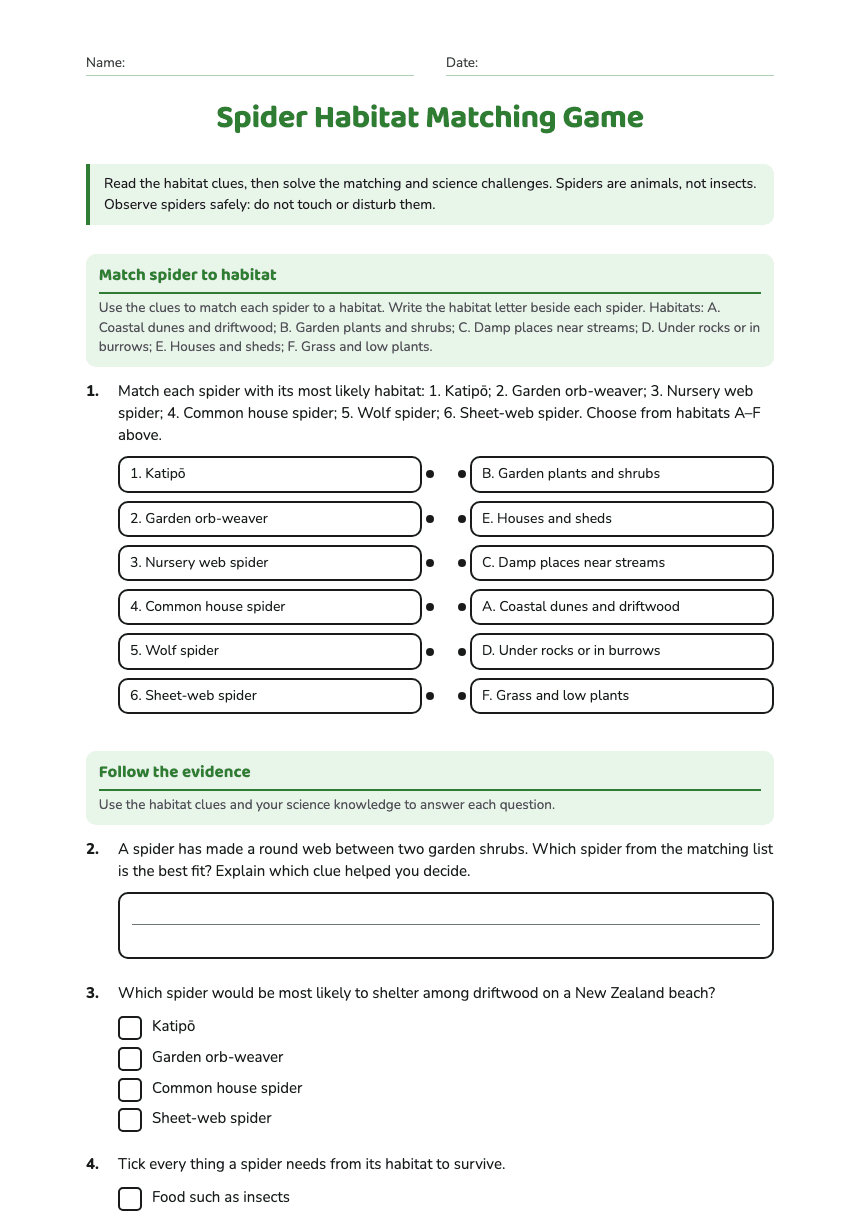
Spider Habitat Matching Game worksheet preview
Name:Date:

Spider Habitat Matching Game

Read the habitat clues, then solve the matching and science challenges. Spiders are animals, not insects. Observe spiders safely: do not touch or disturb them.

Match spider to habitat

Use the clues to match each spider to a habitat. Write the habitat letter beside each spider. Habitats: A. Coastal dunes and driftwood; B. Garden plants and shrubs; C. Damp places near streams; D. Under rocks or in burrows; E. Houses and sheds; F. Grass and low plants.

1.Match each spider with its most likely habitat: 1. Katipō; 2. Garden orb-weaver; 3. Nursery web spider; 4. Common house spider; 5. Wolf spider; 6. Sheet-web spider. Choose from habitats A–F above.
  • 1. Katipō
  • 2. Garden orb-weaver
  • 3. Nursery web spider
  • 4. Common house spider
  • 5. Wolf spider
  • 6. Sheet-web spider
  • B. Garden plants and shrubs
  • E. Houses and sheds
  • C. Damp places near streams
  • A. Coastal dunes and driftwood
  • D. Under rocks or in burrows
  • F. Grass and low plants

Follow the evidence

Use the habitat clues and your science knowledge to answer each question.

2.A spider has made a round web between two garden shrubs. Which spider from the matching list is the best fit? Explain which clue helped you decide.
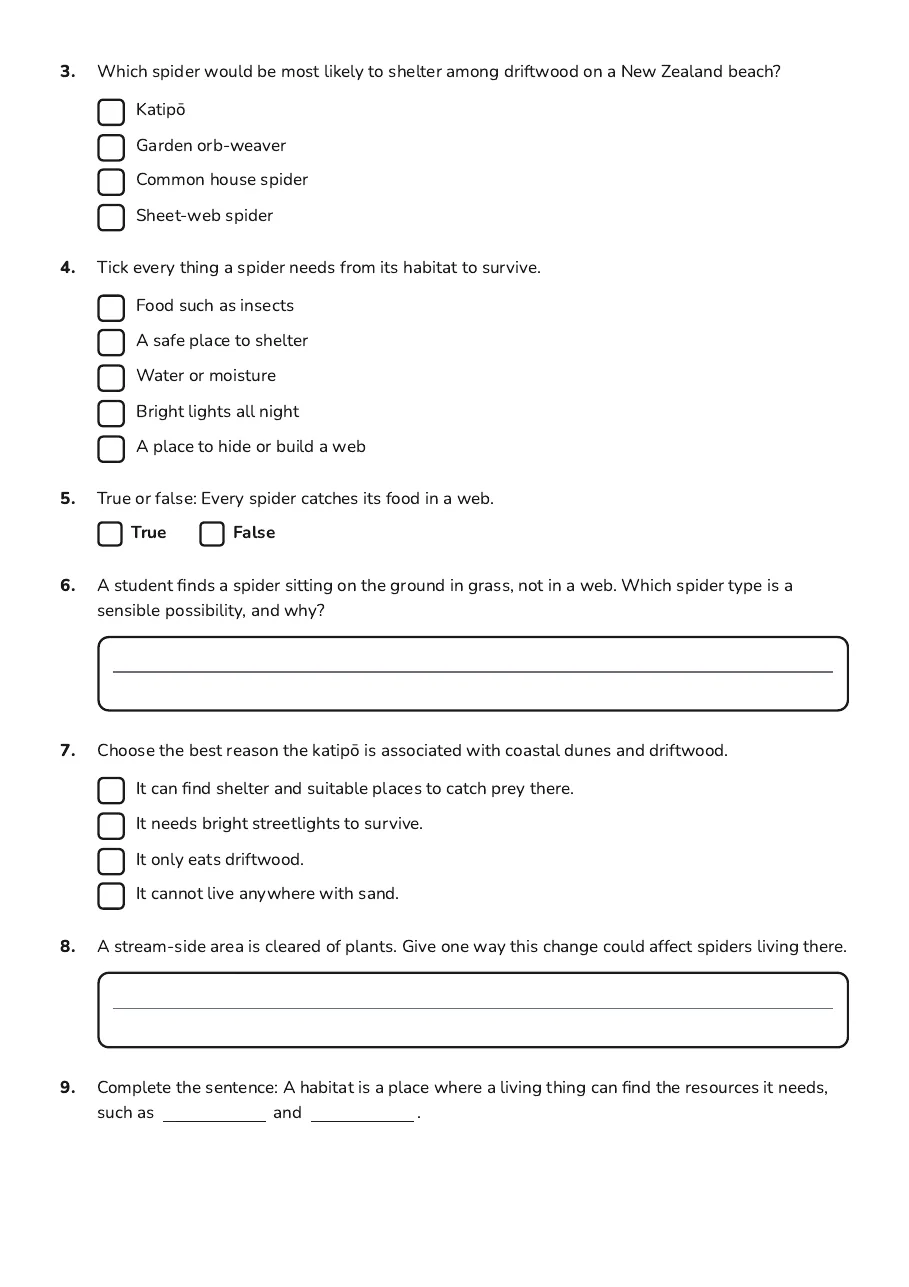
3.Which spider would be most likely to shelter among driftwood on a New Zealand beach?
  • Katipō
  • Garden orb-weaver
  • Common house spider
  • Sheet-web spider
4.Tick every thing a spider needs from its habitat to survive.
  • Food such as insects
  • A safe place to shelter
  • Water or moisture
  • Bright lights all night
  • A place to hide or build a web
5.True or false: Every spider catches its food in a web.
TrueFalse
6.A student finds a spider sitting on the ground in grass, not in a web. Which spider type is a sensible possibility, and why?
7.Choose the best reason the katipō is associated with coastal dunes and driftwood.
  • It can find shelter and suitable places to catch prey there.
  • It needs bright streetlights to survive.
  • It only eats driftwood.
  • It cannot live anywhere with sand.
8.A stream-side area is cleared of plants. Give one way this change could affect spiders living there.
9.Complete the sentence: A habitat is a place where a living thing can find the resources it needs, such as and .
10.Imagine you are planning a small wildlife-friendly garden in Aotearoa New Zealand. Name two features that could provide useful spider habitat, and explain one benefit of leaving spiders undisturbed.

3 printable pages

  • Spider Habitat Matching Game, page 1 of 3: Match spider to habitat, Follow the evidence

    Page 1

  • Spider Habitat Matching Game, page 2 of 3: 3. Which spider would be most likely to shelter among driftwood on a New Zealand beach?

    Page 2

  • Spider Habitat Matching Game, page 3 of 3: 10. Imagine you are planning a small wildlife-friendly garden in Aotearoa New Zealand.…

    Page 3

About This Worksheet

Free in Kuraplan

Sign up free, grab the PDF, and customize it for your class.

Print-Ready

Formatted for standard paper. Clean layout, easy to read.

AI-Generated

Created with Kuraplan's AI, designed for real classroom use.

For Teachers & Parents

Use in classrooms, for homework, tutoring, or homeschool.

Need a custom version of this worksheet?

Kuraplan's AI generates custom worksheets in seconds — differentiated for every learner, aligned to your curriculum.

Generate Custom Worksheets — Free
No credit card Curriculum-aligned Under 60 seconds