EnglishFreePrintable

Story Starter Steps Checklist

A free english worksheet ready for your classroom. Open in Kuraplan to grab the print-ready PDF, customize it for your students, or generate a fresh version in seconds.
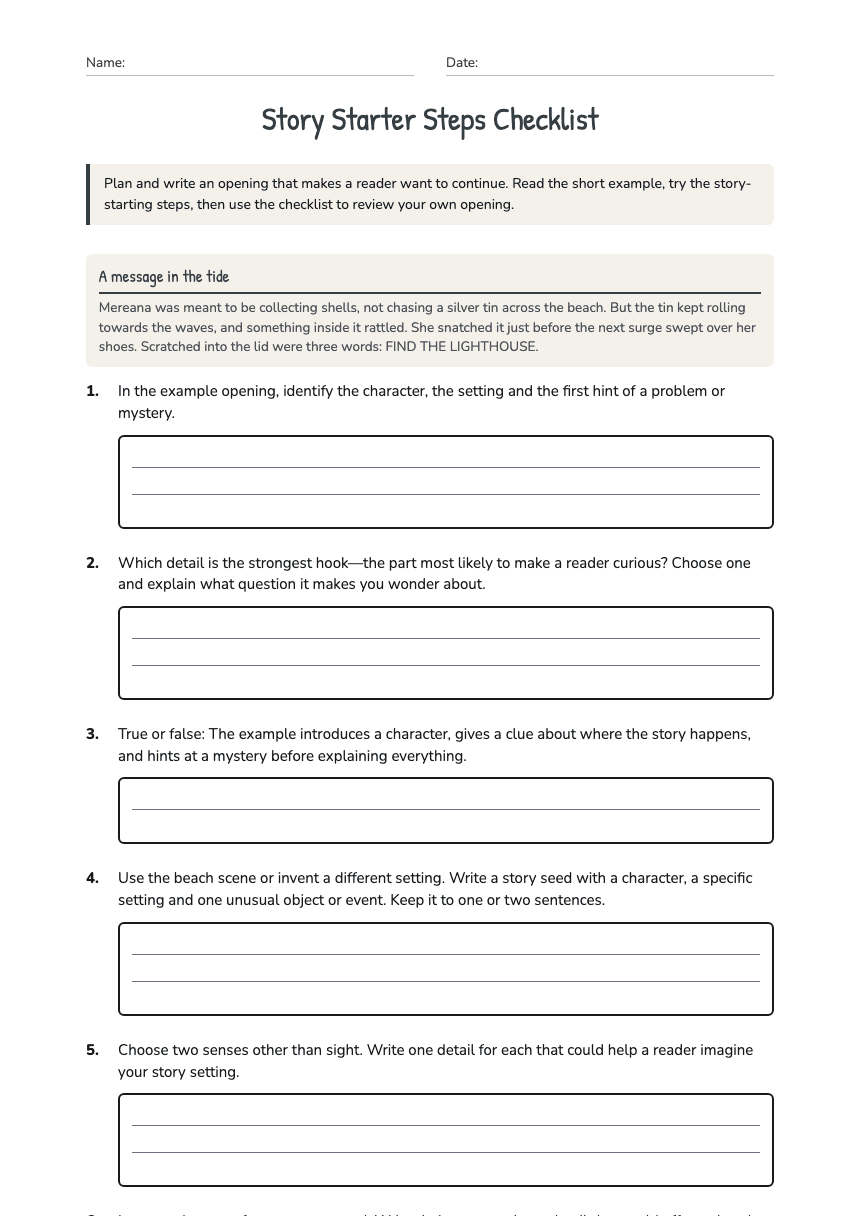
Story Starter Steps Checklist worksheet preview
Name:Date:

Story Starter Steps Checklist

Plan and write an opening that makes a reader want to continue. Read the short example, try the story-starting steps, then use the checklist to review your own opening.

A message in the tide

Mereana was meant to be collecting shells, not chasing a silver tin across the beach. But the tin kept rolling towards the waves, and something inside it rattled. She snatched it just before the next surge swept over her shoes. Scratched into the lid were three words: FIND THE LIGHTHOUSE.

1.In the example opening, identify the character, the setting and the first hint of a problem or mystery.
2.Which detail is the strongest hook—the part most likely to make a reader curious? Choose one and explain what question it makes you wonder about.
3.True or false: The example introduces a character, gives a clue about where the story happens, and hints at a mystery before explaining everything.
4.Use the beach scene or invent a different setting. Write a story seed with a character, a specific setting and one unusual object or event. Keep it to one or two sentences.
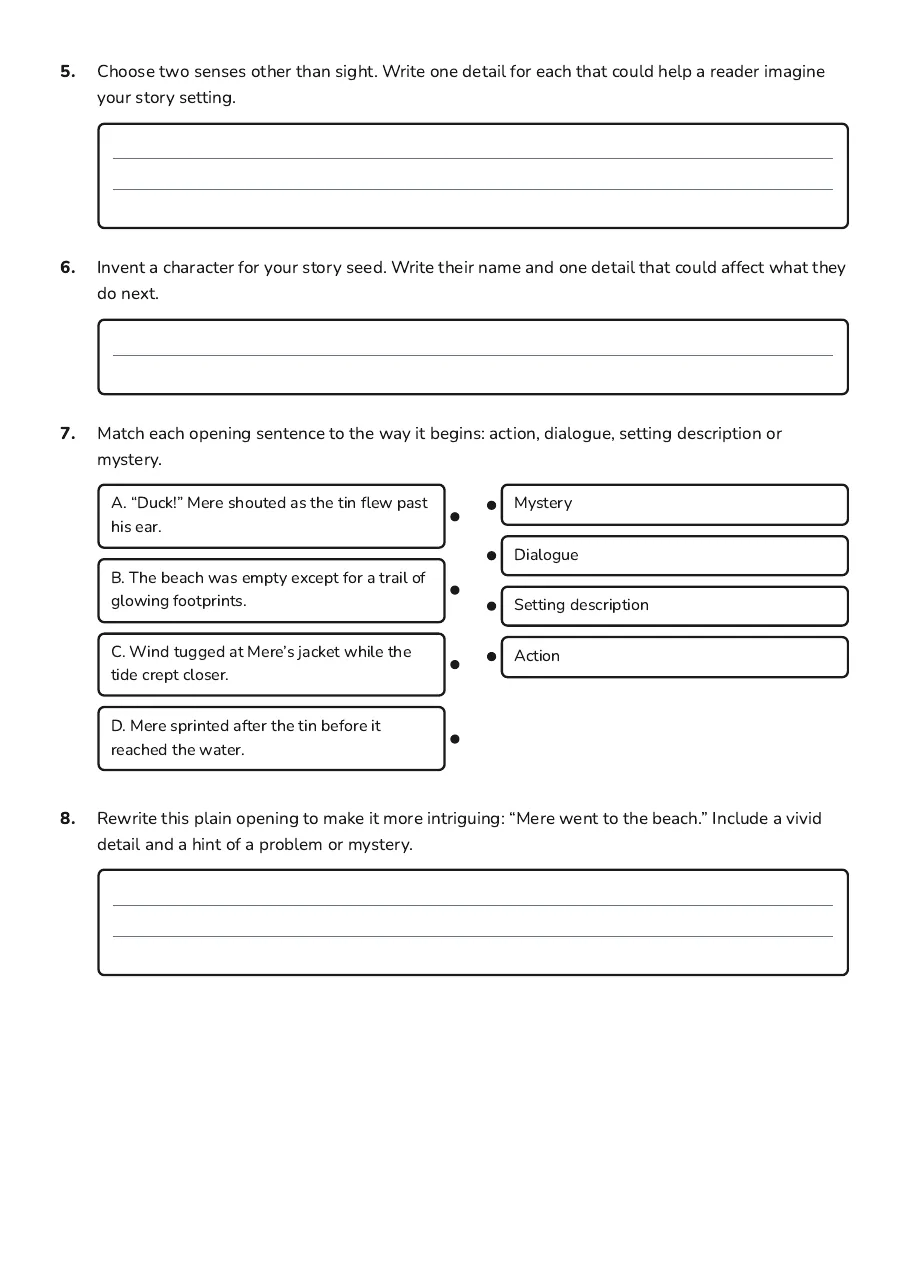
5.Choose two senses other than sight. Write one detail for each that could help a reader imagine your story setting.
6.Invent a character for your story seed. Write their name and one detail that could affect what they do next.
7.Match each opening sentence to the way it begins: action, dialogue, setting description or mystery.
  • A. “Duck!” Mere shouted as the tin flew past his ear.
  • B. The beach was empty except for a trail of glowing footprints.
  • C. Wind tugged at Mere’s jacket while the tide crept closer.
  • D. Mere sprinted after the tin before it reached the water.
  • Mystery
  • Dialogue
  • Setting description
  • Action
8.Rewrite this plain opening to make it more intriguing: “Mere went to the beach.” Include a vivid detail and a hint of a problem or mystery.
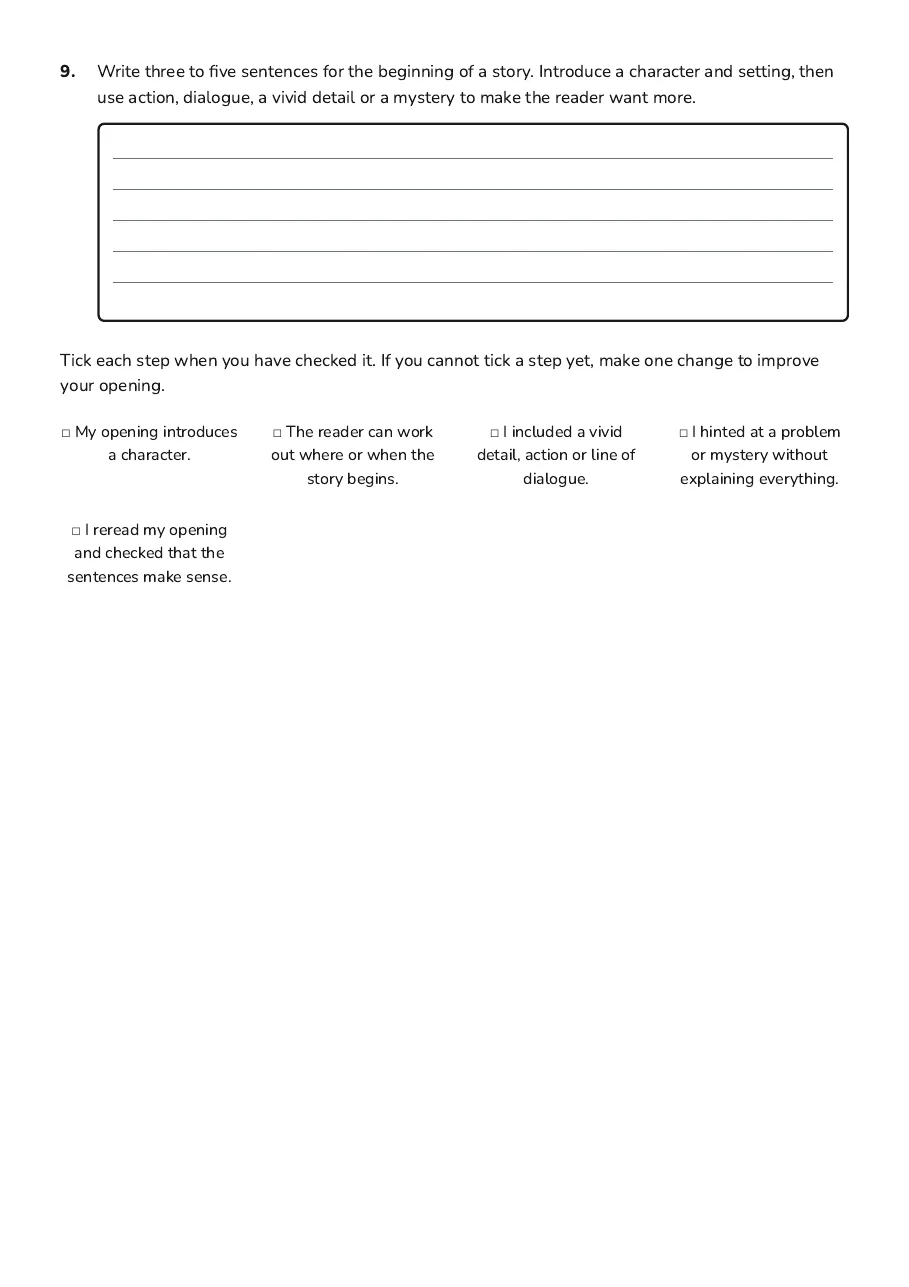
9.Write three to five sentences for the beginning of a story. Introduce a character and setting, then use action, dialogue, a vivid detail or a mystery to make the reader want more.
Tick each step when you have checked it. If you cannot tick a step yet, make one change to improve your opening.

□ My opening introduces a character.

□ The reader can work out where or when the story begins.

□ I included a vivid detail, action or line of dialogue.

□ I hinted at a problem or mystery without explaining everything.

□ I reread my opening and checked that the sentences make sense.

3 printable pages
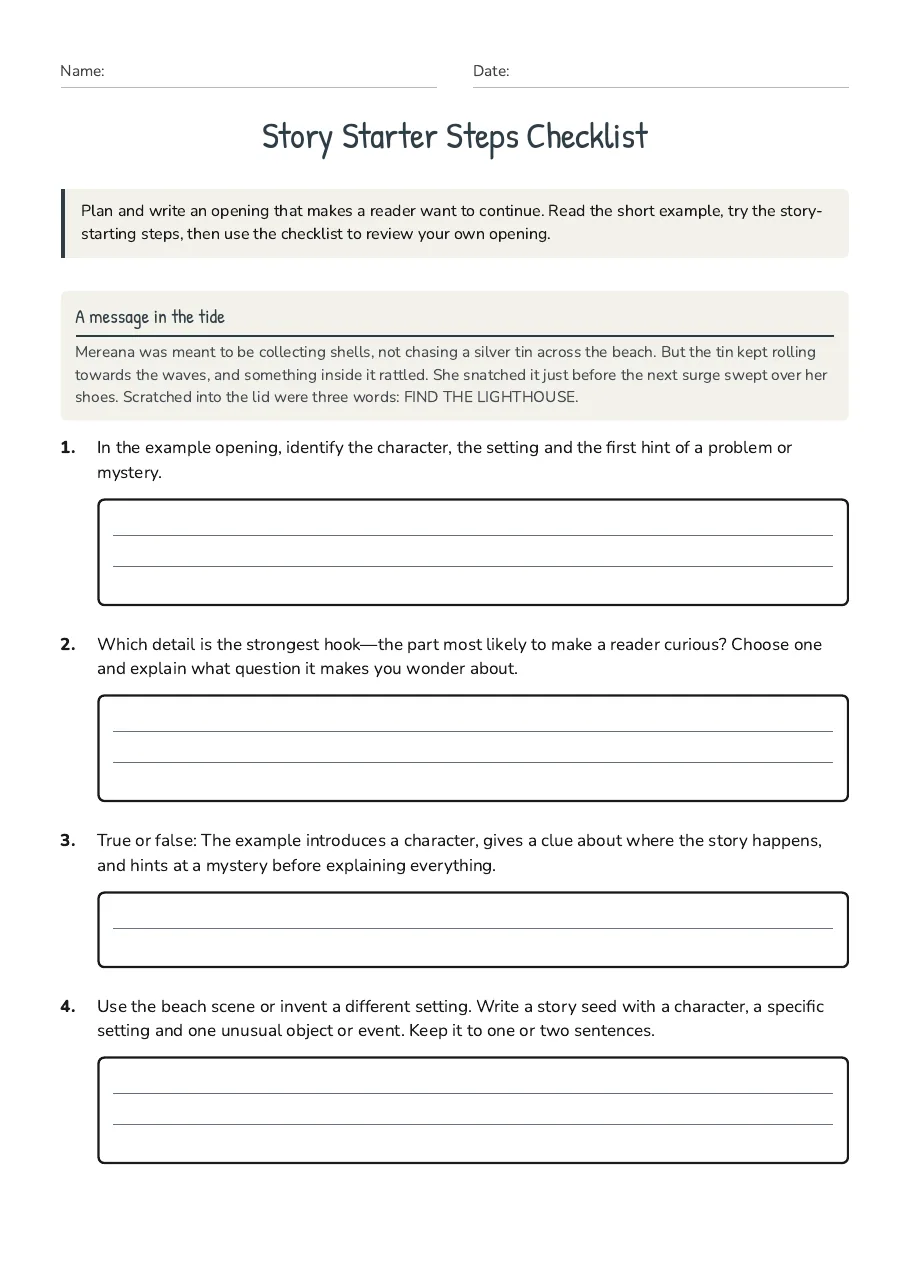
  • Story Starter Steps Checklist, page 1 of 3: A message in the tide

    Page 1

  • Story Starter Steps Checklist, page 2 of 3: 5. Choose two senses other than sight. Write one detail for each that could help a reader…

    Page 2

  • Story Starter Steps Checklist, page 3 of 3: 9. Write three to five sentences for the beginning of a story. Introduce a character and…

    Page 3

About This Worksheet

Free in Kuraplan

Sign up free, grab the PDF, and customize it for your class.

Print-Ready

Formatted for standard paper. Clean layout, easy to read.

AI-Generated

Created with Kuraplan's AI, designed for real classroom use.

For Teachers & Parents

Use in classrooms, for homework, tutoring, or homeschool.

Need a custom version of this worksheet?

Kuraplan's AI generates custom worksheets in seconds — differentiated for every learner, aligned to your curriculum.

Generate Custom Worksheets — Free
No credit card Curriculum-aligned Under 60 seconds