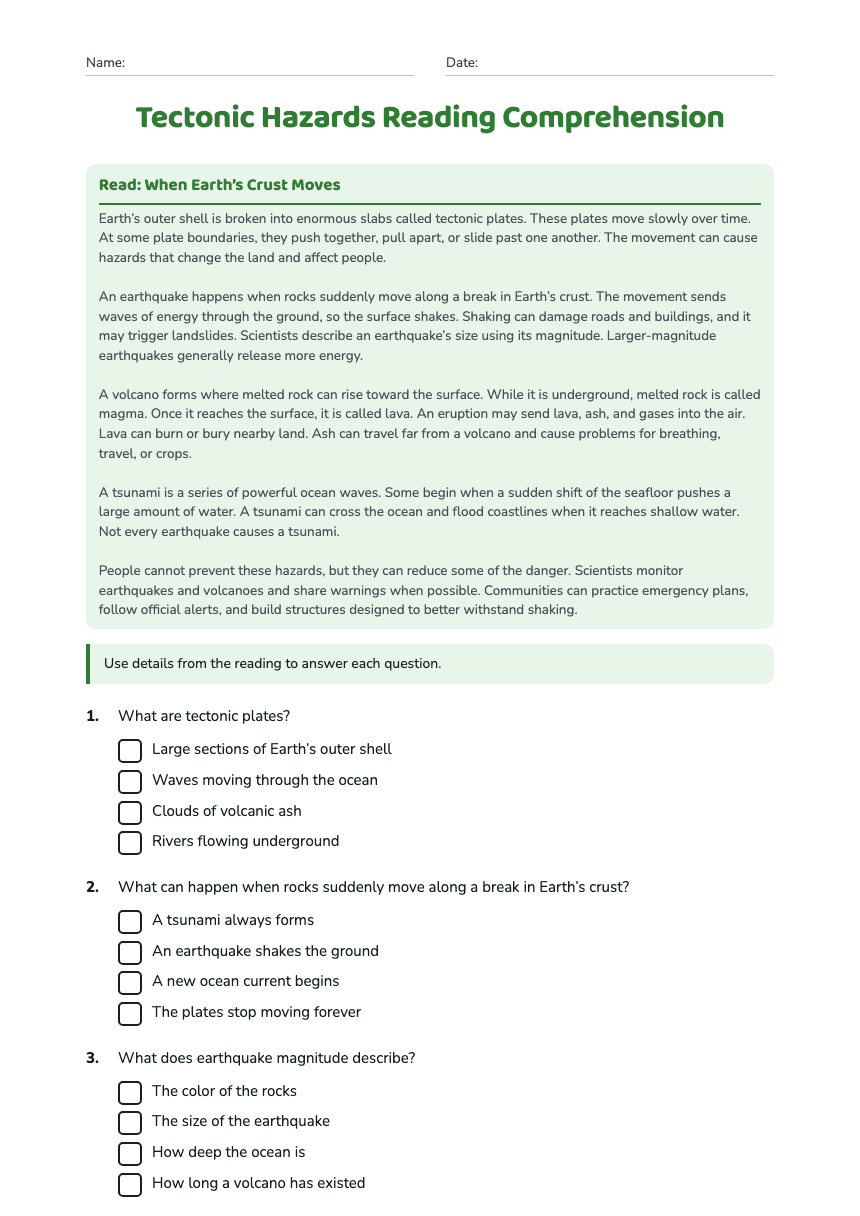
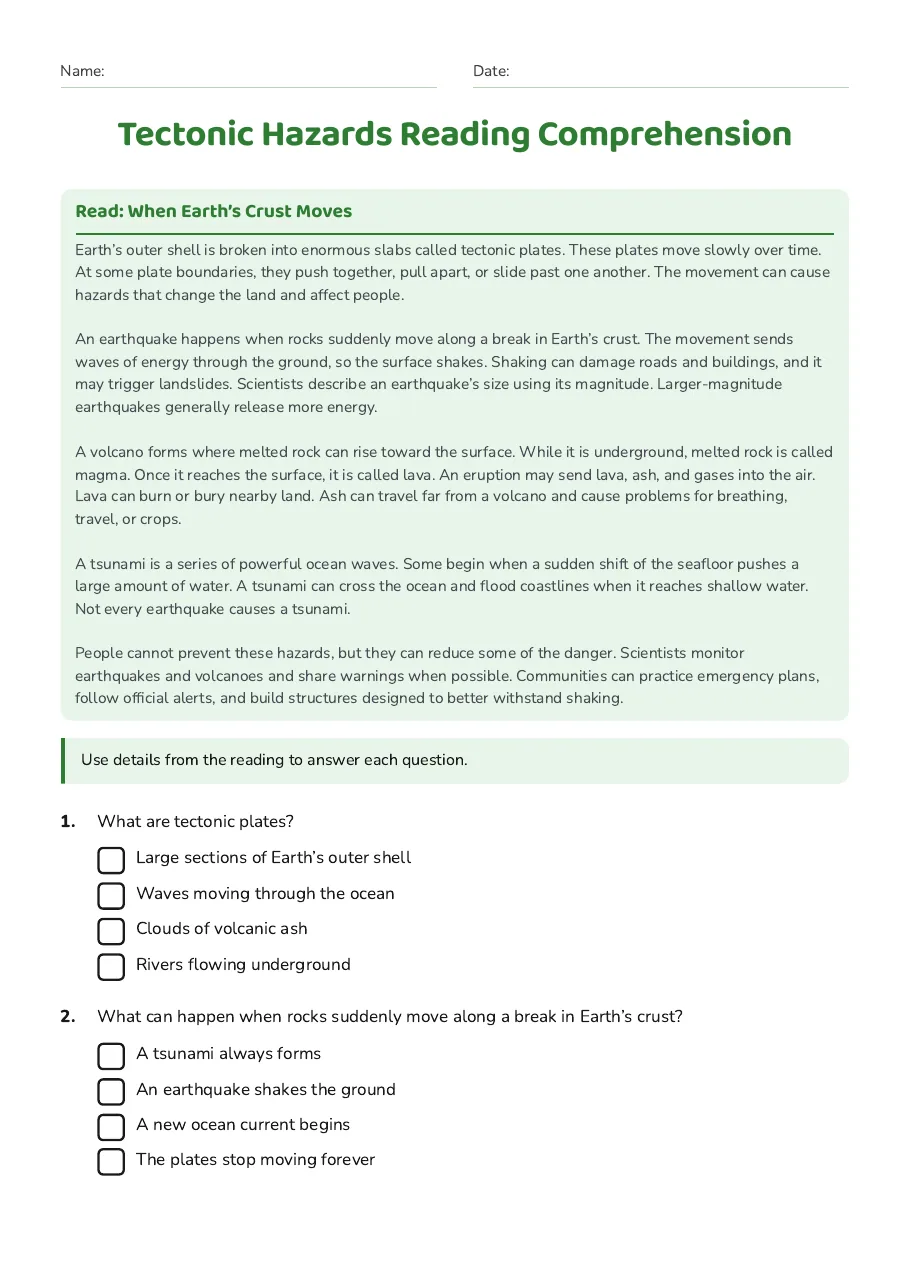
Tectonic Hazards Reading Comprehension
A free science worksheet ready for your classroom. Open in Kuraplan to grab the print-ready PDF, customize it for your students, or generate a fresh version in seconds.
Tectonic Hazards Reading Comprehension
Read: When Earth’s Crust Moves
Earth’s outer shell is broken into enormous slabs called tectonic plates. These plates move slowly over time. At some plate boundaries, they push together, pull apart, or slide past one another. The movement can cause hazards that change the land and affect people. An earthquake happens when rocks suddenly move along a break in Earth’s crust. The movement sends waves of energy through the ground, so the surface shakes. Shaking can damage roads and buildings, and it may trigger landslides. Scientists describe an earthquake’s size using its magnitude. Larger-magnitude earthquakes generally release more energy. A volcano forms where melted rock can rise toward the surface. While it is underground, melted rock is called magma. Once it reaches the surface, it is called lava. An eruption may send lava, ash, and gases into the air. Lava can burn or bury nearby land. Ash can travel far from a volcano and cause problems for breathing, travel, or crops. A tsunami is a series of powerful ocean waves. Some begin when a sudden shift of the seafloor pushes a large amount of water. A tsunami can cross the ocean and flood coastlines when it reaches shallow water. Not every earthquake causes a tsunami. People cannot prevent these hazards, but they can reduce some of the danger. Scientists monitor earthquakes and volcanoes and share warnings when possible. Communities can practice emergency plans, follow official alerts, and build structures designed to better withstand shaking.
- Large sections of Earth’s outer shell
- Waves moving through the ocean
- Clouds of volcanic ash
- Rivers flowing underground
- A tsunami always forms
- An earthquake shakes the ground
- A new ocean current begins
- The plates stop moving forever
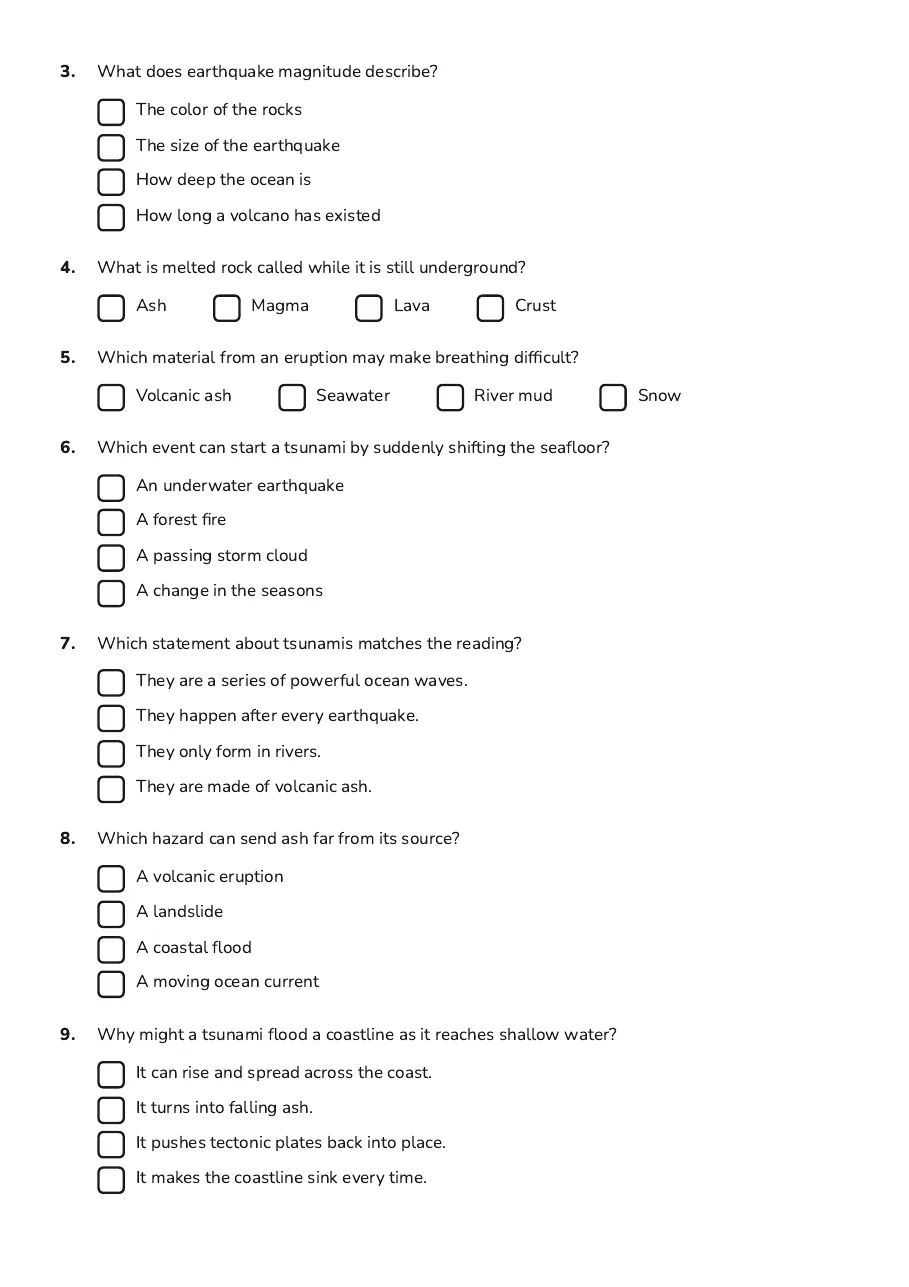
- The color of the rocks
- The size of the earthquake
- How deep the ocean is
- How long a volcano has existed
- Ash
- Magma
- Lava
- Crust
- Volcanic ash
- Seawater
- River mud
- Snow
- An underwater earthquake
- A forest fire
- A passing storm cloud
- A change in the seasons
- They are a series of powerful ocean waves.
- They happen after every earthquake.
- They only form in rivers.
- They are made of volcanic ash.
- A volcanic eruption
- A landslide
- A coastal flood
- A moving ocean current
- It can rise and spread across the coast.
- It turns into falling ash.
- It pushes tectonic plates back into place.
- It makes the coastline sink every time.
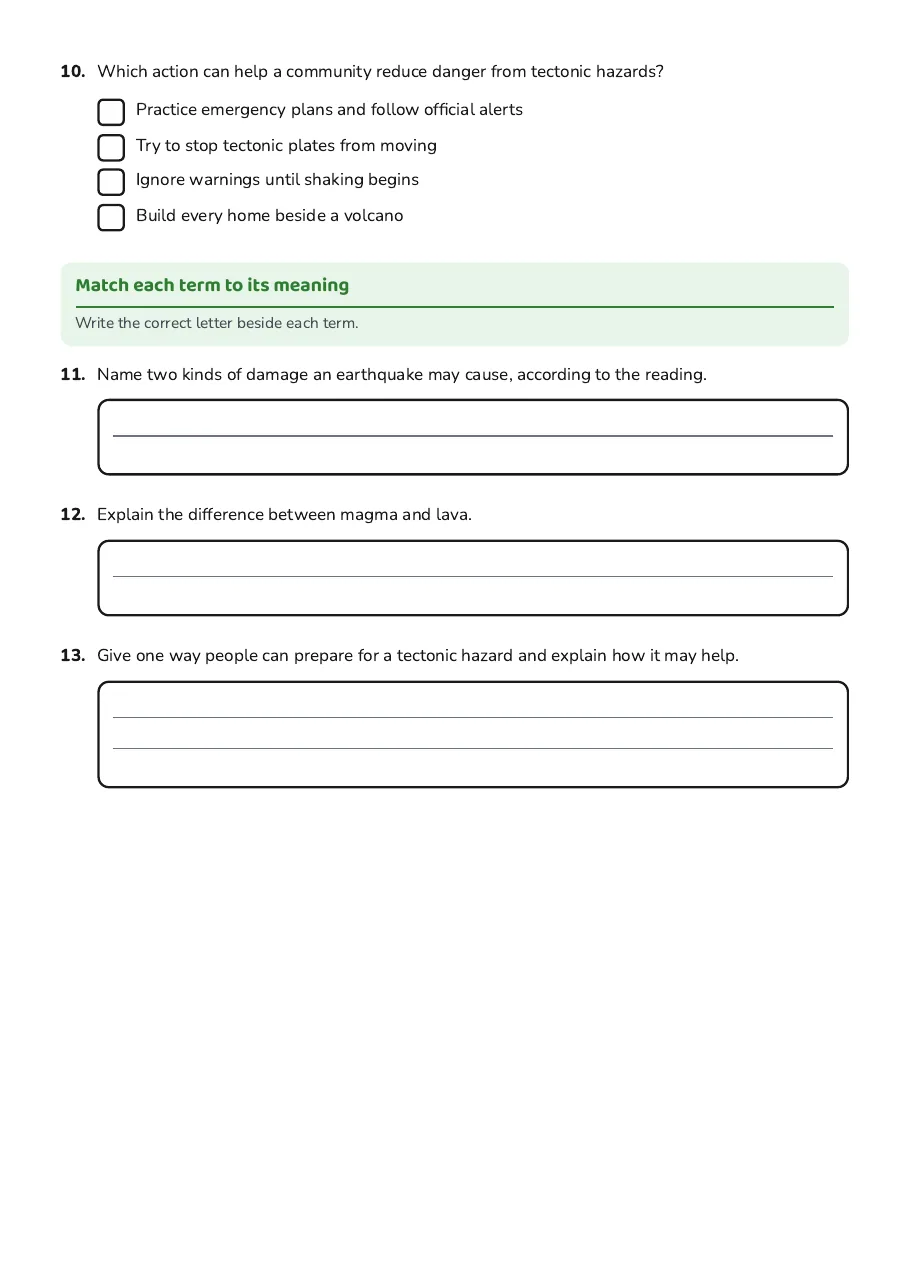
- Practice emergency plans and follow official alerts
- Try to stop tectonic plates from moving
- Ignore warnings until shaking begins
- Build every home beside a volcano
Match each term to its meaning
Write the correct letter beside each term.
3 printable pages
Page 1
Page 2
Page 3
About This Worksheet
Free in Kuraplan
Sign up free, grab the PDF, and customize it for your class.
Print-Ready
Formatted for standard paper. Clean layout, easy to read.
AI-Generated
Created with Kuraplan's AI, designed for real classroom use.
For Teachers & Parents
Use in classrooms, for homework, tutoring, or homeschool.
Need a custom version of this worksheet?
Kuraplan's AI generates custom worksheets in seconds — differentiated for every learner, aligned to your curriculum.
Generate Custom Worksheets — Free