Digestion and Nutrient Absorption
A free health worksheet ready for your classroom. Open in Kuraplan to grab the print-ready PDF, customize it for your students, or generate a fresh version in seconds.
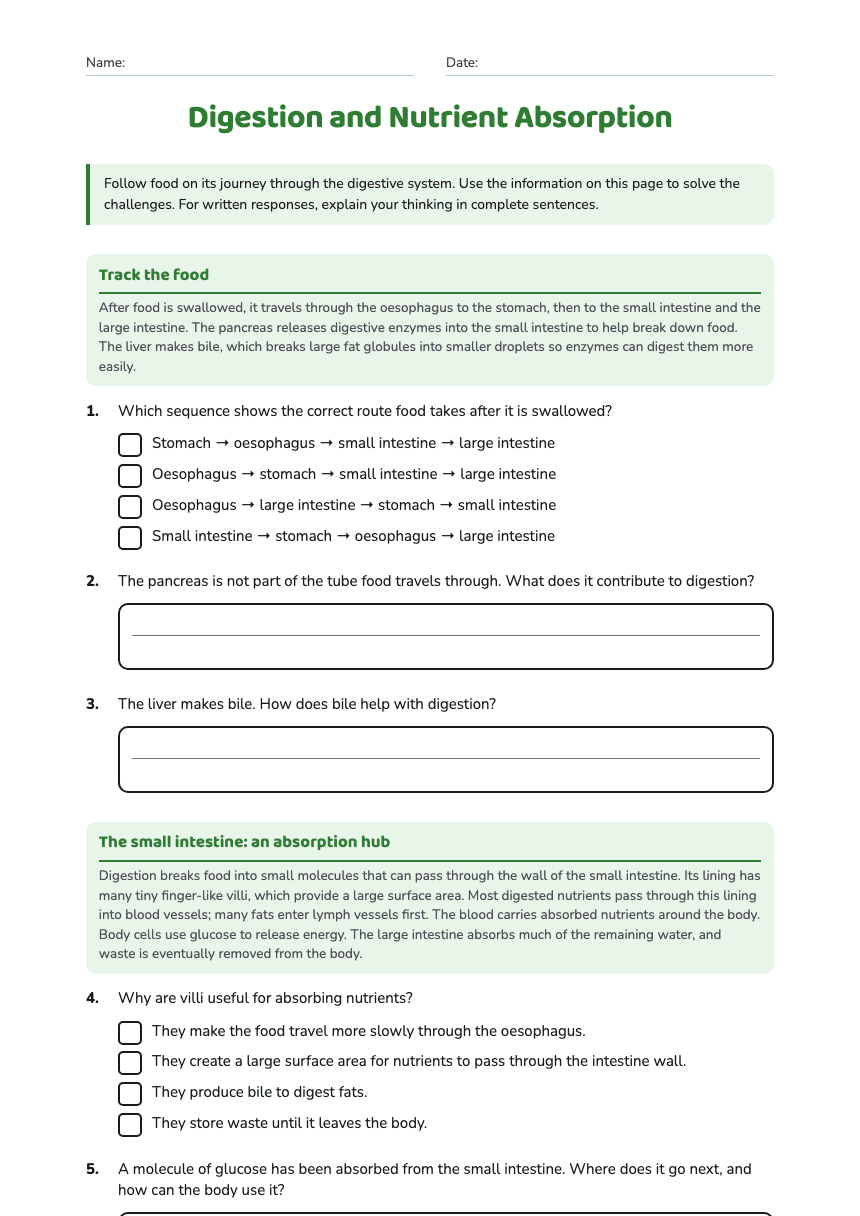
Digestion and Nutrient Absorption
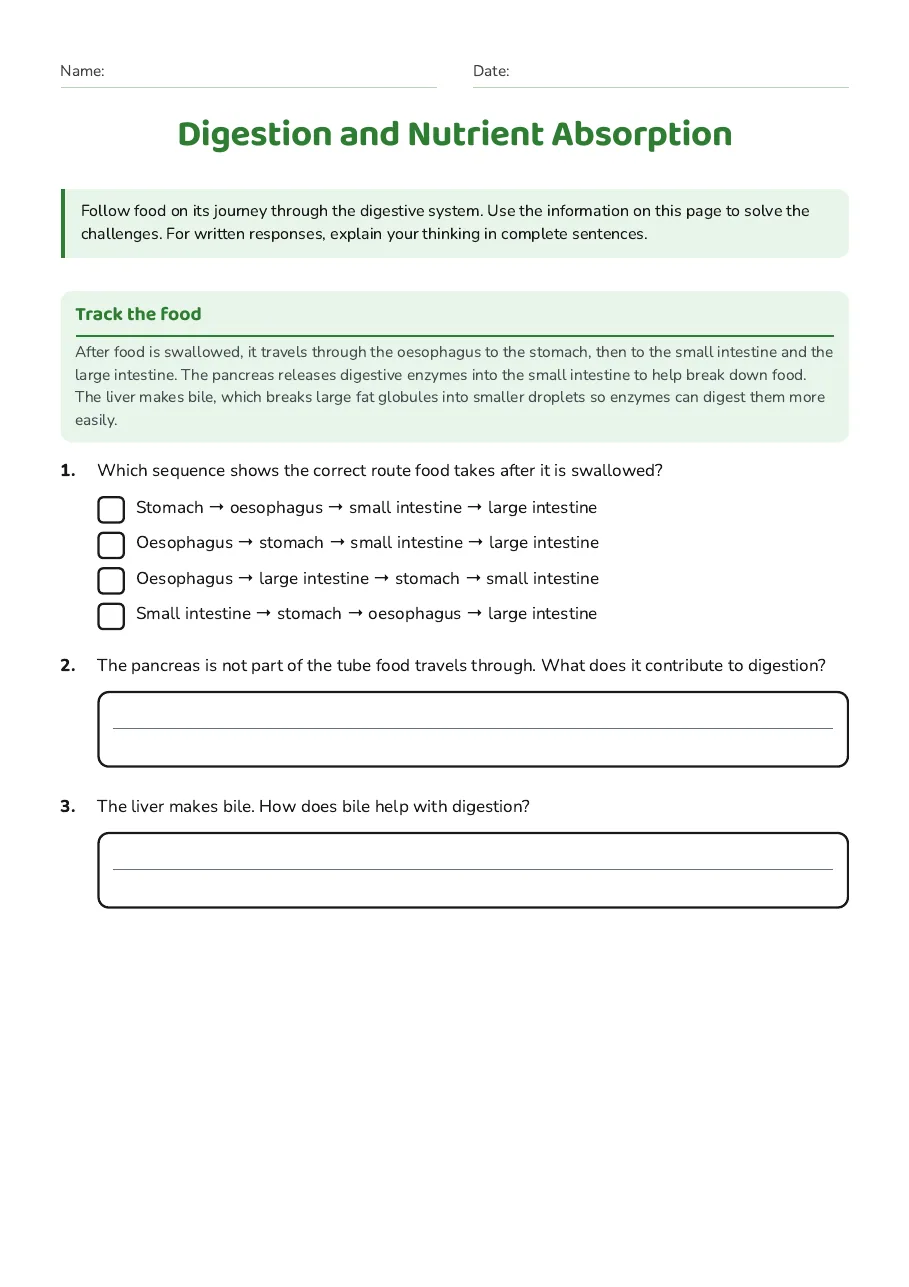
Track the food
After food is swallowed, it travels through the oesophagus to the stomach, then to the small intestine and the large intestine. The pancreas releases digestive enzymes into the small intestine to help break down food. The liver makes bile, which breaks large fat globules into smaller droplets so enzymes can digest them more easily.
- Stomach → oesophagus → small intestine → large intestine
- Oesophagus → stomach → small intestine → large intestine
- Oesophagus → large intestine → stomach → small intestine
- Small intestine → stomach → oesophagus → large intestine
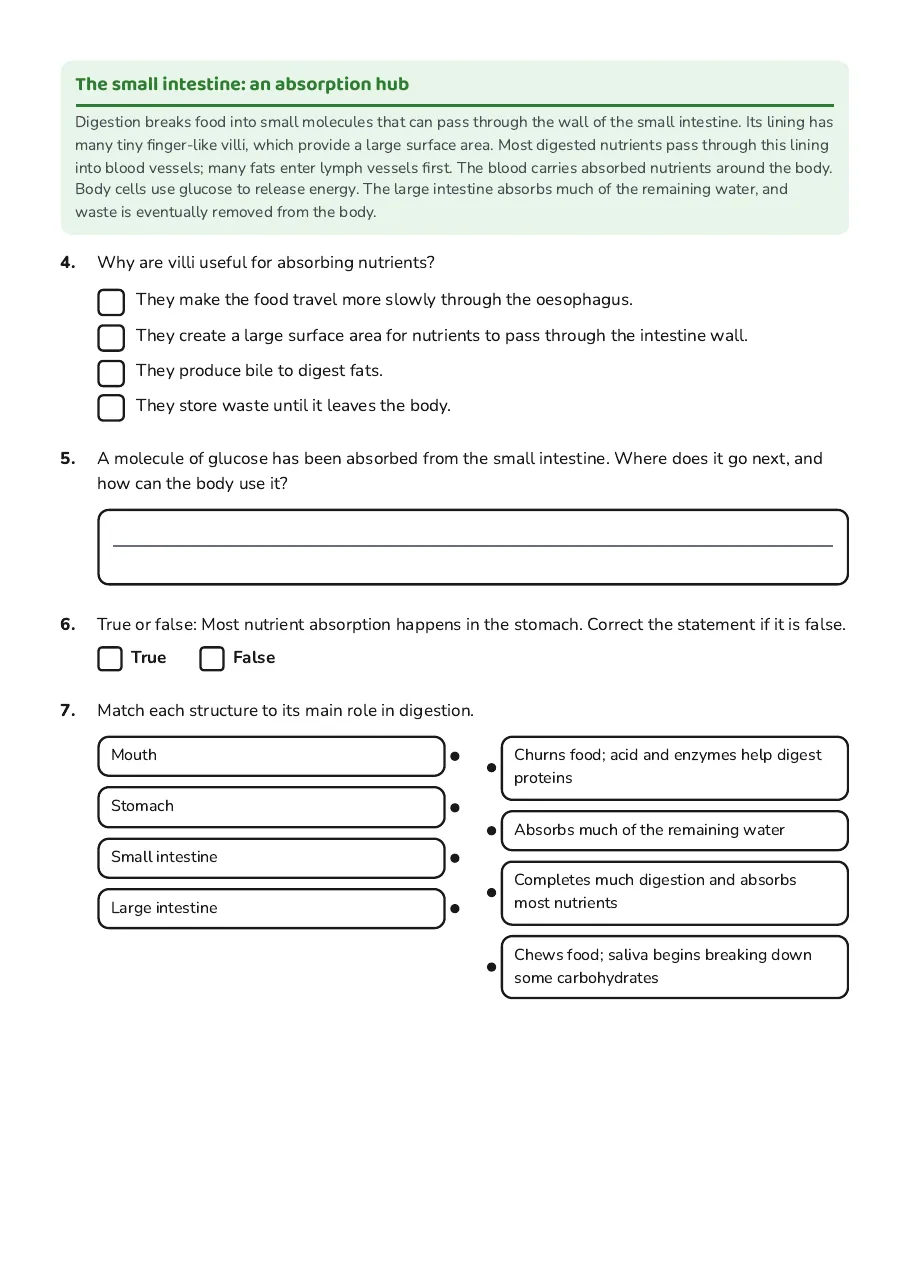
The small intestine: an absorption hub
Digestion breaks food into small molecules that can pass through the wall of the small intestine. Its lining has many tiny finger-like villi, which provide a large surface area. Most digested nutrients pass through this lining into blood vessels; many fats enter lymph vessels first. The blood carries absorbed nutrients around the body. Body cells use glucose to release energy. The large intestine absorbs much of the remaining water, and waste is eventually removed from the body.
- They make the food travel more slowly through the oesophagus.
- They create a large surface area for nutrients to pass through the intestine wall.
- They produce bile to digest fats.
- They store waste until it leaves the body.
- Mouth
- Stomach
- Small intestine
- Large intestine
- Churns food; acid and enzymes help digest proteins
- Absorbs much of the remaining water
- Completes much digestion and absorbs most nutrients
- Chews food; saliva begins breaking down some carbohydrates
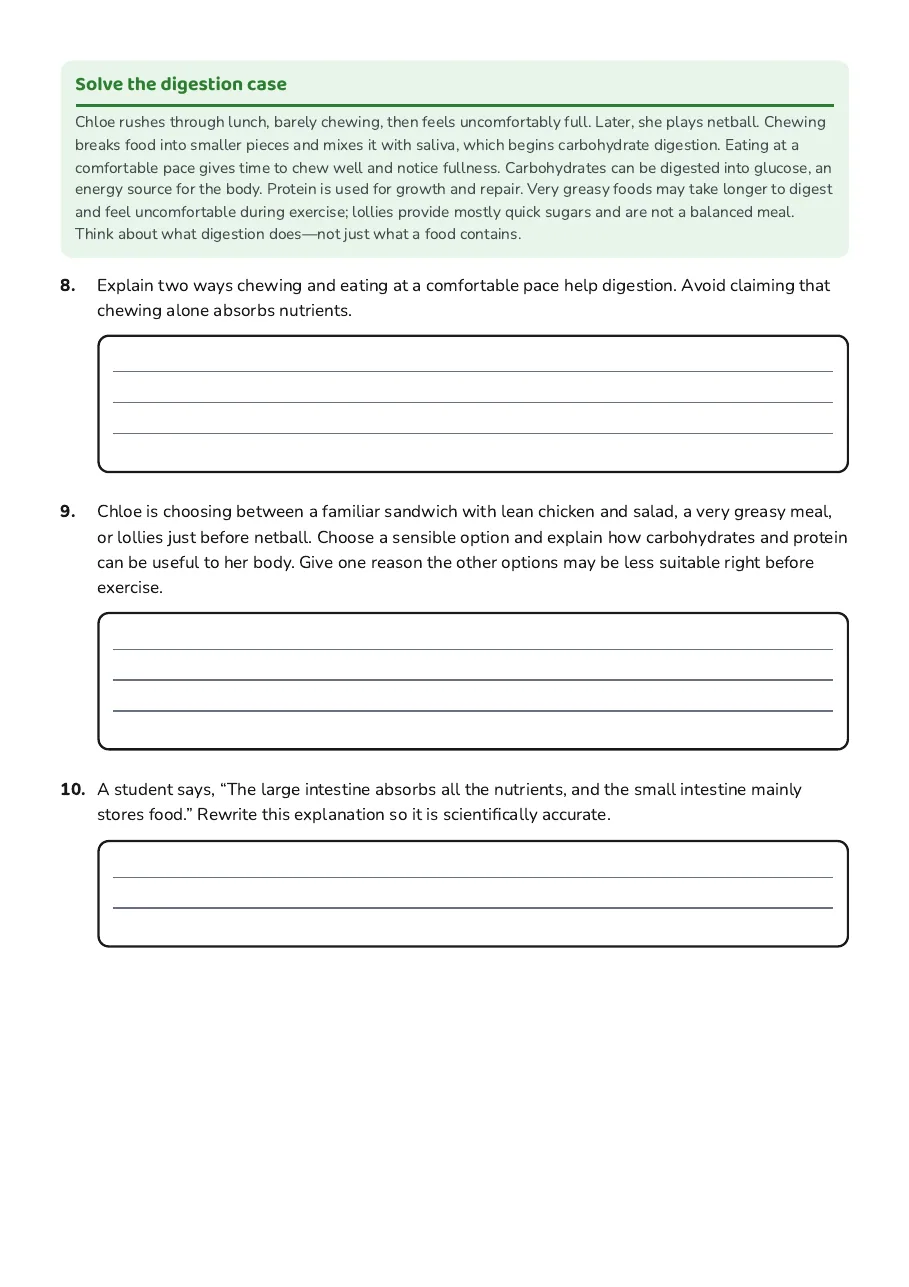
Solve the digestion case
Chloe rushes through lunch, barely chewing, then feels uncomfortably full. Later, she plays netball. Chewing breaks food into smaller pieces and mixes it with saliva, which begins carbohydrate digestion. Eating at a comfortable pace gives time to chew well and notice fullness. Carbohydrates can be digested into glucose, an energy source for the body. Protein is used for growth and repair. Very greasy foods may take longer to digest and feel uncomfortable during exercise; lollies provide mostly quick sugars and are not a balanced meal. Think about what digestion does—not just what a food contains.
3 printable pages
Page 1
Page 2
Page 3
About This Worksheet
Free in Kuraplan
Sign up free, grab the PDF, and customize it for your class.
Print-Ready
Formatted for standard paper. Clean layout, easy to read.
AI-Generated
Created with Kuraplan's AI, designed for real classroom use.
For Teachers & Parents
Use in classrooms, for homework, tutoring, or homeschool.
Need a custom version of this worksheet?
Kuraplan's AI generates custom worksheets in seconds — differentiated for every learner, aligned to your curriculum.
Generate Custom Worksheets — Free