You're holding the Common Core document in one hand, your pacing guide in the other, and a student's unfinished subtraction problem is sitting between them. The standards mention place value, fluency, measurement, geometry, word problems, and explanations, while your class includes children who are ready for enrichment, children who still count every object, multilingual learners, and students who need accessible ways to show their thinking.
The challenge isn't finding another list of standards. It's identifying the specific prerequisite gap behind a mistake, then providing a scaffold that keeps the child working on grade-level mathematics. This guide treats Common Core math 2nd grade as an instructional progression, connecting each expectation to diagnostic evidence, concrete representations, language supports, and practical next steps.
Why 2nd Grade Math Standards Feel Overwhelming And How To Tackle Them
A new teacher once described opening the Grade 2 standards PDF after dismissal. She expected a short checklist. Instead, she found dense language about base-ten units, unknowns in every position, standard measurement, equal shares, and mathematical explanations. Her immediate question was, “How can I teach all of this before the year ends?”
The answer begins with a change in perspective. The standards aren't a collection of unrelated tasks. They form an architecture: place value supports computation, computation supports problem solving, measurement gives those operations a meaningful context, and geometry introduces structure and equal shares.
The Common Core State Standards for Mathematics were released on June 2, 2010. By December 2013, 45 states, the District of Columbia, four U.S. territories, and the Department of Defense Education Activity had adopted the mathematics standards, according to the Common Core development history. That broad adoption explains why teachers often recognize the same major expectations, even though states and districts still control materials, pacing, assessments, and later revisions.
Practical rule: Read each standard twice. First, identify the mathematical idea. Then identify what a child must show, say, draw, or explain.
Start planning with a simple unpacking routine. Write the standard, name the prerequisite skill, choose a representation, and decide what evidence will convince you that the student understands. A structured lesson plan template can help keep those decisions visible instead of burying them in a long standards document.
The Four Critical Areas That Define 2nd Grade Mathematics
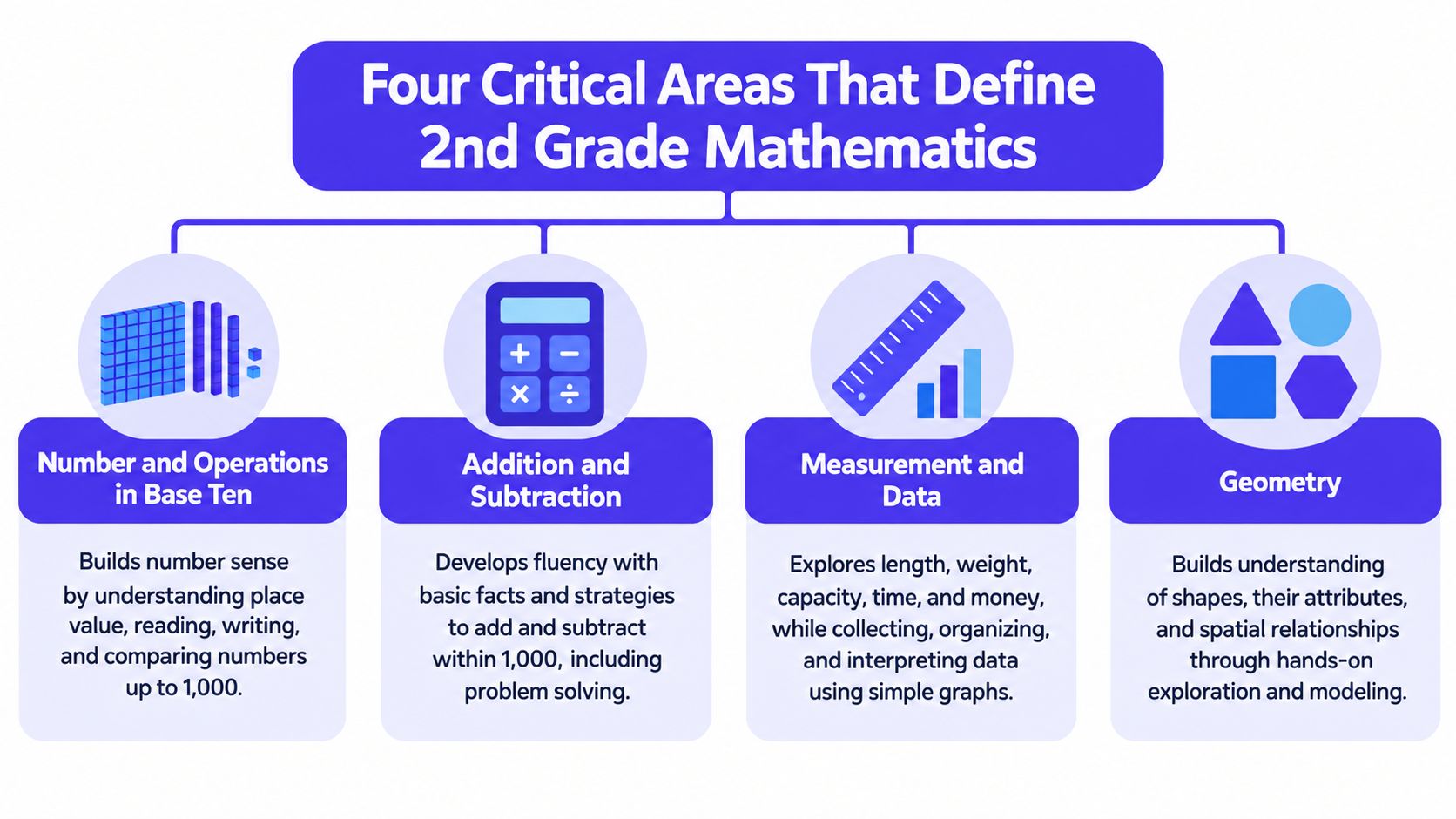
The Grade 2 standards concentrate instructional time in four critical areas:
- Extending base-ten notation
- Developing addition and subtraction fluency
- Measuring with standard units
- Describing and analyzing shapes
The Grade 2 mathematics standards define these priorities and specify that students represent and compare numbers to 1,000, count by 5s, 10s, and 100s, and use place-value concepts to add and subtract within 1,000.
These areas create a progression from Grade 1 work with smaller numbers toward Grade 3 expectations involving multiplication, division, and more advanced place-value reasoning. A child who understands that 347 means three hundreds, four tens, and seven ones has a foundation for decomposing quantities later. A child who can reason about equal shares is beginning to build ideas that will matter for multiplication and division.
The four areas also interact during ordinary lessons. A measurement comparison may require subtraction. A shape task may involve partitioning a rectangle into equal shares. A place-value discussion may lead students to explain why adding a ten changes the tens digit but not the ones digit.
Teachers should resist giving every standard equal time on every day. Instead, protect the central ideas and revisit connections regularly. The aim isn't to rush through isolated objectives. It's to help students build a network of ideas that makes new mathematics more understandable.
Base-Ten Notation and Operations Within 1,000
Base-ten work is where many Grade 2 misconceptions first become visible. Students represent three-digit numbers as hundreds, tens, and ones, compare numbers with symbols, count by 5s, 10s, and 100s, and add or subtract within 1,000. The Grade 2 mathematics PDF emphasizes concrete models, drawings, place-value strategies, and explanations, not procedure alone.
Begin with a quantity students can build. Give a student 347 with base-ten blocks, a place-value chart, and an empty number line. Ask:
- What does each digit represent?
- How could you trade one hundred for tens?
- Which number is greater, 347 or 374, and how do you know?
- What changes when you add 100? What stays the same?
Then move from the model to a drawing, from the drawing to an equation, and from the equation to an explanation. If a child writes the correct answer but can't connect the regrouping to a change in units, the algorithm has outrun the understanding.
A diagnostic view of operations
One- and two-step addition and subtraction problems within 100 should include unknowns in every position. A problem such as “Mia had some counters, received eight more, and now has 15” tests a different understanding from “Mia had 15 counters and gave away eight.” Ask students to model the situation, choose an operation, write an equation with a symbol for the unknown, and explain whether the answer is reasonable.
Use the following decision guide when selecting representations:
| Student need | Recommended representation | Assessment target |
|---|---|---|
| Counts by ones through a three-digit number | Bundled straws, base-ten blocks, and a place-value chart | Represents hundreds, tens, and ones and explains the value of each digit |
| Compares numbers by looking only at the ones digit | Expanded form, comparison cards, and a place-value mat | Compares from the hundreds place first and uses the correct symbol |
| Regroups mechanically without explaining the trade | Base-ten blocks, drawings, and open number lines | Connects a trade to place value and records the related equation |
| Solves facts by counting every object | Ten-frames, doubles, making-ten cards, and mental strategies | Uses an efficient strategy and explains it |
| Misreads a word problem with an unknown | Acting out, bar models, and equations with a box or symbol | Identifies the unknown position and selects the operation |
By the end of Grade 2, students are expected to know from memory all sums of two one-digit numbers and to fluently add and subtract within 20 using mental strategies. The Institute of Education Sciences mathematics guidance specifically recommends number lines to make addition and subtraction visible as movement and distance, with attention to unit length rather than just counting tick marks.
For targeted planning, place-value lesson guidance can support a sequence that keeps manipulatives, visual models, equations, and quick checks connected.
Measurement, Data, and Length Problem Solving
A ruler isn't just a tool for getting an answer. It gives students a way to understand that length is built by iterating equal-sized units.
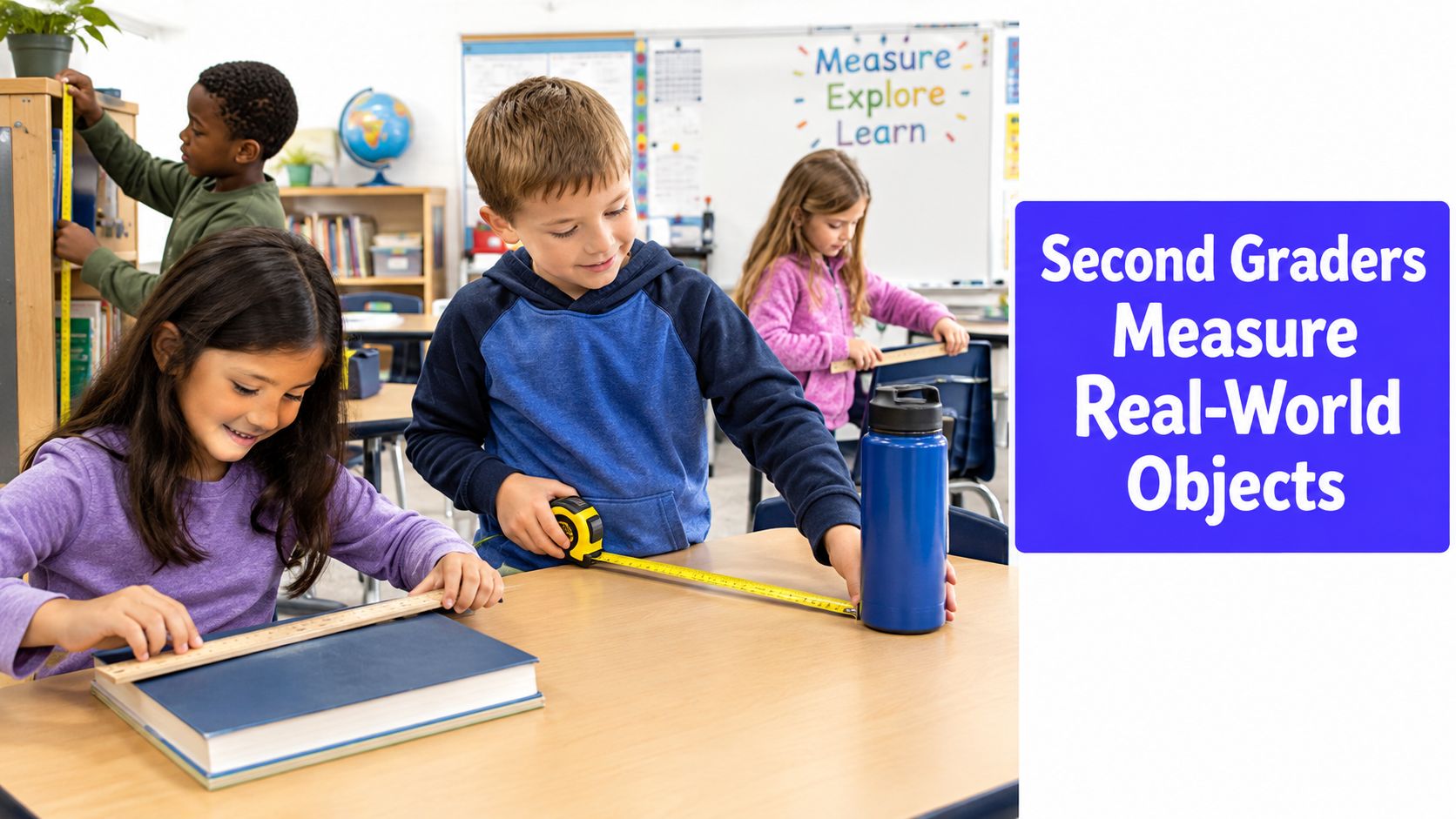
Start with estimation. Place a pencil, book, or desk strip on a table and ask students to predict its length before handing out rulers. Require them to record the tool, unit, estimate, and actual measurement. This creates a reason to discuss why a measurement is sensible rather than treating measurement as a hunt for a number.
Grade 2 students measure with inches, feet, centimeters, and meters and select tools such as rulers, yardsticks, meter sticks, and measuring tapes. The Common Core measurement introduction includes the specific expectation that students measure the same object twice with units of different sizes and describe the relationship between the results.
For example, a child might measure a table in feet and then inches. The table may measure fewer feet than inches because a foot is longer than an inch. The important learning is that the numbers differ. Students should explain that a larger unit covers more length each time it is iterated.
Turn measurement into problem solving
Give pairs several objects and ask them to find:
- Which object is longer?
- How much longer is it?
- What would the length be if the object were placed end to end with another?
- How can the measurement be represented on a number line?
Students should solve length problems represented by whole numbers on a number line, including finding how much longer one object is than another. A number line can show the distance between measurements and connect naturally to subtraction.
A quick assessment might show two labeled points and ask students to write an equation, identify the difference, and explain the distance. If the student subtracts correctly but labels the units incorrectly, the issue is measurement language, not necessarily computation.
Keep the lesson active, but don't let movement replace mathematical discussion. Each student should explain what was measured, which unit was used, why the tool was appropriate, and how the numerical result relates to the unit size.
Geometry, Shape Attributes, and Fraction Foundations
Grade 2 geometry asks students to look beyond a shape's name. A child may recognize a square, but deeper understanding appears when the child describes its attributes, draws a shape with specified attributes, and explains how shapes can belong to more than one category.
Use sorting cards with triangles, rectangles, circles, and other familiar shapes. Ask students to sort them in more than one way, such as by number of sides, number of corners, or whether all sides have the same length. Encourage precise language. “It looks like a house” may start a conversation, but “It has five sides and five corners” gives classmates mathematical evidence.
Partitioning provides a natural bridge to fractions. Students partition rectangles and circles into equal shares and recognize halves, thirds, and fourths. The key word is equal. Two pieces aren't automatically halves because there are two of them. Each piece must represent the same share of the whole.
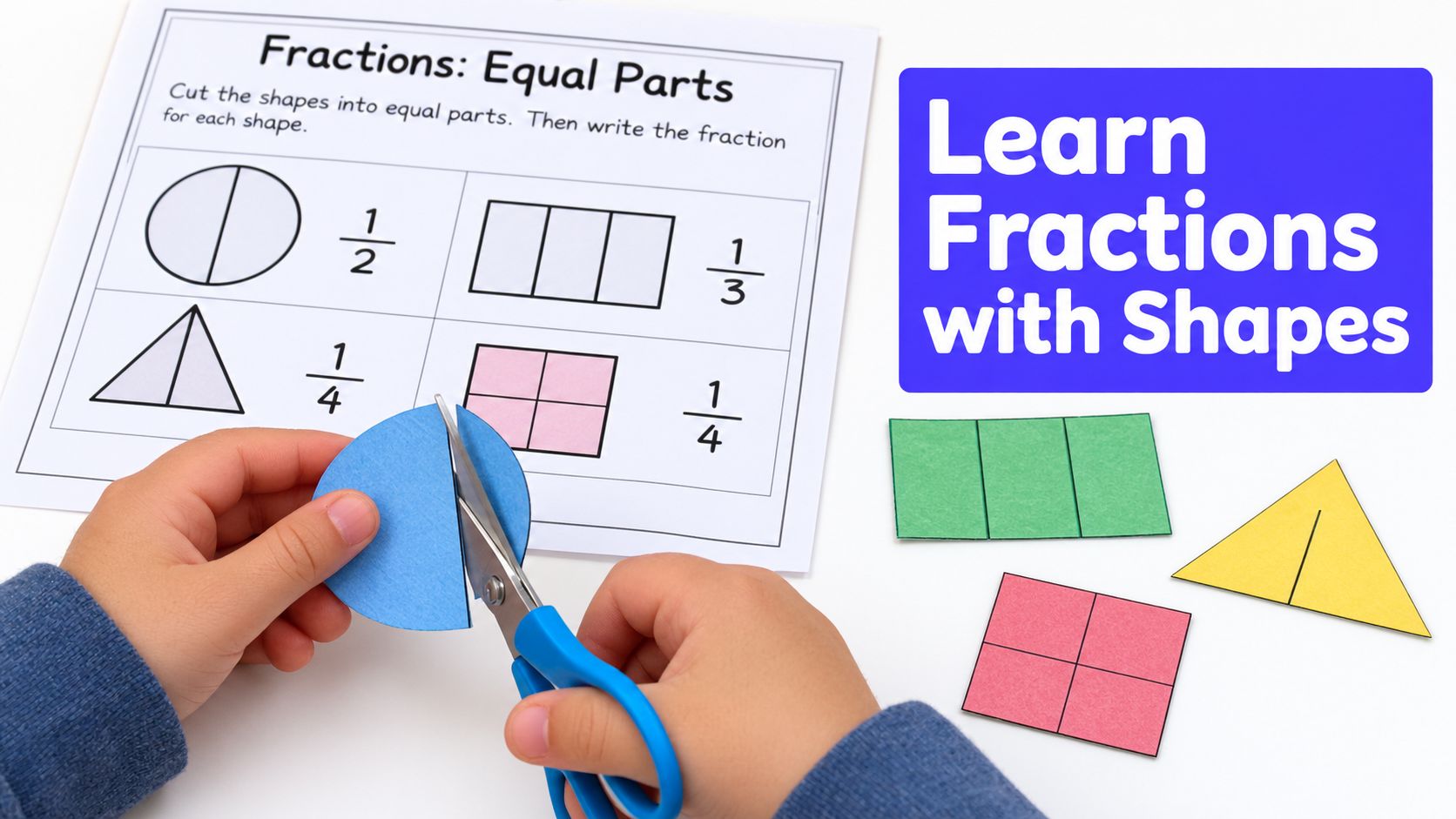
Give students paper rectangles and circles to fold, cut, shade, and label. Ask them to compare a shape divided into two equal parts with one divided into four equal parts. They should notice that more equal pieces mean smaller pieces of the same whole.
Language and access matter
For multilingual learners, pair visual terms with gestures and sentence frames:
- “The shape has ___ sides.”
- “The whole is divided into ___ equal shares.”
- “Each share is called a ___.”
- “These parts are equal because ___.”
Students who need additional concrete experience can use folding strips, fraction circles, and moveable shape pieces. Students ready for abstraction can draw several partitions and explain why a visually unusual partition still represents equal shares. Fraction teaching resources can help organize those concrete-to-symbolic steps while keeping the language of equal shares explicit.
Connecting the Four Areas And Building Toward Grade 3 Readiness
Grade 2 is a transition year because students consolidate two-digit computation while extending their reasoning to three-digit quantities, measurement, fractions, and geometric structure.
Place value prepares students to see quantities as units that can be composed and decomposed. That way of thinking supports later work with equal groups and multiplication. Measurement gives addition and subtraction a context, while number lines help students interpret difference as distance rather than as a detached procedure.
Geometry contributes another important idea. When students partition a rectangle into equal shares, they're reasoning about a whole, the number of parts, and the size of each part. Those ideas connect to division even before students formally study division strategies.
A useful unit-planning question is, “What connection should students name today?” For instance:
- During a place-value lesson, students explain why adding a hundred changes the hundreds unit.
- During measurement, students use subtraction to compare two lengths.
- During geometry, students justify why partitions are equal.
- During problem solving, students choose a representation before writing an equation.
Skipping depth in one area can make later work harder. A student who memorizes regrouping without understanding units may struggle when numbers become larger. A student who shades pieces without understanding equal shares may find fractions and division confusing. Protect the connections, not just the calendar dates.
Intervention and Progression And Identifying Prerequisite Gaps
Intervention should repair a prerequisite without removing the student from grade-level thinking. That requires a more precise question than “Does this child need more practice?”
Madison Metropolitan School District's 2024–25 data show that 27.3% of students in Grades 2–5 ended the year in the High Risk category, with Grade 2 showing the largest representation in that group, according to the Elementary Math Achievement brief. National NWEA data also indicate that first- and second-grade math performance had not fully returned to 2019 levels by spring 2025, although gaps had narrowed substantially from their 2021 low.
Those facts should prompt diagnosis, not lowered expectations. Use a short evidence cycle:
- Name the standard. For example, compare three-digit numbers.
- Identify the prerequisite. The student may need to understand hundreds, tens, and ones.
- Collect evidence. Ask the child to build two numbers, compare them, and explain the first place where they differ.
- Choose a scaffold. Use place-value blocks and a chart, while keeping the comparison task at grade level.
- Reassess quickly. Give a new pair of numbers and ask for a representation and explanation.
Common diagnostic decisions
A child who counts by ones may have a place-value gap, a sequencing issue, or limited fluency with skip-counting patterns. Ask the child to count collections grouped into tens before assigning more fact worksheets. If the child understands groups but loses efficiency with facts within 20, use mental strategies and number lines instead.
For regrouping, don't begin by requiring more pages of vertical computation. Ask the student to represent a number, trade one unit for smaller units, and connect the trade to the written method. The pacing guide can still move forward while the intervention runs alongside grade-level work.
Language support deserves careful attention too. If a multilingual learner chooses the right operation after acting out a problem but misinterprets a sentence, provide visuals, gestures, and a sentence frame before reteaching the mathematics. The error may be linguistic access rather than conceptual understanding.
Equitable and Culturally Responsive Implementation Strategies
Rigor and accessibility aren't opposites. A task becomes more equitable when students can reach the mathematical idea through more than one pathway.
A 2025 EdTrust analysis reported that fewer than 70% of elementary students in the examined Massachusetts context used programs meeting EdReports' expectations and identified elementary teacher preparation and qualified-teacher shortages as persistent concerns, according to the EdTrust analysis of access to high-quality math instruction. The classroom response shouldn't be to simplify the target. It should be to improve access to representations, directions, tools, and participation.
For multilingual learners, reduce unnecessary language load without removing the mathematical demand. Show the situation with counters, a drawing, and an equation. Preteach words such as sum, difference, digit, and equal share, then let students rehearse an explanation with a partner before sharing publicly.
For students using AAC or students with dyscalculia, offer response options that still reveal reasoning. A student might select a visual operation card, arrange number tiles, point to a number line, or use AAC to complete “I know because ___.” The teacher still checks the same mathematical idea.
Context matters, too. Use classroom objects, family routines, games, foods, journeys, and community settings that reflect students' lives, but don't assume one context represents every child. Invite families to share how they solve problems at home, then compare methods respectfully when the school strategy differs.
Recent numeracy scholarship is paying increased attention to contextual, inquiry-based, ethnomathematical, and realistic mathematics approaches, with 27 relevant publications identified in 2025, the highest count in that review, according to the research review referenced in the EdTrust discussion. The practical lesson is simple: keep the standard fixed, but widen the ways students can enter and communicate the mathematics.
How Kuraplan Supports Standards-Aligned 2nd Grade Planning
Traditional planning often leaves teachers to perform the same translation repeatedly: locate the standard, write an objective, create examples, prepare differentiated materials, and design an assessment. That process can work, but it consumes time that could go toward analyzing student work and preparing questions.

Kuraplan is an AI-powered lesson planning platform for K–12 educators. It creates standards-aligned lesson and unit plans, worksheets, and educational visuals, and it automatically maps objectives, differentiates instruction, and includes assessment rubrics for measurable learning outcomes, according to Kuraplan's platform overview.
The useful distinction for Grade 2 planning is the connection between the lesson and the evidence. A teacher can build a place-value sequence that begins with base-ten blocks, moves to drawings, includes a comparison task, and ends with an explanation rubric. The same planning process can include language supports, a quick check, and an intervention branch for students who confuse the tens and ones places.
A practical comparison
| Planning approach | Typical teacher work | What to protect |
|---|---|---|
| Traditional manual planning | Search standards, draft activities, format worksheets, and create assessment criteria separately | Time for reviewing student thinking |
| Standards-aligned digital planning | Map the objective, generate lesson materials, adapt representations, and review the output | Teacher judgment and local curriculum fit |
| Kuraplan workflow | Create lesson and unit plans, worksheets, visuals, differentiated pathways, and rubrics in one planning environment | Accuracy of the standard, accessibility, and student evidence |
Teachers can also convert lessons into printable or shareable worksheets with multiple-choice items, images, and age-appropriate question types. The platform includes a 24/7 AI teaching assistant for planning ideas, classroom management tips, and quick answers, and its stated reach is 1,000+ schools and 30,000+ teachers on the Kuraplan site.
Use any generated plan as a draft, not a substitute for professional judgment. Check the standard, inspect the numbers and representations, consider your students' language and access needs, and revise examples so they fit your classroom.
Implementation Checklist and Next Steps for Teachers
Start small. A strong standards-aligned system doesn't require rebuilding the entire year in one weekend.
Plan the progression
- Map the four areas: Identify where place value, operations, measurement, and geometry appear in your units.
- Name the bridge: Write the Grade 1 prerequisite and the Grade 3 connection beside each major objective.
- Protect representations: Plan a concrete or visual model before equations and procedures.
- Schedule revisiting: Return to fact strategies, place value, and explanation routines throughout the year.
Build the evidence cycle
- Diagnose before intervening: Use a short task that reveals the misconception, not just an incorrect answer.
- Ask for reasoning: Require a model, equation, explanation, or comparison.
- Match the scaffold: Choose blocks, charts, number lines, gestures, sentence frames, AAC supports, or visual directions based on the evidence.
- Reassess with a new example: Change the numbers or context so students demonstrate transfer.
Strengthen access
- Use varied contexts: Invite students' experiences without assuming every family uses the same methods.
- Reduce language barriers: Pair directions with visuals and teach essential vocabulary explicitly.
- Keep the target rigorous: Change the route to the mathematics, not the mathematics students are expected to learn.
- Communicate with families: Share the model or strategy used at school and invite families to explain methods used at home.
Before the next unit begins, choose one standard and complete the full chain: standard, prerequisite, diagnostic prompt, scaffold, and reassessment. That single chain will tell you more about instructional readiness than a completed checklist with no evidence of student thinking.
Use Kuraplan to draft differentiated Grade 2 lessons, worksheets, visuals, and assessment rubrics, then review each resource through the lens of your students and curriculum. Visit Kuraplan to explore how its standards-aligned planning tools can help you turn Common Core math 2nd grade expectations into coherent, accessible daily instruction.