Math · Grades 3–5
How to teach fractions
Fractions are where confident math students first hit a wall, and the wall is almost always conceptual: children apply whole-number thinking to numbers that don't behave like whole numbers. The fix is a concrete-representational-abstract (CRA) progression — fair-sharing and fraction strips before area models and number lines, and all of those before any operation rules. A student who can place 3/4 on a number line has fraction sense; a student who can only shade 3 of 4 parts may not.
Before you start: what students need first
- Equal sharing and the idea of "fair" parts — partitioning shapes and sets into equal groups
- Solid whole-number multiplication and division concepts (fractions lean on both)
- Comfort with the number line as a model for numbers, not just a counting track
A teaching sequence that works
- 1
Start concrete: fair sharing and partitioning
Have students fold strips, split shapes, and share objects equally, naming parts as they go ("one of four equal parts"). Insist on the word equal — unequal-part "fractions" are the root of later errors.
- 2
Name unit fractions and build from them
Teach 1/4 as one part of four equal parts, then build 3/4 as three copies of 1/4. This "unit fraction as building block" idea is how the Common Core progression frames fractions, and it makes improper fractions unremarkable later.
- 3
Move to the number line early
Area models are comfortable but hide that a fraction is a number with a location. Have students partition the interval 0–1, place unit fractions, then count up past 1. The number line is where equivalence and comparison become visible.
- 4
Teach equivalence by reasoning, not rule
Fold the same strip in halves then fourths; show 1/2 and 2/4 occupy the same spot on the line. Only after students can generate equivalents with models do you name the multiply-top-and-bottom shortcut.
- 5
Compare fractions with benchmarks
Is it more or less than 1/2? Than 1? Benchmark reasoning (5/8 > 1/2 because 4/8 is a half) builds the number sense that common-denominator procedures alone never do.
- 6
Introduce operations from meaning
Addition as joining copies of unit fractions with like denominators first; multiplication as "a fraction of". Delay unlike-denominator addition until equivalence is genuinely secure — rushing this step is where fraction rules go to die.
Common misconceptions — and how to fix them
"The bigger the denominator, the bigger the fraction"
Whole-number thinking applied to fraction notation. Counter it physically: fold one strip into thirds and one into eighths, and let students hold 1/3 next to 1/8. More parts means smaller parts.
Adding across: 1/2 + 1/3 = 2/5
Students treat numerator and denominator as unrelated whole numbers. Return to models: show 2/5 is less than 1/2, so the answer can't be right. Estimation-first habits catch this error before the rule does.
"Fractions are always less than one"
Comes from only ever seeing shaded shapes. Count up in unit fractions past 1 on the number line (4/4, 5/4, 6/4…) from the very first weeks, and treat improper fractions as ordinary numbers, not exceptions.
Equal parts must look identical
Students reject halves that are shaped differently. Show a square halved by diagonal and by midline — same area, same fraction. Equal means equal in size, not congruent in shape.
Differentiation notes
- Keep concrete materials on the table for everyone — fraction strips are a tool, not a remediation badge; students drop them naturally when reasoning is secure.
- Strugglers stay longer at partitioning and unit-fraction counting; the most common gap is skipped concrete work, not missing procedure.
- Extend confident students sideways: fractions greater than 2 on the line, comparing with three benchmarks, or non-routine sharing problems — not early algorithm drill.
The fractions teaching kit
Our best picks from the Kuraplan library — free to view, and each opens with the full resource.
Lesson plan · Grade 3
Comparing Fractions
Targets the benchmark-comparison step of the sequence — the lesson where fraction sense either forms or doesn't.
Open free
Slideshow · Grade 3
Fun With Fractions: Grade 3
A visual whole-class introduction with partitioning and naming — pitched right at the concrete-to-representational hand-off.
Open free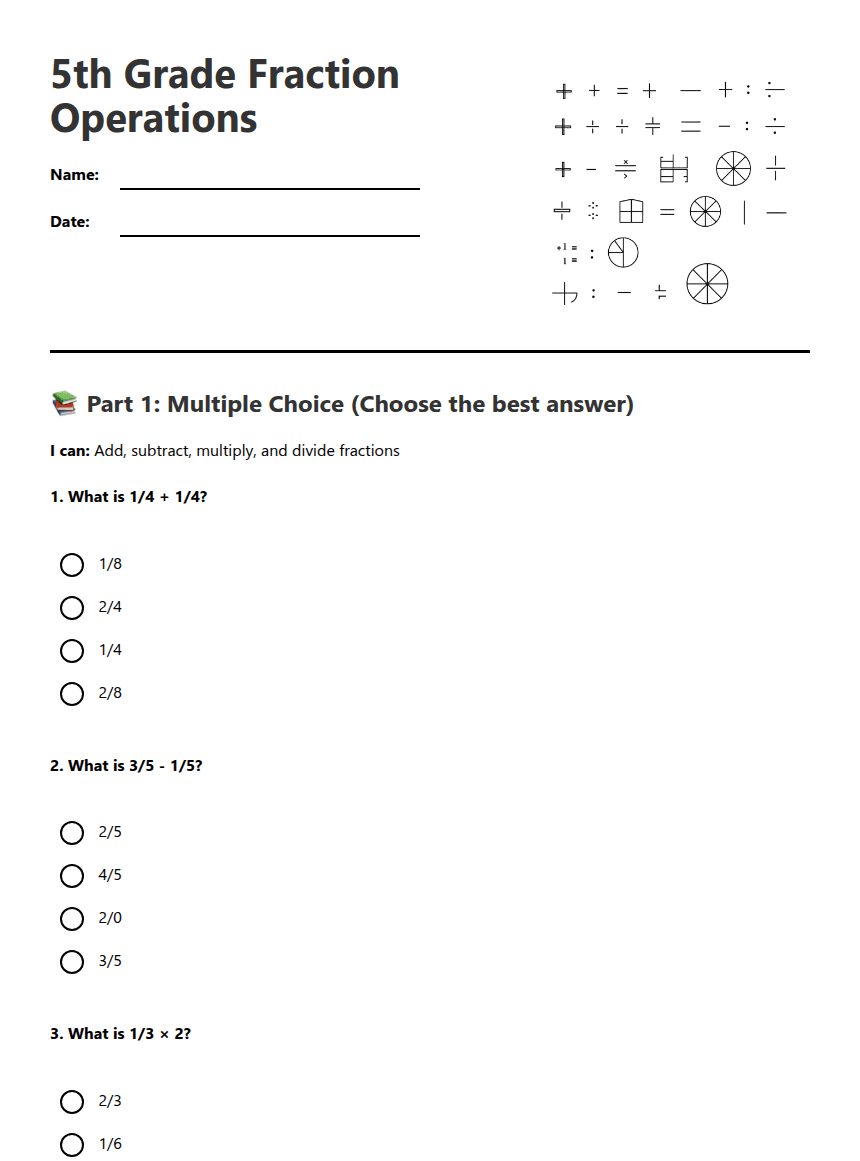
Worksheet · Grades 5–6
5th Grade Fraction Operations
Mixed fraction-operations practice for the end of the progression, once meaning is in place and fluency is the goal.
Open freeTeaching fractions — common questions
What grade should students learn fractions?
Formal fraction instruction typically starts in grade 3 (unit fractions, equivalence, comparison), with operations building across grades 4–5. Fair sharing and partitioning groundwork belongs in K–2.
Why do students struggle with fractions so much?
Mostly whole-number interference: rules that worked for counting numbers (bigger digits mean bigger numbers, adding combines digits) fail for fractions. Instruction that starts with rules instead of models bakes those errors in.
Should I teach the number line or area models first?
Start with concrete partitioning and area-style models to establish equal parts, but move to the number line quickly — it's the model that makes equivalence, comparison, and improper fractions visible, and it's where standardized assessments live.
Keep going
Create your own fractions lesson in seconds
Kuraplan's AI builds curriculum-aligned lessons, worksheets and slides - free to try.