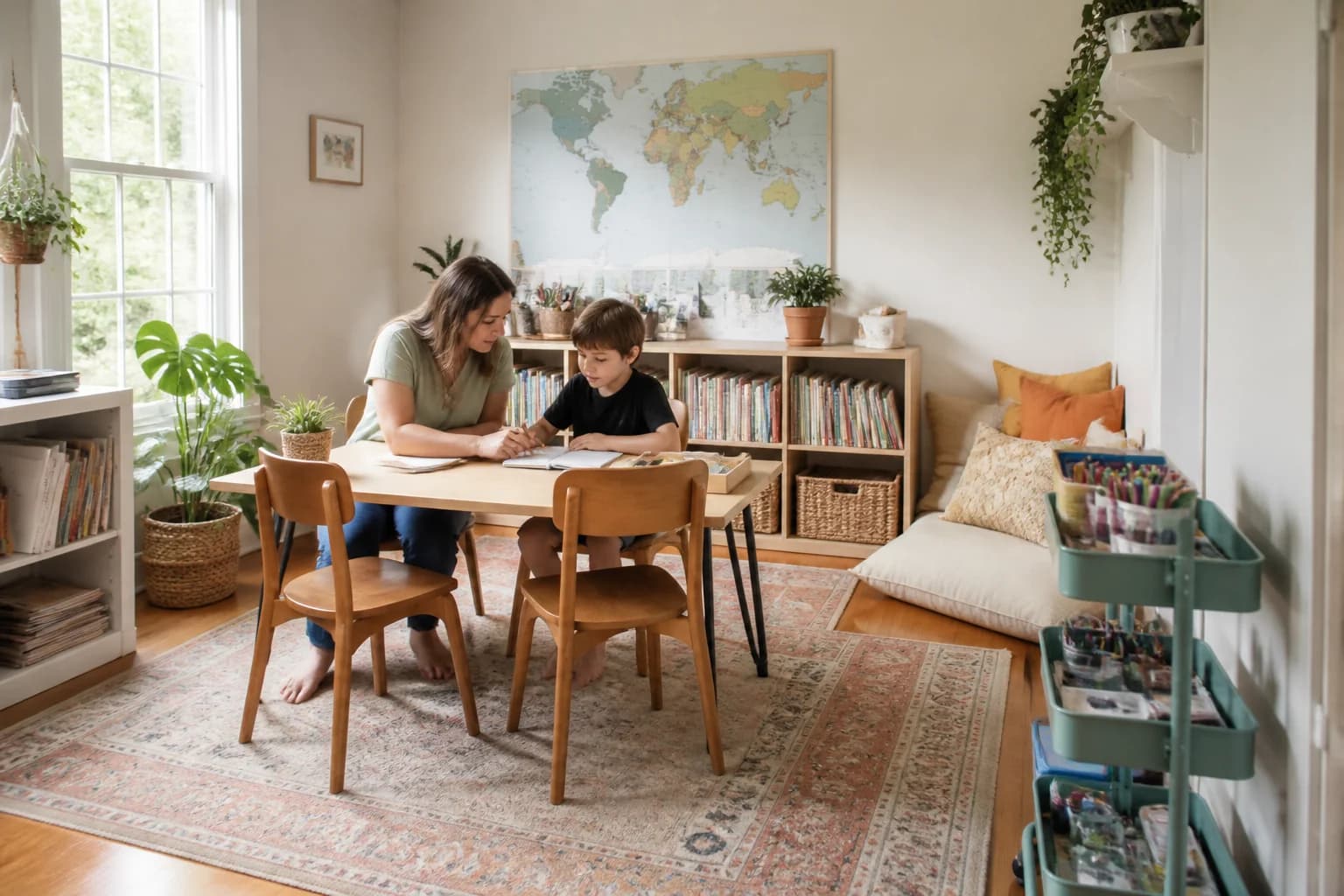
Three principles before you buy anything
- Learning happens near the parent. Put the space where you already are (the kitchen, the living room), not where it would look best.
- Reachable beats pretty. If a child cannot get the supplies and put them back alone, the setup fails by October.
- Lived-in beats classroom. Warm, book-filled, a bit messy. Children work in rooms they like being in.
1. The rolling cart
A three-tier cart beside the kitchen table holds everything for the day: binders on top, workbooks in the middle, supplies at the bottom. It rolls into a closet at dinner. This is the single most-used homeschool space in the world and it costs $30.
2. The kitchen table, owned
Most homeschools happen at the table because that is where the parent is. Make it work: a whiteboard on the nearest wall, a caddy of pencils that lives on the table, a wipe-clean cloth, and a rule that the table is cleared for lunch.
3. One low shelf per child
A single shelf each, at child height, with that child's current books, workbooks and a tray of supplies. Children can start without asking where things are. Montessori families do this with materials; everyone else does it with binders.
4. The living-room corner
A bookcase turned sideways to make a nook, a small table and two chairs, a wall map, a plant. It reads as part of the room rather than a classroom and gets used because it is where the family already is.
5. A whiteboard wall
Whiteboard paint or a large board on the wall nearest the table. Math worked large, spelling patterns, the day's plan, a running list of questions to look up. Used more than any desk.
6. The reading nook
Cushions, a lamp, a basket of library books, in a corner or under the stairs. Independent reading needs a place that is not the work table. This is the one piece of furniture that pays for itself daily.
7. Wall map and globe
A large world map at child height and a globe on a shelf. Every history and news conversation ends at the map. Cheap, decorative, educational; the best square metre of wall in the house.
8. The science box and nature table
A labelled box (vinegar, baking soda, magnets, string, balloons, magnifier, thermometer, kitchen scale) and a small table or tray for the current nature finds. Science happens when the supplies are findable.
9. An art station that stays out
A tray of quality supplies (watercolours, brushes, pencils, glue, scissors, paper) that is allowed to stay on a side table. Art that has to be fetched from a cupboard does not happen.
10. The records shelf
One binder per child per year, a folder for this term's samples, the attendance sheet clipped to the inside cover, all on one shelf. Records that have a home get kept. See the free templates.
11. Desks for older children
From about age ten, a desk of their own somewhere quiet (a bedroom, a landing) for independent work, with a lamp and a checklist. Younger children do not need desks; older ones do.
12. The closet school
Doors off a hall closet, shelves inside, a fold-down desk if there is room. Everything closes away at the end of the day. A favourite in small homes.
13. The converted dining room
If you have a room nobody eats in, it becomes the school room: a big table, wall shelves, whiteboard, map, reading corner. Keep it warm and lived-in rather than institutional; children avoid rooms that feel like school.
14. The outdoor classroom
A weatherproof table, a chalkboard on a fence, a bucket of supplies in a shed. Reading, nature study, art and even math move outside on any dry day, and the day is better for it.
Layouts by family
One young child: the kitchen table, a cart, a reading nook and a wall map. Total under $100. Two or three children under ten: the table plus one low shelf per child, a whiteboard wall, the science box and art tray, and a records shelf. Mixed ages including a middle or high schooler: all of the above plus a desk of their own somewhere quiet, because independent work needs a door. Four or more: this is where a dedicated room earns its keep: one big table, shelves by child, a whiteboard, and the nook, with the youngest still likely to end up in the kitchen with you.
Whatever the layout, print the supply checklist before you shop. Most families own most of it; the rest is a single trip.