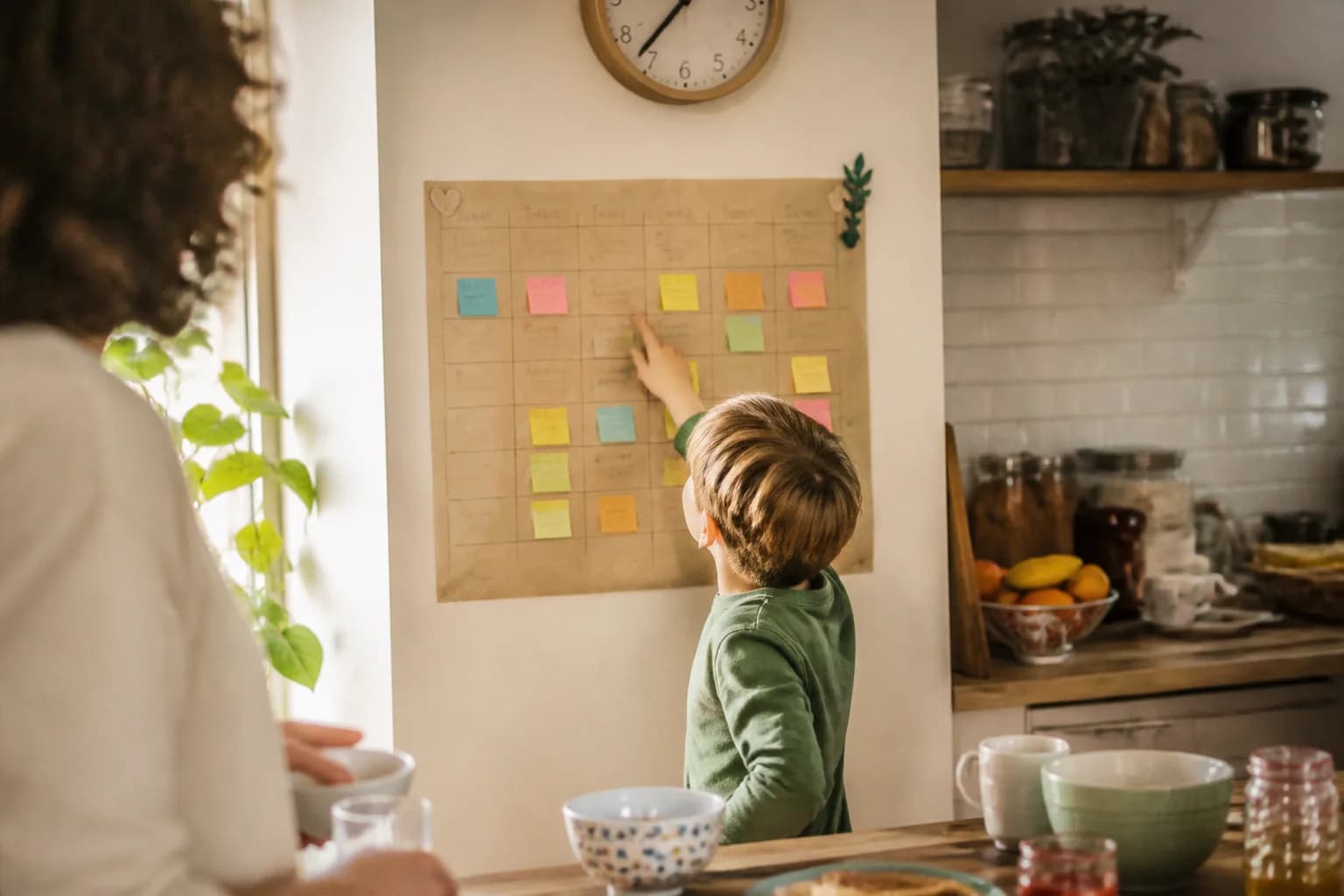
Five rules for any homeschool schedule
- Hard subjects first. Math, phonics and writing when attention is fresh; content subjects and art after the break.
- Short blocks, real breaks. Fifteen minutes for a five-year-old, forty-five for a twelve-year-old, then move.
- One child needs you at a time. Stagger the teacher-intensive subjects; share the content subjects.
- Done by lunch (until high school). Afternoons are reading, projects, activities and play, which are also learning.
- Plan four days. Life takes the fifth. A schedule that needs all five to work will not work.
Kindergarten: 90 minutes, done by 10:30
One five-year-old, a parent at home
Short blocks, movement between them, and a hard stop before attention fails. The afternoon is the real curriculum.
| 8:30 | Breakfast, free play |
| 9:00 | Morning basket: two picture books, a song, calendar (15 min) |
| 9:15 | Phonics lesson and a decodable book (15 min) |
| 9:30 | Handwriting (5–10 min) |
| 9:40 | Outside, snack |
| 10:00 | Math with objects and a game (15 min) |
| 10:15 | One activity: craft, science tray, Five in a Row (15 min) |
| 10:30 | Done. Park, errands, play |
| 13:00 | Quiet time with books or an audiobook |
| 19:00 | Bedtime chapter book |
Elementary (grade 3): three hours, mostly with the parent
One eight-year-old
Math and language arts when attention is freshest, content subjects after the break, everything finished before lunch.
| 8:30 | Morning basket: read-aloud chapter, poem, memory work (20 min) |
| 8:50 | Math lesson and practice (35 min) |
| 9:25 | Reading: independent, then discuss (25 min) |
| 9:50 | Break outside (20 min) |
| 10:10 | Spelling and copywork (15 min) |
| 10:25 | Writing: narration or paragraph (20 min) |
| 10:45 | History (Mon/Wed) or science (Tue/Thu) or art (Fri) (40 min) |
| 11:25 | Done. Free reading, projects, sport, library |
Three children (5, 8, 11): staggered so one needs the parent at a time
Kindergartner, third grader, sixth grader
The eleven-year-old runs from a checklist; the parent alternates between the two younger ones; content subjects are shared.
| 8:30 | All: morning basket, read-aloud, memory work (20 min) |
| 8:50 | Parent with 8yo: math. 11yo: math independently. 5yo: play/audiobook |
| 9:20 | Parent with 5yo: phonics + handwriting. 8yo: reading + copywork. 11yo: writing draft |
| 9:45 | Break, everyone outside |
| 10:05 | Parent with 11yo: writing feedback, science check-in. 8yo: math practice page. 5yo: math game with parent first 10 min |
| 10:35 | All: history or science together (read-aloud, activity), then split output: 5yo draws, 8yo narrates, 11yo writes (45 min) |
| 11:20 | 5yo done. Parent with 8yo: spelling (15 min). 11yo: reading |
| 11:35 | 8yo done. 11yo: foreign language / instrument (30 min), then done |
| Afternoon | Free, co-op, sport, projects |
Middle school (grade 7): independent blocks with a daily check-in
One twelve-year-old
The student owns the checklist; the parent teaches the two hard subjects and checks the rest at the end of the day.
| 8:30 | Check-in with parent: today's list, yesterday's questions (10 min) |
| 8:40 | Math: video lesson + problem set, self-checked (60 min) |
| 9:40 | English: reading and annotation, writing in progress (60 min) |
| 10:40 | Break, move, snack |
| 11:00 | Science (Mon/Wed/Fri) or history (Tue/Thu): reading, notes, lab or source task (60 min) |
| 12:00 | Lunch |
| 13:00 | Spanish (30 min) and instrument (30 min) |
| 14:00 | Free: sport, coding, friends, job |
| 16:30 | Parent reviews the day's work (15 min) |
High school (grade 10): a self-managed day with credit hours
One fifteen-year-old
Roughly six hours across five credits, logged, with a weekly meeting instead of daily supervision.
| 8:00 | Geometry (75 min) |
| 9:15 | Chemistry: reading and problems; lab on Wednesdays (75 min) |
| 10:30 | Break |
| 10:50 | English: literature and essay (60 min) |
| 11:50 | Lunch |
| 12:45 | World history: sources and writing (60 min) |
| 13:45 | Spanish, including a weekly online conversation (45 min) |
| 14:30 | PE, job, dual-enrollment class, or volunteering |
| Friday 16:00 | Weekly meeting with parent: grades, hours log, next week |
A parent working 1–5pm: mornings only, four days
Two children (7 and 10), parent works afternoons
Formal work is compressed into three focused morning hours, four days a week; Friday is co-op and errands; afternoons are a grandparent, a sitter, or independent reading and projects.
| 7:45 | Breakfast, chores |
| 8:15 | Both: read-aloud and memory work (15 min) |
| 8:30 | Parent with 7yo: reading and math. 10yo: math independently (45 min) |
| 9:15 | Parent with 10yo: writing and math check. 7yo: handwriting, then audiobook (30 min) |
| 9:45 | Break |
| 10:05 | Both: history or science (40 min) |
| 10:45 | 7yo: spelling with parent (15 min). 10yo: reading |
| 11:00 | Both: art, music or PE (30 min) |
| 11:30 | Lunch, then afternoon care; children's afternoon list: 30 min reading, one project |
| Friday | Co-op morning, library, errands |
The four-day week
Any family
Four full school days and a free fifth for field trips, co-op, appointments and catching up. Most families find they lose nothing and gain sanity. 144 four-day weeks still meets a 180-day requirement if you count Fridays' outings, which most states allow.
| Mon–Thu | Full schedule as above, formal work done by lunch |
| Friday | Field trip, co-op, library, nature day, projects, or a catch-up morning |
| Records | Log Friday outings as school days where your state allows; they are |
The loop schedule
Families who keep losing Thursday
Daily subjects every day; content subjects in a rotating list, so a lost day moves the loop instead of skipping science for a month.
| Every day | Math, reading, writing or copywork (60–90 min) |
| Then the next loop item | 1 History · 2 Science · 3 History · 4 Art · 5 Science · 6 Geography · 7 History · 8 Music · 9 Science · 10 Nature study |
| Marker | Move a paper clip along the list. Lost a day? Do the next item tomorrow. |
| Off the loop | Fixed weekly things: co-op, tutor, lessons |
Make your own
Print the free daily schedule (a column per child, so the staggering is visible), the weekly planner, the loop schedule and the year at a glance. Fill them in pencil. Run the schedule for four weeks before you change it; almost every problem in the first month is adjustment, not design. And if you want the week built for you, Kuraplan will draft it from your children's ages and the programs you use.