Bear Life Cycle Stages
A free science worksheet ready for your classroom. Open in Kuraplan to grab the print-ready PDF, customize it for your students, or generate a fresh version in seconds.
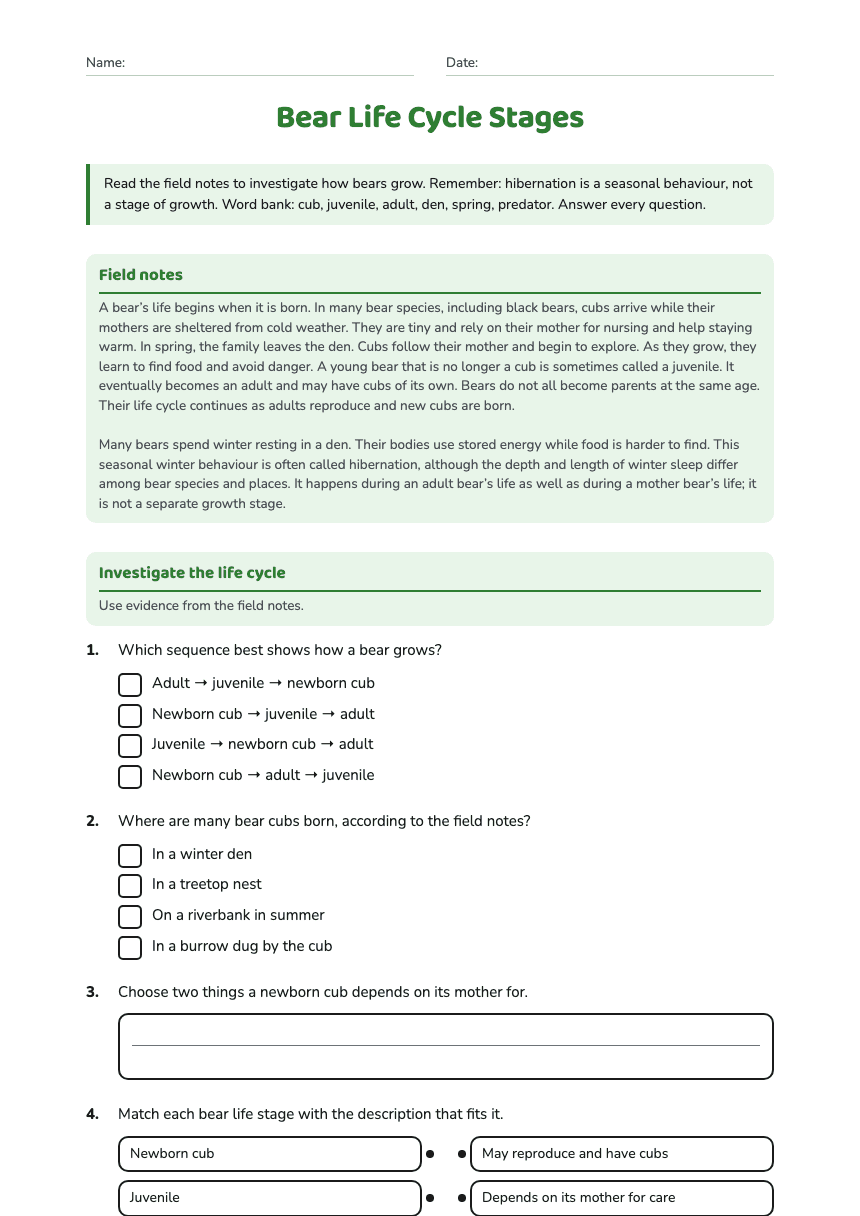
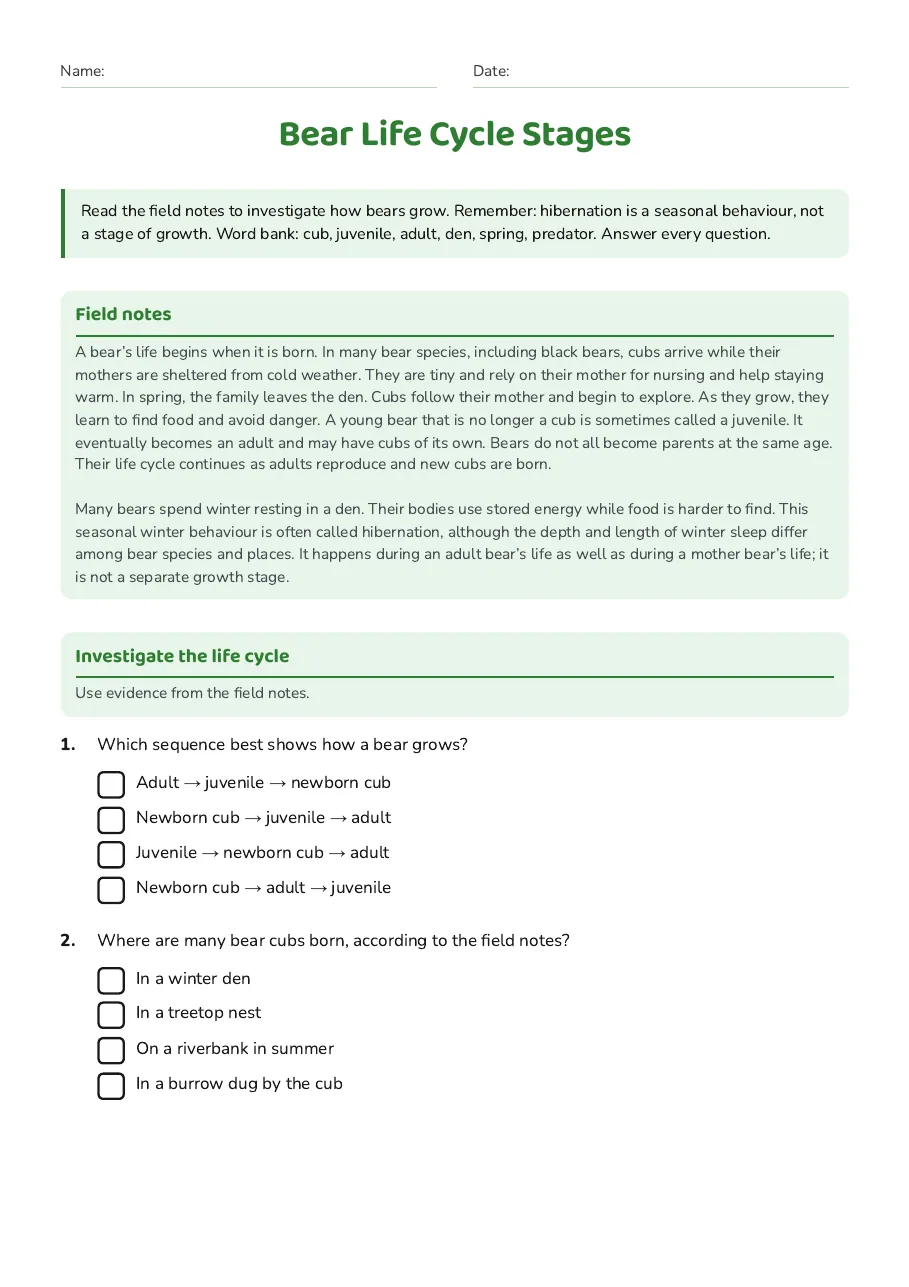
Bear Life Cycle Stages
Field notes
A bear’s life begins when it is born. In many bear species, including black bears, cubs arrive while their mothers are sheltered from cold weather. They are tiny and rely on their mother for nursing and help staying warm. In spring, the family leaves the den. Cubs follow their mother and begin to explore. As they grow, they learn to find food and avoid danger. A young bear that is no longer a cub is sometimes called a juvenile. It eventually becomes an adult and may have cubs of its own. Bears do not all become parents at the same age. Their life cycle continues as adults reproduce and new cubs are born. Many bears spend winter resting in a den. Their bodies use stored energy while food is harder to find. This seasonal winter behaviour is often called hibernation, although the depth and length of winter sleep differ among bear species and places. It happens during an adult bear’s life as well as during a mother bear’s life; it is not a separate growth stage.
Investigate the life cycle
Use evidence from the field notes.
- Adult → juvenile → newborn cub
- Newborn cub → juvenile → adult
- Juvenile → newborn cub → adult
- Newborn cub → adult → juvenile
- In a winter den
- In a treetop nest
- On a riverbank in summer
- In a burrow dug by the cub
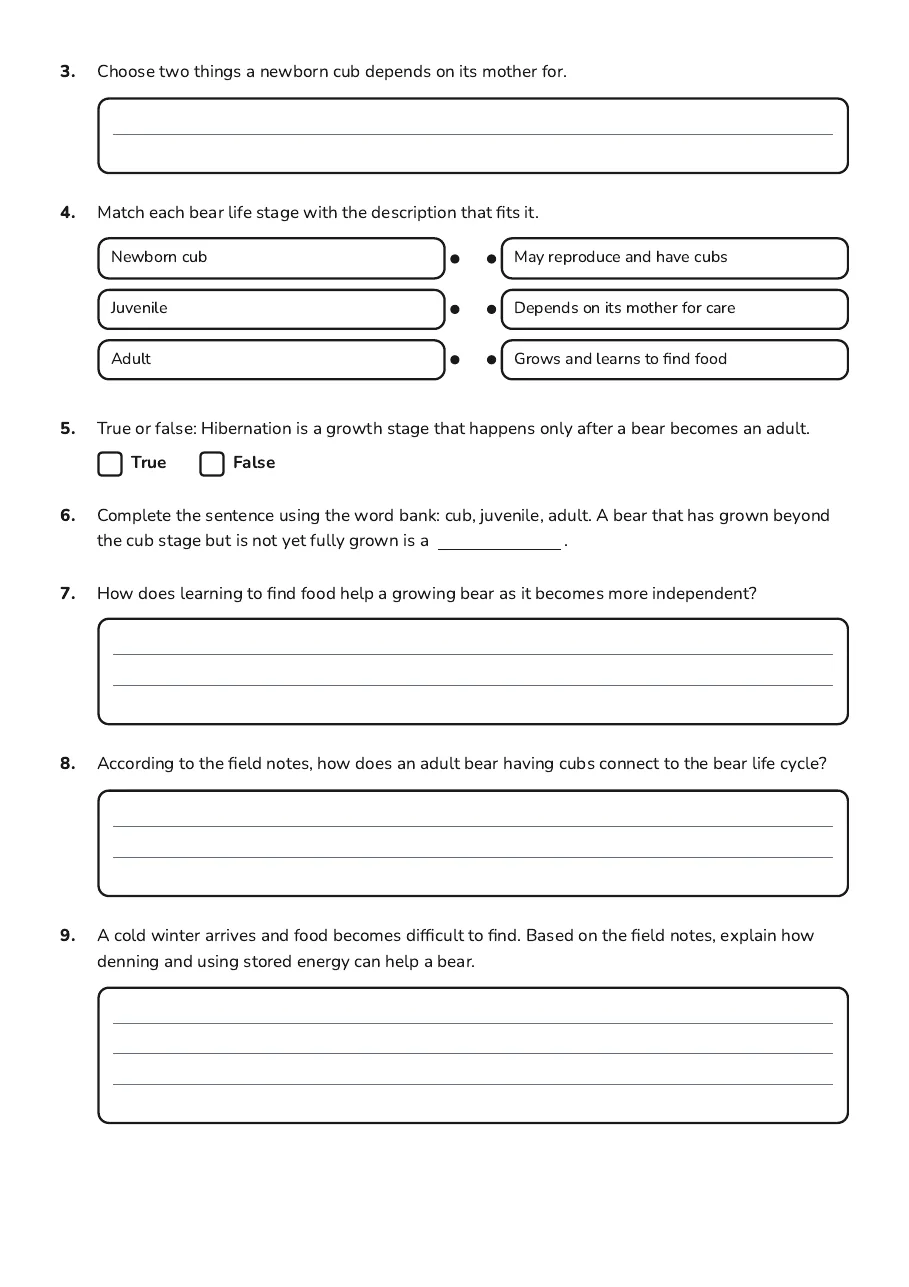
- Newborn cub
- Juvenile
- Adult
- May reproduce and have cubs
- Depends on its mother for care
- Grows and learns to find food
2 printable pages
Page 1
Page 2
About This Worksheet
Free in Kuraplan
Sign up free, grab the PDF, and customize it for your class.
Print-Ready
Formatted for standard paper. Clean layout, easy to read.
AI-Generated
Created with Kuraplan's AI, designed for real classroom use.
For Teachers & Parents
Use in classrooms, for homework, tutoring, or homeschool.
Need a custom version of this worksheet?
Kuraplan's AI generates custom worksheets in seconds — differentiated for every learner, aligned to your curriculum.
Generate Custom Worksheets — Free