ScienceFreePrintable

Invertebrate Pollination Cards

A free science worksheet ready for your classroom. Open in Kuraplan to grab the print-ready PDF, customize it for your students, or generate a fresh version in seconds.
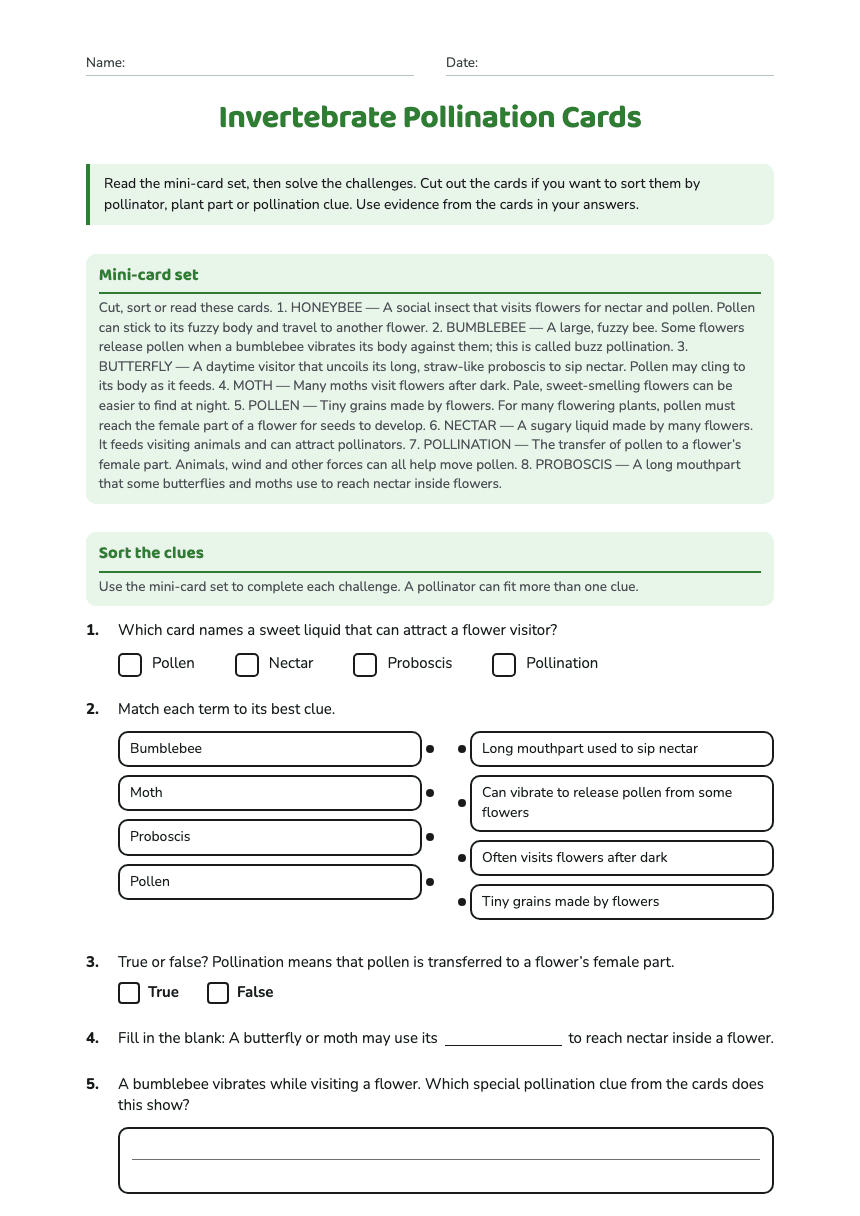
Invertebrate Pollination Cards worksheet preview

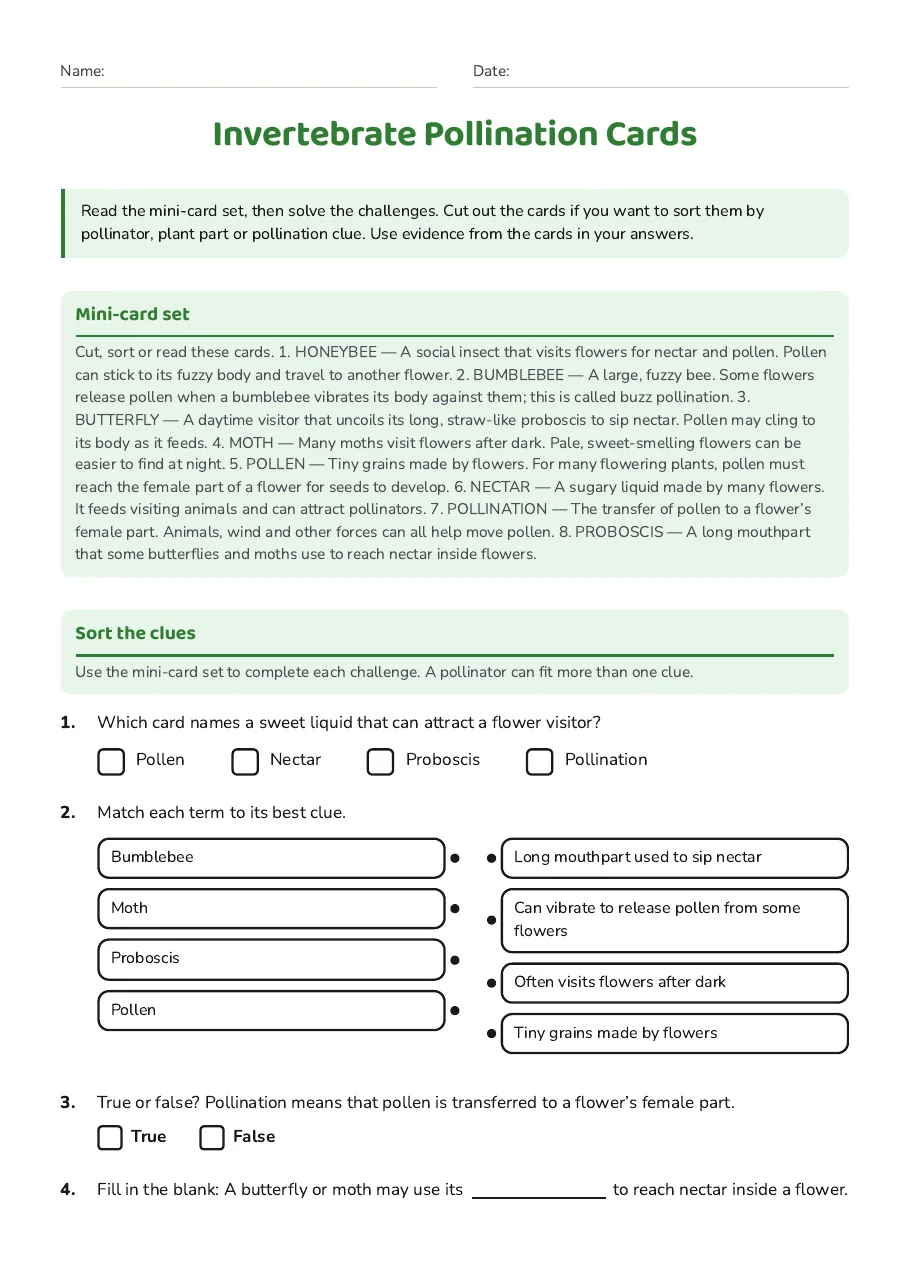
Invertebrate Pollination Cards

Montessori Three-Part Cards: Arthropods & Pollination

Bee pollinating a flower illustration

🐝 Direction Card — How to Use These Cards

Materials: Image cards, label cards, definition cards, control of error card, small tray or mat

Preparation: Lay out all cards on a clean work mat. Separate the image cards, label cards, and definition cards into three groups.

Steps:

1. Place each image card in a column on the left side of your mat.

2. Read each label card aloud. Match each label to its correct image card.

3. Read each definition card carefully. Match each definition to its image and label.

4. When all cards are matched, use the control of error card to check your work.

5. Return all cards to their correct groups and replace them on the tray.

💡 Differentiation Tip (Support): Beginners may start by matching image cards to label cards only, then add definitions when ready.

💡 Extension (Advanced Learners): After matching, turn over all image cards and write the label and one fact from memory in your science journal.

🃏 Pollination Vocabulary Cards — Labels & Definitions

Cut out and use these cards with your Montessori card set. Each card below represents one card in the three-part set.

Card 1 — Label: Honeybee (Apis mellifera)

Definition: A social arthropod that collects nectar and pollen from flowers. As it moves from flower to flower, pollen sticks to its fuzzy body and is transferred, helping plants reproduce. The honeybee is one of the most important pollinators in Canada.

Card 2 — Label: Bumblebee (Bombus sp.)

Definition: A large, fuzzy bee with black and yellow stripes. Bumblebees are native to Canada and are excellent pollinators because they perform "buzz pollination," vibrating their bodies to shake pollen loose from flowers.

Card 3 — Label: Butterfly

Definition: A winged arthropod with a long, tube-like tongue called a proboscis. Butterflies sip nectar from flowers and carry pollen on their legs and body as they travel between blooms.

Card 4 — Label: Moth

Definition: A nocturnal arthropod that pollinates flowers at night. Moths are attracted to pale, sweet-smelling flowers. Like butterflies, they transfer pollen using their proboscis and body as they feed.

Card 5 — Label: Pollen

Definition: Tiny, powdery grains produced by flowers. Pollen contains the male reproductive cells of a plant. When pollen is carried from one flower to another by an invertebrate pollinator, fertilisation can occur.

Card 6 — Label: Nectar

Definition: A sweet liquid produced inside flowers. Invertebrates such as bees and butterflies are attracted to nectar as a food source. While drinking nectar, they accidentally pick up and transport pollen.

Card 7 — Label: Pollination

Definition: The process of transferring pollen from the stamen (male part) of one flower to the pistil (female part) of another. Invertebrate pollinators like bees make this possible for many of Canada's food crops and wildflowers.

Card 8 — Label: Proboscis

Definition: A long, straw-like mouthpart found on butterflies and moths. The proboscis uncoils to reach deep inside flowers to drink nectar. Pollen grains cling to the proboscis and are carried to the next flower.

✅ Control of Error Card

Use this card AFTER you have completed your matching. Check each pair carefully.

Correct Matches:

🐝 Honeybee → collects nectar and pollen; fuzzy body transfers pollen between flowers

🐝 Bumblebee → native Canadian bee; uses buzz pollination to shake pollen free

🦋 Butterfly → uses proboscis; active during the day; carries pollen on legs and body

🌙 Moth → nocturnal pollinator; attracted to pale, sweet-smelling flowers

🌼 Pollen → tiny powdery grains; male reproductive cells of a plant

🍯 Nectar → sweet liquid inside flowers; attracts invertebrate pollinators

🌸 Pollination → transfer of pollen from stamen to pistil; enables plant reproduction

🌀 Proboscis → straw-like mouthpart on butterflies and moths; used to drink nectar

How many did you match correctly?

8 out of 8 — Excellent work! You are a pollination expert. 🌟

6–7 out of 8 — Great effort! Review the cards you missed and try again.

5 or fewer — Keep practising! Re-read the definition cards carefully before matching again.

💡 Extension Activity (Advanced Learners):

Choose one invertebrate pollinator from the cards. In your science journal, draw and label its body parts, describe how it pollinates flowers, and explain why it is important to Canadian ecosystems. Research one Canadian wildflower or crop that depends on your chosen pollinator.

💡 Differentiation Strategy (Diverse Learners):

For learners who need additional support: use only 4 cards at a time (image + label only). Gradually add more cards and definitions as confidence grows. Read definition cards aloud together before independent matching.

Reflection: What surprised you most about invertebrate pollinators?
Draw your favourite pollinator from the cards and label two of its body parts:

About This Worksheet

Free in Kuraplan

Sign up free, grab the PDF, and customize it for your class.

Print-Ready

Formatted for standard paper. Clean layout, easy to read.

AI-Generated

Created with Kuraplan's AI, designed for real classroom use.

For Teachers & Parents

Use in classrooms, for homework, tutoring, or homeschool.

Need a custom version of this worksheet?

Kuraplan's AI generates custom worksheets in seconds — differentiated for every learner, aligned to your curriculum.

Generate Custom Worksheets — Free
No credit card Curriculum-aligned Under 60 seconds