ScienceFreePrintable

Honeybee Habitat Cards

A free science worksheet ready for your classroom. Open in Kuraplan to grab the print-ready PDF, customize it for your students, or generate a fresh version in seconds.
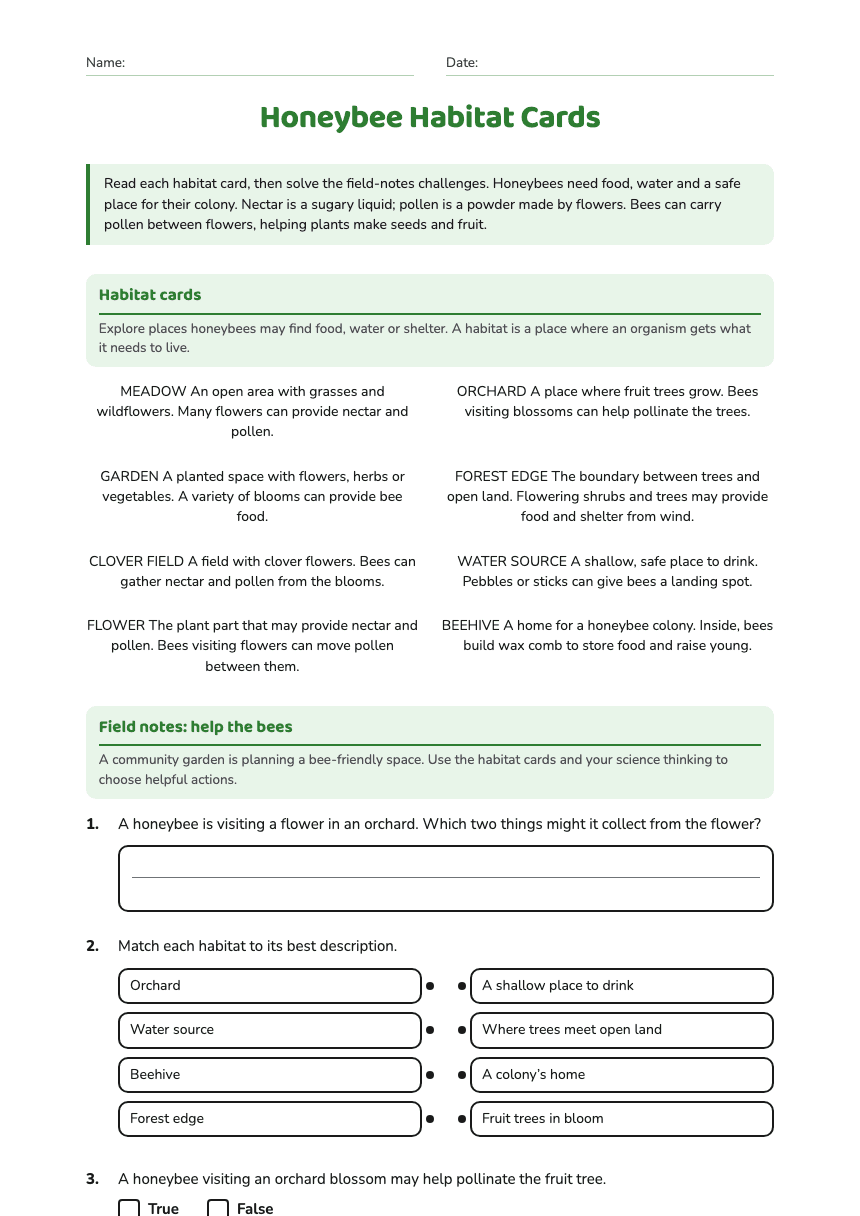
Honeybee Habitat Cards worksheet preview

Honeybee Habitat Cards

Montessori Zoology — Three-Part Cards

Honeybee on a flower in a meadow habitat

🐝 Direction Card — How to Use These Cards

Materials: Picture cards, label cards, definition cards, control of error card, work mat

Purpose: To learn the names and descriptions of the places and features that make up a honeybee's habitat.

Steps:

1. Lay out all picture cards on your work mat in a column on the left.

2. Read each label card and match it to the correct picture. Place labels beside the pictures.

3. Read each definition card and match it to the correct picture and label. Place definitions on the right.

4. When finished, use the Control of Error Card to check your work.

5. Return all cards to the envelope sorted by type (pictures / labels / definitions).

Work quietly and carefully. Take your time reading each card.

🌸 Habitat Picture Cards — Labels & Definitions

Cut apart and laminate each card. Use on a work mat for three-part card matching.

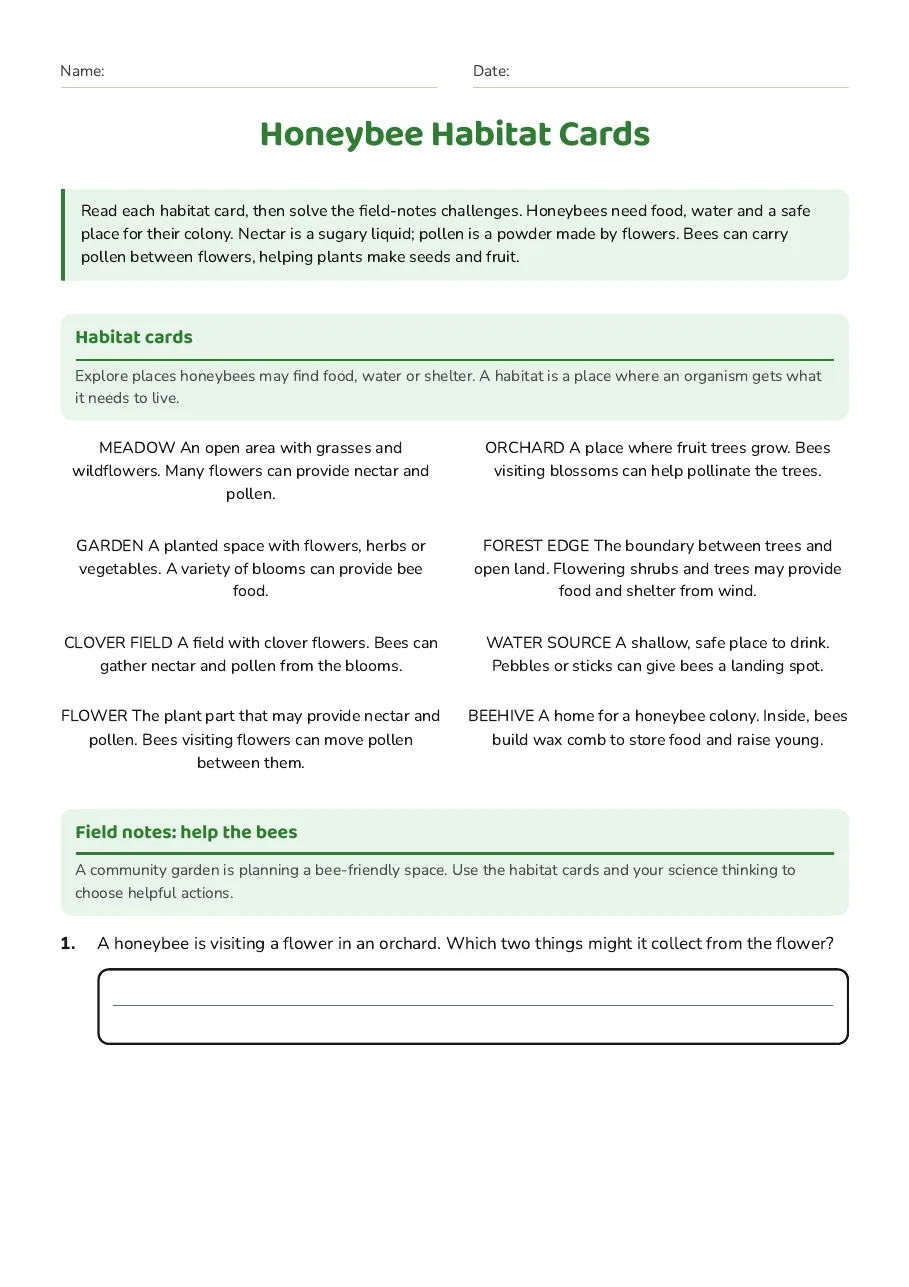
Card 1 — MEADOW

🖼️ [Picture: A wide open field filled with wildflowers and grasses in summer sunshine]

Label: Meadow

Definition: An open area of land covered with grasses and wildflowers. Honeybees visit meadows to collect nectar and pollen from many different flowers.

Card 2 — FLOWER

🖼️ [Picture: A bright wildflower showing petals, centre, and stem]

Label: Flower

Definition: The part of a plant that produces nectar and pollen. Honeybees visit flowers to gather food and carry pollen from plant to plant.

Card 3 — BEEHIVE (COLONY)

🖼️ [Picture: A wooden beehive box placed at the edge of a garden or orchard]

Label: Beehive (Colony)

Definition: The home of a honeybee colony. A hive can hold tens of thousands of bees. Bees build wax combs inside to store honey and raise young bees.

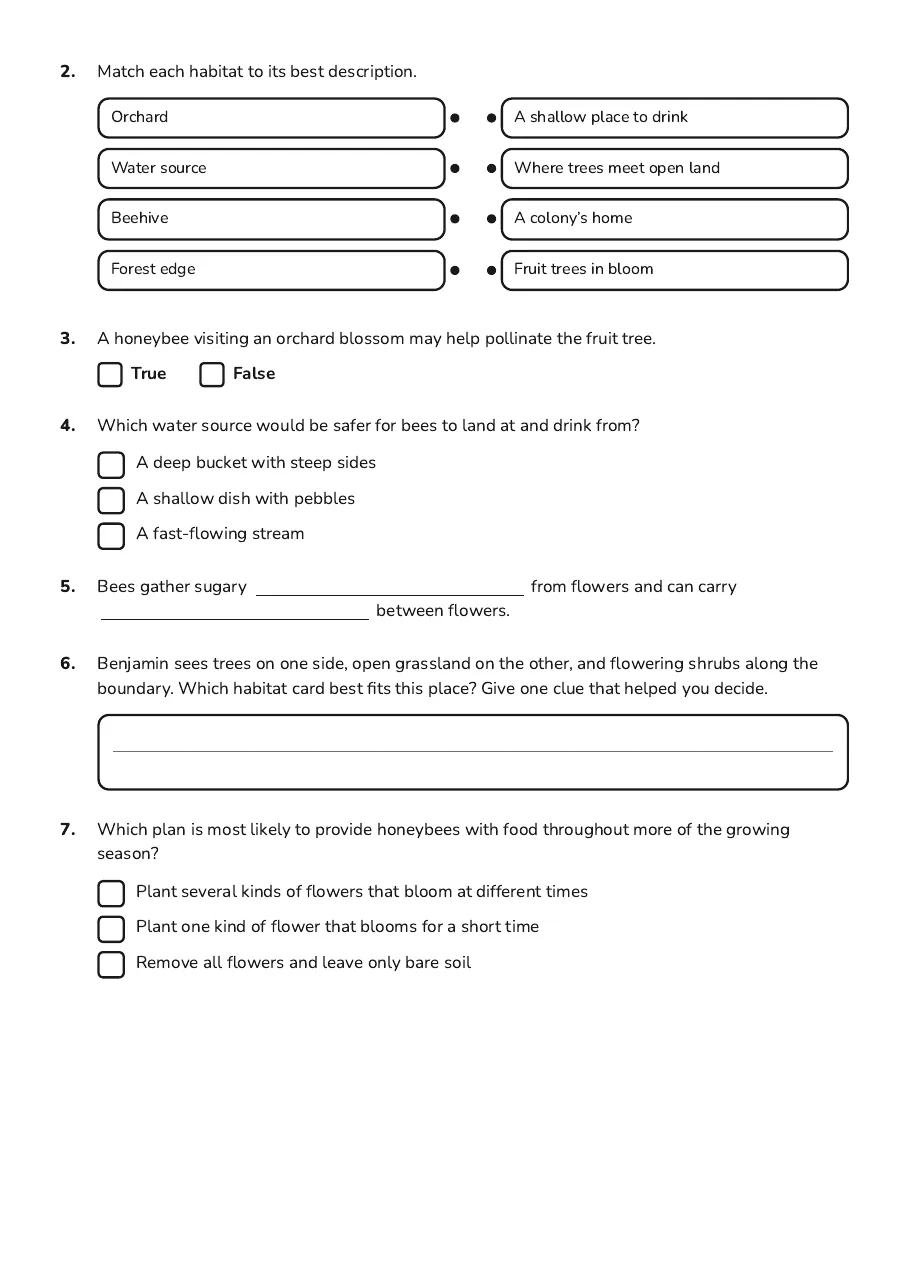
Card 4 — ORCHARD

🖼️ [Picture: Rows of fruit trees in bloom with white and pink blossoms]

Label: Orchard

Definition: A garden of fruit trees such as apple, cherry, or pear trees. Honeybees pollinate orchard blossoms in spring, helping the trees produce fruit.

Card 5 — WATER SOURCE

🖼️ [Picture: A shallow pond or birdbath with bees landing on the edge to drink]

Label: Water Source

Definition: A place where bees can find fresh water. Honeybees need water to cool the hive and to mix with honey for feeding young bees. They prefer shallow, still water.

Card 6 — FOREST EDGE

🖼️ [Picture: The border between a forest and an open field, with trees, shrubs, and wildflowers]

Label: Forest Edge

Definition: The area where a forest meets open land. This habitat offers bees shelter from wind and rain, as well as flowering shrubs and trees for foraging.

Card 7 — GARDEN

🖼️ [Picture: A backyard garden with lavender, sunflowers, and herbs in raised beds]

Label: Garden

Definition: A planted area where people grow flowers, herbs, and vegetables. Gardens with native plants are excellent habitats for honeybees because they provide a rich source of nectar and pollen.

Card 8 — CLOVER FIELD

🖼️ [Picture: A green field densely covered in white and red clover blossoms]

Label: Clover Field

Definition: A field planted with clover plants. Clover is one of the most important plants for honeybees in Canada. Bees collect large amounts of nectar from clover to make honey.

✅ Control of Error Card

Use this card AFTER you have finished matching. Check each row carefully.

Correct Matches:

1. 🖼️ Open field with wildflowers → Meadow → An open area of land covered with grasses and wildflowers.

2. 🖼️ Bright wildflower → Flower → The part of a plant that produces nectar and pollen.

3. 🖼️ Wooden hive box → Beehive (Colony) → The home of a honeybee colony.

4. 🖼️ Fruit trees in bloom → Orchard → A garden of fruit trees such as apple, cherry, or pear trees.

5. 🖼️ Shallow pond or birdbath → Water Source → A place where bees can find fresh water.

6. 🖼️ Forest meets open land → Forest Edge → The area where a forest meets open land.

7. 🖼️ Backyard garden with flowers → Garden → A planted area where people grow flowers, herbs, and vegetables.

8. 🖼️ Field of clover → Clover Field → A field planted with clover plants.

How many did you match correctly? _____ / 8

🌿 Differentiation Strategies

For Emerging Learners:

• Begin with only 3–4 cards (Meadow, Flower, Beehive, Garden). Add more cards as confidence grows.

• Use the picture card and label card only (two-part matching) before introducing definition cards.

• Allow the learner to keep the Control of Error Card visible during matching as a reference.

For On-Level Learners:

• Use all 8 cards for full three-part matching as described on the Direction Card.

• Encourage the learner to read each definition aloud before placing it.

For Advanced Learners — Extension Activities:

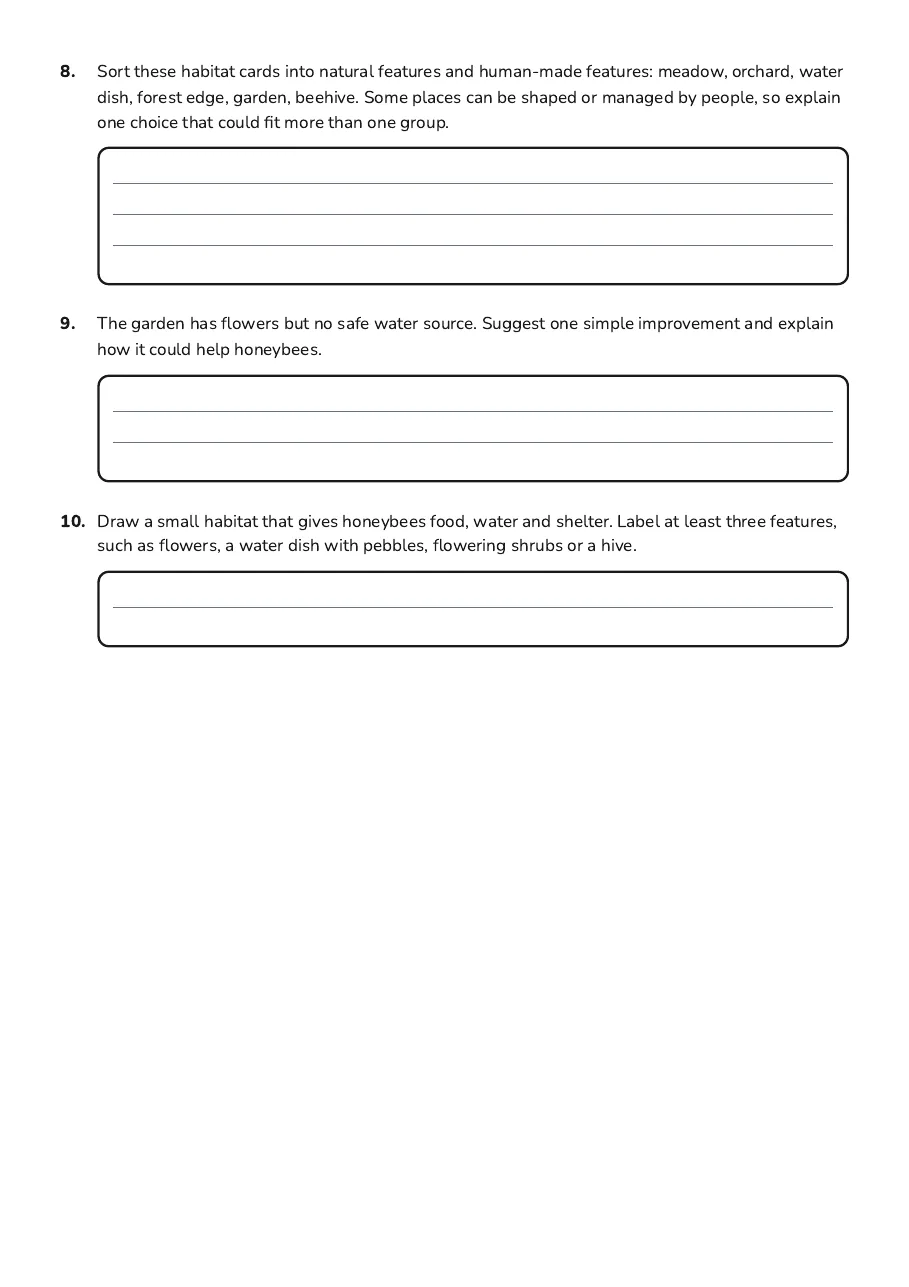
Draw Your Own Habitat: Choose one habitat card and draw a detailed scene showing a honeybee visiting that habitat. Label at least 3 features in your drawing.

Research Challenge: Find out which habitat is most important for honeybees in your province of Canada. Write 2–3 sentences explaining what you discovered.

Create a New Card: Can you think of another habitat where honeybees might live or forage? Design your own picture card, label card, and definition card on blank paper and add it to the set.

Sorting Challenge: Sort the 8 habitat cards into two groups: Natural Habitats and Human-Made Habitats. Record your groups below.

Natural Habitats:
Human-Made Habitats:

About This Worksheet

Free in Kuraplan

Sign up free, grab the PDF, and customize it for your class.

Print-Ready

Formatted for standard paper. Clean layout, easy to read.

AI-Generated

Created with Kuraplan's AI, designed for real classroom use.

For Teachers & Parents

Use in classrooms, for homework, tutoring, or homeschool.

Need a custom version of this worksheet?

Kuraplan's AI generates custom worksheets in seconds — differentiated for every learner, aligned to your curriculum.

Generate Custom Worksheets — Free
No credit card Curriculum-aligned Under 60 seconds