Water Cycle Diagram — free printable diagram
Free geography resource for teachers · CC BY-NC 4.0
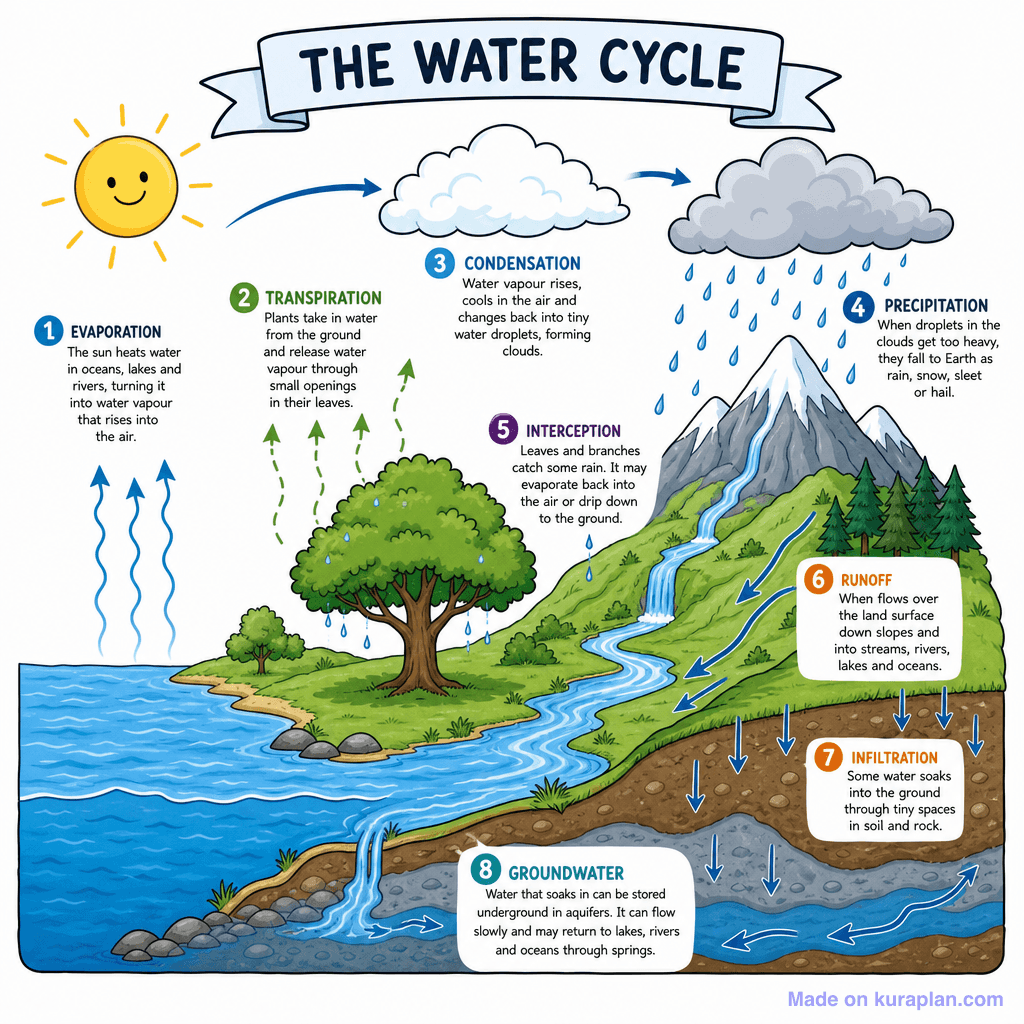
About this illustration
This vibrant, cartoon-style diagram clearly illustrates the complete water cycle. It depicts a landscape featuring a smiling sun, clouds, mountains, trees, a river flowing into a larger body of water, and a detailed cross-section of the earth. Eight numbered steps, each with a descriptive text box, explain key processes such as evaporation, condensation, precipitation, transpiration, runoff, infiltration, interception, and groundwater. This visual is designed to teach the hydrologic cycle as a core Earth science concept for K-12 students. It is perfect for use on educational slides, as a reference on worksheets, or for classroom discussions. The flat illustration style, with clear labels and arrows, makes the complex process easily understandable.
The stages of the water cycle
The water cycle, or hydrological cycle, is the continuous movement of water between the oceans, the air and the land. It is drawn as a loop because it has no beginning and no end, and it is driven by just two things: energy from the sun, which lifts water into the air, and gravity, which brings it back down. The stages below are the ones normally labelled.
- Evaporation
- The sun heats liquid water, turning it into water vapour
- Transpiration
- Water vapour released into the air by plants
- Condensation
- Vapour cools and turns back into droplets, forming cloud
- Precipitation
- Rain, snow, sleet or hail falling from cloud
- Infiltration
- Water soaking down into soil and rock
- Surface runoff
- Water flowing over the land into rivers
- Storage
- Oceans, lakes, rivers, ice and groundwater
- The sun is the engine and gravity is the return path. Naming both is usually worth a mark, and it explains why the cycle never stops.
- Condensation happens because air cools as it rises. That is why clouds form high up and why hills and mountains force rain out of moving air.
- Precipitation is the collective word for everything that falls — rain, snow, sleet and hail — so it is the safer term to use when labelling.
- Evaporation from surfaces and transpiration from plants are often combined under one term, evapotranspiration, because together they are what returns water to the air from the land.
- Water that infiltrates takes the slow route. It becomes groundwater and may not reach a river or the sea for years, while surface runoff gets there in hours — a useful contrast when studying flooding.
- The total amount of water on Earth does not change. The cycle moves it between stores rather than creating or destroying it, so the water in a glass today has been round the loop countless times.
How to use
- 1Right-click the image and choose “Save image as”, or use the download button.
- 2Use it in your classroom worksheets, slides or printables — free under CC BY-NC 4.0.
- 3Attribute as “Image by Kuraplan” or link back to kuraplan.com. Not for commercial resale.
Turn this image into a worksheet
This illustration is already in Kuraplan's editor — describe the worksheet you need and the AI builds it around the image in seconds.
Related illustrations
More from Deserts, Glaciers, Caves
Free worksheets on Water Cycle Diagram
All free worksheetsBrowse by subject
21 subjects · 5,118 free illustrations
Maths
1,894 free illustrations
Cross-Curricular
835 free illustrations
Science
814 free illustrations
English
612 free illustrations
Health
200 free illustrations
Social Studies
177 free illustrations
Religious Education
139 free illustrations
Music
128 free illustrations
Art
66 free illustrations
Drama
56 free illustrations
Social Sciences
48 free illustrations
History
47 free illustrations
Arts
26 free illustrations
PE
25 free illustrations
Te Reo Māori
24 free illustrations
Technology
16 free illustrations
Culture
7 free illustrations
Business
1 free illustrations
English
1 free illustrations
English (ELA)
1 free illustrations
Languages
1 free illustrations