ScienceFreePrintable

Building Blocks of Matter

A free science worksheet ready for your classroom. Open in Kuraplan to grab the print-ready PDF, customize it for your students, or generate a fresh version in seconds.
Building Blocks of Matter worksheet preview
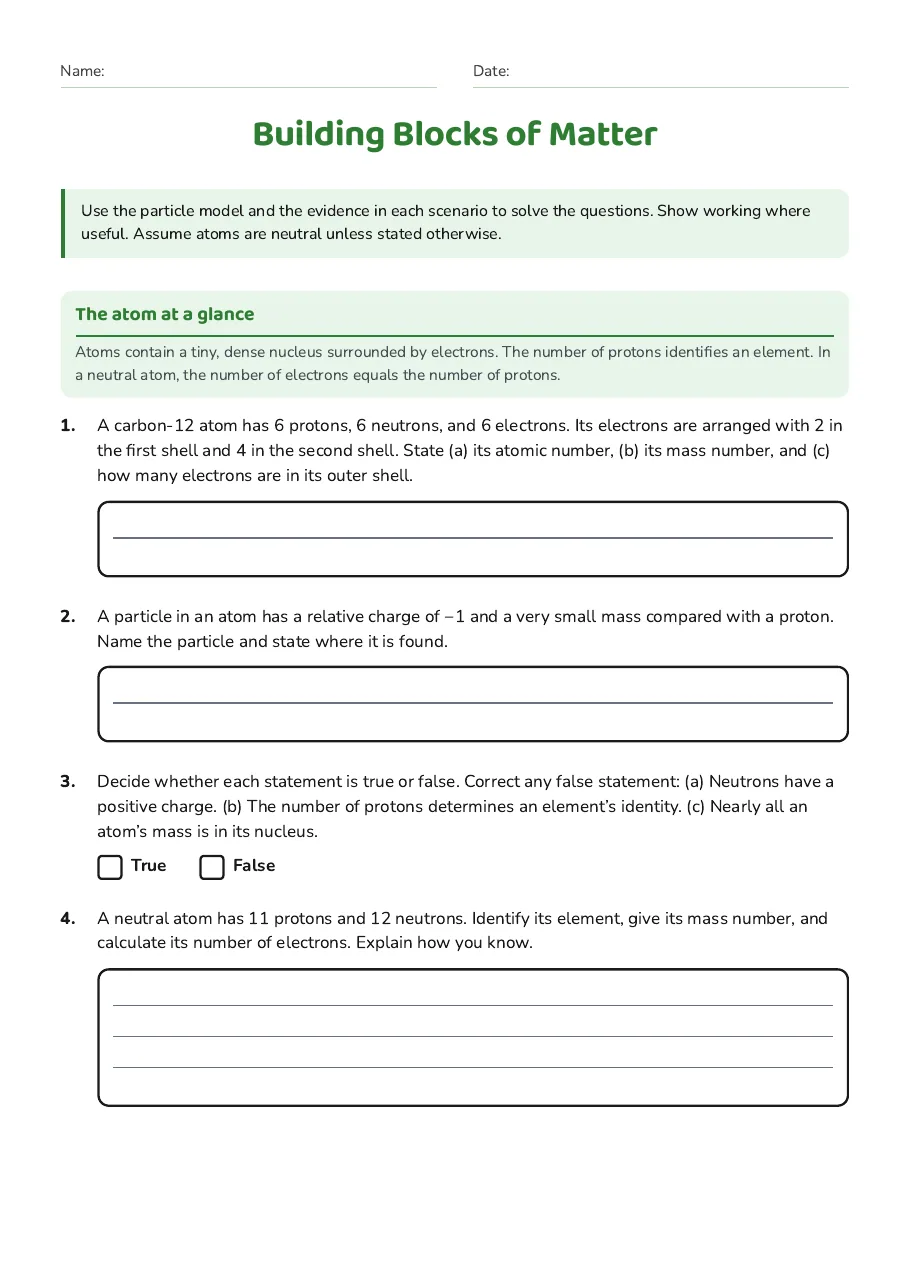
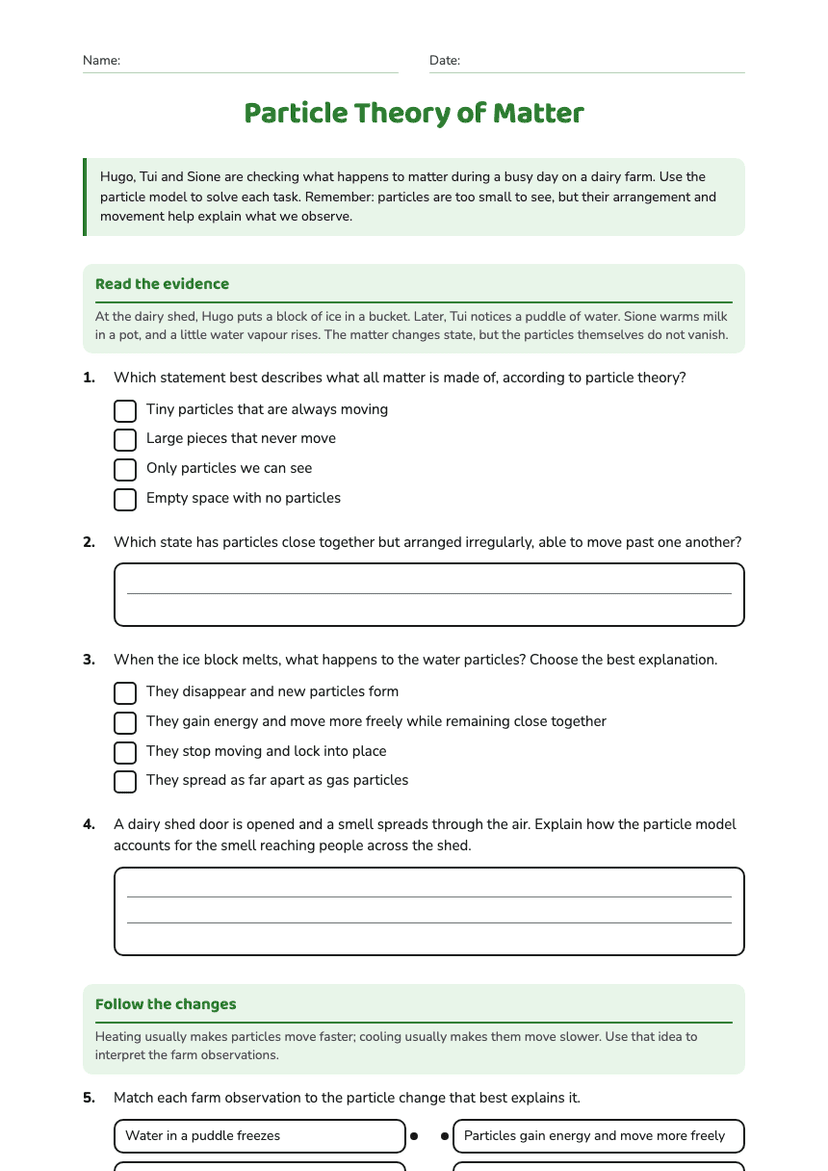
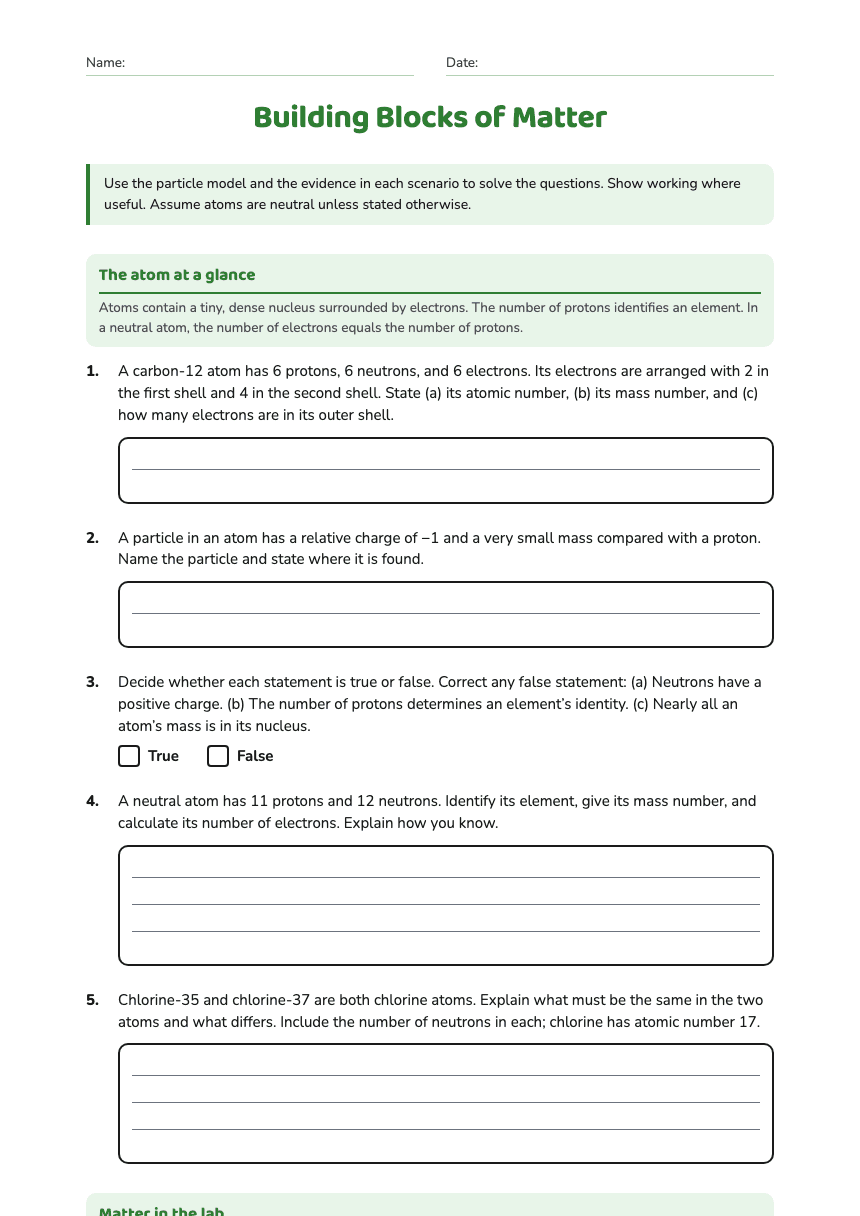
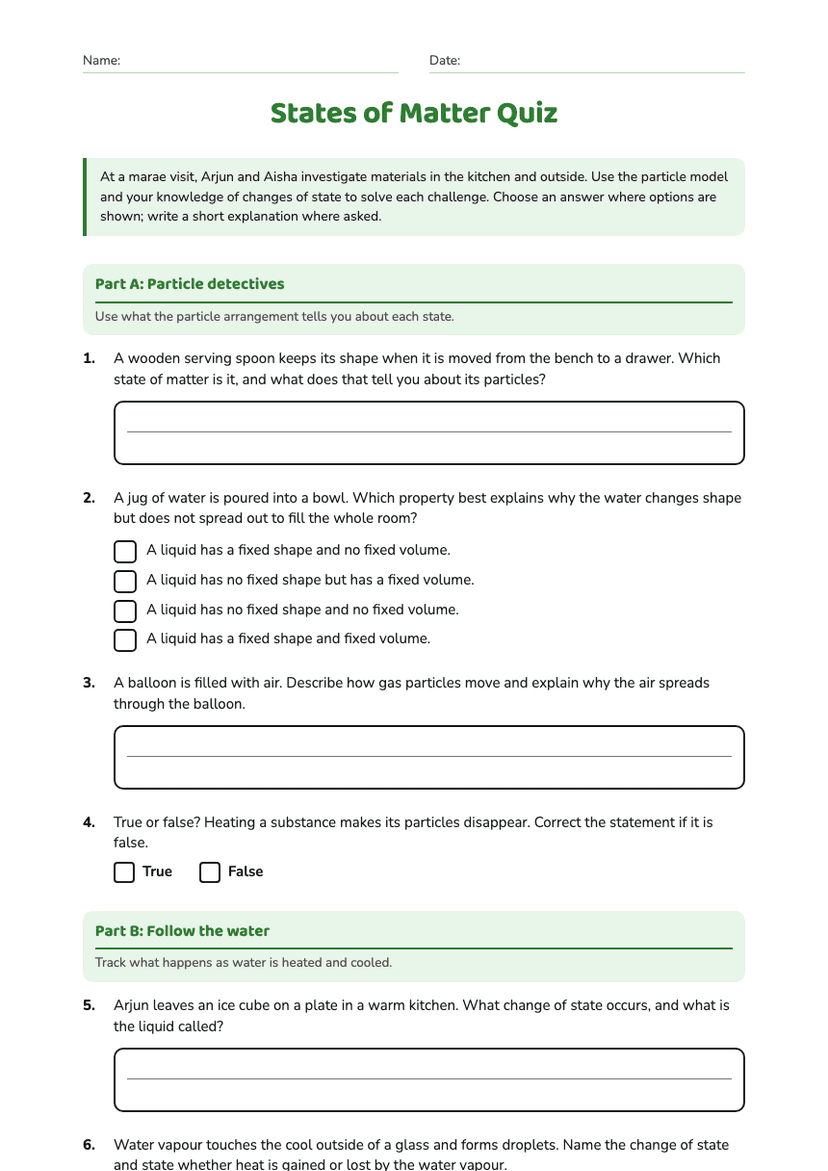
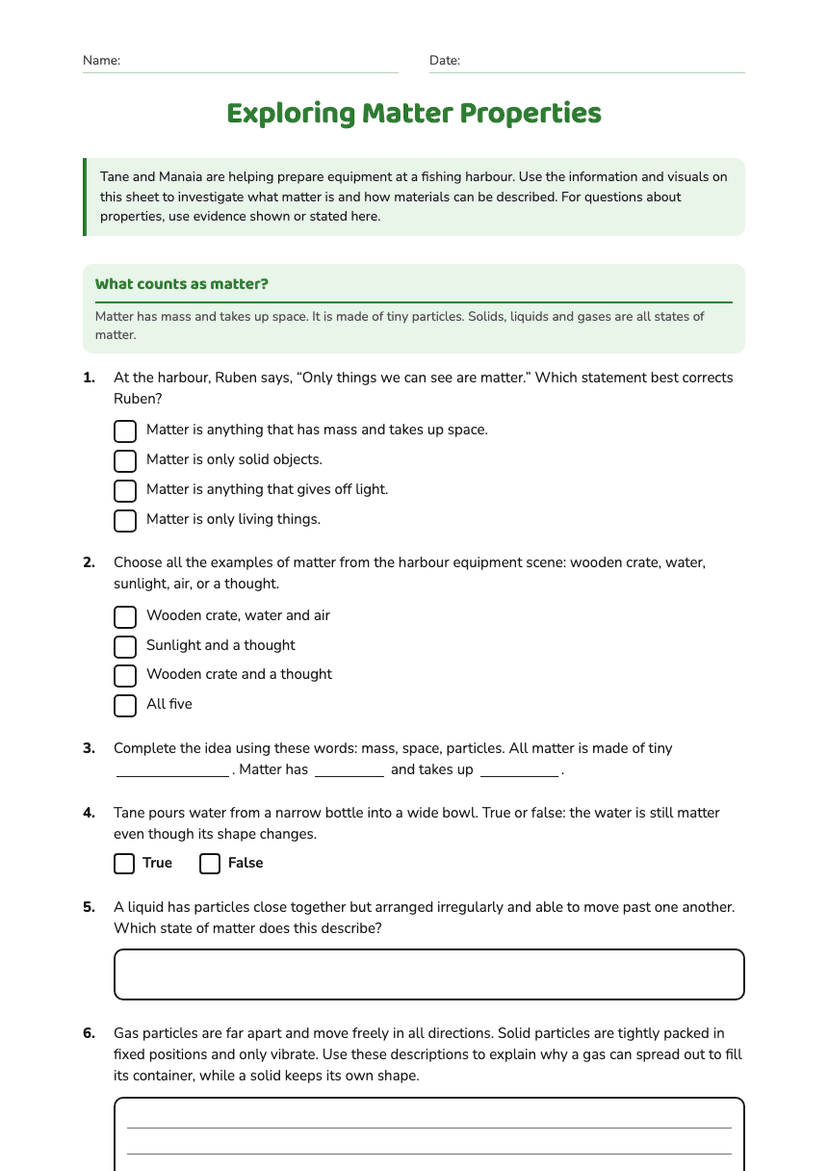
Name:Date:

Building Blocks of Matter

Use the particle model and the evidence in each scenario to solve the questions. Show working where useful. Assume atoms are neutral unless stated otherwise.

The atom at a glance

Atoms contain a tiny, dense nucleus surrounded by electrons. The number of protons identifies an element. In a neutral atom, the number of electrons equals the number of protons.

1.A carbon-12 atom has 6 protons, 6 neutrons, and 6 electrons. Its electrons are arranged with 2 in the first shell and 4 in the second shell. State (a) its atomic number, (b) its mass number, and (c) how many electrons are in its outer shell.
2.A particle in an atom has a relative charge of −1 and a very small mass compared with a proton. Name the particle and state where it is found.
3.Decide whether each statement is true or false. Correct any false statement: (a) Neutrons have a positive charge. (b) The number of protons determines an element’s identity. (c) Nearly all an atom’s mass is in its nucleus.
TrueFalse
4.A neutral atom has 11 protons and 12 neutrons. Identify its element, give its mass number, and calculate its number of electrons. Explain how you know.
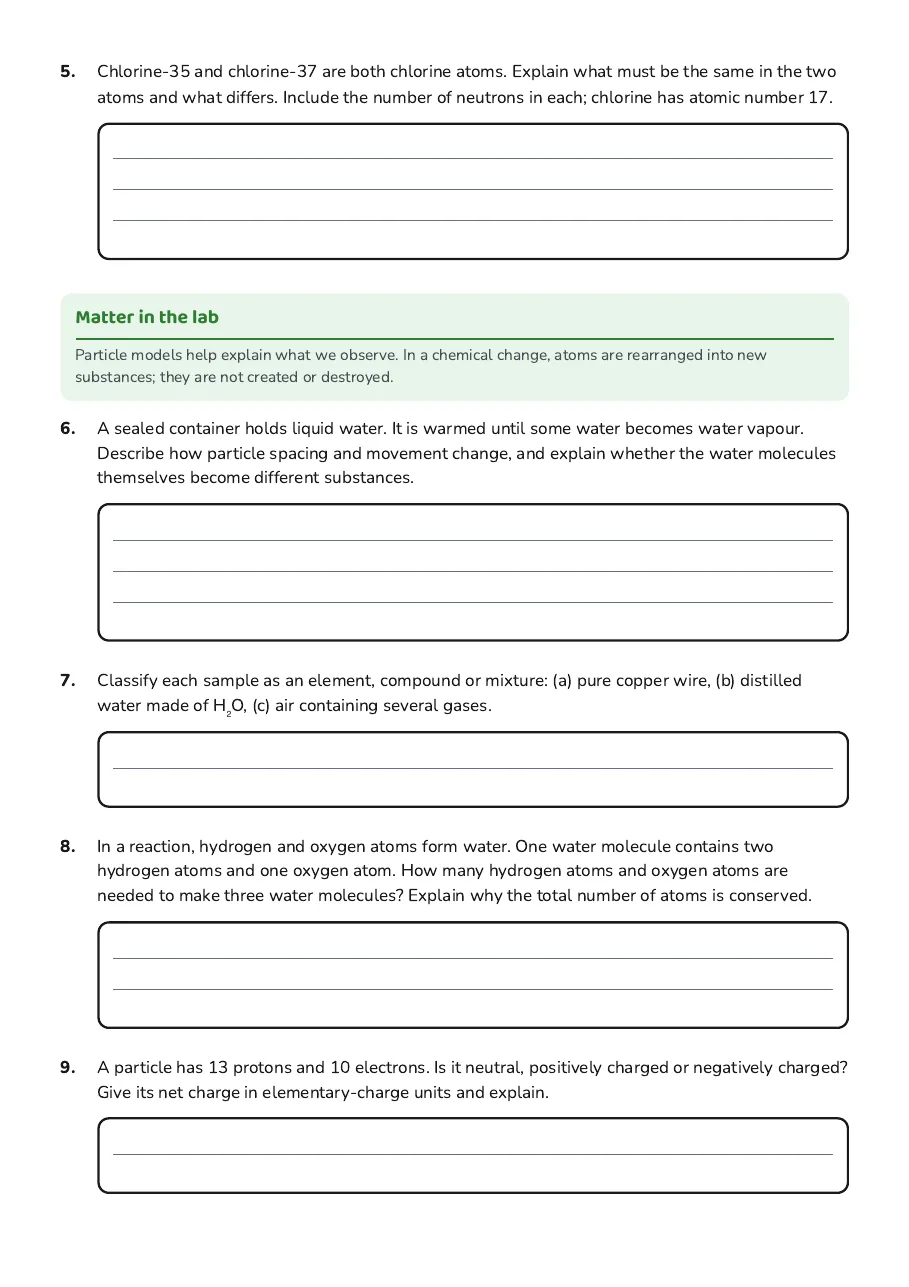
5.Chlorine-35 and chlorine-37 are both chlorine atoms. Explain what must be the same in the two atoms and what differs. Include the number of neutrons in each; chlorine has atomic number 17.

Matter in the lab

Particle models help explain what we observe. In a chemical change, atoms are rearranged into new substances; they are not created or destroyed.

6.A sealed container holds liquid water. It is warmed until some water becomes water vapour. Describe how particle spacing and movement change, and explain whether the water molecules themselves become different substances.
7.Classify each sample as an element, compound or mixture: (a) pure copper wire, (b) distilled water made of H₂O, (c) air containing several gases.
8.In a reaction, hydrogen and oxygen atoms form water. One water molecule contains two hydrogen atoms and one oxygen atom. How many hydrogen atoms and oxygen atoms are needed to make three water molecules? Explain why the total number of atoms is conserved.
9.A particle has 13 protons and 10 electrons. Is it neutral, positively charged or negatively charged? Give its net charge in elementary-charge units and explain.
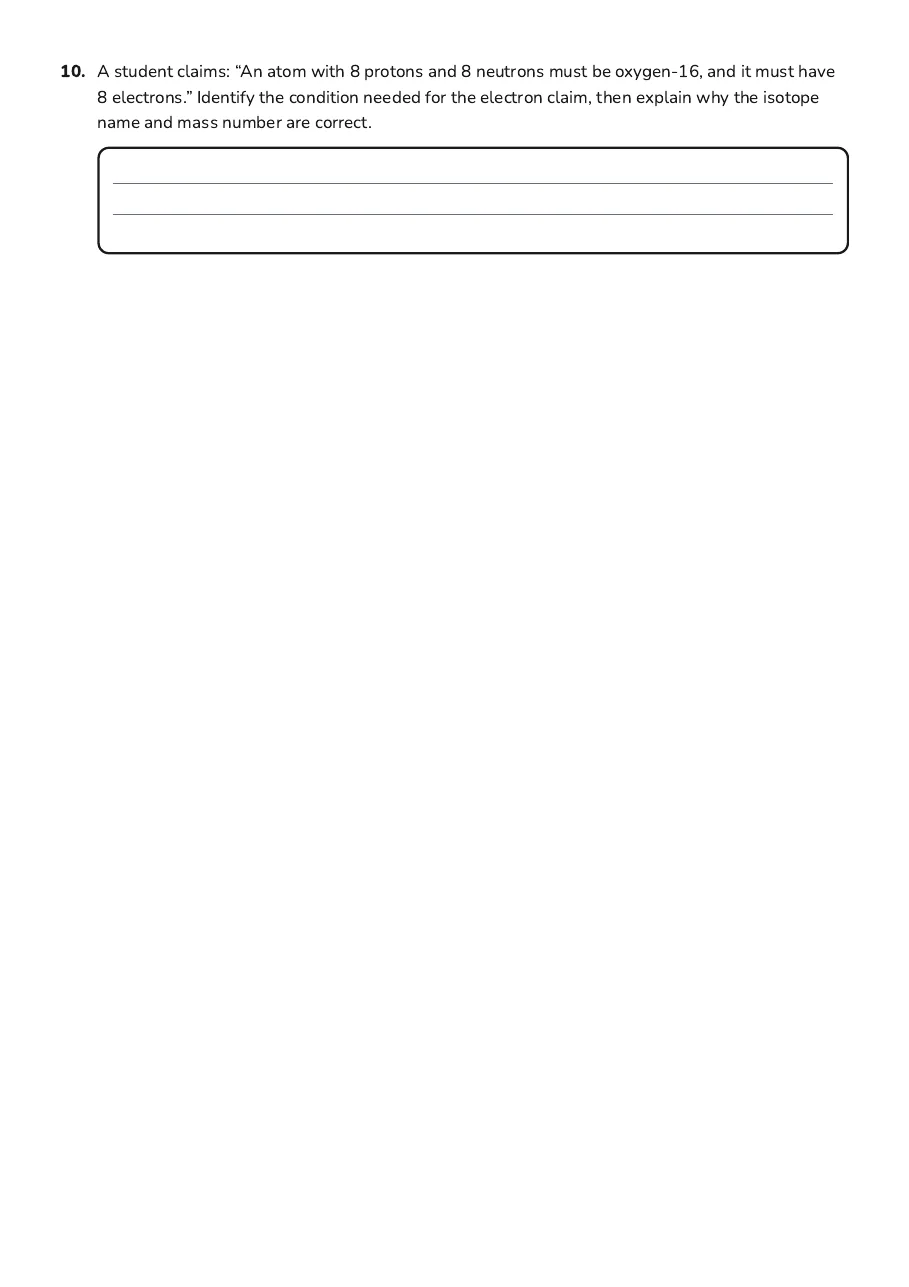
10.A student claims: “An atom with 8 protons and 8 neutrons must be oxygen-16, and it must have 8 electrons.” Identify the condition needed for the electron claim, then explain why the isotope name and mass number are correct.

3 printable pages

  • Building Blocks of Matter, page 1 of 3: The atom at a glance

    Page 1

  • Building Blocks of Matter, page 2 of 3: Matter in the lab

    Page 2

  • Building Blocks of Matter, page 3 of 3: 10. A student claims: “An atom with 8 protons and 8 neutrons must be oxygen-16, and it…

    Page 3

About This Worksheet

Free in Kuraplan

Sign up free, grab the PDF, and customize it for your class.

Print-Ready

Formatted for standard paper. Clean layout, easy to read.

AI-Generated

Created with Kuraplan's AI, designed for real classroom use.

For Teachers & Parents

Use in classrooms, for homework, tutoring, or homeschool.

Need a custom version of this worksheet?

Kuraplan's AI generates custom worksheets in seconds — differentiated for every learner, aligned to your curriculum.

Generate Custom Worksheets — Free
No credit card Curriculum-aligned Under 60 seconds