ScienceFreePrintable
Energy Types and Conservation
A free science worksheet ready for your classroom. Open in Kuraplan to grab the print-ready PDF, customize it for your students, or generate a fresh version in seconds.

Name:Date:
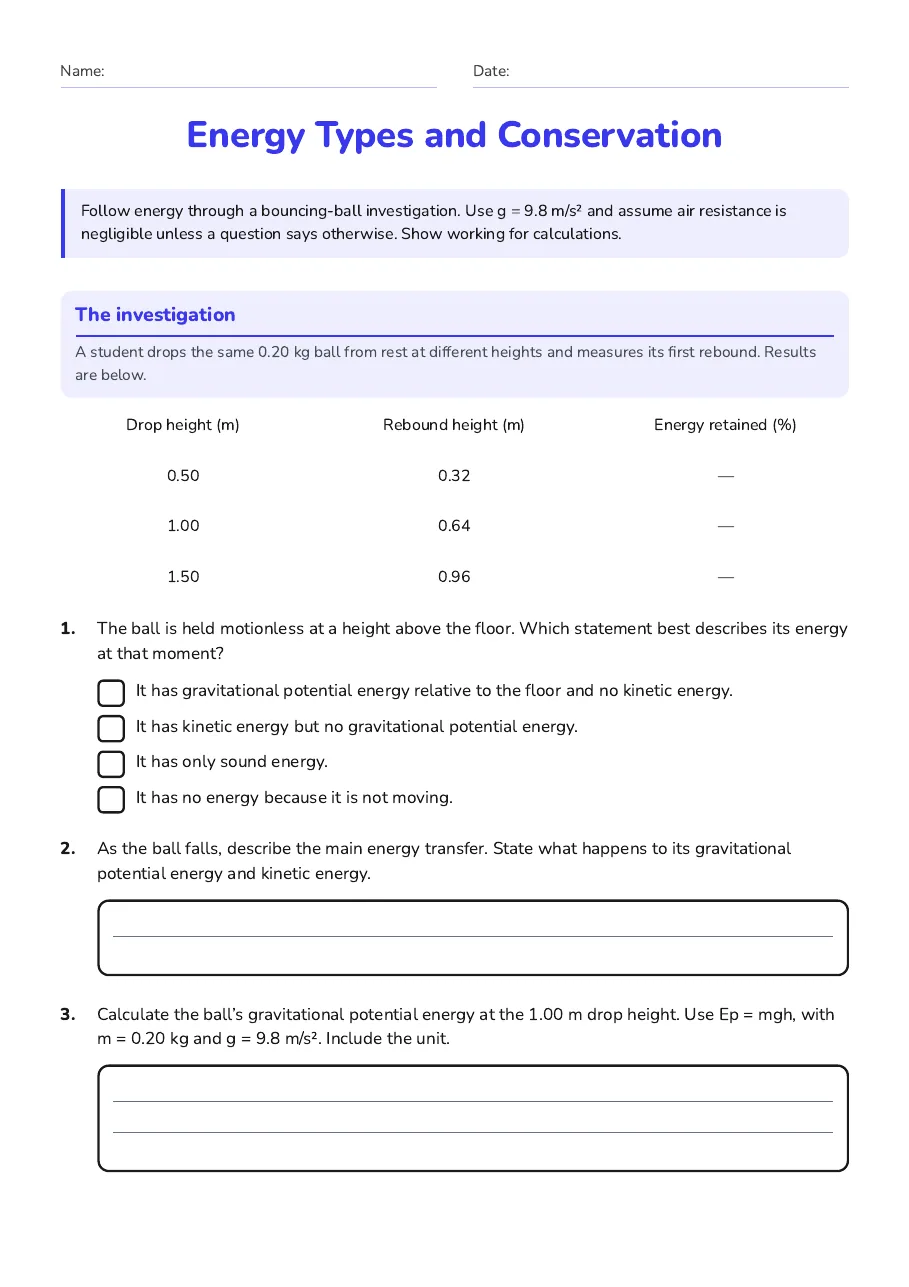
Energy Types and Conservation
Follow energy through a bouncing-ball investigation. Use g = 9.8 m/s² and assume air resistance is negligible unless a question says otherwise. Show working for calculations.
The investigation
A student drops the same 0.20 kg ball from rest at different heights and measures its first rebound. Results are below.
Drop height (m)
Rebound height (m)
Energy retained (%)
0.50
0.32
—
1.00
0.64
—
1.50
0.96
—
1.The ball is held motionless at a height above the floor. Which statement best describes its energy at that moment?
- It has gravitational potential energy relative to the floor and no kinetic energy.
- It has kinetic energy but no gravitational potential energy.
- It has only sound energy.
- It has no energy because it is not moving.
2.As the ball falls, describe the main energy transfer. State what happens to its gravitational potential energy and kinetic energy.
3.Calculate the ball’s gravitational potential energy at the 1.00 m drop height. Use Ep = mgh, with m = 0.20 kg and g = 9.8 m/s². Include the unit.
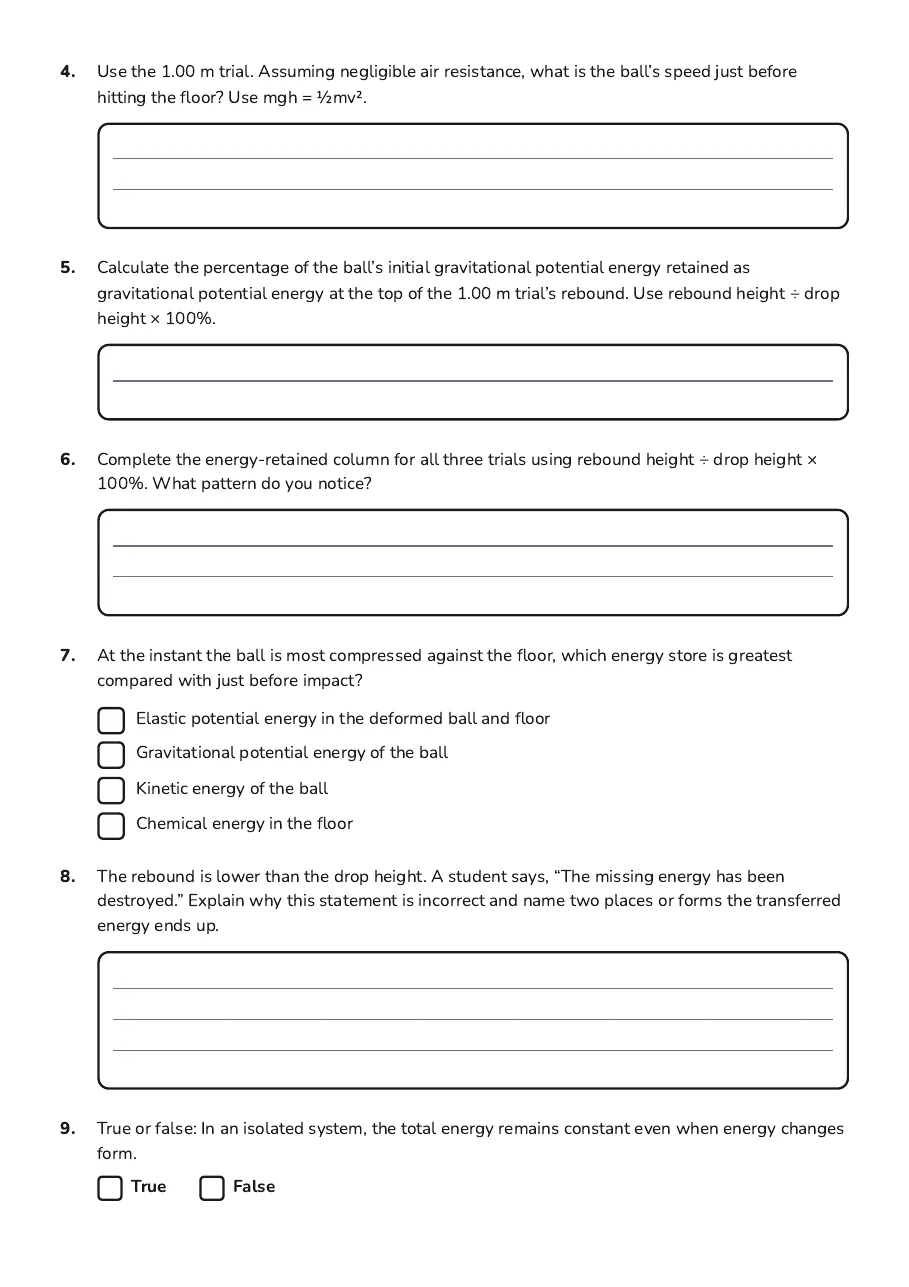
4.Use the 1.00 m trial. Assuming negligible air resistance, what is the ball’s speed just before hitting the floor? Use mgh = ½mv².
5.Calculate the percentage of the ball’s initial gravitational potential energy retained as gravitational potential energy at the top of the 1.00 m trial’s rebound. Use rebound height ÷ drop height × 100%.
6.Complete the energy-retained column for all three trials using rebound height ÷ drop height × 100%. What pattern do you notice?
7.At the instant the ball is most compressed against the floor, which energy store is greatest compared with just before impact?
- Elastic potential energy in the deformed ball and floor
- Gravitational potential energy of the ball
- Kinetic energy of the ball
- Chemical energy in the floor
8.The rebound is lower than the drop height. A student says, “The missing energy has been destroyed.” Explain why this statement is incorrect and name two places or forms the transferred energy ends up.
9.True or false: In an isolated system, the total energy remains constant even when energy changes form.
TrueFalse
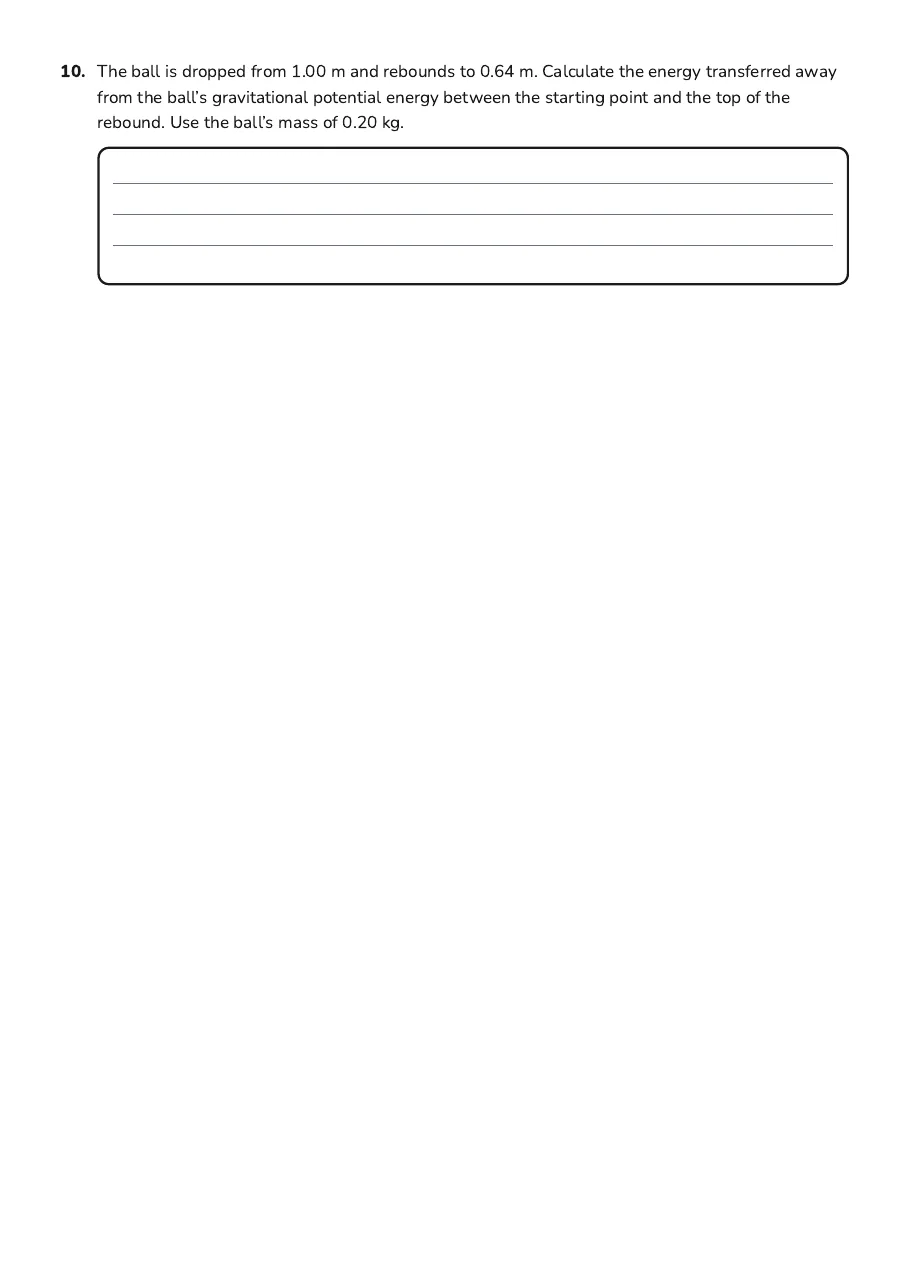
10.The ball is dropped from 1.00 m and rebounds to 0.64 m. Calculate the energy transferred away from the ball’s gravitational potential energy between the starting point and the top of the rebound. Use the ball’s mass of 0.20 kg.
3 printable pages
Page 1
Page 2
Page 3
About This Worksheet
Free in Kuraplan
Sign up free, grab the PDF, and customize it for your class.
Print-Ready
Formatted for standard paper. Clean layout, easy to read.
AI-Generated
Created with Kuraplan's AI, designed for real classroom use.
For Teachers & Parents
Use in classrooms, for homework, tutoring, or homeschool.
Need a custom version of this worksheet?
Kuraplan's AI generates custom worksheets in seconds — differentiated for every learner, aligned to your curriculum.
Generate Custom Worksheets — Free No credit card Curriculum-aligned Under 60 seconds