PEFreePrintable

Fitness Components Overview

A free pe worksheet ready for your classroom. Open in Kuraplan to grab the print-ready PDF, customize it for your students, or generate a fresh version in seconds.
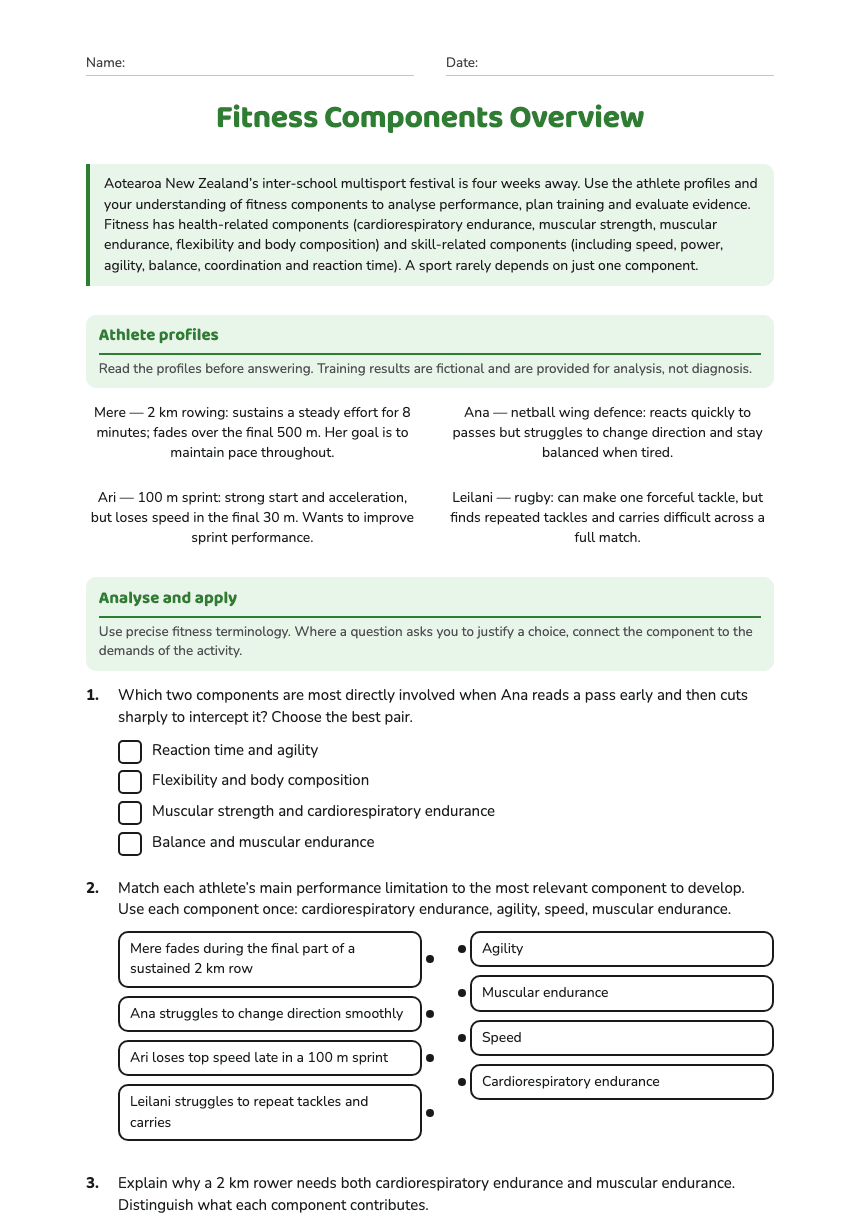
Fitness Components Overview worksheet preview
Name:Date:

Fitness Components Overview

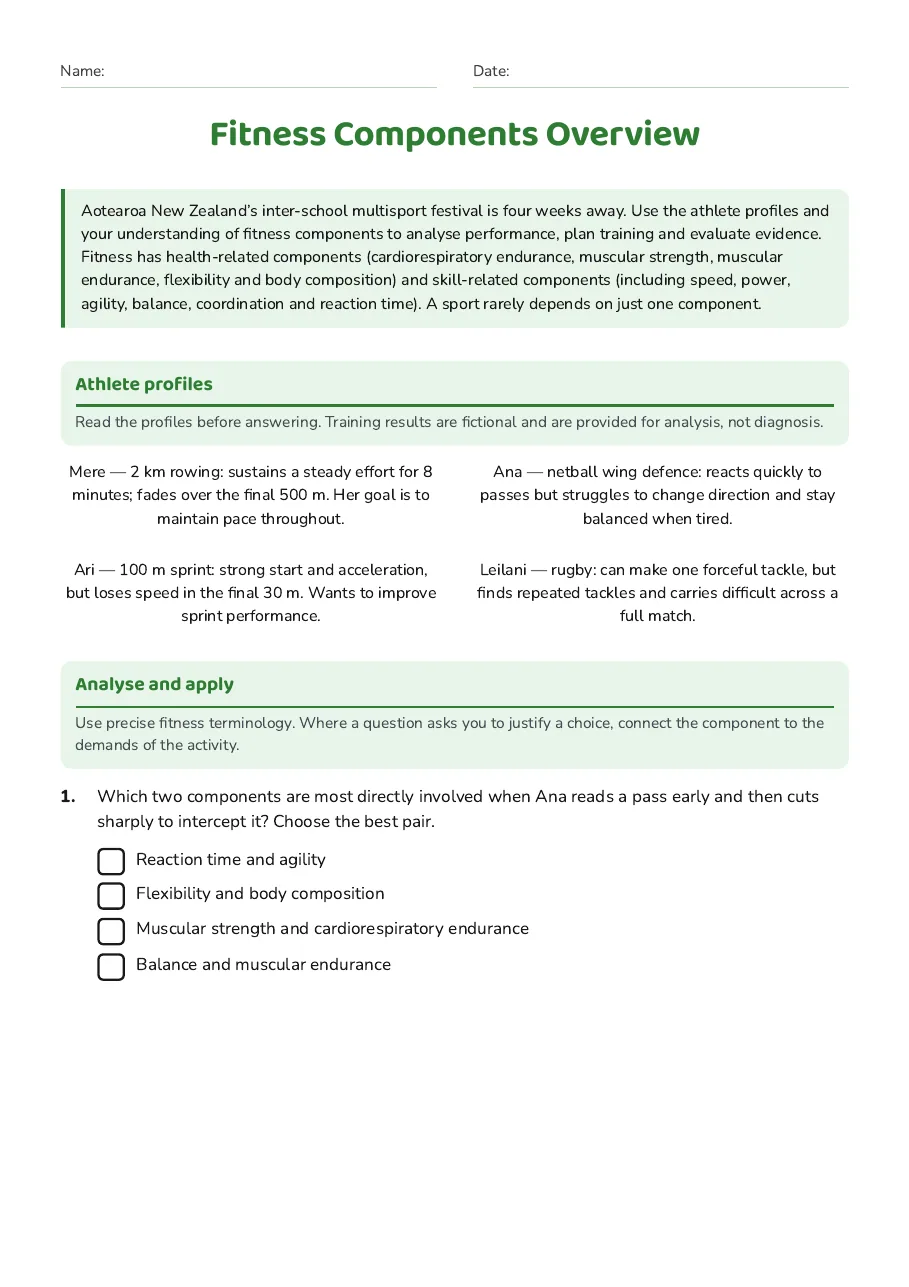
Aotearoa New Zealand’s inter-school multisport festival is four weeks away. Use the athlete profiles and your understanding of fitness components to analyse performance, plan training and evaluate evidence. Fitness has health-related components (cardiorespiratory endurance, muscular strength, muscular endurance, flexibility and body composition) and skill-related components (including speed, power, agility, balance, coordination and reaction time). A sport rarely depends on just one component.

Athlete profiles

Read the profiles before answering. Training results are fictional and are provided for analysis, not diagnosis.

Mere — 2 km rowing: sustains a steady effort for 8 minutes; fades over the final 500 m. Her goal is to maintain pace throughout.

Ana — netball wing defence: reacts quickly to passes but struggles to change direction and stay balanced when tired.

Ari — 100 m sprint: strong start and acceleration, but loses speed in the final 30 m. Wants to improve sprint performance.

Leilani — rugby: can make one forceful tackle, but finds repeated tackles and carries difficult across a full match.

Analyse and apply

Use precise fitness terminology. Where a question asks you to justify a choice, connect the component to the demands of the activity.

1.Which two components are most directly involved when Ana reads a pass early and then cuts sharply to intercept it? Choose the best pair.
  • Reaction time and agility
  • Flexibility and body composition
  • Muscular strength and cardiorespiratory endurance
  • Balance and muscular endurance
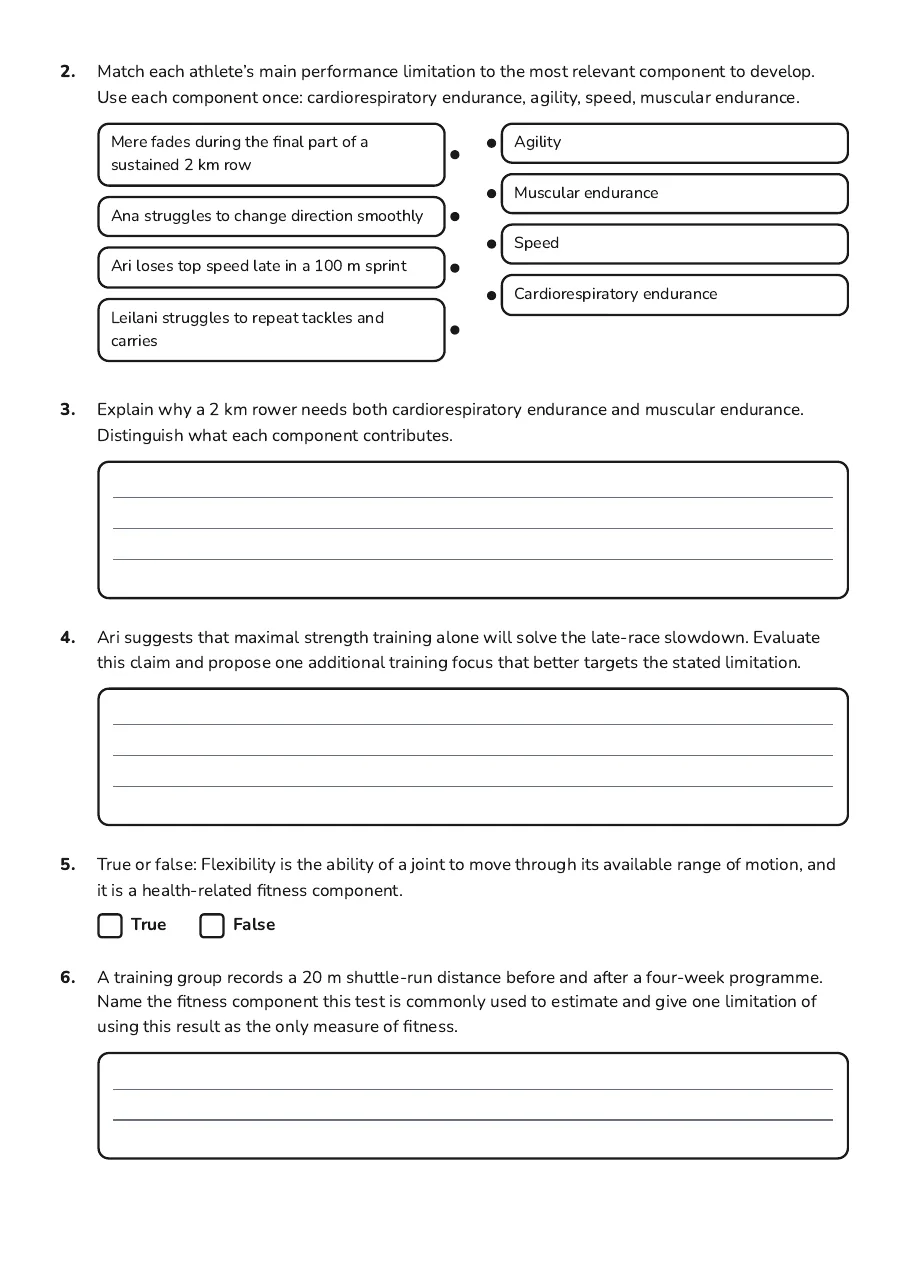
2.Match each athlete’s main performance limitation to the most relevant component to develop. Use each component once: cardiorespiratory endurance, agility, speed, muscular endurance.
  • Mere fades during the final part of a sustained 2 km row
  • Ana struggles to change direction smoothly
  • Ari loses top speed late in a 100 m sprint
  • Leilani struggles to repeat tackles and carries
  • Agility
  • Muscular endurance
  • Speed
  • Cardiorespiratory endurance
3.Explain why a 2 km rower needs both cardiorespiratory endurance and muscular endurance. Distinguish what each component contributes.
4.Ari suggests that maximal strength training alone will solve the late-race slowdown. Evaluate this claim and propose one additional training focus that better targets the stated limitation.
5.True or false: Flexibility is the ability of a joint to move through its available range of motion, and it is a health-related fitness component.
TrueFalse
6.A training group records a 20 m shuttle-run distance before and after a four-week programme. Name the fitness component this test is commonly used to estimate and give one limitation of using this result as the only measure of fitness.
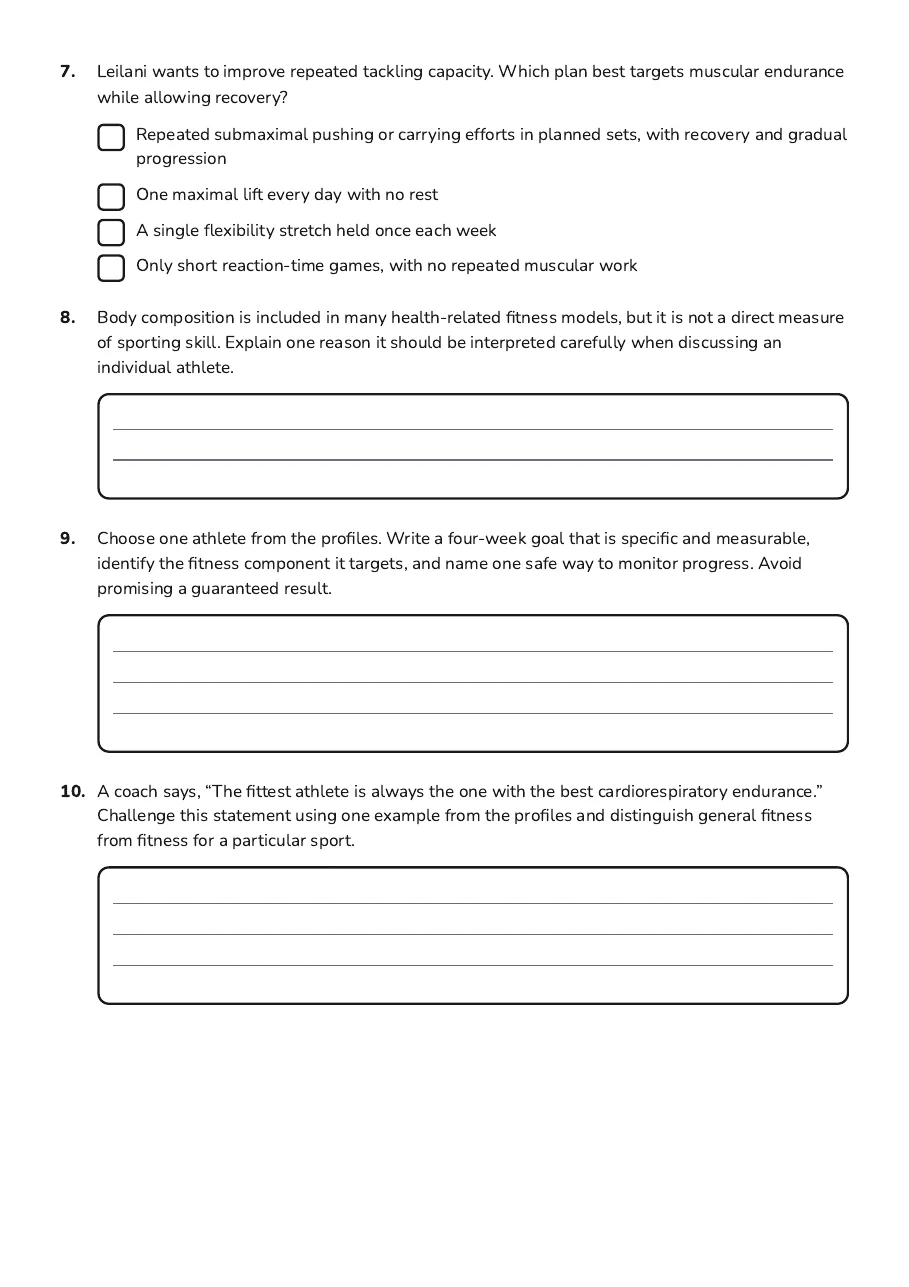
7.Leilani wants to improve repeated tackling capacity. Which plan best targets muscular endurance while allowing recovery?
  • Repeated submaximal pushing or carrying efforts in planned sets, with recovery and gradual progression
  • One maximal lift every day with no rest
  • A single flexibility stretch held once each week
  • Only short reaction-time games, with no repeated muscular work
8.Body composition is included in many health-related fitness models, but it is not a direct measure of sporting skill. Explain one reason it should be interpreted carefully when discussing an individual athlete.
9.Choose one athlete from the profiles. Write a four-week goal that is specific and measurable, identify the fitness component it targets, and name one safe way to monitor progress. Avoid promising a guaranteed result.
10.A coach says, “The fittest athlete is always the one with the best cardiorespiratory endurance.” Challenge this statement using one example from the profiles and distinguish general fitness from fitness for a particular sport.

3 printable pages

  • Fitness Components Overview, page 1 of 3: Athlete profiles, Analyse and apply

    Page 1

  • Fitness Components Overview, page 2 of 3: 2. Match each athlete’s main performance limitation to the most relevant component to…

    Page 2

  • Fitness Components Overview, page 3 of 3: 7. Leilani wants to improve repeated tackling capacity. Which plan best targets muscular…

    Page 3

About This Worksheet

Free in Kuraplan

Sign up free, grab the PDF, and customize it for your class.

Print-Ready

Formatted for standard paper. Clean layout, easy to read.

AI-Generated

Created with Kuraplan's AI, designed for real classroom use.

For Teachers & Parents

Use in classrooms, for homework, tutoring, or homeschool.

Need a custom version of this worksheet?

Kuraplan's AI generates custom worksheets in seconds — differentiated for every learner, aligned to your curriculum.

Generate Custom Worksheets — Free
No credit card Curriculum-aligned Under 60 seconds

Explore more free resources