ScienceFreePrintable

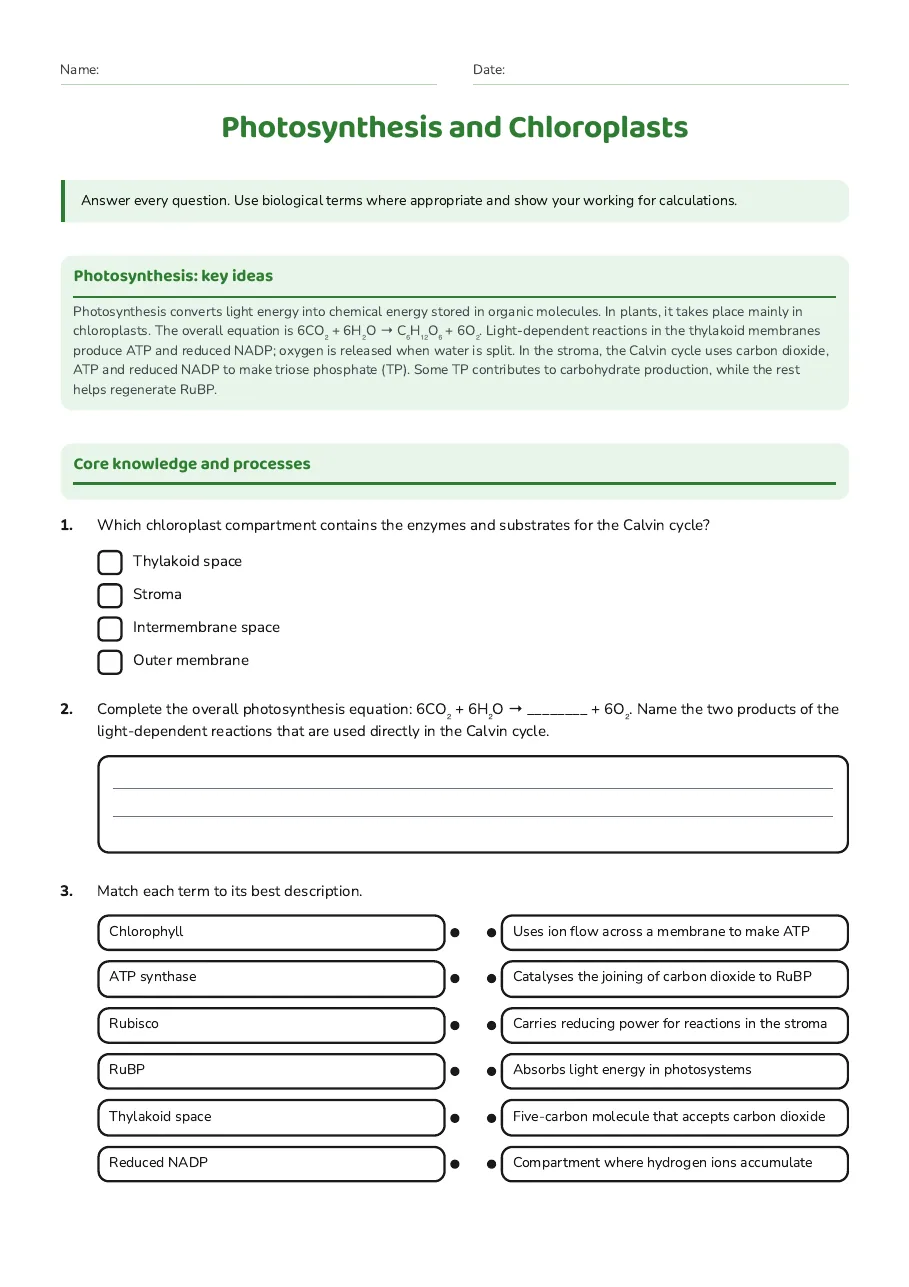
Photosynthesis and Chloroplasts

A free science worksheet ready for your classroom. Open in Kuraplan to grab the print-ready PDF, customize it for your students, or generate a fresh version in seconds.
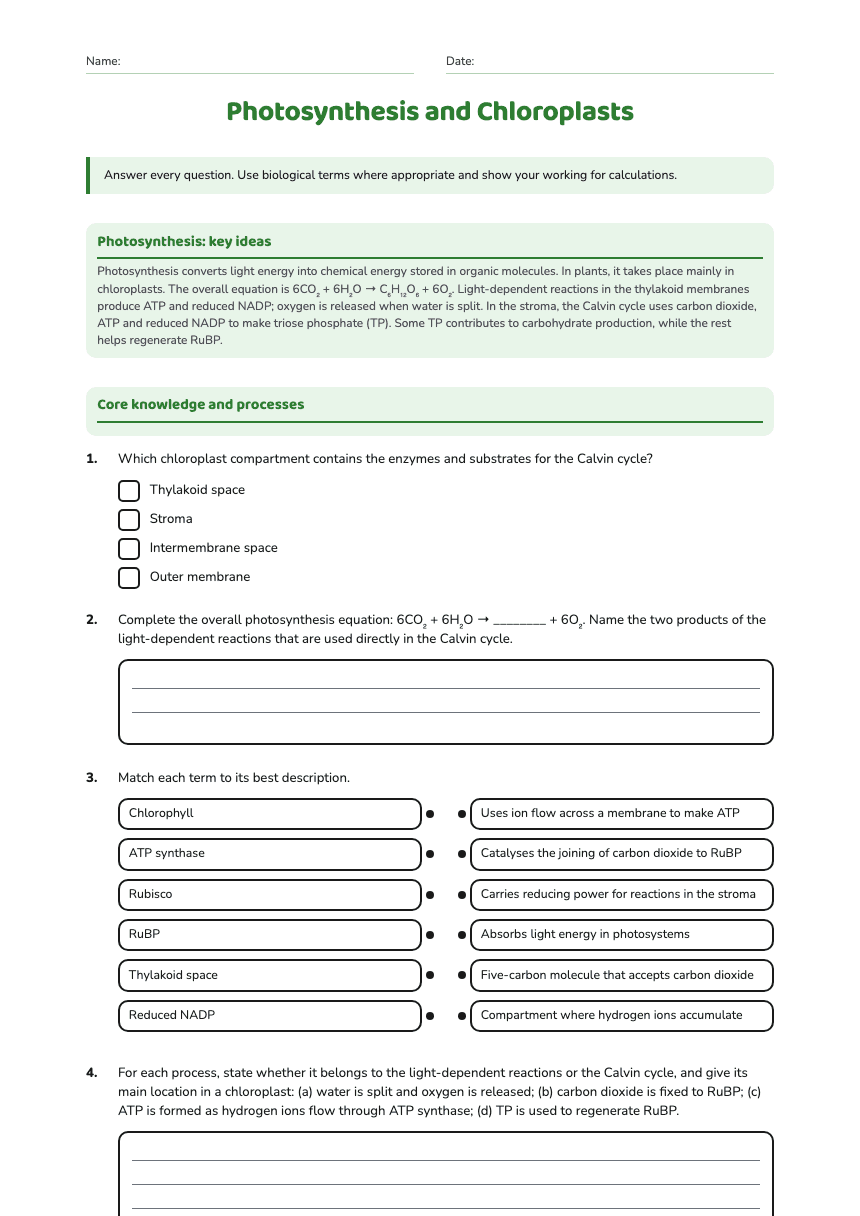
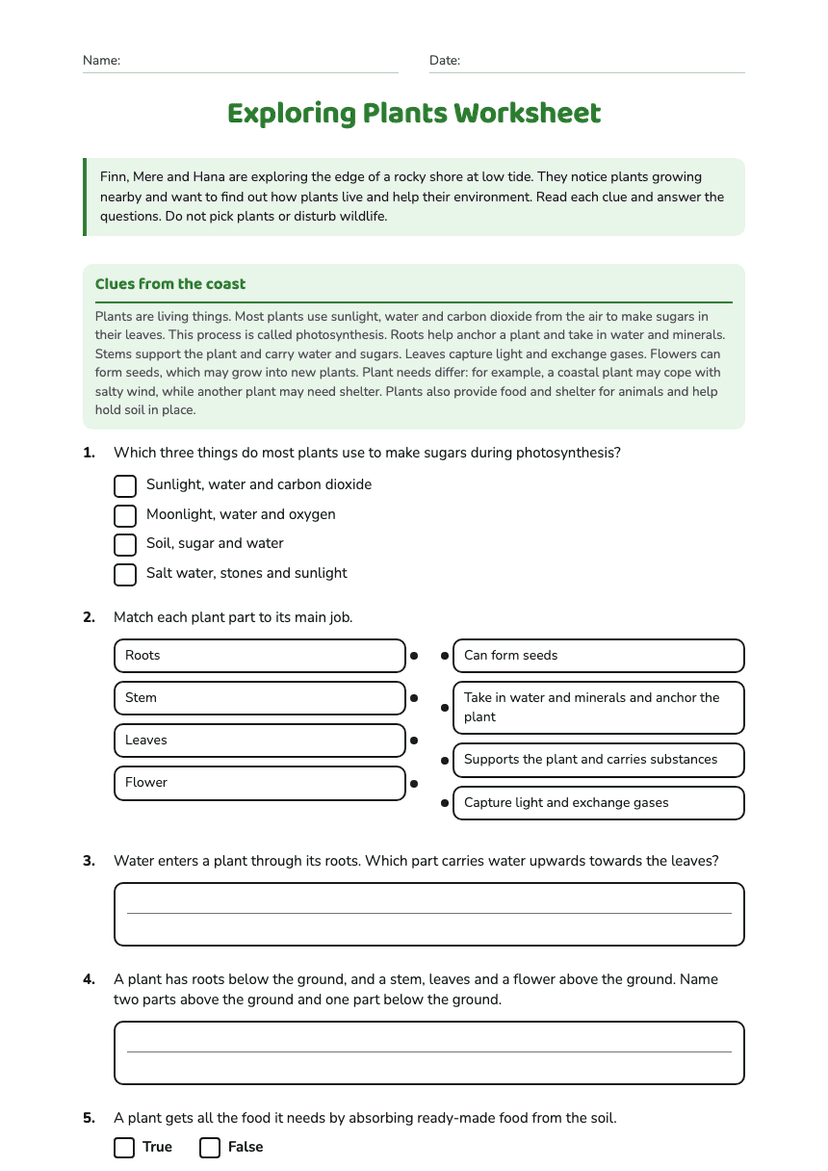
Photosynthesis and Chloroplasts worksheet preview

Photosynthesis and the Chloroplast

Worksheet illustration

Part 1: Revision Notes and Core Knowledge

Photosynthesis is an enzyme-controlled process in which light energy is converted into chemical energy. In plants, this energy is used to synthesise carbohydrates from carbon dioxide and water. Photosynthesis occurs mainly in the chloroplasts of mesophyll cells.

Balanced word equation: carbon dioxide + water → glucose + oxygen

Balanced symbol equation: 6CO2 + 6H2O → C6H12O6 + 6O2

Chloroplasts are surrounded by an outer membrane and an inner membrane. The fluid-filled stroma contains enzymes, chloroplast DNA, ribosomes, and substances required for carbon fixation. The internal membrane system consists of flattened sacs called thylakoids. Stacks of thylakoids are called grana, and grana are connected by stroma lamellae. The thylakoid membrane contains chlorophyll, photosystems, electron carriers, and ATP synthase.

In the light-dependent reactions, photons are absorbed by chlorophyll in photosystems located in the thylakoid membrane. In photosystem II, light energy excites electrons and causes water to split by photolysis. Oxygen is released, while hydrogen ions and electrons are supplied to the reaction pathway. Electrons pass along an electron transport chain. Their energy is used to pump hydrogen ions into the thylakoid space, creating an electrochemical gradient.

Hydrogen ions diffuse back through ATP synthase by chemiosmosis. The energy released drives the phosphorylation of ADP to form ATP. In photosystem I, light re-excites electrons, which are transferred to NADP+ to form reduced NADP, also called NADPH. ATP and reduced NADP provide energy and reducing power for the Calvin cycle.

The Calvin cycle occurs in the stroma. Carbon dioxide combines with ribulose bisphosphate (RuBP) in a reaction catalysed by rubisco. The unstable six-carbon intermediate splits into two molecules of glycerate 3-phosphate (GP). ATP and reduced NADP are used to reduce GP to triose phosphate (TP). Some TP is used to form carbohydrates, while the remainder regenerates RuBP so the cycle can continue.

1. Which organelle is the main site of photosynthesis?

Nucleus

Chloroplast

Ribosome

Vacuole

2. Complete the equations and identify the main products used directly in the Calvin cycle.

Word equation: carbon dioxide + ____________ → glucose + ____________

Symbol equation: 6CO2 + 6H2O → ____________ + 6O2

The light-dependent reactions produce ____________ and reduced ____________, which are used in the Calvin cycle.

3. Match each structure, substance, or process with its role.
A. Chlorophyll
B. Thylakoid membrane
C. ATP synthase
D. Reduced NADP
E. Rubisco
F. RuBP
1. Five-carbon molecule that combines with carbon dioxide
2. Absorbs photons and transfers excited electrons
3. Enzyme that catalyses carbon dioxide fixation
4. Site of photosystems, electron carriers, and the proton gradient
5. Uses the proton gradient to form ATP
6. Provides reducing power for the Calvin cycle
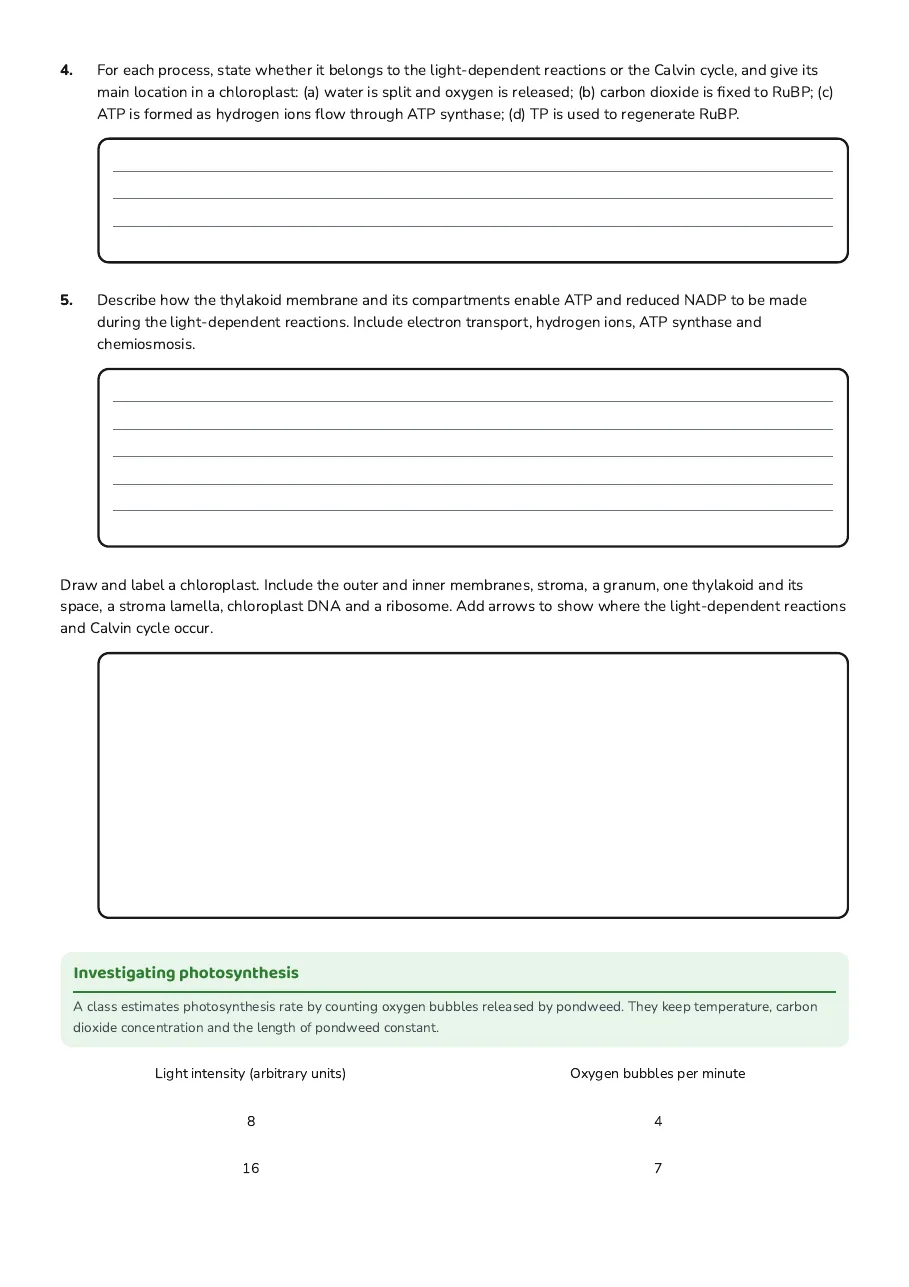
4. For each statement, choose light-dependent reactions or Calvin cycle. Where appropriate, include the relevant chloroplast location.

a) Occurs mainly in the stroma: ____________________

b) Uses photosystems embedded in a membrane: ____________________

c) Splits water and releases oxygen: ____________________

d) Uses ATP and reduced NADP to produce triose phosphate: ____________________

e) Regenerates RuBP: ____________________

f) Forms ATP by chemiosmosis: ____________________

Part 2: Chloroplasts, Reactions, Factors and Applications

5. Draw and clearly label a chloroplast. Include: outer membrane, inner membrane, intermembrane space, stroma, granum or grana, thylakoid, thylakoid space, stroma lamella, chloroplast DNA, and ribosome. Use arrows to indicate where the light-dependent reactions and Calvin cycle occur.
6. Explain how the structure of the thylakoid membrane allows ATP and reduced NADP to be produced during the light-dependent reactions. Your answer should refer to photosystems, electron carriers, hydrogen ions, the proton gradient, ATP synthase, and chemiosmosis.
7. A student investigates how light intensity affects the rate of photosynthesis. Temperature, carbon dioxide concentration, and the volume of plant material are kept constant.

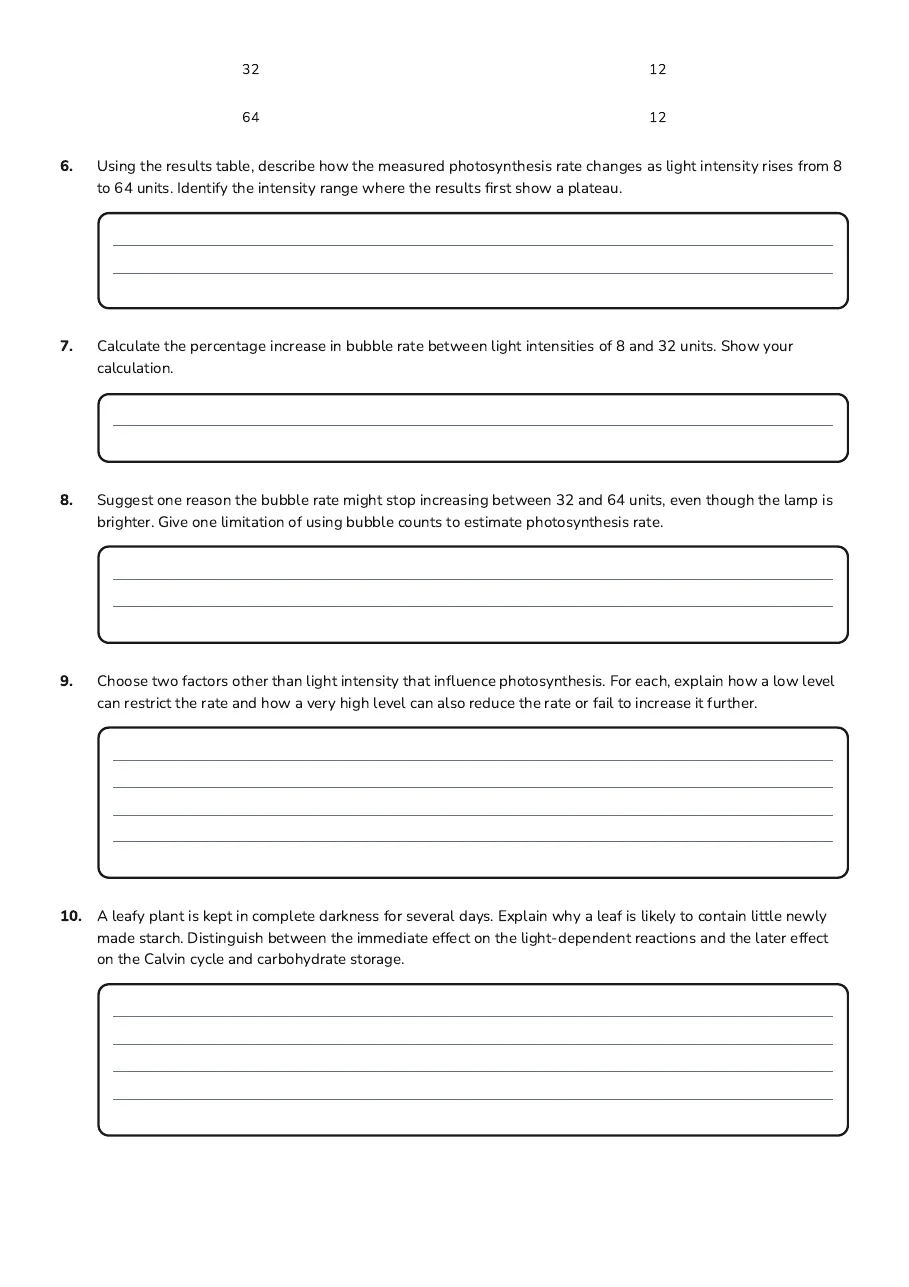
Results: light intensity 10 units = 3 bubbles per minute; 20 units = 6 bubbles per minute; 40 units = 10 bubbles per minute; 80 units = 10 bubbles per minute.

a) Describe the relationship between light intensity and the rate of photosynthesis.

b) Calculate the percentage increase in rate between 10 and 40 units.

c) Explain why the rate does not increase between 40 and 80 units.

d) Identify one limitation of using bubble production as a measure of photosynthesis.

8. Name two other factors that can affect the rate of photosynthesis. For each factor, explain how a low value and an excessively high value could affect the rate, referring to enzymes, stomata, or limiting factors where relevant.
9. Explain why a plant kept in darkness for several days would produce little or no starch in its leaves. Distinguish between the immediate effect on the light-dependent reactions and the longer-term effect on the Calvin cycle and carbohydrate storage.
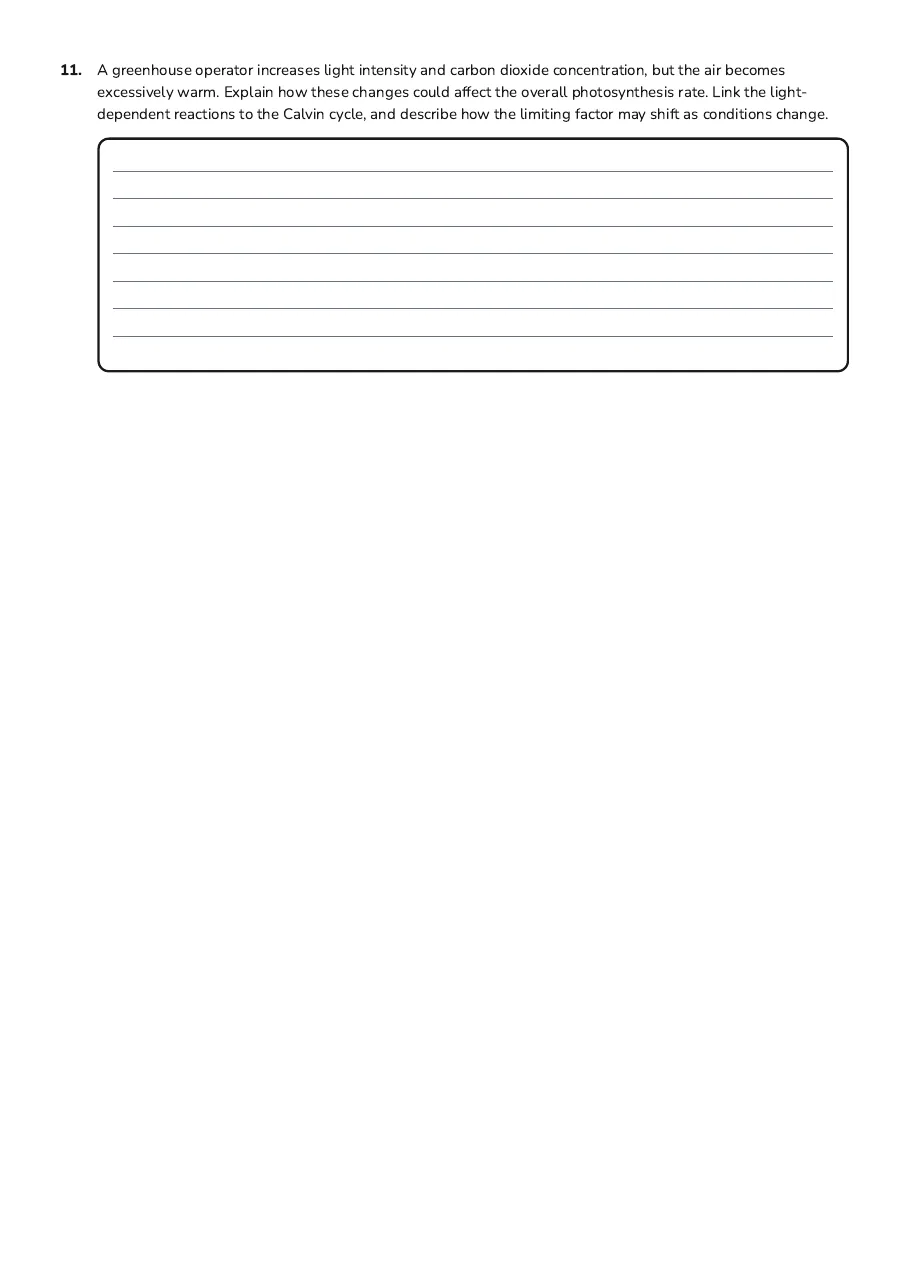
10. Merit/Excellence-style extended response: A greenhouse grower increases light intensity and carbon dioxide concentration, but the temperature becomes too high. Explain how these changes could affect the rate of photosynthesis. Use detailed cause-and-effect reasoning, refer to both stages of photosynthesis, and explain how limiting factors may change as conditions change.

Teacher Answer Key and Marking Guide

1. Chloroplast.

2. Water; oxygen; C6H12O6; ATP; NADP. Accept “reduced NADP” or “NADPH” for the final blank. Award credit for correctly completing the balanced equations.

3. A–2, B–4, C–5, D–6, E–3, F–1.

4. a) Calvin cycle; b) light-dependent reactions; c) light-dependent reactions; d) Calvin cycle; e) Calvin cycle; f) light-dependent reactions. The light-dependent reactions occur in the thylakoid membranes; the Calvin cycle occurs in the stroma.

5. Award credit for a clearly labelled chloroplast showing an outer and inner membrane, intermembrane space, stroma, grana, individual thylakoids, thylakoid space, stroma lamellae, chloroplast DNA, and ribosomes. The light-dependent reactions should be located in the thylakoid membranes. The Calvin cycle should be located in the stroma. Higher-level responses should link the compartmentalisation of the chloroplast to the separate conditions required for electron transport and carbon fixation.

6. Light excites electrons in photosystem II. Water undergoes photolysis, replacing the lost electrons and producing oxygen and hydrogen ions. Electrons move through carriers in the thylakoid membrane, and energy released is used to pump hydrogen ions into the thylakoid space. This creates a proton or electrochemical gradient across the membrane. Hydrogen ions diffuse back into the stroma through ATP synthase, and the energy released drives ADP phosphorylation to form ATP. Light re-excites electrons in photosystem I, and the electrons reduce NADP+ to reduced NADP. The membrane is selectively permeable and maintains the gradient needed for chemiosmosis.

7. a) The rate increases from 3 to 10 bubbles per minute as light intensity rises from 10 to 40 units, then reaches a plateau at 10 bubbles per minute between 40 and 80 units. b) Percentage increase = (10 − 3) ÷ 3 × 100 = approximately 233%. c) At 40 units, light is no longer the limiting factor. Carbon dioxide concentration, temperature, enzyme activity, or another factor limits the rate, so extra light cannot increase the rate under these conditions. d) Bubble size may vary, bubbles may combine or be missed, and oxygen solubility can change with temperature; therefore bubble number is only an indirect estimate of oxygen production.

8. Accept carbon dioxide concentration and temperature. Low carbon dioxide limits the substrate available for rubisco and the Calvin cycle. Increasing carbon dioxide may increase the rate until another factor becomes limiting; very high concentrations may eventually have little further effect. Low temperature reduces enzyme activity and slows the Calvin cycle. High temperature can alter enzyme shape, increase photorespiration, and cause stomata to close, reducing carbon dioxide entry and increasing water conservation. Other scientifically valid factors may be accepted with appropriate explanations.

9. In darkness, chlorophyll cannot absorb photons, so the light-dependent reactions stop or greatly slow. Water is not split at the normal rate, the electron transport chain is not maintained, and production of ATP and reduced NADP falls. Without sufficient ATP and reduced NADP, the Calvin cycle cannot continue at its normal rate, even if carbon dioxide is available. Less triose phosphate and glucose are produced, so less glucose is converted into starch for storage. Respiration may also continue to use existing carbohydrate reserves.

10. Increasing light intensity can increase the rate when light is limiting because more photons excite electrons in the photosystems, increasing electron transport, proton pumping, ATP production, and reduced NADP formation. Increasing carbon dioxide can increase the Calvin cycle rate when carbon dioxide is limiting because more substrate is available for rubisco and carbon fixation. However, if temperature becomes too high, photosynthetic enzymes may lose their functional shape or operate less efficiently. High temperature can also increase photorespiration and cause stomata to close, reducing carbon dioxide entry and limiting the Calvin cycle. As temperature becomes limiting, further increases in light or carbon dioxide produce little additional increase. A high-quality response links the light-dependent reactions and Calvin cycle through ATP and reduced NADP, explains the changing limiting factors, and gives a coherent cause-and-effect sequence.

About This Worksheet

Free in Kuraplan

Sign up free, grab the PDF, and customize it for your class.

Print-Ready

Formatted for standard paper. Clean layout, easy to read.

AI-Generated

Created with Kuraplan's AI, designed for real classroom use.

For Teachers & Parents

Use in classrooms, for homework, tutoring, or homeschool.

Need a custom version of this worksheet?

Kuraplan's AI generates custom worksheets in seconds — differentiated for every learner, aligned to your curriculum.

Generate Custom Worksheets — Free
No credit card Curriculum-aligned Under 60 seconds