HealthFreePrintable

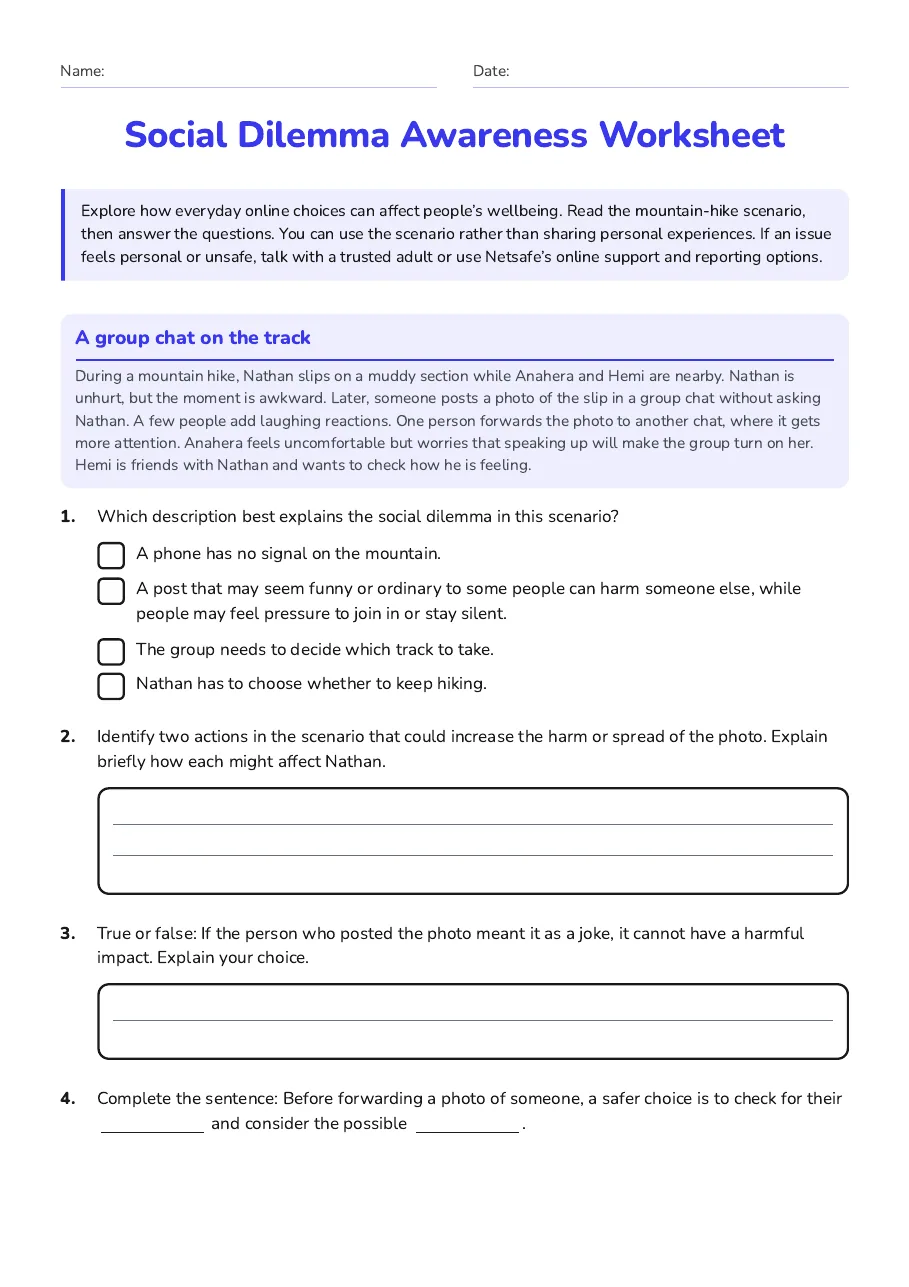
Social Dilemma Awareness Worksheet

A free health worksheet ready for your classroom. Open in Kuraplan to grab the print-ready PDF, customize it for your students, or generate a fresh version in seconds.
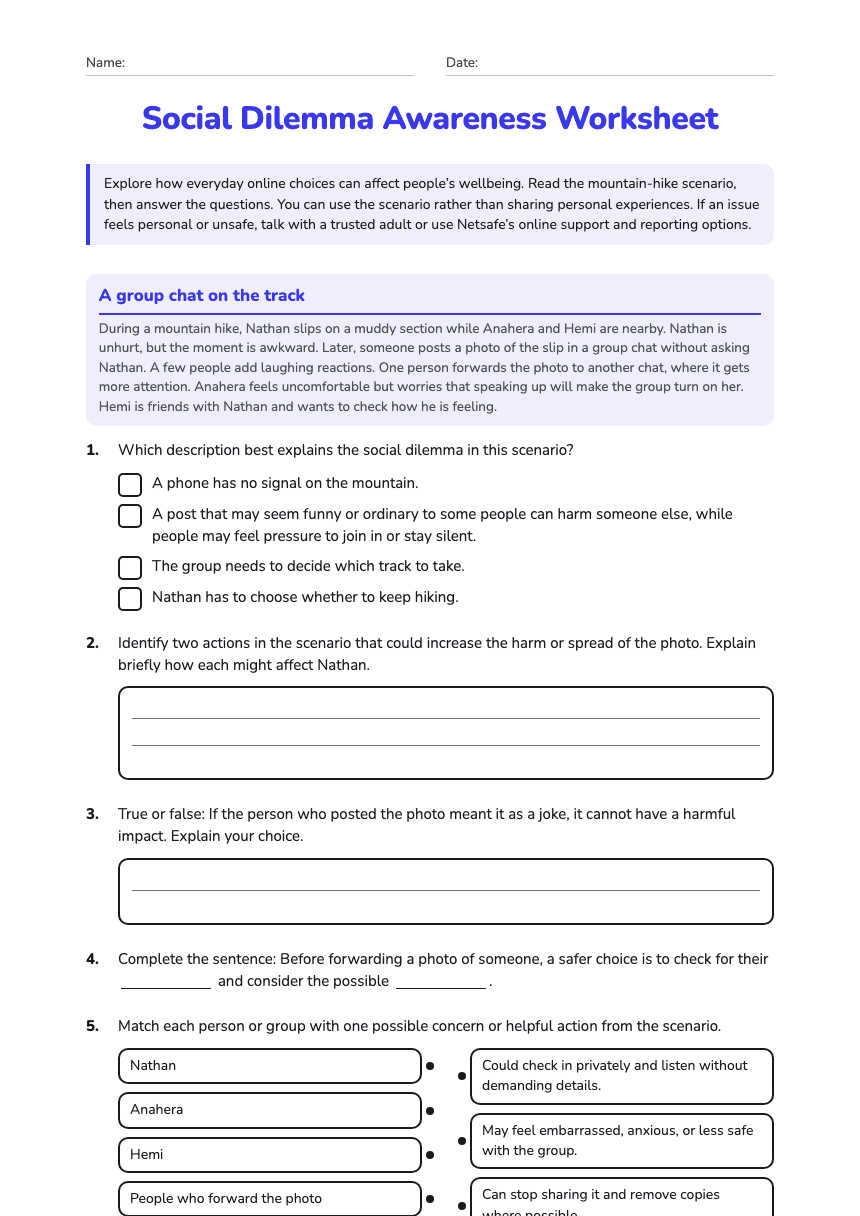
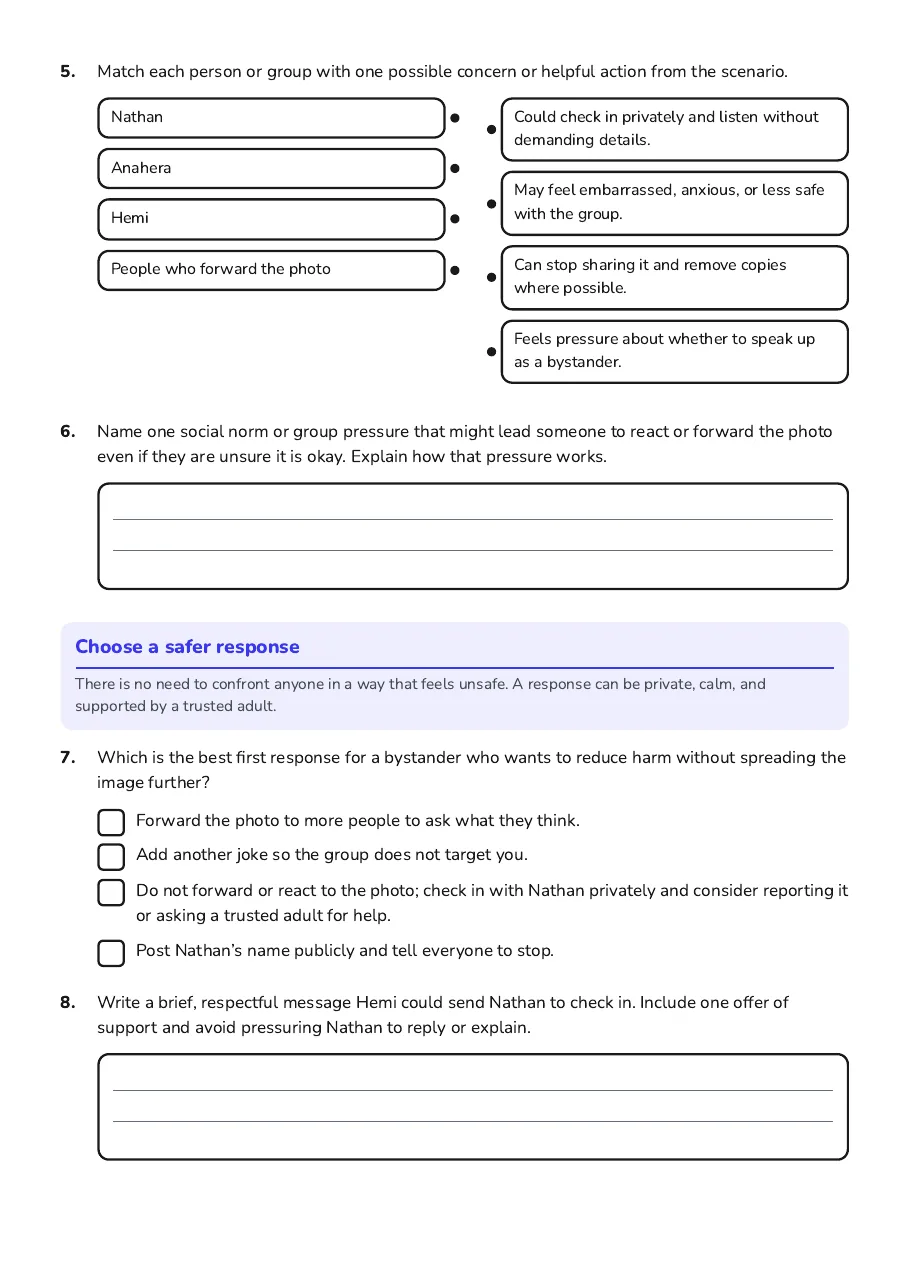
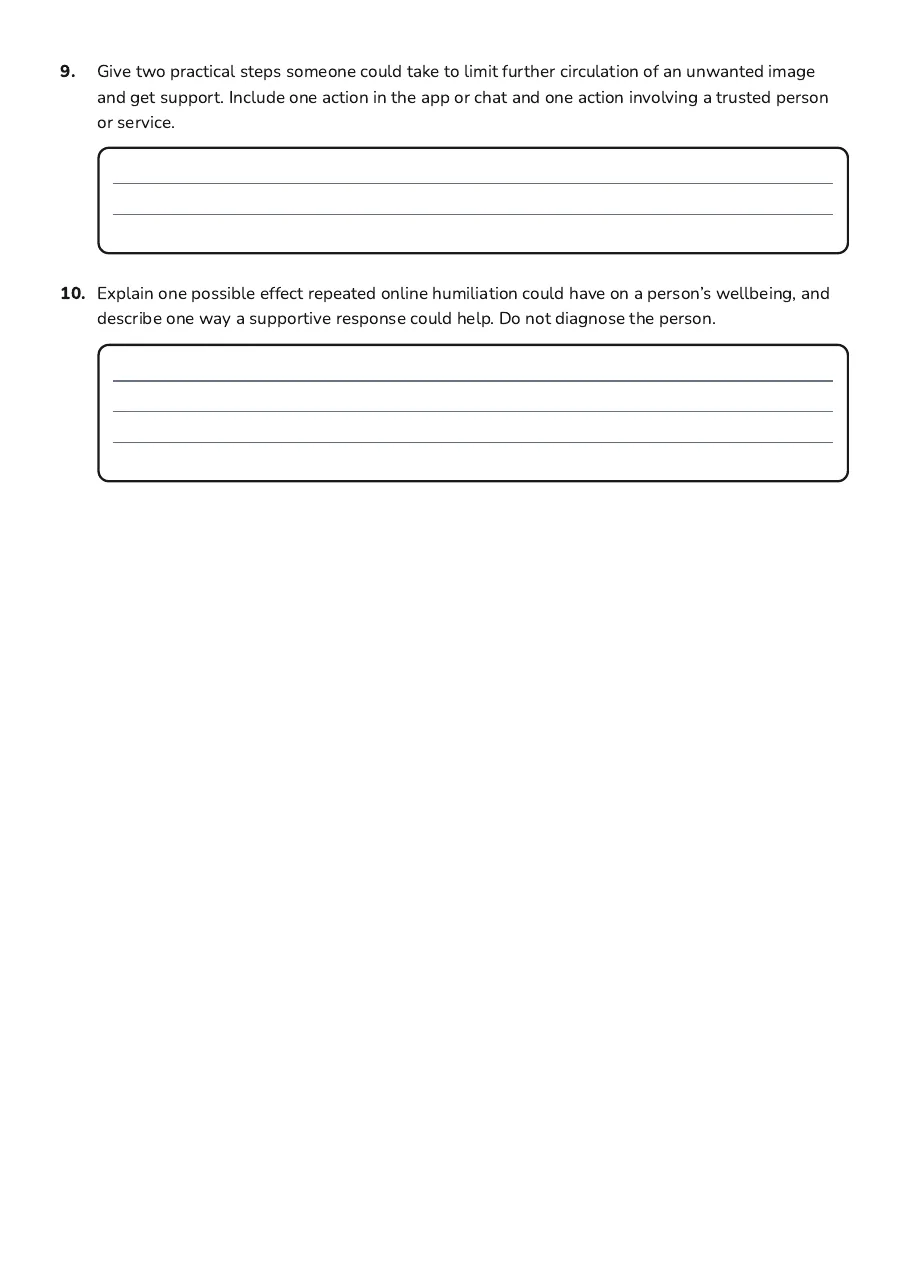
Social Dilemma Awareness Worksheet worksheet preview

Social Dilemma Awareness Worksheet

Digital safety and social media awareness illustration

📱 Part 1: Understanding Social Dilemmas Online

1. What does "social dilemma" mean in an online context?

When people disagree about social issues online

When actions that seem normal online can create harmful impacts for others

When social media platforms have technical problems

When people spend too much time on social media

2. Which factors can make online harm worse? (Select all that apply)

Screenshots being shared

Many people seeing the content

Bystanders not responding

Using privacy settings

Platform algorithms spreading content

3. Complete this sentence: "Online platforms can encourage harmful behaviour because they reward _____________ and make people want to _____________ social expectations."

Answer: _________________ and _________________

4. List two potential mental health impacts of harmful digital communication:

🔍 Part 2: Scenario Analysis

Scenario: A student posts an embarrassing photo of a classmate without permission in a group chat. Several people screenshot it and share it to other groups. The photo spreads to multiple year levels at school.

5. Complete this "Harm Ladder" for the scenario above:

What happened (facts only):

Who is affected (direct and indirect):

Likely mental health impacts:

6. What social norms might have influenced people's behaviour in this scenario?

🛡️ Part 3: Protective Responses

7. If you were a bystander in the scenario above, write a "safer response plan" using these sentence starters:

"I would not share because..."

"I would support the person by..."

"I would report/block/make a record by..."

8. Reflect on your own social media use. Describe one situation where you've seen or experienced a social dilemma online:
9. What is one protective strategy you will use in future online interactions and why does it matter for mental health?

📋 Answer Key & Teaching Notes

Question 1 Answer:

✓ When actions that seem normal online can create harmful impacts for others

Teaching note: This definition emphasizes the disconnect between intention and impact in digital spaces.

Question 2 Answers:

✓ Screenshots being shared
✓ Many people seeing the content
✓ Bystanders not responding
✓ Platform algorithms spreading content

Teaching note: "Using privacy settings" is protective, not harmful. Discuss how these factors amplify harm exponentially.

Question 3 Sample Answers:

First blank: engagement/likes/shares/shocking content/extreme behaviour
Second blank: push against/break/challenge/ignore

Teaching note: Accept variations that show understanding of how platforms incentivize attention-seeking behaviour.

Question 4 Sample Answers:

• Anxiety and stress
• Depression and low self-esteem
• Social isolation and withdrawal
• Sleep disruption
• Academic performance decline
• Trust issues

Teaching note: Accept any two relevant mental health impacts with brief explanation.

Question 5 - Harm Ladder Guidance:

What happened: Student shared embarrassing photo without consent, others screenshot and redistributed it across multiple school groups

Who is affected: Direct - person in photo; Indirect - original poster, sharers, viewers, friends/family of victim

Mental health impacts: Humiliation, anxiety, loss of trust, social isolation, potential depression, school avoidance

Question 6 Sample Answers:

• "Everyone shares funny content"
• "It's normal to screenshot things"
• "If it's already posted, it's fair game"
• "Staying silent to avoid drama"
• "FOMO - fear of missing out on gossip"

Question 7 - Response Plan Guidance:

"I would not share because..." it violates consent, causes harm, spreads without context, etc.

"I would support the person by..." checking in privately, encouraging them to seek help, not engaging with the content

"I would report/block/make a record by..." reporting to platform, telling trusted adult, documenting evidence

Questions 8-9 Assessment Criteria:

Question 8: Look for personal reflection showing understanding of social dilemmas, consideration of multiple perspectives, and recognition of harm potential.

Question 9: Assess for specific, realistic strategies (e.g., pause before sharing, check consent, support others) with clear connection to mental health outcomes.

Extension Discussion Points:

• How do platform design features influence our behaviour?
• What's the difference between intent and impact online?
• How can schools create better digital citizenship cultures?
• What role do bystanders play in online harm prevention?

About This Worksheet

Free in Kuraplan

Sign up free, grab the PDF, and customize it for your class.

Print-Ready

Formatted for standard paper. Clean layout, easy to read.

AI-Generated

Created with Kuraplan's AI, designed for real classroom use.

For Teachers & Parents

Use in classrooms, for homework, tutoring, or homeschool.

Need a custom version of this worksheet?

Kuraplan's AI generates custom worksheets in seconds — differentiated for every learner, aligned to your curriculum.

Generate Custom Worksheets — Free
No credit card Curriculum-aligned Under 60 seconds