HealthFreePrintable

Ten-Week Wellbeing Workbook

A free health worksheet ready for your classroom. Open in Kuraplan to grab the print-ready PDF, customize it for your students, or generate a fresh version in seconds.
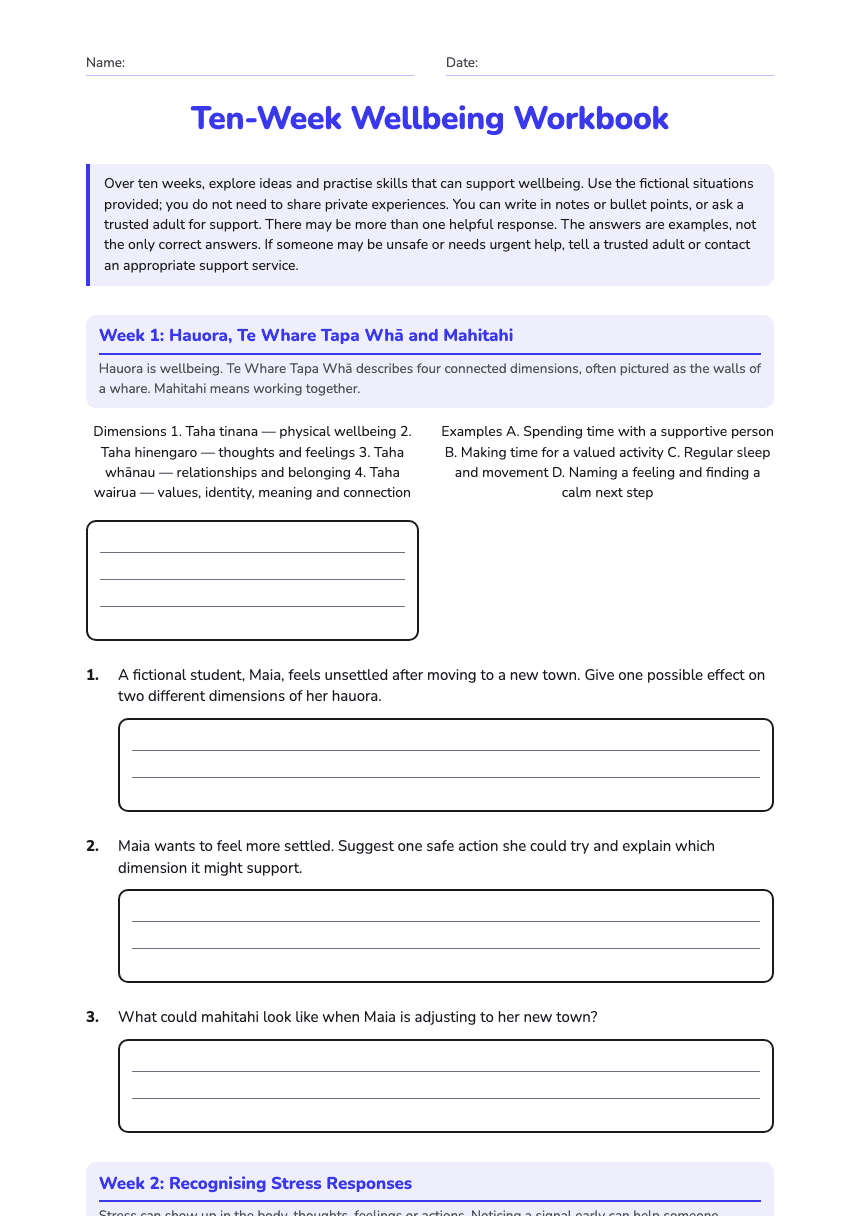
Ten-Week Wellbeing Workbook worksheet preview
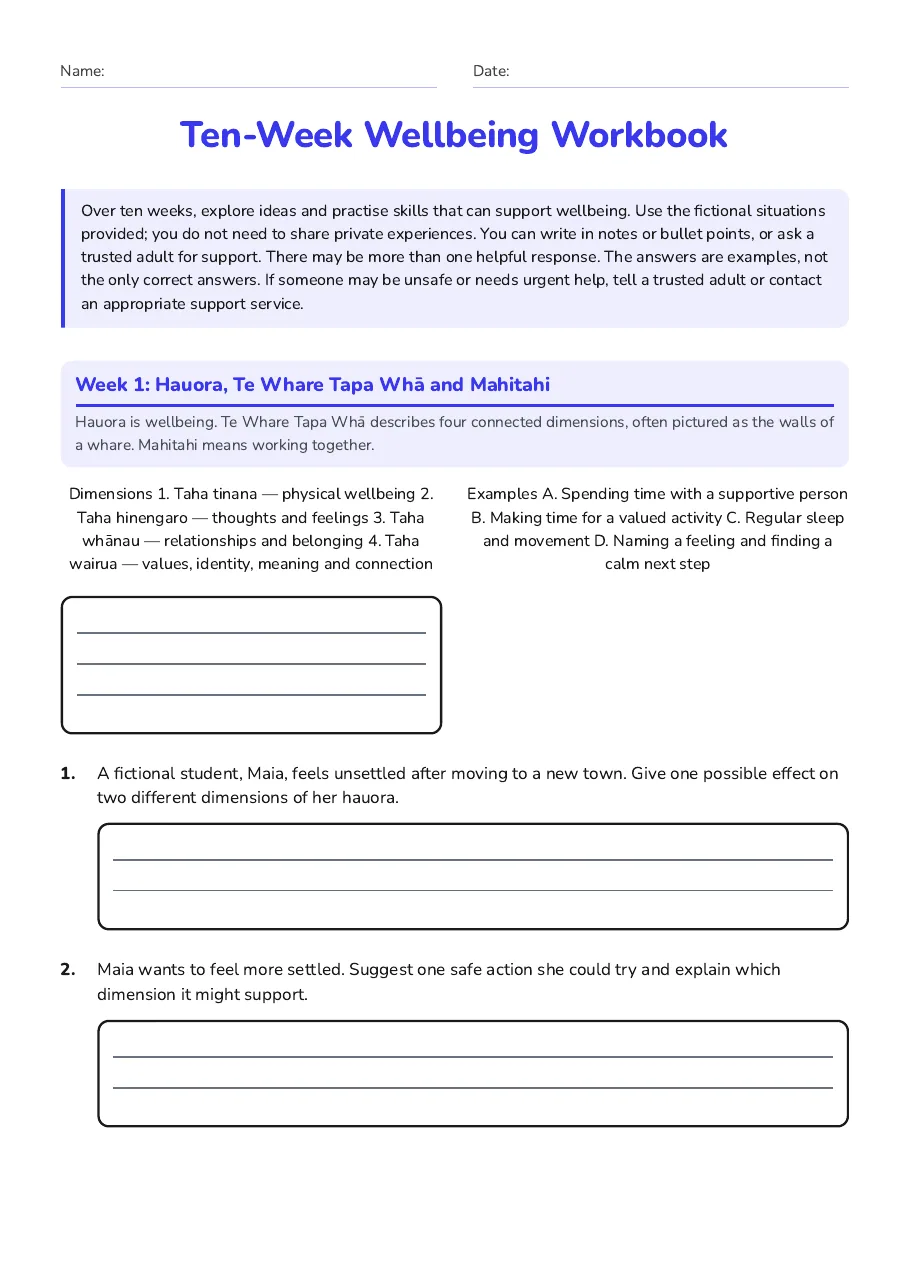
Name:Date:

Ten-Week Wellbeing Workbook

Over ten weeks, explore ideas and practise skills that can support wellbeing. Use the fictional situations provided; you do not need to share private experiences. You can write in notes or bullet points, or ask a trusted adult for support. There may be more than one helpful response. The answers are examples, not the only correct answers. If someone may be unsafe or needs urgent help, tell a trusted adult or contact an appropriate support service.

Week 1: Hauora, Te Whare Tapa Whā and Mahitahi

Hauora is wellbeing. Te Whare Tapa Whā describes four connected dimensions, often pictured as the walls of a whare. Mahitahi means working together.

Dimensions 1. Taha tinana — physical wellbeing 2. Taha hinengaro — thoughts and feelings 3. Taha whānau — relationships and belonging 4. Taha wairua — values, identity, meaning and connection

Examples A. Spending time with a supportive person B. Making time for a valued activity C. Regular sleep and movement D. Naming a feeling and finding a calm next step

1.A fictional student, Maia, feels unsettled after moving to a new town. Give one possible effect on two different dimensions of her hauora.
2.Maia wants to feel more settled. Suggest one safe action she could try and explain which dimension it might support.
3.What could mahitahi look like when Maia is adjusting to her new town?

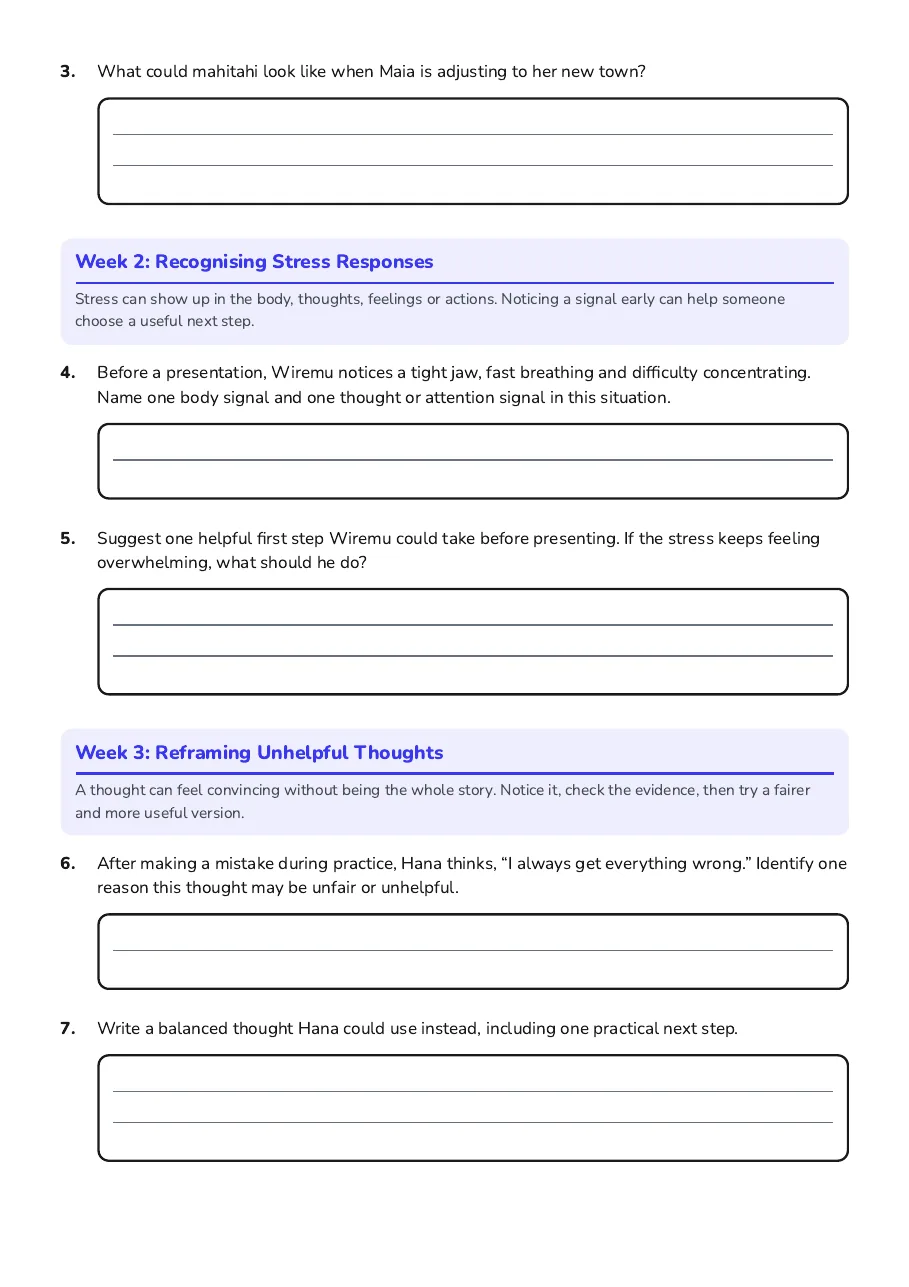
Week 2: Recognising Stress Responses

Stress can show up in the body, thoughts, feelings or actions. Noticing a signal early can help someone choose a useful next step.

4.Before a presentation, Wiremu notices a tight jaw, fast breathing and difficulty concentrating. Name one body signal and one thought or attention signal in this situation.
5.Suggest one helpful first step Wiremu could take before presenting. If the stress keeps feeling overwhelming, what should he do?

Week 3: Reframing Unhelpful Thoughts

A thought can feel convincing without being the whole story. Notice it, check the evidence, then try a fairer and more useful version.

6.After making a mistake during practice, Hana thinks, “I always get everything wrong.” Identify one reason this thought may be unfair or unhelpful.
7.Write a balanced thought Hana could use instead, including one practical next step.

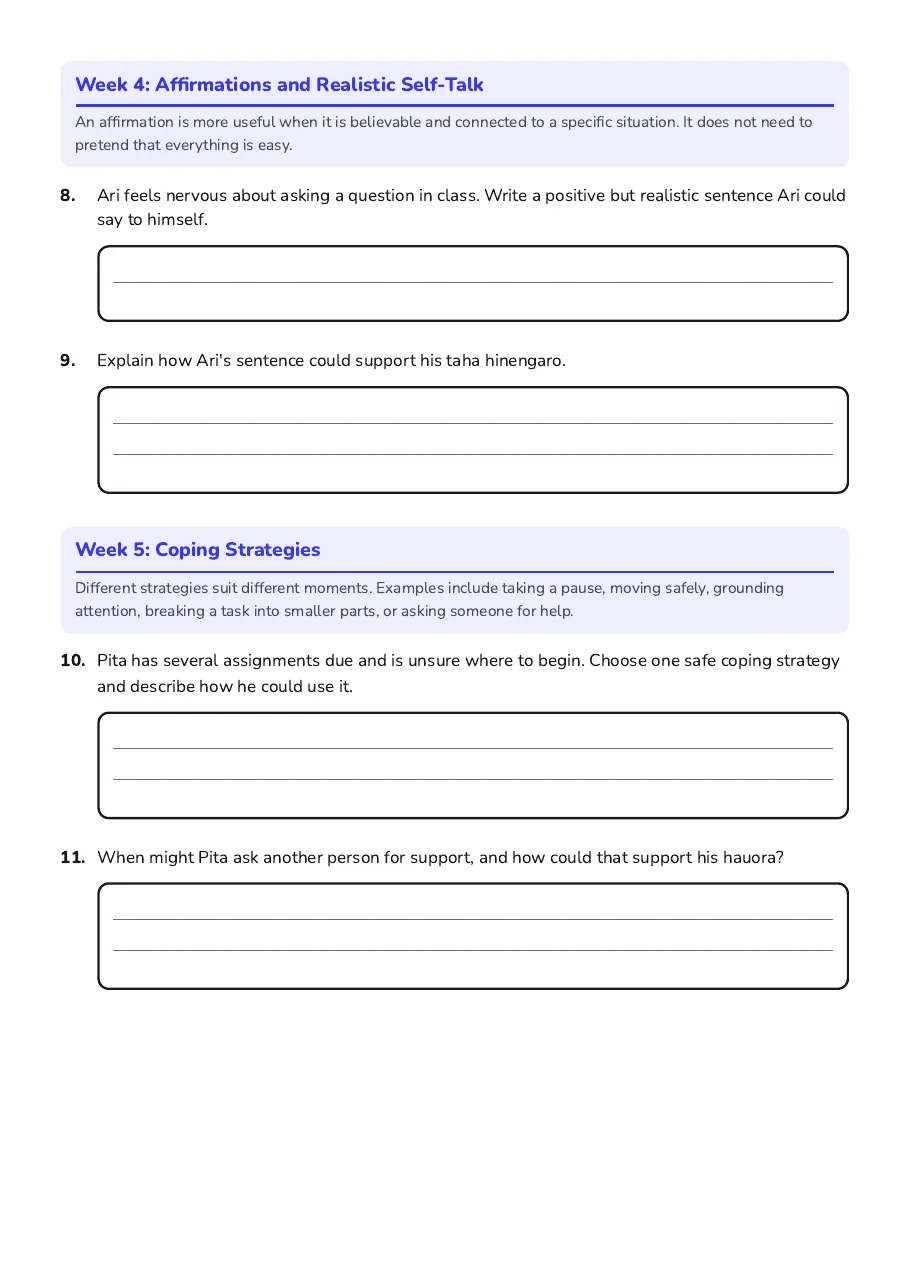
Week 4: Affirmations and Realistic Self-Talk

An affirmation is more useful when it is believable and connected to a specific situation. It does not need to pretend that everything is easy.

8.Ari feels nervous about asking a question in class. Write a positive but realistic sentence Ari could say to himself.
9.Explain how Ari's sentence could support his taha hinengaro.

Week 5: Coping Strategies

Different strategies suit different moments. Examples include taking a pause, moving safely, grounding attention, breaking a task into smaller parts, or asking someone for help.

10.Pita has several assignments due and is unsure where to begin. Choose one safe coping strategy and describe how he could use it.
11.When might Pita ask another person for support, and how could that support his hauora?

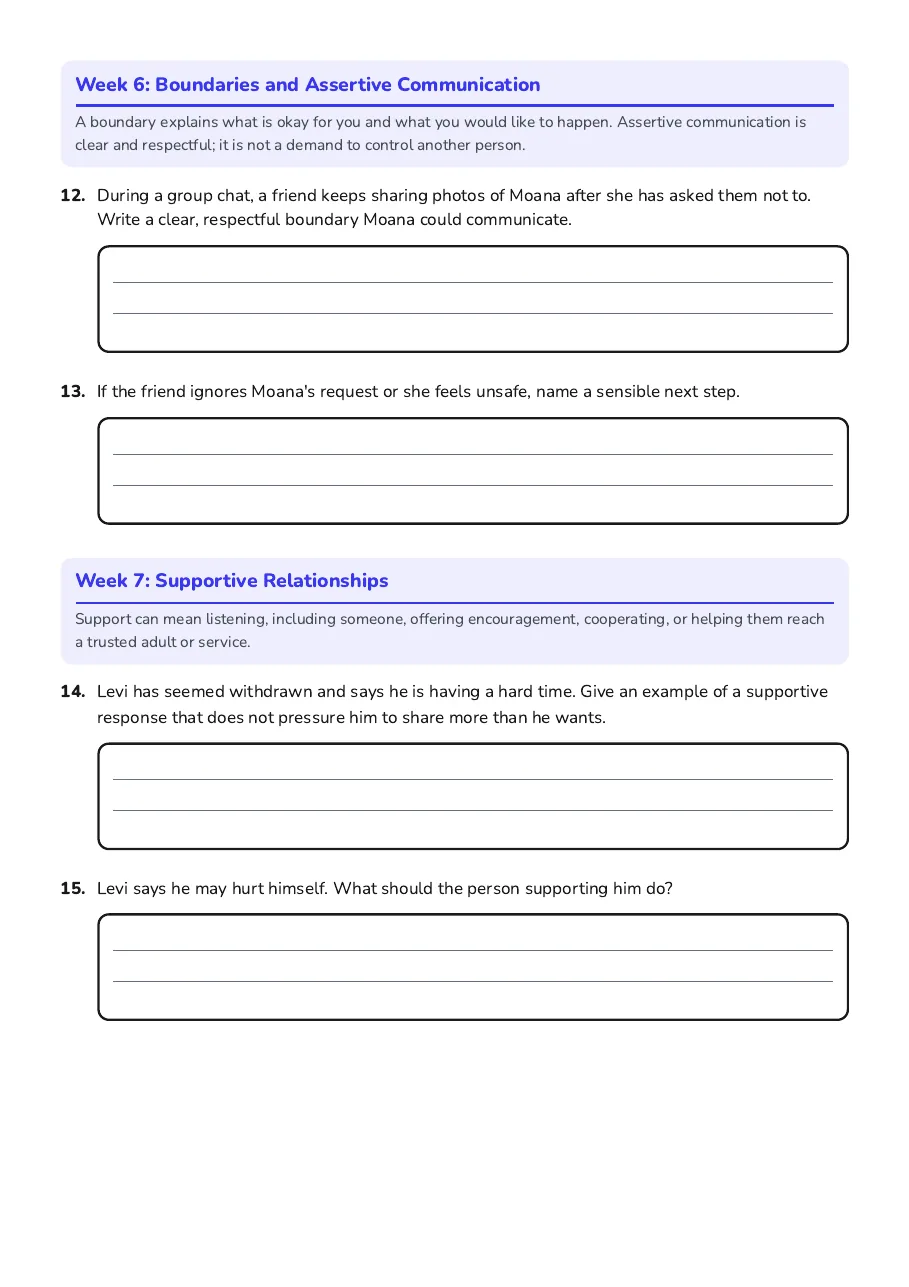
Week 6: Boundaries and Assertive Communication

A boundary explains what is okay for you and what you would like to happen. Assertive communication is clear and respectful; it is not a demand to control another person.

12.During a group chat, a friend keeps sharing photos of Moana after she has asked them not to. Write a clear, respectful boundary Moana could communicate.
13.If the friend ignores Moana's request or she feels unsafe, name a sensible next step.

Week 7: Supportive Relationships

Support can mean listening, including someone, offering encouragement, cooperating, or helping them reach a trusted adult or service.

14.Levi has seemed withdrawn and says he is having a hard time. Give an example of a supportive response that does not pressure him to share more than he wants.
15.Levi says he may hurt himself. What should the person supporting him do?

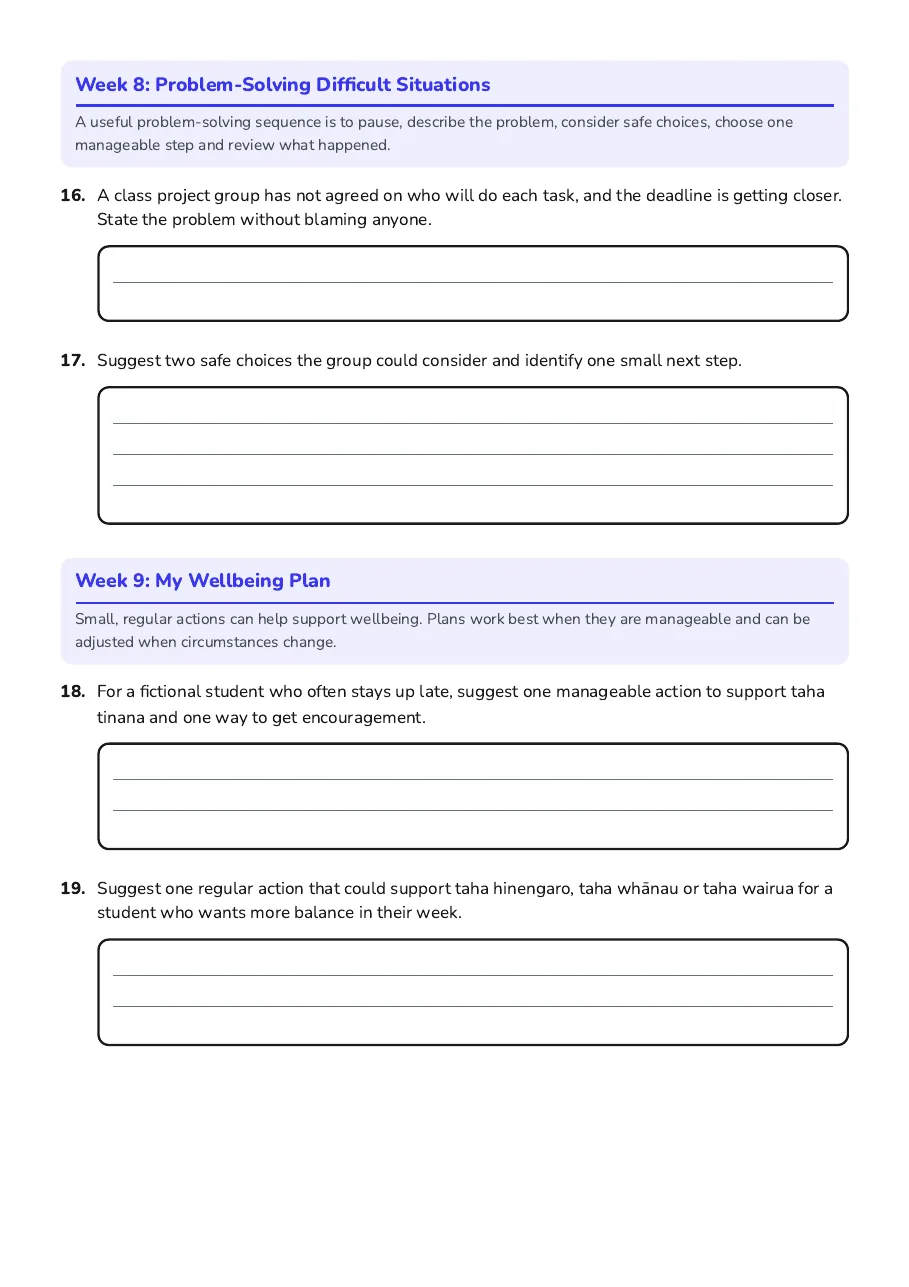
Week 8: Problem-Solving Difficult Situations

A useful problem-solving sequence is to pause, describe the problem, consider safe choices, choose one manageable step and review what happened.

16.A class project group has not agreed on who will do each task, and the deadline is getting closer. State the problem without blaming anyone.
17.Suggest two safe choices the group could consider and identify one small next step.

Week 9: My Wellbeing Plan

Small, regular actions can help support wellbeing. Plans work best when they are manageable and can be adjusted when circumstances change.

18.For a fictional student who often stays up late, suggest one manageable action to support taha tinana and one way to get encouragement.
19.Suggest one regular action that could support taha hinengaro, taha whānau or taha wairua for a student who wants more balance in their week.

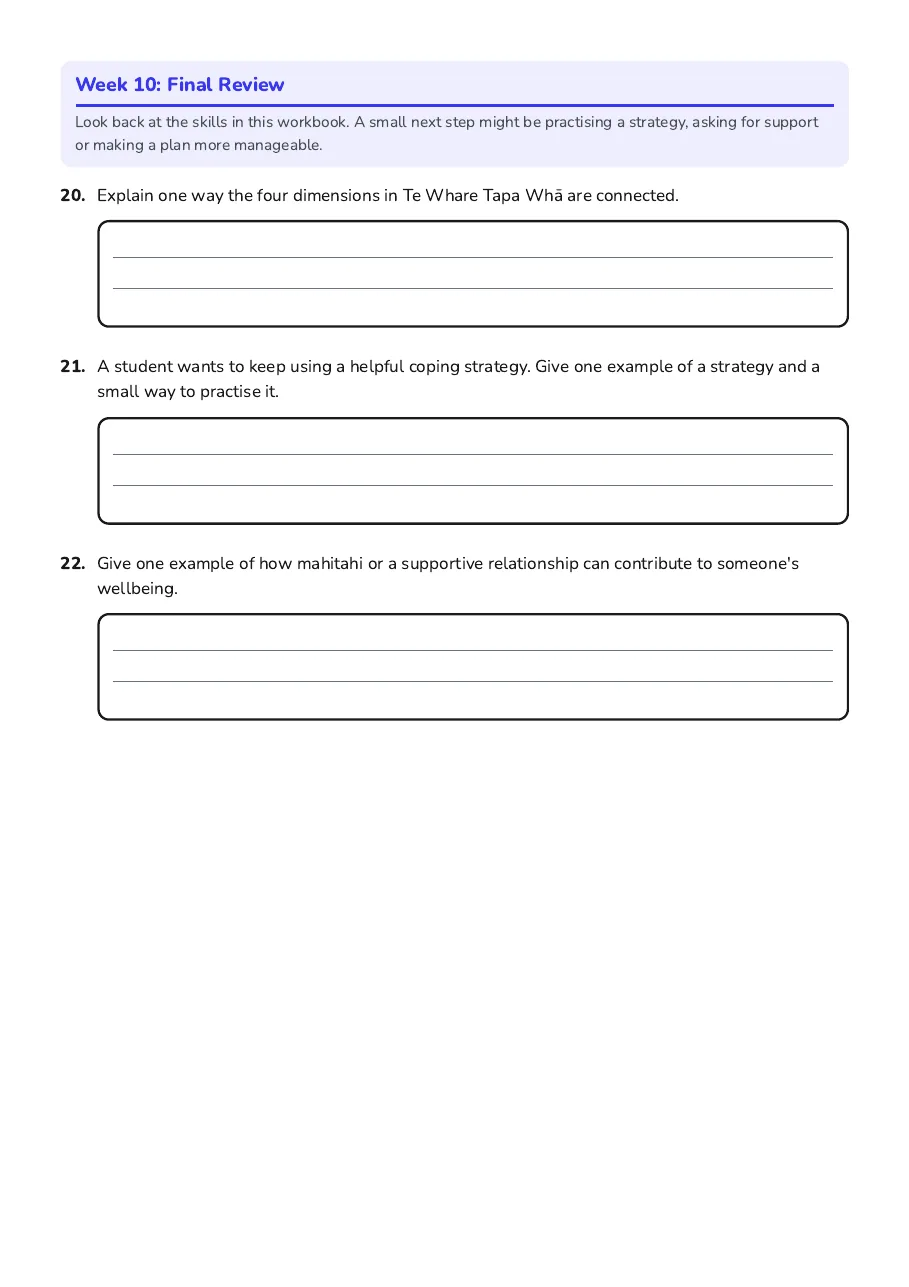
Week 10: Final Review

Look back at the skills in this workbook. A small next step might be practising a strategy, asking for support or making a plan more manageable.

20.Explain one way the four dimensions in Te Whare Tapa Whā are connected.
21.A student wants to keep using a helpful coping strategy. Give one example of a strategy and a small way to practise it.
22.Give one example of how mahitahi or a supportive relationship can contribute to someone's wellbeing.

6 printable pages

  • Ten-Week Wellbeing Workbook, page 1 of 6: Week 1: Hauora, Te Whare Tapa Whā and Mahitahi

    Page 1

  • Ten-Week Wellbeing Workbook, page 2 of 6: Week 2: Recognising Stress Responses, Week 3: Reframing Unhelpful Thoughts

    Page 2

  • Ten-Week Wellbeing Workbook, page 3 of 6: Week 4: Affirmations and Realistic Self-Talk, Week 5: Coping Strategies

    Page 3

  • Ten-Week Wellbeing Workbook, page 4 of 6: Week 6: Boundaries and Assertive Communication, Week 7: Supportive Relationships

    Page 4

  • Ten-Week Wellbeing Workbook, page 5 of 6: Week 8: Problem-Solving Difficult Situations, Week 9: My Wellbeing Plan

    Page 5

  • Ten-Week Wellbeing Workbook, page 6 of 6: Week 10: Final Review

    Page 6

About This Worksheet

Free in Kuraplan

Sign up free, grab the PDF, and customize it for your class.

Print-Ready

Formatted for standard paper. Clean layout, easy to read.

AI-Generated

Created with Kuraplan's AI, designed for real classroom use.

For Teachers & Parents

Use in classrooms, for homework, tutoring, or homeschool.

Need a custom version of this worksheet?

Kuraplan's AI generates custom worksheets in seconds — differentiated for every learner, aligned to your curriculum.

Generate Custom Worksheets — Free
No credit card Curriculum-aligned Under 60 seconds