ScienceFreePrintable
Year 13 Waves Summary
A free science worksheet ready for your classroom. Open in Kuraplan to grab the print-ready PDF, customize it for your students, or generate a fresh version in seconds.
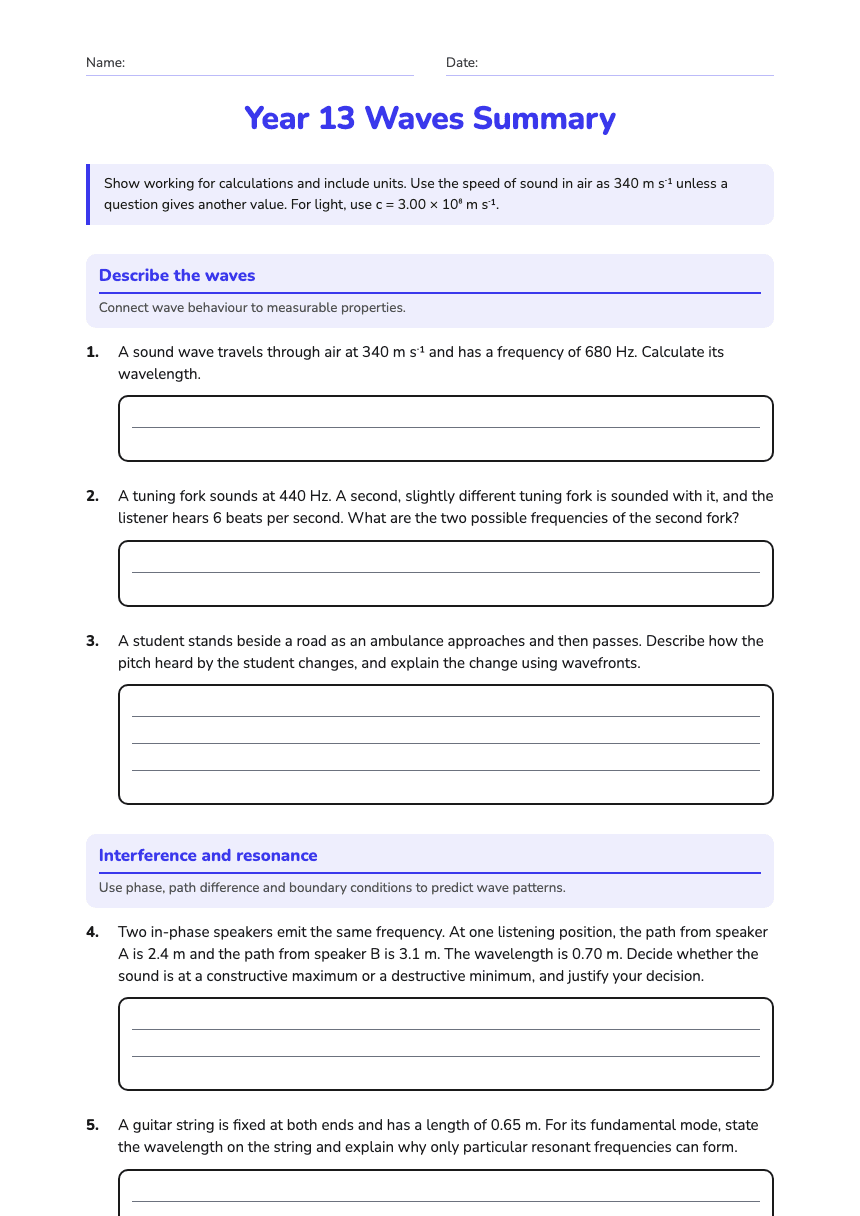
Name:Date:
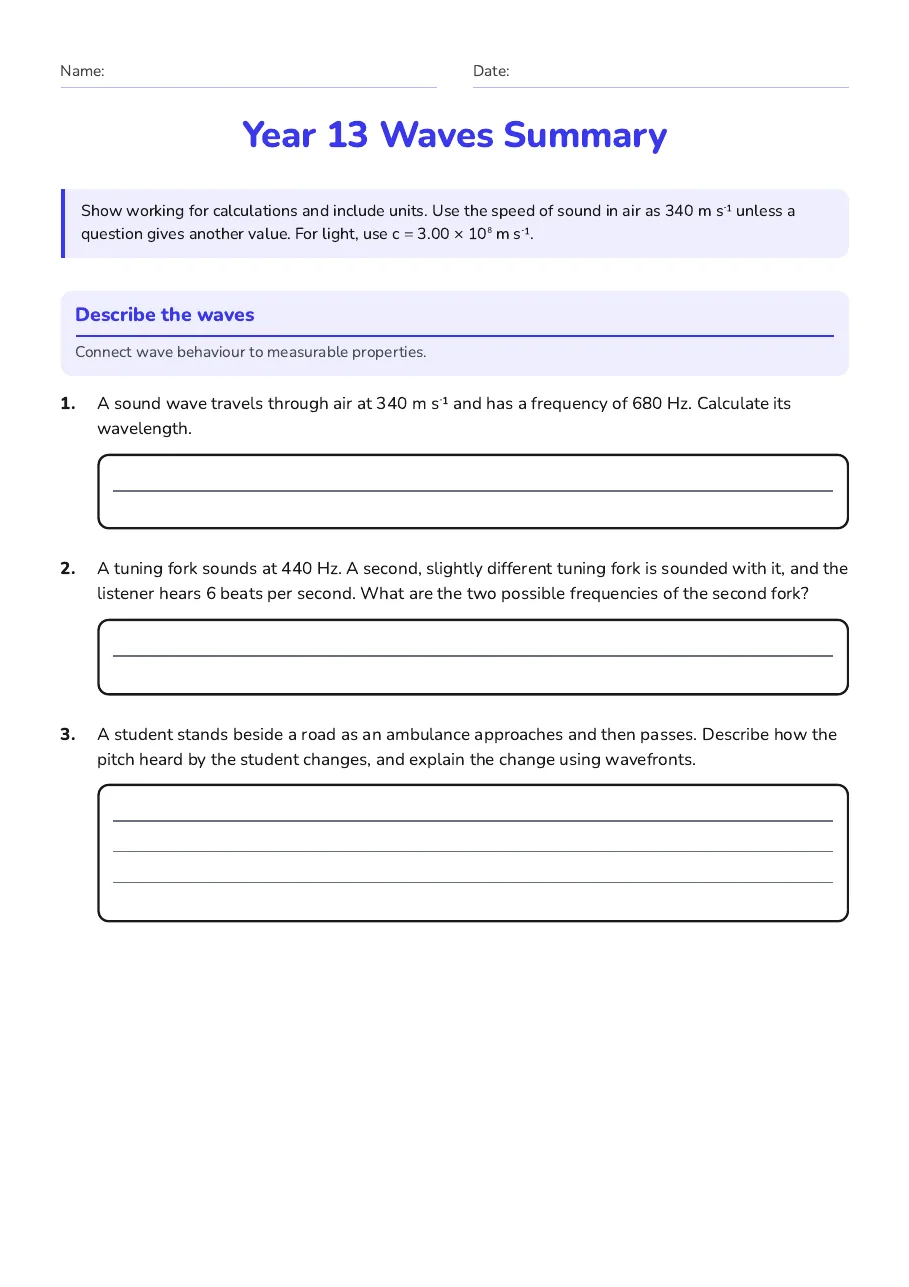
Year 13 Waves Summary
Show working for calculations and include units. Use the speed of sound in air as 340 m s⁻¹ unless a question gives another value. For light, use c = 3.00 × 10⁸ m s⁻¹.
Describe the waves
Connect wave behaviour to measurable properties.
1.A sound wave travels through air at 340 m s⁻¹ and has a frequency of 680 Hz. Calculate its wavelength.
2.A tuning fork sounds at 440 Hz. A second, slightly different tuning fork is sounded with it, and the listener hears 6 beats per second. What are the two possible frequencies of the second fork?
3.A student stands beside a road as an ambulance approaches and then passes. Describe how the pitch heard by the student changes, and explain the change using wavefronts.
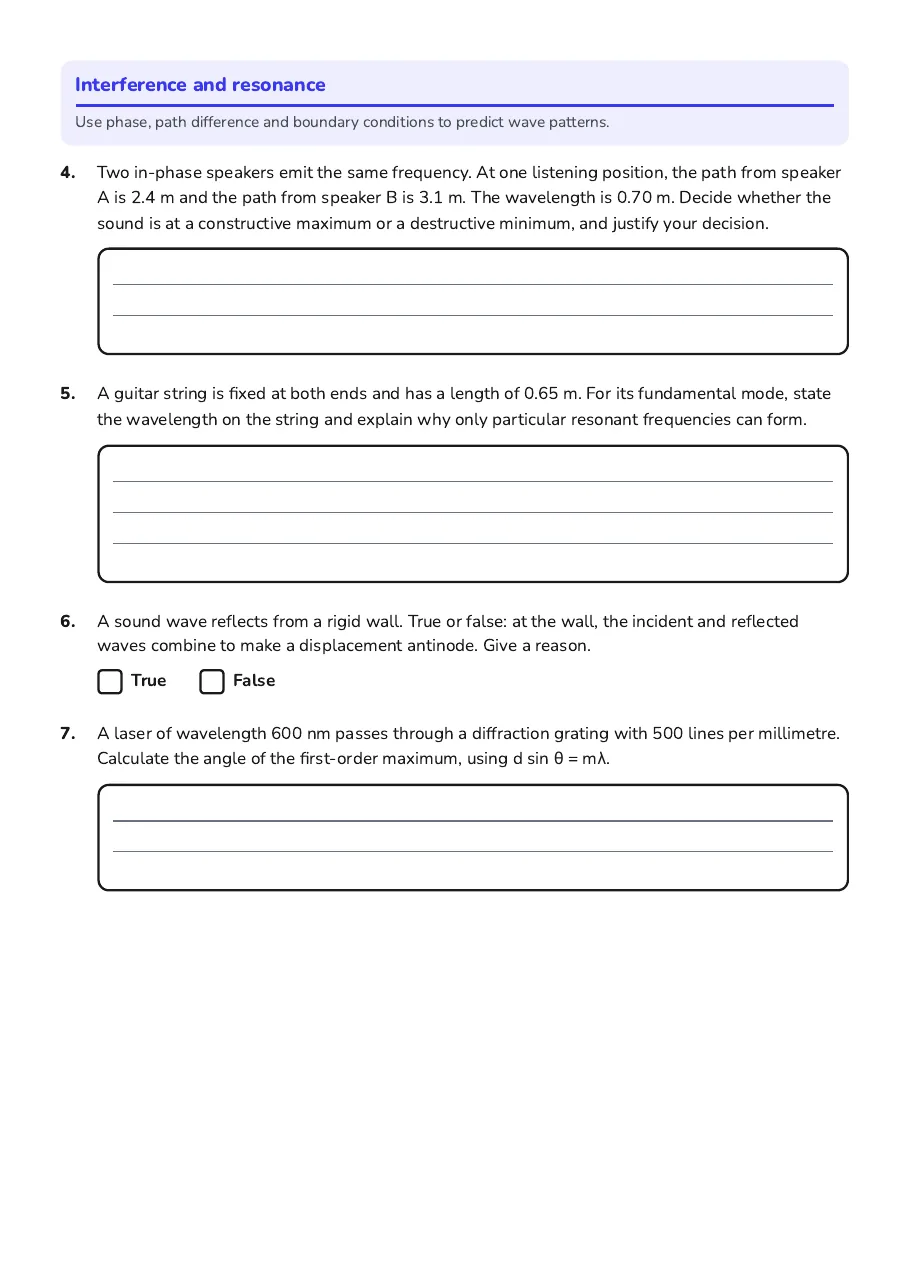
Interference and resonance
Use phase, path difference and boundary conditions to predict wave patterns.
4.Two in-phase speakers emit the same frequency. At one listening position, the path from speaker A is 2.4 m and the path from speaker B is 3.1 m. The wavelength is 0.70 m. Decide whether the sound is at a constructive maximum or a destructive minimum, and justify your decision.
5.A guitar string is fixed at both ends and has a length of 0.65 m. For its fundamental mode, state the wavelength on the string and explain why only particular resonant frequencies can form.
6.A sound wave reflects from a rigid wall. True or false: at the wall, the incident and reflected waves combine to make a displacement antinode. Give a reason.
TrueFalse
7.A laser of wavelength 600 nm passes through a diffraction grating with 500 lines per millimetre. Calculate the angle of the first-order maximum, using d sin θ = mλ.
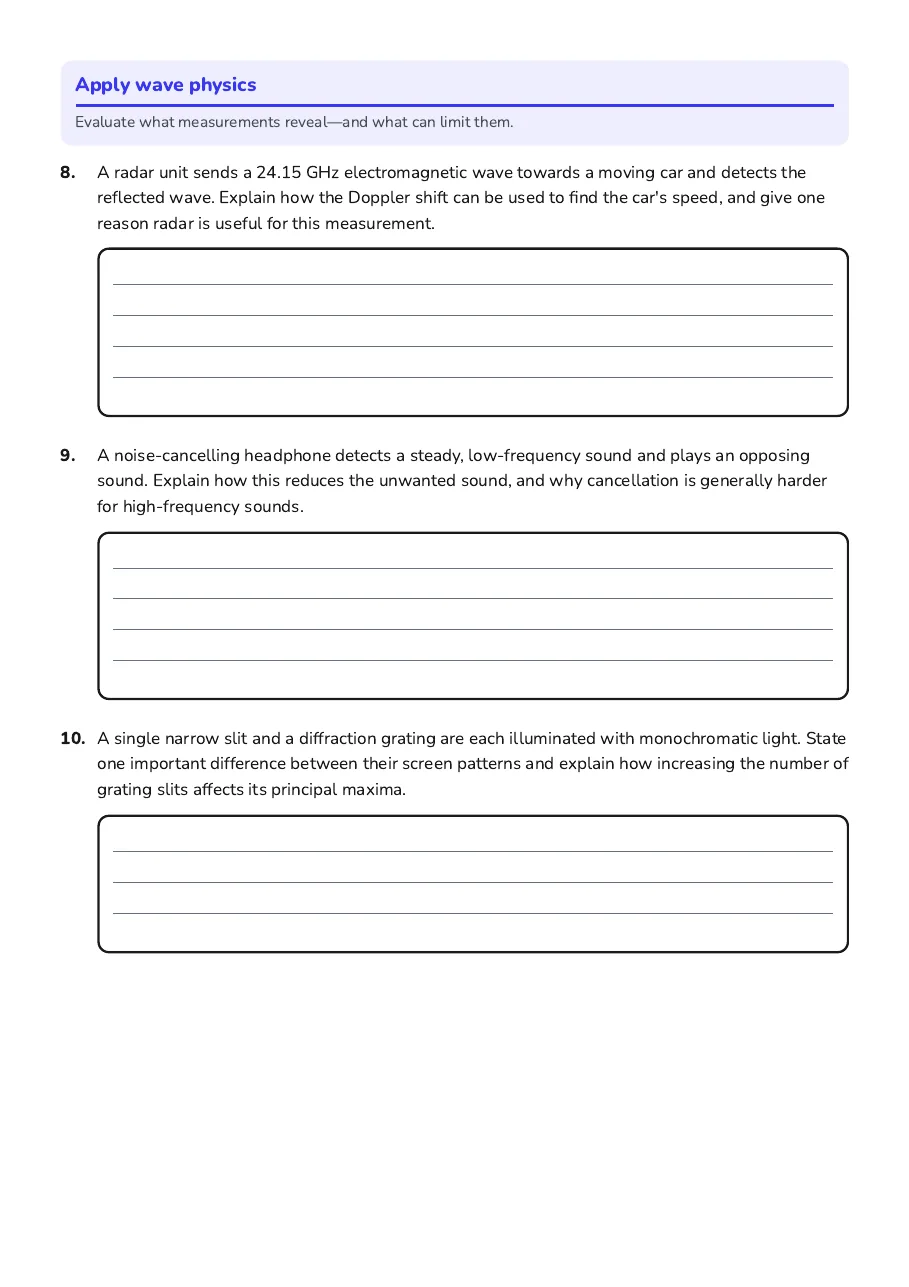
Apply wave physics
Evaluate what measurements reveal—and what can limit them.
8.A radar unit sends a 24.15 GHz electromagnetic wave towards a moving car and detects the reflected wave. Explain how the Doppler shift can be used to find the car's speed, and give one reason radar is useful for this measurement.
9.A noise-cancelling headphone detects a steady, low-frequency sound and plays an opposing sound. Explain how this reduces the unwanted sound, and why cancellation is generally harder for high-frequency sounds.
10.A single narrow slit and a diffraction grating are each illuminated with monochromatic light. State one important difference between their screen patterns and explain how increasing the number of grating slits affects its principal maxima.
3 printable pages
Page 1
Page 2
Page 3
About This Worksheet
Free in Kuraplan
Sign up free, grab the PDF, and customize it for your class.
Print-Ready
Formatted for standard paper. Clean layout, easy to read.
AI-Generated
Created with Kuraplan's AI, designed for real classroom use.
For Teachers & Parents
Use in classrooms, for homework, tutoring, or homeschool.
Need a custom version of this worksheet?
Kuraplan's AI generates custom worksheets in seconds — differentiated for every learner, aligned to your curriculum.
Generate Custom Worksheets — Free No credit card Curriculum-aligned Under 60 seconds