Ionic vs Covalent Properties
A free science worksheet ready for your classroom. Open in Kuraplan to grab the print-ready PDF, customize it for your students, or generate a fresh version in seconds.
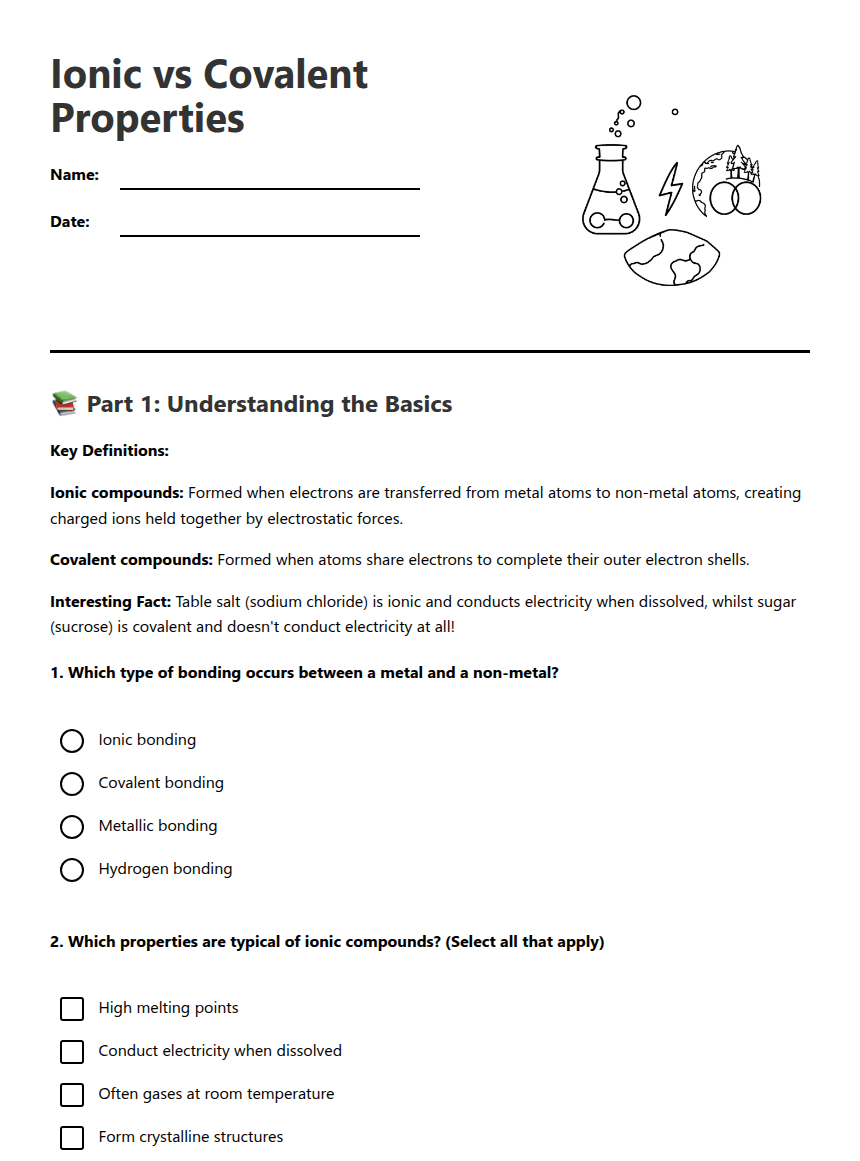
Ionic vs Covalent Properties

📚 Part 1: Understanding the Basics
Key Definitions:
Ionic compounds: Formed when electrons are transferred from metal atoms to non-metal atoms, creating charged ions held together by electrostatic forces.
Covalent compounds: Formed when atoms share electrons to complete their outer electron shells.
Interesting Fact: Table salt (sodium chloride) is ionic and conducts electricity when dissolved, whilst sugar (sucrose) is covalent and doesn't conduct electricity at all!
Fill in the blanks: _____________ and _____________
🔬 Part 2: Extended Analysis
🎯 Part 3: Quick Recap & Application
Ionic Compounds:
• Melting point: _____________
• Electrical conductivity: _____________ when dissolved
• Structure: _____________
Covalent Compounds:
• Melting point: _____________
• Electrical conductivity: _____________
• Structure: _____________ molecules
Model Answers:
Q1: Ionic bonding | Q2: High melting points, Conduct electricity when dissolved, Form crystalline structures | Q3: low, do not | Q4: Sodium chloride (NaCl) | Q5: Ionic compounds form ions when dissolved which carry electric current; covalent compounds remain as neutral molecules | Q8: Ionic - High, Conducts, Crystalline; Covalent - Low, Does not conduct, Discrete
About This Worksheet
Free in Kuraplan
Sign up free, grab the PDF, and customize it for your class.
Print-Ready
Formatted for standard paper. Clean layout, easy to read.
AI-Generated
Created with Kuraplan's AI, designed for real classroom use.
For Teachers & Parents
Use in classrooms, for homework, tutoring, or homeschool.
Need a custom version of this worksheet?
Kuraplan's AI generates custom worksheets in seconds — differentiated for every learner, aligned to your curriculum.
Generate Custom Worksheets — FreeMore Science Worksheets

Atomic Structure and Bonding Revision
Free
GCSE Chemistry Diagnostic Assessment
Free
Atomic Structure Exploration Worksheet
Free
Atomic Structure Teacher Answers
Free
Foundational Chemistry Concepts
Free
Acids and Alkalis Worksheet
Free
Molecular Structure Exploration
Free