You're teaching one lesson to a room full of different starting points. One student is ready for an extension, another is still building the prerequisite skill, and someone else understands the concept but struggles to explain it in writing. Several students are learning in an additional language. Others need movement, audio, visual structure, extra processing time, or a quieter way to participate.
Inclusive teaching isn't a separate add-on, and it doesn't mean lowering the standard. It means designing flexible ways for students to access content, take part, and show what they know. The nine inclusive teaching strategies below connect planning, instruction, assessment, accessibility, relationships, and behavior so inclusion becomes part of the daily lesson rather than an emergency adjustment.
You don't need to redesign your entire curriculum tomorrow. Start with one lesson, one classroom routine, or one assessment choice. A planning tool such as Kuraplan can help create standards-aligned differentiated lessons, worksheets, visuals, and rubrics, but your knowledge of the students in front of you should guide every final decision.
1. Universal Design for Learning
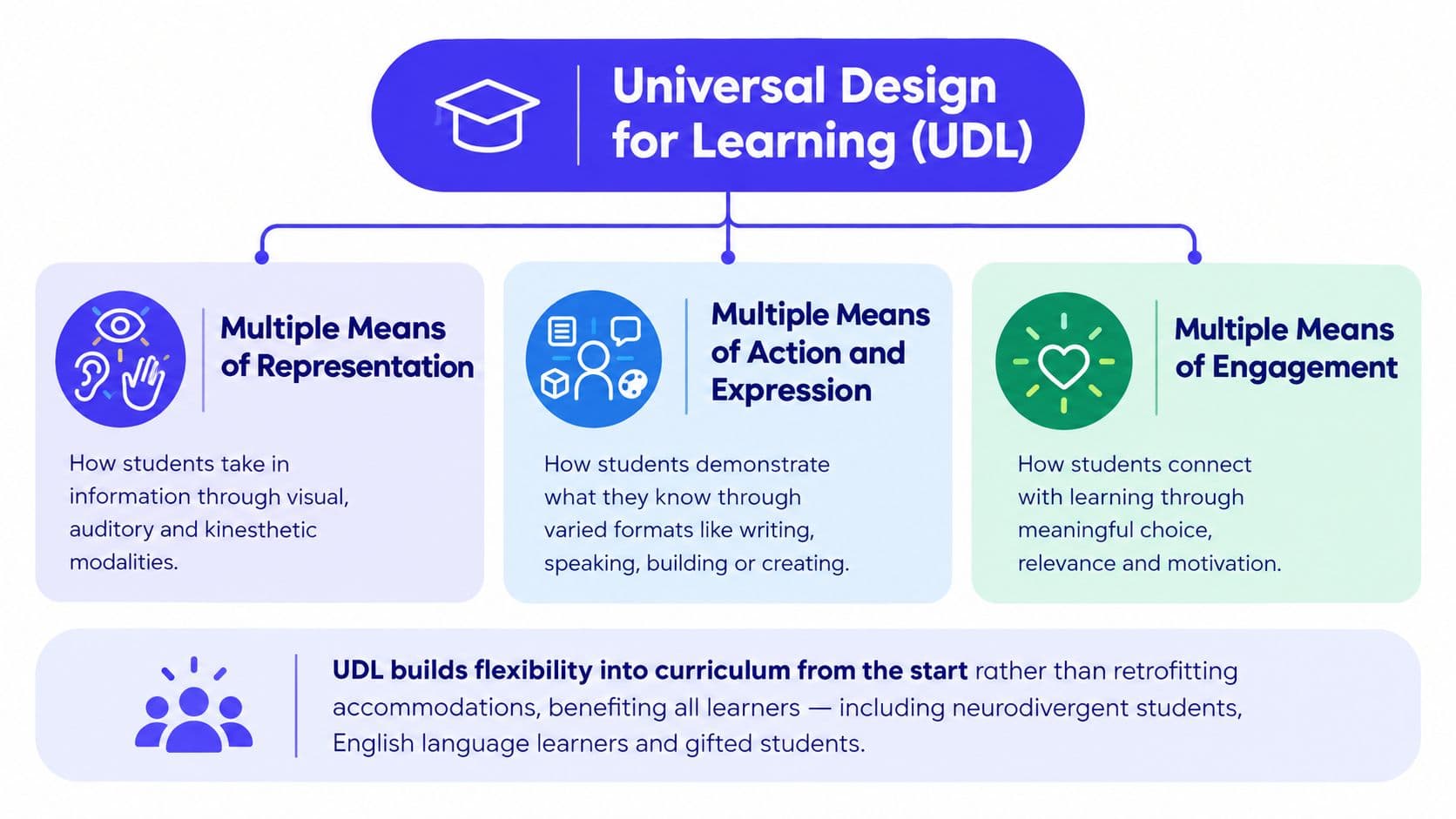
Universal Design for Learning, or UDL, asks you to remove predictable barriers before students encounter them. Instead of planning for an imaginary “average” learner and adapting the lesson later, offer multiple ways to engage with the purpose, access the content, and demonstrate understanding from the beginning.
The framework uses three dimensions: engagement, the reason students learn; representation, the ways they encounter information; and action and expression, the ways they respond. The University of Denver's UDL overview presents these as a practical planning structure, not an abstract ideal.
A fractions lesson might begin with a short teacher explanation, a visual model, fraction tiles, and an interactive representation. Students could then explain their reasoning in writing, record an oral response, annotate a diagram, or demonstrate the solution with manipulatives. The learning goal stays consistent while the route changes.
Apply UDL to one lesson
Audit an upcoming lesson and find the first point where students are expected to follow only one route. Then add a realistic alternative.
- Representation: Pair a reading with an audio version, diagram, demonstration, or vocabulary support.
- Participation: Let students think on their own, discuss with a partner, submit a response digitally, or contribute aloud.
- Expression: Accept a written explanation, presentation, model, portfolio entry, or recorded response when each option measures the same objective.
Inclusive UDL guidance from the University of Illinois Chicago includes accessible formats such as print, audio, diagrams, varied reading levels, and formative responses submitted through writing, audio, or video. Kuraplan can help you prepare several versions of the same content, but check the language, visuals, accessibility, and cognitive demand yourself.
Practical rule: Add choice to the route, not to the learning goal.
High-fidelity UDL implementation across 87 K–12 institutions and 2,473 learners was associated with a 37.4% increase in overall learner performance and a 42.8% increase for disengaged learners, according to the published study. The same analysis identified administrative support, professional development, technology availability, collaborative pedagogy, and flexible data use as important implementation requirements. A single flexible worksheet won't create UDL on its own, but it can be a useful first design change.
2. Culturally Responsive Teaching
A student studies a local park in mathematics, reads a migration story in language arts, or compares two accounts of a historical event. The learning objective stays clear, while the context connects with students' communities, histories, languages, and questions. Culturally responsive teaching makes that connection part of regular planning rather than a themed activity for one month.
Begin with the material already on your desk. Check whose voices appear as authors, scientists, mathematicians, artists, inventors, and historical actors. Then ask which community or experience the lesson treats as the default. In history, students might compare a textbook account with primary sources from people who experienced colonization, enslavement, migration, or political change differently.
In science, place local or traditional ecological knowledge alongside the scientific methods students are learning. Ask students to compare the evidence, identify the questions each perspective addresses, and explain how each approach reaches its conclusions. The goal is not to present every perspective as interchangeable. It is to teach students how knowledge is developed, documented, and evaluated.
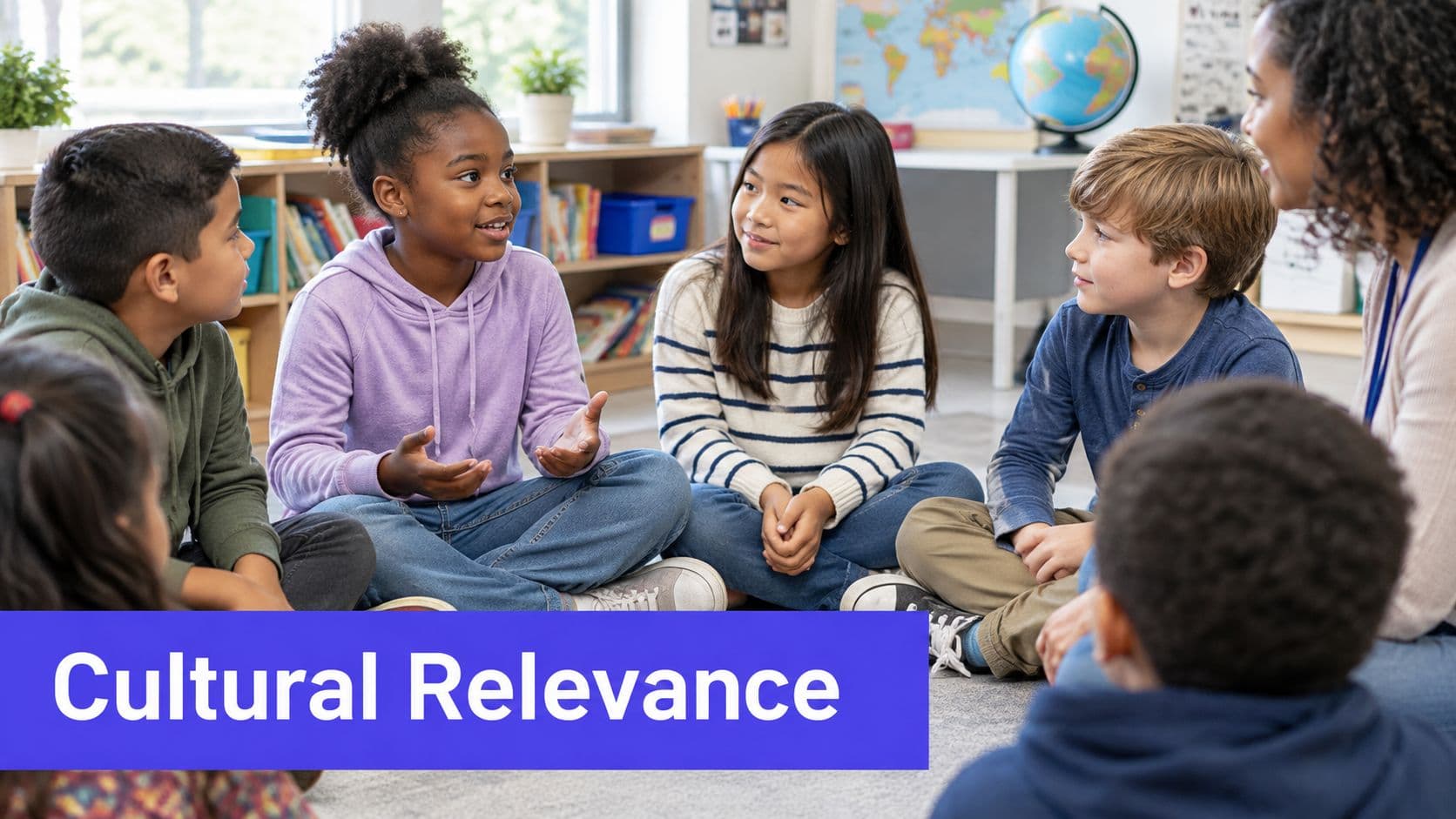
A mathematics class could calculate the cost of improving a park or interpret information about the students' city. Use a map, photo, short data table, or worksheet with adjustable reading support. Students can explain their reasoning in writing, with a labeled model, or during a partner conference, provided each option measures the same mathematical objective.
Use a short planning check before a unit:
- Representation: Which communities and experiences appear?
- Context: Who is treated as the default?
- Voice: Can students connect the content to family or community knowledge?
- Language: Can students use home languages while preparing ideas or discussing them?
Invite families to suggest stories, practices, knowledge, or local examples. Pronounce names correctly, and invite sharing without making one student speak for an entire culture. Address bias or microaggressions directly. A private reflection prompt, structured discussion, or restorative conversation may help students examine the impact and repair relationships.
Kuraplan can generate alternative scenarios, passages, prompts, and examples for different contexts. Review every draft for accuracy, specificity, accessibility, and respect. Superficial references do not create cultural relevance.
The UNESCO account of inclusion's evolution connects inclusive education with a longer policy history. The 1994 Salamanca Statement established that “all children should learn together, wherever possible, regardless of any difficulties or differences they may have,” and called on governments to adapt teaching methods, curricula, and learning environments. UNESCO marked the 30th anniversary in 2024, while the 2015 Sustainable Development Goals, especially Goal 4, continued the call for equitable and inclusive quality education. Culturally responsive routines put that commitment into daily classroom practice.
3. Differentiated Instruction
A class may share one learning goal while students need different routes to reach it. Start with the target, then adjust the reading load, scaffolds, pace, complexity, or response format. This keeps expectations clear without turning the classroom into a set of unrelated lessons.
For a lesson on character motivation, offer a shorter supported passage and a visual organizer to students who need help locating evidence. Other students can read the grade-level text and cite details independently. Students ready for extension might compare two characters or defend an alternative interpretation. All students practise evidence-based reasoning, while the language demand and level of independence vary.
The same approach works beyond literacy. In mathematics, stations can explore fractions with fraction strips, diagrams, or numerical problems matched to current readiness. In science, students can investigate one question, with some following a guided procedure and others designing their own method. A choice board can show the available routes, while a common success checklist keeps the standard visible.
Let evidence shape the next task
Use a quick exit ticket, short quiz, observation note, or student explanation to identify what each learner should try next. Group students for a specific purpose, then regroup as the evidence changes. A learner might join one group for reading fluency, another to explore a shared interest, and a mixed-readiness group to explain reasoning.
Use these planning moves:
- Tier the task: Keep the central skill constant while changing the complexity, text length, or number of steps.
- Vary the support: Offer a word bank, worked model, guided questions, audio, or an independent extension.
- Protect choice: Let students select a topic, example, tool, or response format when the choice does not change the learning goal.
- Teach the routine: Model how to collect materials, start, request help, and check work. A visual checklist or worksheet box can make the process easier to follow.
Kuraplan can turn one objective into differentiated worksheets and assessment options. It can also reduce formatting time when you need below-grade, on-grade, and above-grade versions. Review each version to confirm that it addresses the same standard and still requires students to think, rather than only recall simpler facts. For reading adaptations, try Kuraplan's text differentiation tool, then check the revised text for accuracy, tone, cultural fit, and accessibility.
“Different” should describe the route to the goal, not the value of the learner.
A survey of International Baccalaureate educators reported high implementation of inclusive practices, while knowledge of the UDL framework varied. The report described 127 completed respondents after distribution through 439 coordinators. For teachers, the point is practical: classroom techniques may develop before a shared planning vocabulary does. Professional learning can connect existing routines with common terms for reviewing instruction.
4. Collaborative and Cooperative Learning
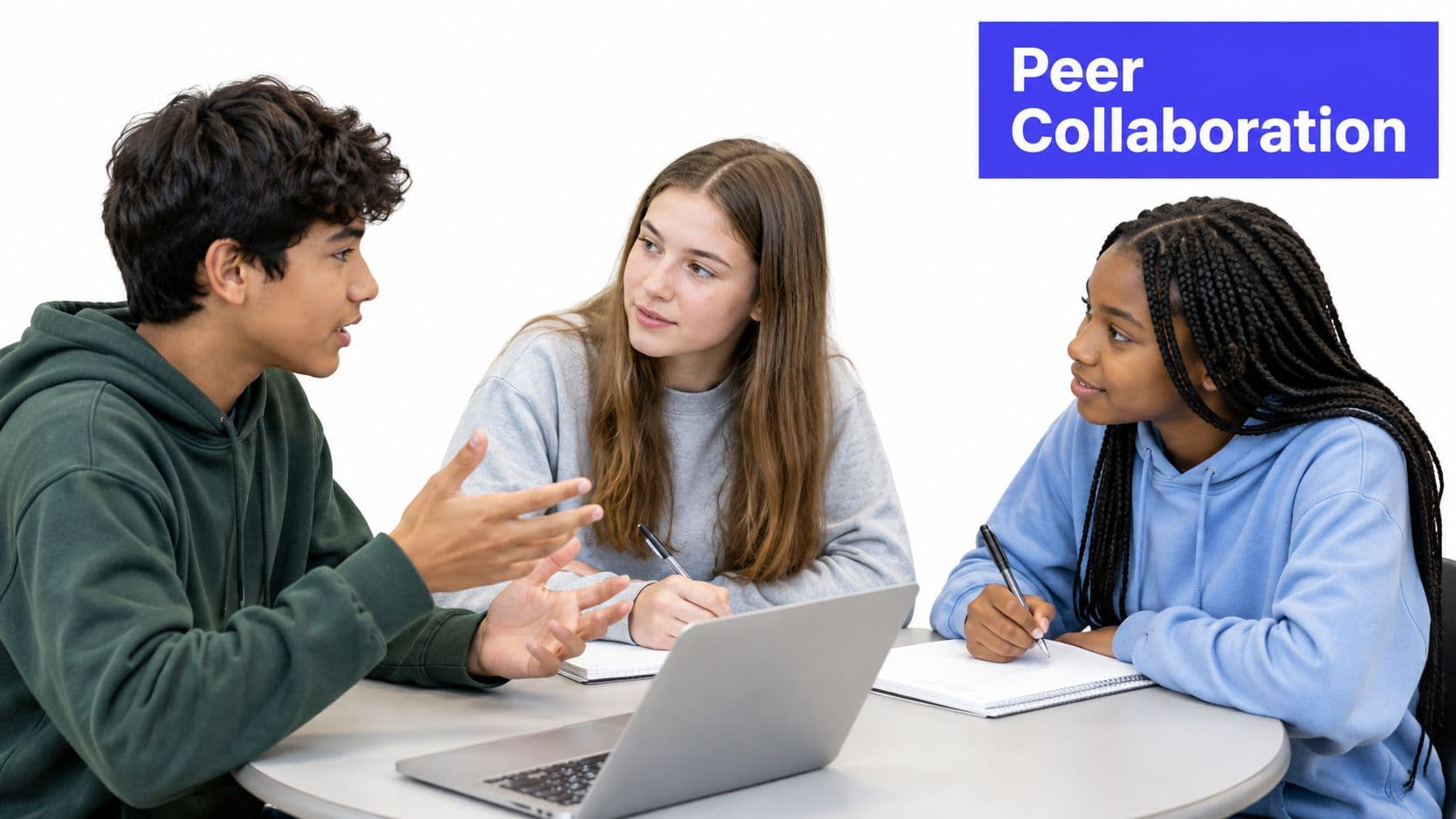
A group task works as an inclusive routine when each student has a clear contribution and the learning goal depends on shared thinking. Start with a short individual prompt, then move to pairs or groups. This gives students who need processing time something prepared to bring into the conversation.
In literature, use a jigsaw. Each student reads one section, records a key detail on a shared worksheet, and teaches it to a mixed group. The group combines those details to reconstruct the full text. In mathematics, try numbered heads together: students solve independently, compare methods, and prepare every group member to explain the answer. For a project, assign roles such as researcher, organizer, communicator, and quality checker. Rotate roles so one student does not become the permanent writer or spokesperson.
Design for shared responsibility
Before group work, model two or three useful phrases: “Can you explain that another way?”, “I see it differently because…”, and “Who has not shared yet?” Post these prompts beside the task, or place them on each group's worksheet. Students need a routine for inviting participation, questioning an idea respectfully, and acknowledging a contribution.
Use these checks while planning:
- Give every student a job the group needs.
- Add individual evidence, such as a reflection, quiz, explanation, or brief presentation.
- Change groups periodically, while considering readiness, interests, communication styles, and relationships.
- Provide a visual role card, sentence starters, or a choice of drawing, writing, speaking, or organizing evidence.
A student who communicates through drawing might create the group's visual model. Another might organize evidence, explain the process orally, or check the final response against the criteria. Assess both the shared product and each student's contribution, so speed and whole-class confidence do not define participation.
Use Kuraplan's think-pair-share guide to structure private thinking before partner and whole-class discussion. Kuraplan can also generate prompts and reflection questions. Preview them for age appropriateness and check that more than one reasonable response is possible.
Design the group task so students need one another, then teach them how to use that dependence well.
5. Scaffolding and Gradual Release of Responsibility
Students often know the idea but stall at the next move. A scaffold gives them that move temporarily, then makes room for independent work. Useful supports include a worked example, sentence frame, diagram, word bank, guided notes, or questions arranged in sequence.
Start with the teacher's decisions visible. In a writing lesson, model how you select evidence and connect it to a claim. Then compose a paragraph with the class, explaining each choice. Pairs can draft the next paragraph before students write independently. In mathematics, demonstrate a problem-solving process, solve a related example together, provide paired practice, and finish with an individual problem.
Choose support by the barrier
UDL planning guidance recommends identifying the barrier, locating the course element that creates it, and adjusting that element. A student who understands a science concept but cannot organize a lab report may need a writing frame. A student who explains the process orally but loses the sequence of instructions may need a visual checklist instead.
Use the support that addresses the specific difficulty:
- Make thinking visible: Narrate decisions, including why one option fits better than another.
- Support academic language: Provide sentence frames and word banks while leaving room for original responses.
- Change the visual aid: Use a labelled model, flowchart, or partially completed example, then remove parts as control grows.
- Build in a release point: Mark which prompt, example, or checklist item students should try without help.
- Check transfer: Ask students to apply the strategy to a new task, not repeat the model.
A worksheet can show the full process for guided practice, then leave selected steps blank for paired work and the final steps open for independent use. Kuraplan can create assignment versions with different levels of structure, hints, and guided practice. This can reduce preparation when students need different entry points, but the teacher still decides when each scaffold should disappear.
Check whether students are using the strategy without the prompt. If they are, remove or reduce the support. If they are not, adjust the scaffold to address the barrier rather than adding help automatically.
6. Inclusive Assessment Practices
A student may understand a science concept yet struggle to show it in a timed written test. Plan assessment around the learning objective, then offer suitable ways to explain, apply, create, or demonstrate it. The format should provide access without lowering the standard.
For a science unit, students might submit a lab report, give an oral explanation, create a poster, or demonstrate safe practical procedures. In reading, they could write a comprehension response, retell a scene, illustrate evidence from the text, write from a character's perspective, or record a video explanation. In mathematics, pair fluency checks with open-ended problems and a short explanation of reasoning. A choice board or visual assessment menu can make these options clear.
Assess the target, then remove avoidable barriers
If the objective is to explain cause and effect, assess that relationship directly. Handwriting, typing speed, accent, or unfamiliar vocabulary should not hide the evidence unless those features are part of the standard.
Use a small routine throughout the unit:
- Begin with an exit response, observation, quick conference, or one-minute paper.
- Share criteria before students begin, and invite them to use the rubric for self-assessment.
- Offer feedback and revision when the goal is mastery.
- Plan access supports such as assistive tools, extra processing time, oral responses, or adapted response formats.
- Compare classroom talk, work samples, performance, and reflection rather than relying on one product.
The University of Washington's universal design of instruction framework recommends considering native language, age, race, ethnicity, learning preferences, and sensory or mobility needs. If course design does not provide full access, it advises planning accommodations such as sign-language interpreters and including accommodation-request information in the syllabus.
For quick ways to vary checks for understanding, use formative assessment examples from Kuraplan. Its rubric generation can help connect criteria to objectives. Read each descriptor yourself, and revise wording that rewards polished presentation more than the intended learning.
A 2025 review of inclusive assessment research, including the Frontiers in Education study, found that flexible or differentiated assessment remains weak even when inclusive pedagogy is discussed, while standardized criteria continue to dominate. The same study reported that about 7% of students reported little to no instructional or emotional support, and rated cooperative learning, collaborative teaching, and multi-level strategies only moderately. Varied assessment works best when daily instruction gives students consistent opportunities to receive support, practise, and show progress.
7. Peer Teaching and Cross-Age Tutoring
A student who is stuck on fractions may understand a classmate's explanation faster than another teacher-led example. Peer teaching adds a second route to the idea, provided students learn how to support thinking rather than supply answers.
Start with a routine that gives each learner a clear job. During reciprocal reading, students can rotate through summarizer, questioner, clarifier, and discussion leader. In mathematics, pair a student who has shown a strategy with a partner using prepared practice problems. Cross-age tutoring can pair older and younger students to read, discuss vocabulary, make predictions, and explain meaning. The older student should ask and listen, rather than read aloud.
Make support a coached routine
Model prompts before students work together:
- “What do you notice?”
- “Which step feels unclear?”
- “Can you show me what you tried?”
Teach tutors to pause, ask one question, and give the learner time to respond. Provide examples, practice items, key vocabulary, and answer guidance so the tutor can prepare without turning the activity into a script.
Use these classroom safeguards:
- Rotate roles: Let every student teach and receive support.
- Check interactions: Listen for accurate explanations and misconceptions.
- Ask for feedback: Have learners describe which support helped.
- Protect dignity: Present tutoring as shared expertise, not a ranking of ability.
- Name the skills: Recognize patience, questioning, explanation, and encouragement.
A sixth-grade student might use counters to explain multiplication while a partner records each step. Later, the partner teaches the strategy to someone else. Both students practise mathematics, language, and communication, while the teacher checks whether the method is accurate.
Kuraplan can generate age-appropriate supplementary worksheets, practice problems, and explanations for peer tutors. Give each pair a short purpose and a clear stopping point. A visual sequence such as “read, ask, try, explain” can keep the exchange focused, and a simple checklist can help students review whether they listened, questioned, and explained. Circulate throughout the activity. Peer teaching expands classroom support while keeping responsibility for assessment with the teacher.
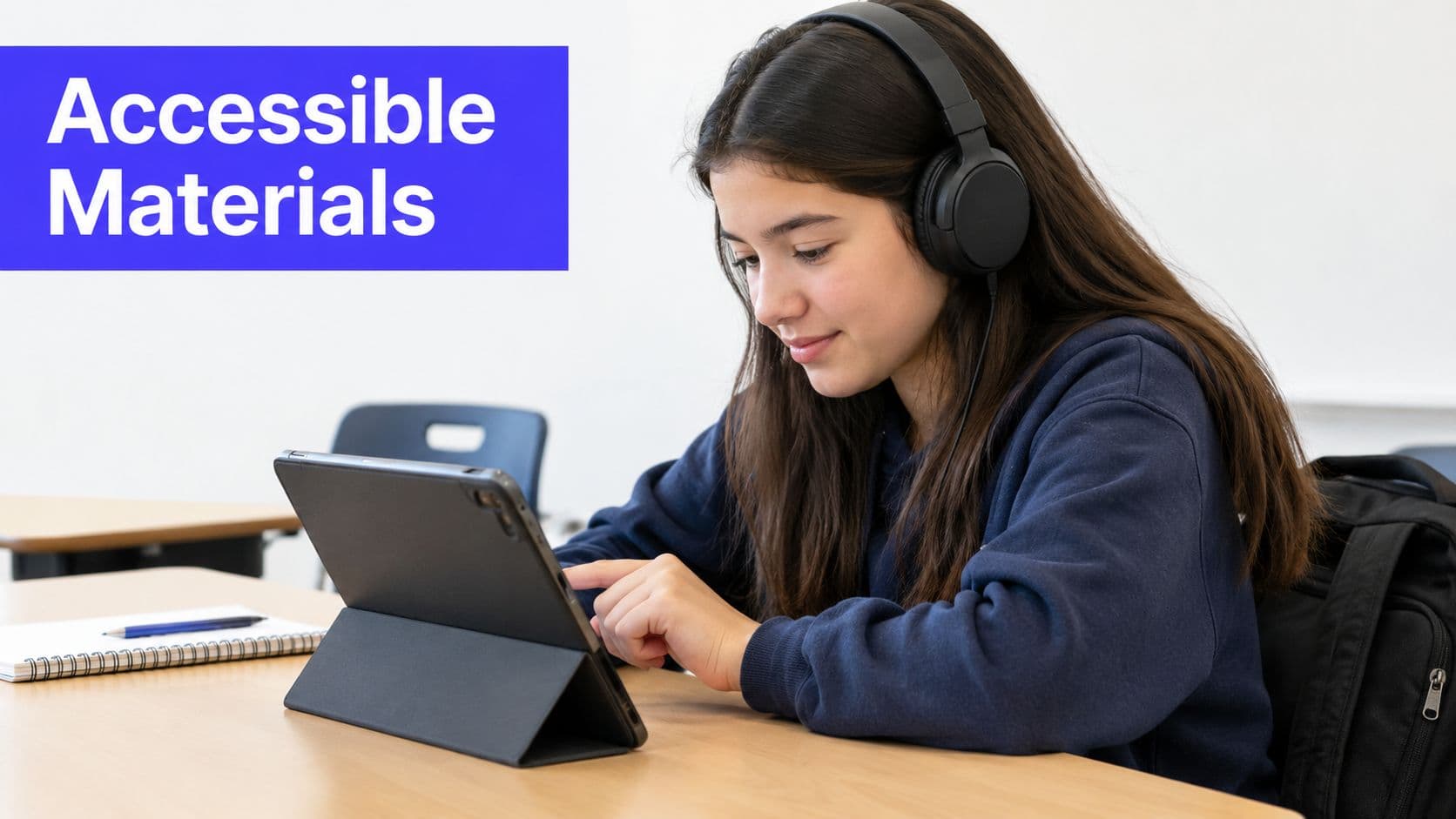
8. Accessible Materials, Multimodal Content, and Technology Integration
A student opens a science PDF, but the screen reader announces the headings in the wrong order. Another watches the lesson video without captions. Accessible teaching begins during planning, before either student has to request help. Choose formats that support sensory, language, communication, and motor needs, then connect each option to the learning goal.
For one science concept, prepare a short article, captioned video, labeled diagram, podcast, and interactive simulation. In a history unit, offer English, Spanish, and simplified-English resources, plus a transcript and interactive timeline. A student with dyslexia may use text-to-speech. A student with fine motor challenges may submit work through speech-to-text. Make these tools available to the whole class so choosing one does not identify a student.
Test the route a learner must take
Open the file with the screen reader and text-to-speech software your students use. Check headings, reading order, contrast, captions, transcripts, image descriptions, font size, keyboard access, and whether every task works without a mouse. A colorful worksheet can still block learning if its labels or sequence are unclear.
Use a short access routine:
- Give students adjustable digital copies alongside printed materials.
- Caption videos and provide transcripts for Deaf and hard-of-hearing students, multilingual learners, and students who prefer reading.
- Demonstrate text-to-speech, speech-to-text, magnification, and relevant platform controls. Let students practise before graded work.
- Ask about home access. Device, internet, and software availability may differ.
- Keep the objective visible. Technology should improve access, practice, or feedback rather than become the task.
A 2025 study of teacher educators found that 70% reported constraints applying inclusive strategies and 44% reported a lack of adapted materials and assistive technologies, according to the published study. Start with one repeated barrier, such as inaccessible PDFs or videos without captions, and correct it throughout the unit.
Kuraplan can produce printable and digital worksheets, visuals, diagrams, and audio-friendly lesson versions. Test generated materials with the assistive technology students use, then revise labels, contrast, and reading order before sharing them.
9. Positive Behavior Support and Restorative Practices
A noisy transition starts before the noise. Students may be unsure where to go, what to bring, or how long the change will take. Positive behavior support treats expectations as skills to teach. Restorative practices then help students repair relationships when harm occurs.
Start with a small routine students can see and rehearse. In an elementary classroom, post Be Respectful, Be Responsible, and Be Safe with simple visuals. Model each expectation during group work, transitions, and independent practice. Practise the routine, notice specific successes, and give a calm reminder when a student interrupts. If a concern continues or becomes serious, use a functional behavior assessment and involve the appropriate support team.
A visual schedule, transition card, or short behavior reflection sheet can make the routine easier to follow. For an older student, offer a private check-in before a difficult class period. The same goal may need different supports: one student might need a movement break, another a clear first step, and another a quieter work space.
Start with the situation, then choose the response
Keep brief records of the student, time, location, and incident type. A pattern may show difficulty during unstructured transitions, noisy group work, challenging reading, or a particular peer interaction. Adjust the setting or instruction before treating the behavior as a fixed character flaw.
Restorative practice adds a structured repair conversation. A middle school circle can build community and address conflict early. After harm occurs, a conference gives the person responsible, the person affected, and relevant community members time to describe what happened, understand its impact, and agree on repair. Participation should be safe, voluntary where appropriate, and supported by an adult.
Use these prompts:
- What happened?
- Who was affected?
- What support would help now?
- What action could repair the harm?
Teach expectations directly, build trust through consistent care, ask about academic, sensory, emotional, social, or environmental triggers, and review discipline patterns for unequal responses.
Kuraplan's AI teaching assistant can suggest classroom management ideas, de-escalation steps, and positive culture routines during a busy school week. Treat suggestions as starting points, not diagnoses. Student knowledge, school policy, family context, and the support team should guide the final response.
Inclusive Teaching: 9-Strategy Comparison
| Approach | Implementation complexity 🔄 | Resource & technology needs ⚡ | Expected outcomes 📊 | Ideal use cases 💡 | Key advantages ⭐ |
|---|---|---|---|---|---|
| Universal Design for Learning (UDL) | High upfront planning; becomes sustainable once embedded | Moderate–high: varied materials, multimedia, PD | Greater access, engagement, reduced achievement gaps | Diverse classrooms, mixed-ability units, curriculum redesign | Flexible curriculum, reduces need for separate accommodations ⭐⭐⭐⭐ |
| Culturally Responsive Teaching | High; ongoing reflective practice and community work | Moderate: diverse texts, community partnerships, PD | Improved engagement and outcomes for marginalized students | Schools serving culturally diverse populations; community-linked projects | Increases relevance, builds trust and critical thinking ⭐⭐⭐⭐ |
| Differentiated Instruction | High logistical complexity; continuous adjustment | Moderate: tiered materials, assessment tools, planning time | Closer match to student readiness; higher engagement | Mixed-ability classes; lessons needing varied entry points | Targets individual readiness; closes gaps without whole-class changes ⭐⭐⭐ |
| Collaborative & Cooperative Learning | Moderate: requires teaching group skills and routines | Low–moderate: group materials, protocols, monitoring tools | Stronger social skills, peer learning, increased achievement | Project work, discussions, peer-led tasks | Promotes peer explanation, belonging, scalable support ⭐⭐⭐ |
| Scaffolding & Gradual Release | Moderate: careful sequencing and observation needed | Low–moderate: models, exemplars, prompts, guided tasks | Increased independence and mastery of new skills | Teaching new or complex skills; stepwise instruction | Builds confidence, supports metacognition, reduces overwhelm ⭐⭐⭐ |
| Inclusive Assessment Practices | High: design of varied tasks and clear rubrics | Moderate: portfolios, performance tasks, assessment literacy | Fuller evidence of learning; increased student agency | Formative/summative assessment with diverse learners | Reveals strengths, reduces test anxiety, supports mastery ⭐⭐⭐ |
| Peer Teaching & Cross‑Age Tutoring | Moderate: requires tutor training and monitoring | Low–moderate: training materials, scheduling, progress tracking | Deeper learning for tutors; more support for learners | Remediation, literacy buddies, leadership programs | Scales support, builds leadership and confidence ⭐⭐⭐ |
| Accessible Materials, Multimodal Content & Tech Integration | High: technical work to ensure accessibility and compatibility | High: assistive tech, captioning, adaptive platforms, connectivity | Broad accessibility, personalization, reduced barriers | Students with disabilities, ELLs, blended/remote learning | Universal access, personalization, compatibility with AT ⭐⭐⭐⭐ |
| Positive Behavior Support & Restorative Practices | High: schoolwide systems and sustained commitment | Moderate–high: training, data systems, staff time | Improved climate, fewer exclusions, better equity in discipline | Schools addressing behavioral disparities or climate issues | Keeps students in school, repairs harm, builds relationships ⭐⭐⭐ |
Turn One Inclusive Move Into a Classroom System
Inclusive teaching becomes manageable when you treat it as a cycle of small design decisions. Begin with one upcoming lesson. Read through the directions, materials, grouping plan, and assessment as if you were a student encountering the content for the first time. Where might language, reading load, sensory input, movement, technology, prior knowledge, or public performance create a barrier?
Choose one barrier and make one planned change. Add an audio version, a visual model, a partner rehearsal, a sentence frame, a choice of response format, or a short extension. Keep the learning objective visible. If the goal is to compare evidence, students should still compare evidence, whether they explain it in writing, speech, a diagram, or a presentation.
Then plan one flexible check for understanding before the lesson ends. Ask students to annotate, explain, sort, demonstrate, record, or respond to a quick prompt. Look for evidence rather than compliance. A student who doesn't raise a hand may still show deep understanding through a written response or a quiet conference.
Review the work before deciding what to change next. If students struggled with the concept, adjust instruction. If they understood the concept but couldn't access the material, adjust representation or scaffolding. If they knew the answer but couldn't show it in the required format, adjust assessment. If only a few students participated, examine the discussion structure, group roles, wait time, and sense of safety.
You don't need to implement all nine strategies at once. Combine them where the fit is natural:
- UDL and accessible materials: Offer multiple ways to encounter content and use assistive technology.
- Differentiation and formative assessment: Use quick evidence to decide who needs more modeling, practice, or challenge.
- Culturally responsive teaching and collaboration: Use meaningful contexts that invite students to bring knowledge from their communities.
- Scaffolding and peer teaching: Prepare students to explain strategies, then gradually transfer responsibility.
- Restorative routines and cooperative learning: Teach communication, repair, listening, and shared accountability as classroom skills.
Kuraplan can reduce preparation time when you need differentiated worksheets, visuals, lesson sequences, or aligned rubrics. Use it to generate a starting point, then check every resource for accessibility, cultural relevance, factual accuracy, reading level, and fit for the students in front of you. The tool can help with production, but teacher judgment decides whether a lesson is inclusive.
The strongest system is one you can repeat. Audit, adjust, teach, check, and revise. Over time, those ordinary choices change who can enter the lesson, who feels able to participate, and how accurately your assessments show what students know.
Kuraplan helps K–12 educators create standards-aligned lessons, differentiated worksheets, educational visuals, and assessment rubrics that support inclusive classroom planning. Visit Kuraplan to turn one upcoming lesson into flexible, accessible learning materials while keeping your professional judgment at the center.