Aggressive Dictators Rise Worksheet
A free social studies worksheet ready for your classroom. Open in Kuraplan to grab the print-ready PDF, customize it for your students, or generate a fresh version in seconds.

Aggressive Dictators Rise Worksheet
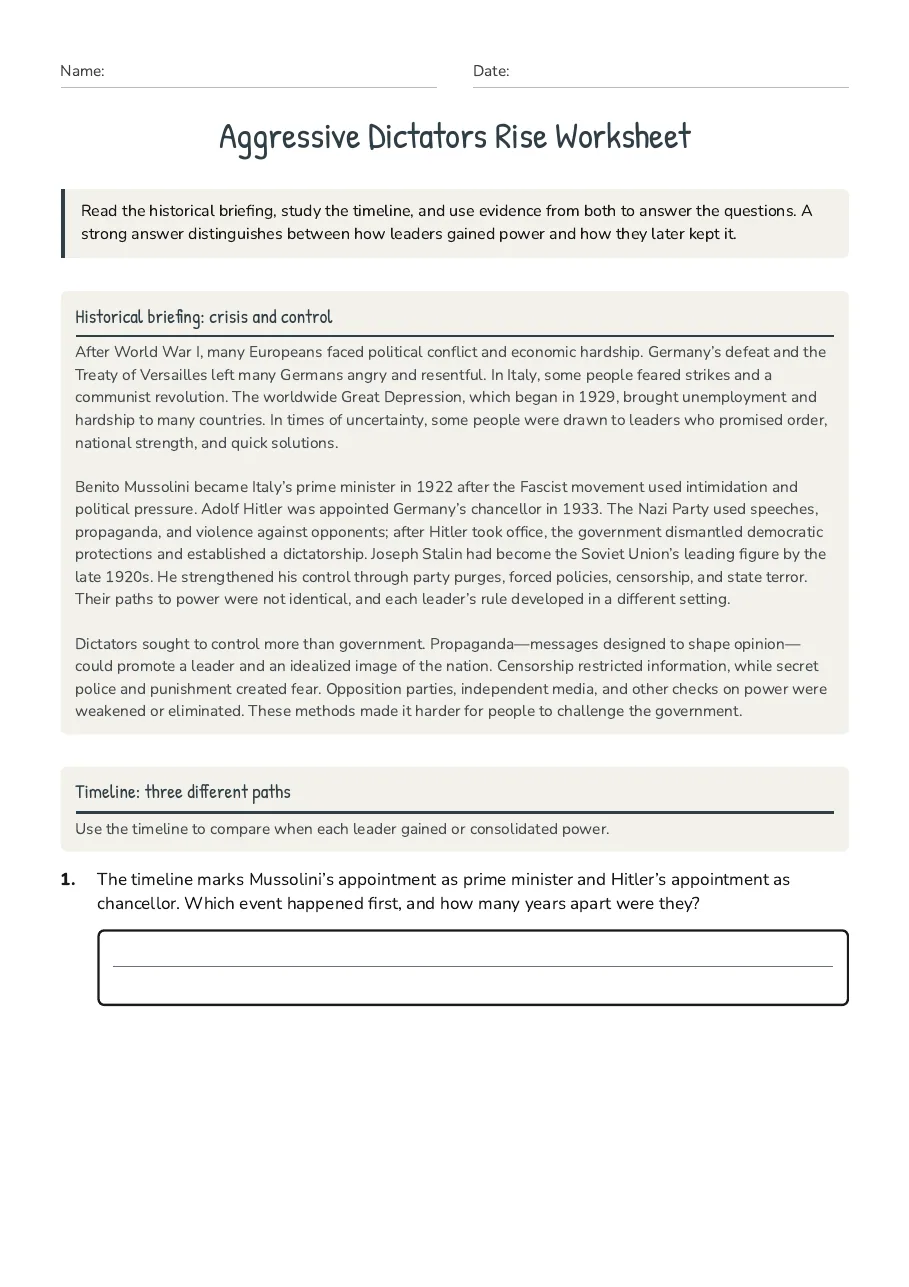
Historical briefing: crisis and control
After World War I, many Europeans faced political conflict and economic hardship. Germany’s defeat and the Treaty of Versailles left many Germans angry and resentful. In Italy, some people feared strikes and a communist revolution. The worldwide Great Depression, which began in 1929, brought unemployment and hardship to many countries. In times of uncertainty, some people were drawn to leaders who promised order, national strength, and quick solutions. Benito Mussolini became Italy’s prime minister in 1922 after the Fascist movement used intimidation and political pressure. Adolf Hitler was appointed Germany’s chancellor in 1933. The Nazi Party used speeches, propaganda, and violence against opponents; after Hitler took office, the government dismantled democratic protections and established a dictatorship. Joseph Stalin had become the Soviet Union’s leading figure by the late 1920s. He strengthened his control through party purges, forced policies, censorship, and state terror. Their paths to power were not identical, and each leader’s rule developed in a different setting. Dictators sought to control more than government. Propaganda—messages designed to shape opinion—could promote a leader and an idealized image of the nation. Censorship restricted information, while secret police and punishment created fear. Opposition parties, independent media, and other checks on power were weakened or eliminated. These methods made it harder for people to challenge the government.
Timeline: three different paths
Use the timeline to compare when each leader gained or consolidated power.
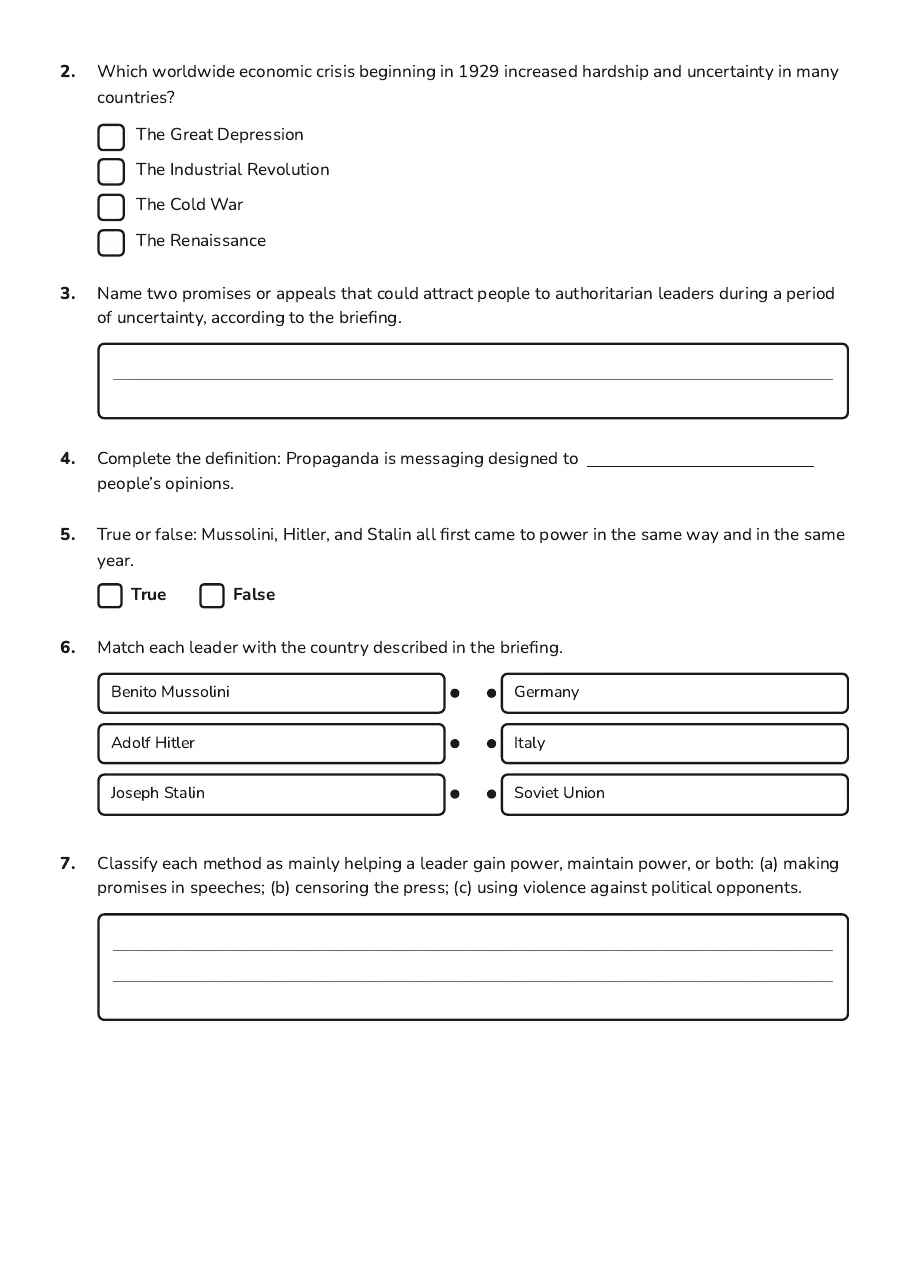
- The Great Depression
- The Industrial Revolution
- The Cold War
- The Renaissance
- Benito Mussolini
- Adolf Hitler
- Joseph Stalin
- Germany
- Italy
- Soviet Union
3 printable pages
Page 1
Page 2
Page 3
About This Worksheet
Free in Kuraplan
Sign up free, grab the PDF, and customize it for your class.
Print-Ready
Formatted for standard paper. Clean layout, easy to read.
AI-Generated
Created with Kuraplan's AI, designed for real classroom use.
For Teachers & Parents
Use in classrooms, for homework, tutoring, or homeschool.
Need a custom version of this worksheet?
Kuraplan's AI generates custom worksheets in seconds — differentiated for every learner, aligned to your curriculum.
Generate Custom Worksheets — Free