Amish American History Exploration
A free social studies worksheet ready for your classroom. Open in Kuraplan to grab the print-ready PDF, customize it for your students, or generate a fresh version in seconds.
Amish American History Exploration
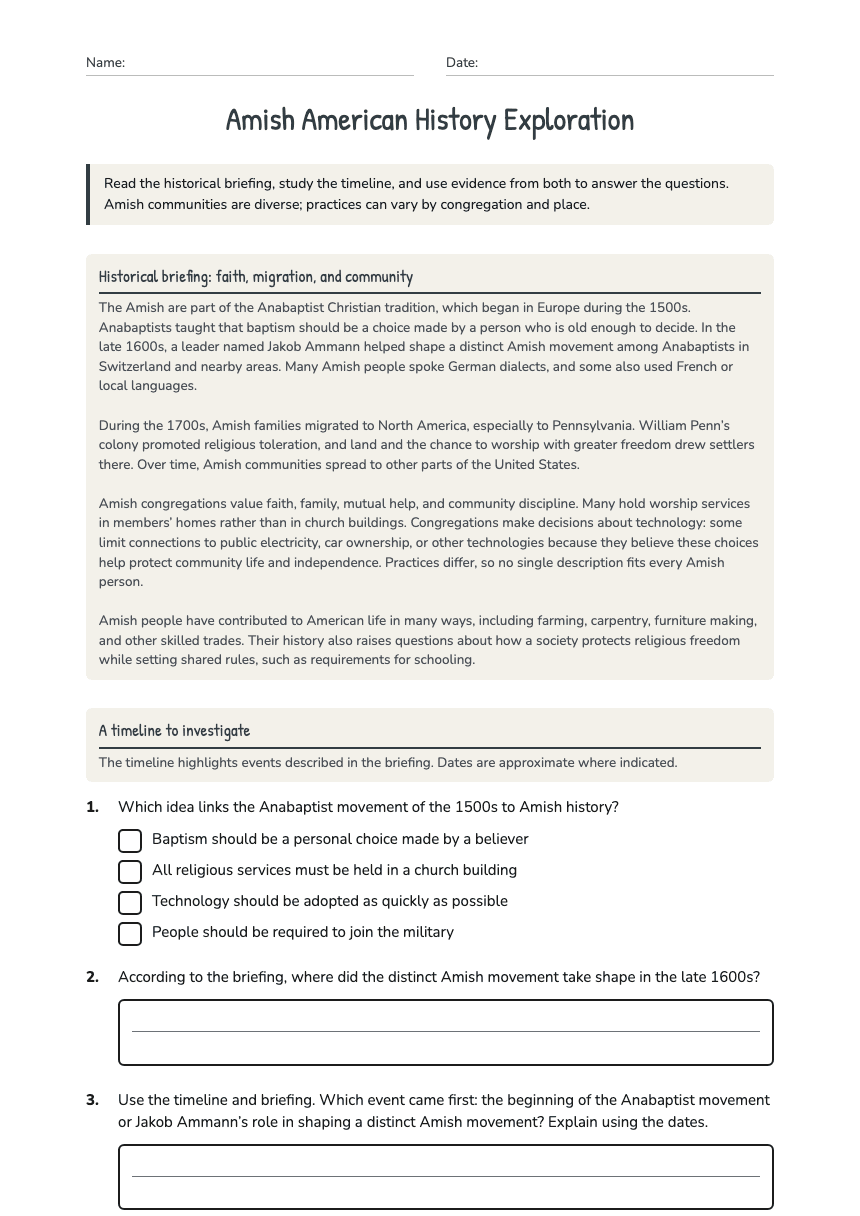
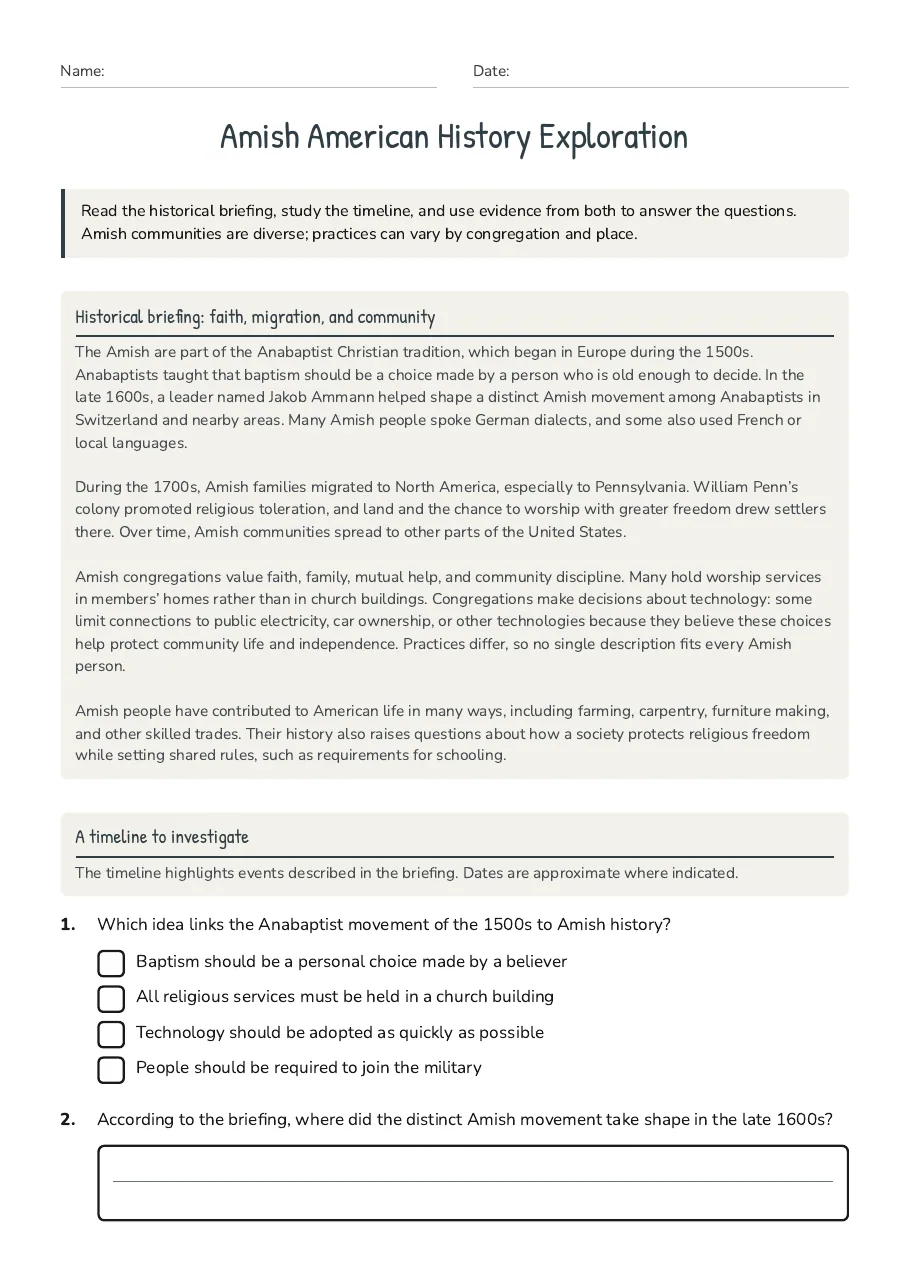
Historical briefing: faith, migration, and community
The Amish are part of the Anabaptist Christian tradition, which began in Europe during the 1500s. Anabaptists taught that baptism should be a choice made by a person who is old enough to decide. In the late 1600s, a leader named Jakob Ammann helped shape a distinct Amish movement among Anabaptists in Switzerland and nearby areas. Many Amish people spoke German dialects, and some also used French or local languages. During the 1700s, Amish families migrated to North America, especially to Pennsylvania. William Penn’s colony promoted religious toleration, and land and the chance to worship with greater freedom drew settlers there. Over time, Amish communities spread to other parts of the United States. Amish congregations value faith, family, mutual help, and community discipline. Many hold worship services in members’ homes rather than in church buildings. Congregations make decisions about technology: some limit connections to public electricity, car ownership, or other technologies because they believe these choices help protect community life and independence. Practices differ, so no single description fits every Amish person. Amish people have contributed to American life in many ways, including farming, carpentry, furniture making, and other skilled trades. Their history also raises questions about how a society protects religious freedom while setting shared rules, such as requirements for schooling.
A timeline to investigate
The timeline highlights events described in the briefing. Dates are approximate where indicated.
- Baptism should be a personal choice made by a believer
- All religious services must be held in a church building
- Technology should be adopted as quickly as possible
- People should be required to join the military
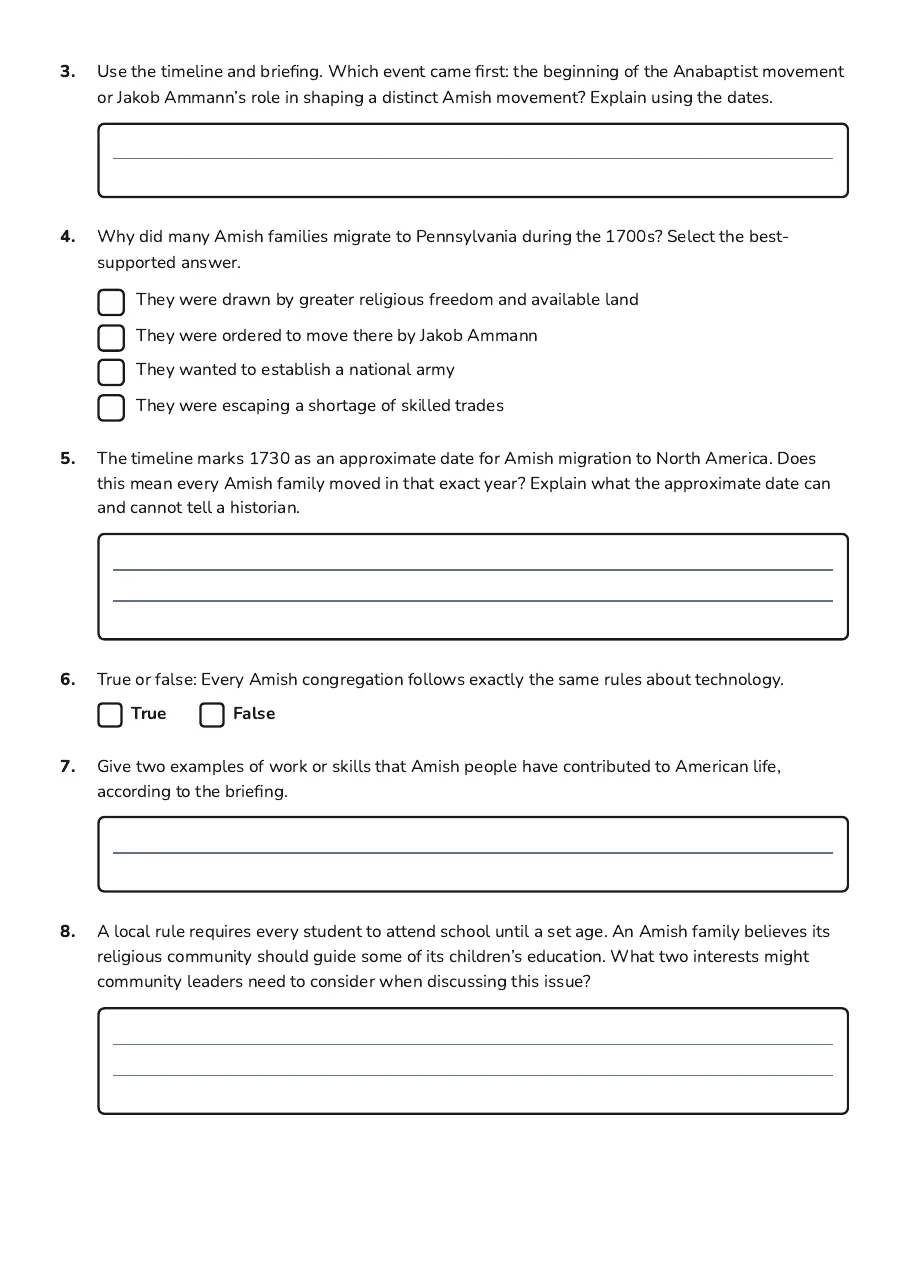
- They were drawn by greater religious freedom and available land
- They were ordered to move there by Jakob Ammann
- They wanted to establish a national army
- They were escaping a shortage of skilled trades
- Mutual help and community life
- The exact clothing worn by every Amish person today
- A specific law passed in Pennsylvania
- The precise date every family migrated
3 printable pages
Page 1
Page 2

Page 3
About This Worksheet
Free in Kuraplan
Sign up free, grab the PDF, and customize it for your class.
Print-Ready
Formatted for standard paper. Clean layout, easy to read.
AI-Generated
Created with Kuraplan's AI, designed for real classroom use.
For Teachers & Parents
Use in classrooms, for homework, tutoring, or homeschool.
Need a custom version of this worksheet?
Kuraplan's AI generates custom worksheets in seconds — differentiated for every learner, aligned to your curriculum.
Generate Custom Worksheets — Free