Body Systems Data Investigation
A free science worksheet ready for your classroom. Open in Kuraplan to grab the print-ready PDF, customize it for your students, or generate a fresh version in seconds.
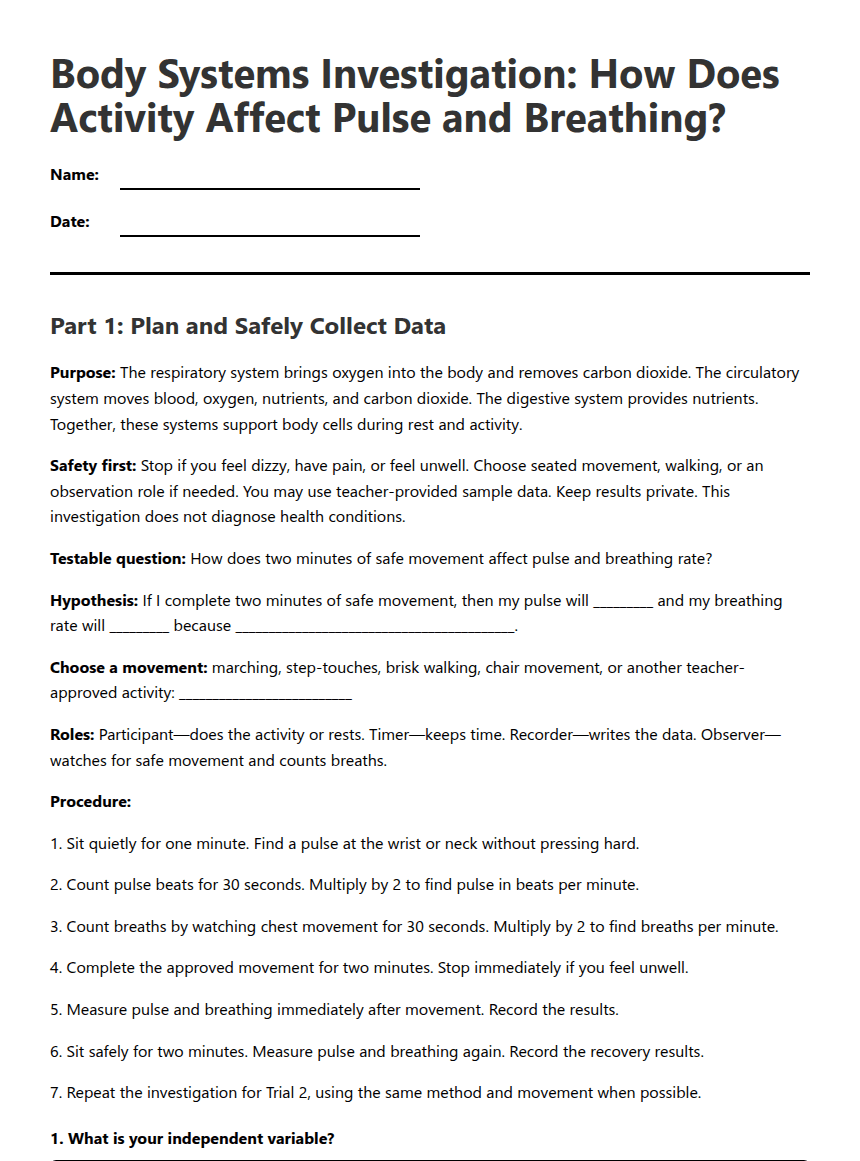
Body Systems Investigation: How Does Activity Affect Pulse and Breathing?
Part 1: Plan and Safely Collect Data
Purpose: The respiratory system brings oxygen into the body and removes carbon dioxide. The circulatory system moves blood, oxygen, nutrients, and carbon dioxide. The digestive system provides nutrients. Together, these systems support body cells during rest and activity.
Safety first: Stop if you feel dizzy, have pain, or feel unwell. Choose seated movement, walking, or an observation role if needed. You may use teacher-provided sample data. Keep results private. This investigation does not diagnose health conditions.
Testable question: How does two minutes of safe movement affect pulse and breathing rate?
Hypothesis: If I complete two minutes of safe movement, then my pulse will _________ and my breathing rate will _________ because __________________________________________.
Choose a movement: marching, step-touches, brisk walking, chair movement, or another teacher-approved activity: __________________________
Roles: Participant—does the activity or rests. Timer—keeps time. Recorder—writes the data. Observer—watches for safe movement and counts breaths.
Procedure:
1. Sit quietly for one minute. Find a pulse at the wrist or neck without pressing hard.
2. Count pulse beats for 30 seconds. Multiply by 2 to find pulse in beats per minute.
3. Count breaths by watching chest movement for 30 seconds. Multiply by 2 to find breaths per minute.
4. Complete the approved movement for two minutes. Stop immediately if you feel unwell.
5. Measure pulse and breathing immediately after movement. Record the results.
6. Sit safely for two minutes. Measure pulse and breathing again. Record the recovery results.
7. Repeat the investigation for Trial 2, using the same method and movement when possible.
Data Table
Record pulse in beats per minute (bpm) and breathing in breaths per minute. For each 30-second count, multiply by 2.
Columns: Resting pulse (bpm) | Active pulse (bpm) | Recovery pulse (bpm) | Resting breaths/min | Active breaths/min | Recovery breaths/min
Trial 1: ______________ | ______________ | ______________ | ______________ | ______________ | ______________
Trial 2: ______________ | ______________ | ______________ | ______________ | ______________ | ______________
Part 2: Analyze the Data
Trial 1 pulse: active ________ − resting ________ = ________ bpm
Trial 1 breathing: active ________ − resting ________ = ________ breaths/min
Trial 2 pulse change: ________ bpm Trial 2 breathing change: ________ breaths/min
Make a Graph
Make one line graph for pulse and one line graph for breathing, or make one graph with two clearly labeled lines. Put time on the x-axis: resting, active, and recovery. Put rate on the y-axis: bpm or breaths/min. Add a title, labels, units, and a key.
Part 3: Explain and Reflect
Claim-Evidence-Reasoning
Claim: Two minutes of movement ______________________________ pulse and breathing.
Evidence: My data show that pulse changed from ________ to ________ bpm, and breathing changed from ________ to ________ breaths/min.
Reasoning: During activity, muscles need more oxygen and produce more carbon dioxide. The respiratory system __________ oxygen and __________ carbon dioxide, while the circulatory system ______________________________.
Success Criteria
I followed the procedure and used safe, respectful roles. I recorded measurements with correct units. I represented data in a table and graph. I identified a pattern and supported it with evidence. I explained how at least three body systems support cells. I suggested an inclusive health action without blaming or judging people.Support and Challenge
Support: Use this word bank: oxygen, carbon dioxide, nutrients, blood, muscles, pulse, breathing, recovery, evidence, pattern. You may draw a labeled diagram, give an oral response, use sentence frames, work with a partner, or use sample data.
Challenge: Compare your results with teacher-provided sample data. Explain how sleep, nutrition, environment, or activity could affect more than one body system. Evaluate two health claims using evidence.
Sample-data pathway: If you cannot participate physically, use the teacher’s sample data, complete the same graph and analysis, and serve as timer, recorder, or observer.
Teacher Note
Expected pattern: Pulse and breathing usually increase during activity and move toward resting levels during recovery. Individual results vary. One investigation is not a medical assessment.
Literacy connections: Follow a multistep procedure and represent quantitative information in tables and graphs (CCSS.ELA-LITERACY.RST.6-8.3 and RST.6-8.7).
About This Worksheet
Free in Kuraplan
Sign up free, grab the PDF, and customize it for your class.
Print-Ready
Formatted for standard paper. Clean layout, easy to read.
AI-Generated
Created with Kuraplan's AI, designed for real classroom use.
For Teachers & Parents
Use in classrooms, for homework, tutoring, or homeschool.
Need a custom version of this worksheet?
Kuraplan's AI generates custom worksheets in seconds — differentiated for every learner, aligned to your curriculum.
Generate Custom Worksheets — Free