Building Story Structure
A free english (ela) worksheet ready for your classroom. Open in Kuraplan to grab the print-ready PDF, customize it for your students, or generate a fresh version in seconds.
Building Story Structure
📖 Part 1: Read and Notice
Learning intention: I can identify the main events, narrator, and point of view in a story.
Vocabulary: orientation = the beginning that introduces the characters and setting; rising action = events that build the problem; climax = the most important turning point; resolution = how the problem is solved; perspective = the way a narrator sees or understands events.
The Missing Welcome Sign
On Monday morning, Lina arrived early at school to hang a welcome sign for new students. The sign showed the names of students in English and in their home languages. Lina wanted everyone to feel that their voices belonged in the school.
When she opened the storage room, the sign was gone. Lina checked the art room, the library, and the hallway. She found only a trail of blue paint on the floor. The welcome assembly would begin in thirty minutes.
Lina followed the paint trail to the gym. There, she saw a younger student named Pavel trying to repair the sign. A strong wind had torn it while he carried it outside. Pavel looked worried because he thought Lina would be angry.
Lina took a slow breath. Instead of blaming Pavel, she asked him to help. Together, they used tape, cardboard, and markers to fix the torn places. Lina added one more sentence at the bottom: “Every voice helps build our school.”
They carried the repaired sign to the assembly just before it began. The sign was not perfect, but Pavel proudly stood beside Lina. When the students read the message, Lina felt that the welcome was stronger because they had solved the problem together.
Beginning/orientation: Who, where, and when? ________________________________________________
Rising problem: What problem begins? ________________________________________________________
Climax/turning point: What important choice does Lina make? ____________________________________
Falling action: What happens after the turning point? ___________________________________________
Resolution: How is the problem solved? ______________________________________________________
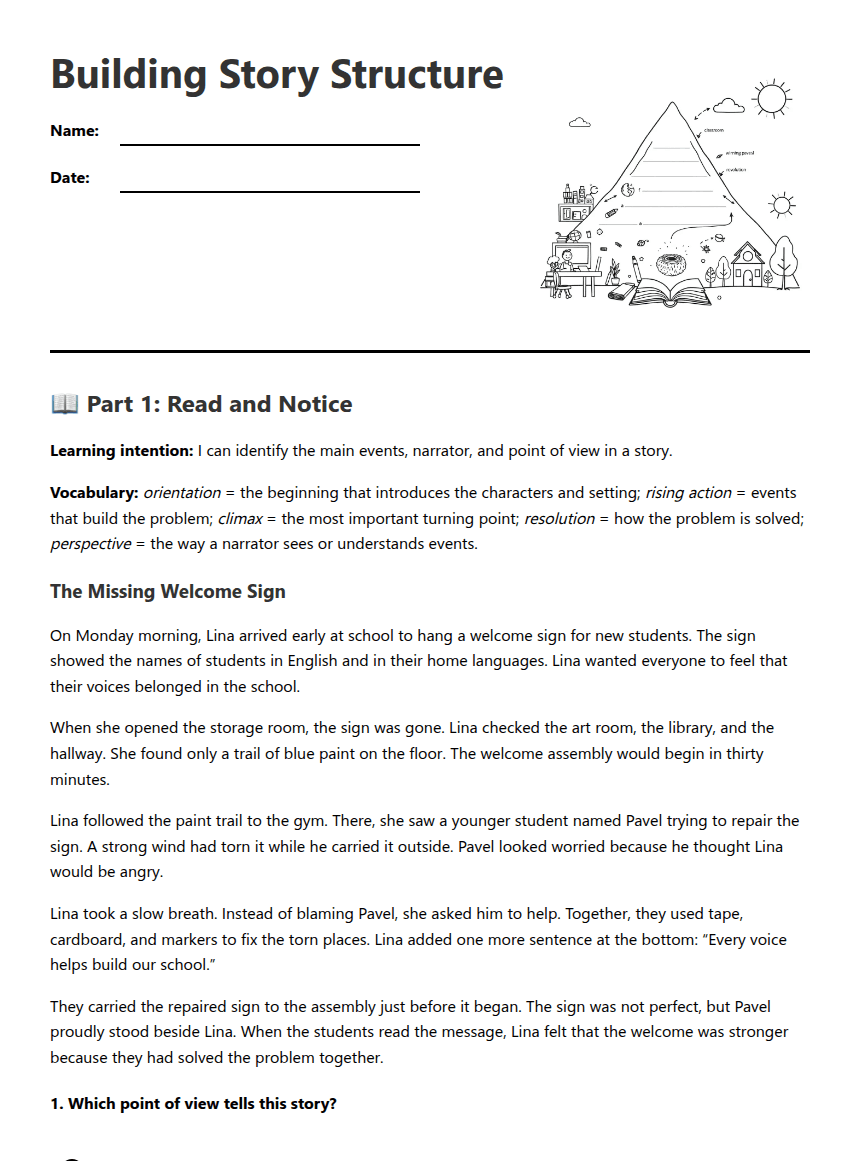
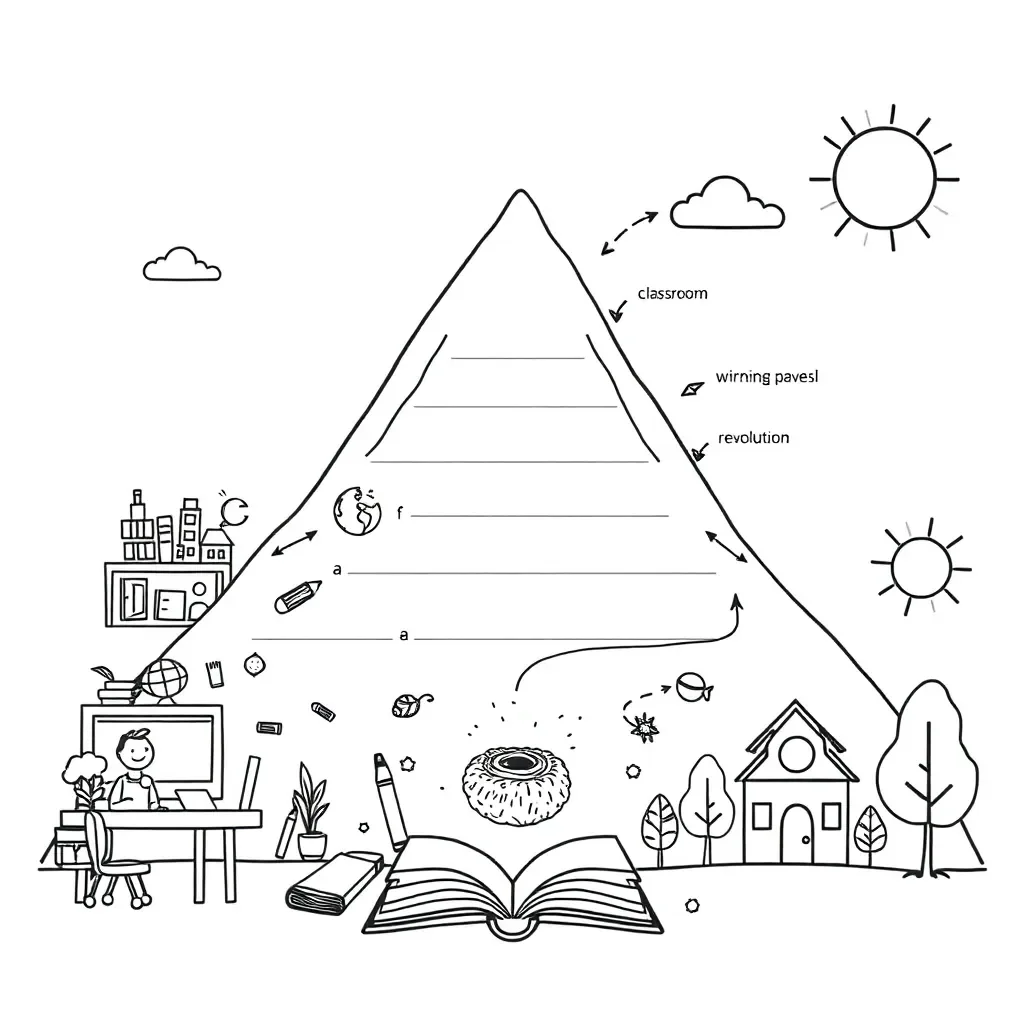
⛰️ Part 2: Build a Story Mountain
Success criteria: I can sequence major events, explain how a problem grows, and show how the ending connects to the problem.
Record one or two important events in each part of the story. You may use words, phrases, or complete sentences.
Introduce the character, setting, and situation.
Show the problem and the events that build tension.
List an important attempt, discovery, or complication.
Show the most important choice or change.
Explain what happens after the climax and how the problem ends.
Support frames: “First, __________. Then, __________. The problem becomes more serious when __________. Finally, __________.”
Grades 5–6: Use the frames and describe the events in order.
Grades 7–8: Explain how the order of events shapes suspense, surprise, or sympathy.
✍️ Part 3: Plan and Check Your Own Story
Writing task: Plan a short narrative about a student solving a meaningful problem. Include a clear sequence of events, a turning point, and a resolution. Choose first person or third person.
My character is ____________________. The story takes place ____________________. I will use __________ person because __________________________________________.
Beginning: Introduce the character and situation.
Rising problem: What goes wrong or becomes difficult?
Climax: What important choice or action changes the situation?
Resolution: How is the problem solved, and what does the character learn?
Grades 5–6: Write a clear beginning, problem, turning point, and ending.
Grades 7–8: Add sensory details, dialogue, or reflection to show the character’s feelings and make the resolution meaningful.
Extension challenge: Rewrite the climax from another character’s point of view. Explain how the new perspective changes what the reader knows or feels.
Self-Check
Check each statement when you can do it.
I introduced a character, setting, and situation. I organized events in a logical order. I included a problem and a clear climax or turning point. I showed how the resolution connects to the problem. I used details, dialogue, or description to make the story clear. I can explain how point of view affects what the reader knows or feels.Teacher Answer Key
1. Third person. 2. Lina is the main perspective character; the reader learns that she wants every student to feel included and that she feels worried, then proud and relieved. 3. Beginning: Lina arrives early to hang a multilingual welcome sign. Rising problem: the sign is missing, and the assembly is soon. Climax: Lina chooses to help Pavel instead of blaming him. Falling action: they repair the sign together. Resolution: they bring it to the assembly, and its message welcomes the students. 4. Sample: Because the story is told from Lina’s point of view, the reader knows that she wants people to feel included but does not know what Pavel was thinking until Lina meets him. 5. Answers may vary; students should identify a text event and explain its effect on tension, surprise, or sympathy.
CCSS connections: W.6.3, W.7.3, and W.8.3: students sequence events, develop a narrative problem and resolution, use narrative techniques, and explain how structure and point of view shape a reader’s experience.
Differentiation: EAL learners may use the vocabulary, sentence frames, labeled organizer, oral rehearsal, word banks, or labeled phrases before writing. Students who need support may work with a partner, listen to the passage more than once, or dictate responses. Advanced learners may complete the extension challenge and compare two perspectives.
About This Worksheet
Free in Kuraplan
Sign up free, grab the PDF, and customize it for your class.
Print-Ready
Formatted for standard paper. Clean layout, easy to read.
AI-Generated
Created with Kuraplan's AI, designed for real classroom use.
For Teachers & Parents
Use in classrooms, for homework, tutoring, or homeschool.
Need a custom version of this worksheet?
Kuraplan's AI generates custom worksheets in seconds — differentiated for every learner, aligned to your curriculum.
Generate Custom Worksheets — Free