English (ELA)FreePrintable

Citing Evidence and Inferences

A free english (ela) worksheet ready for your classroom. Open in Kuraplan to grab the print-ready PDF, customize it for your students, or generate a fresh version in seconds.
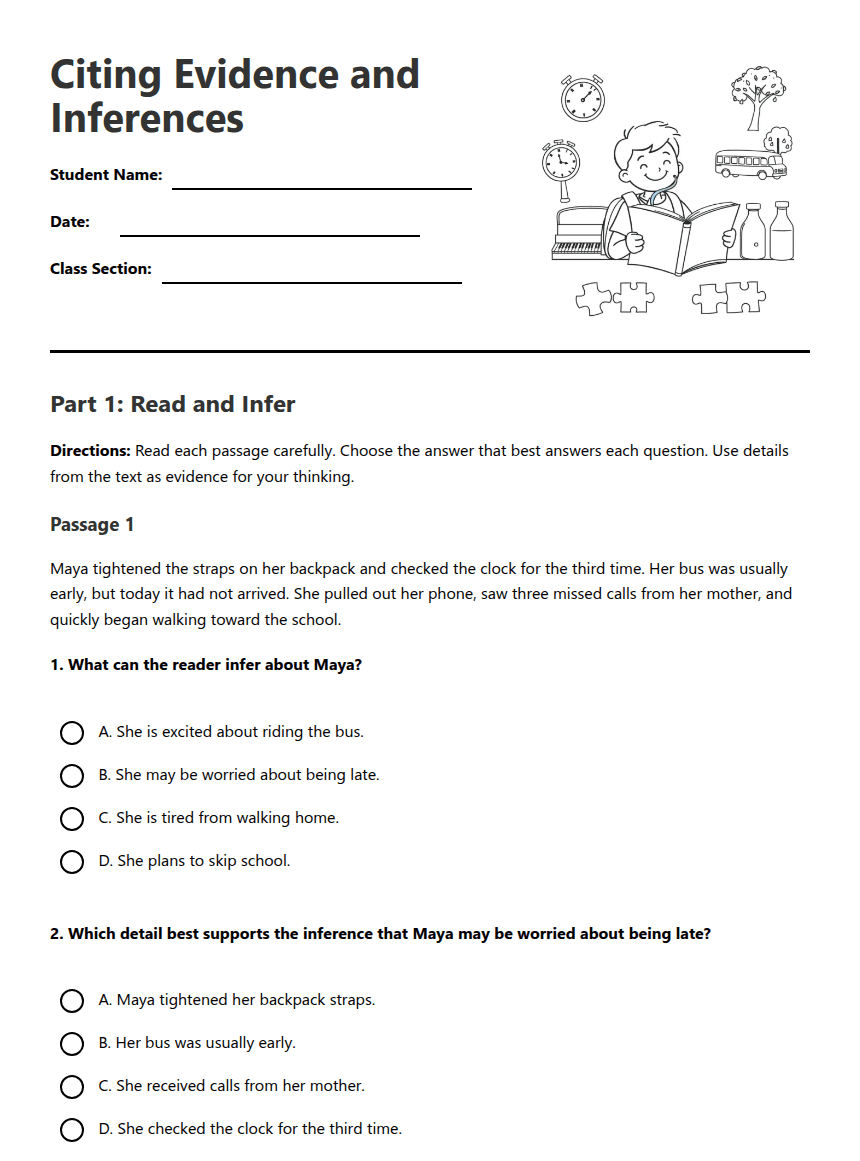
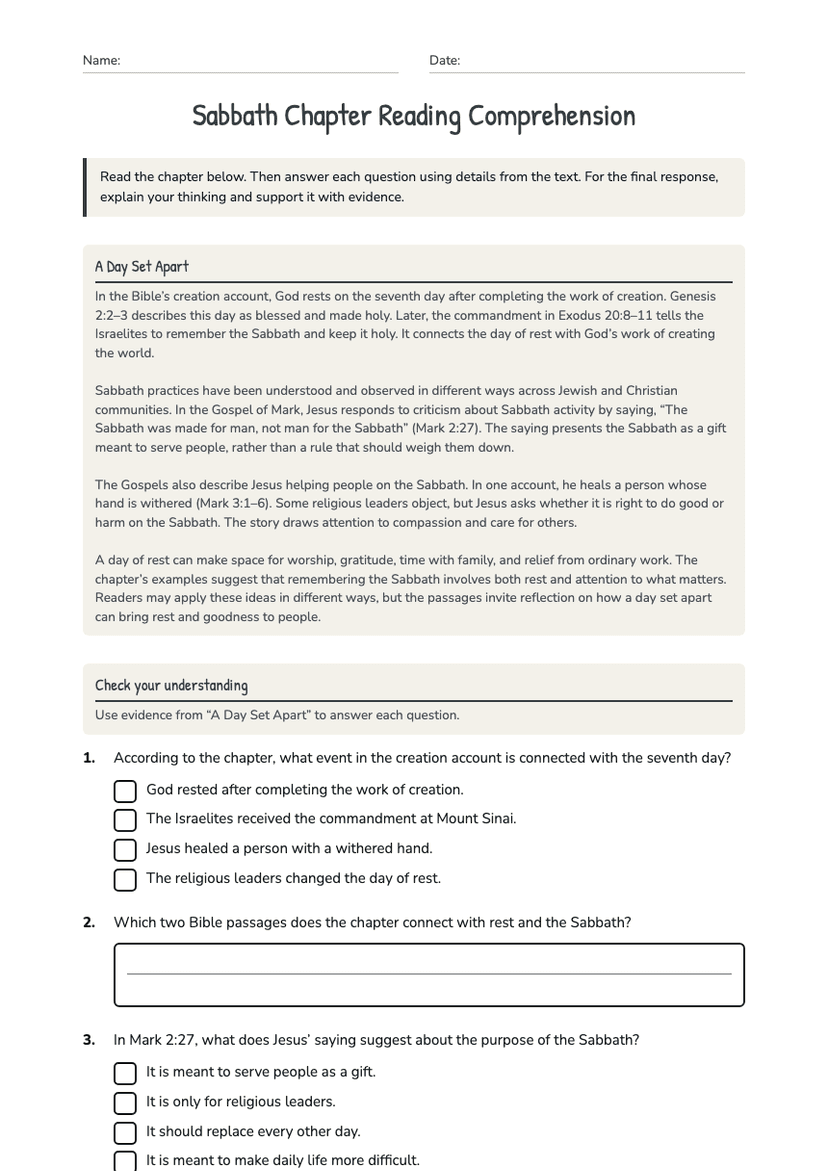
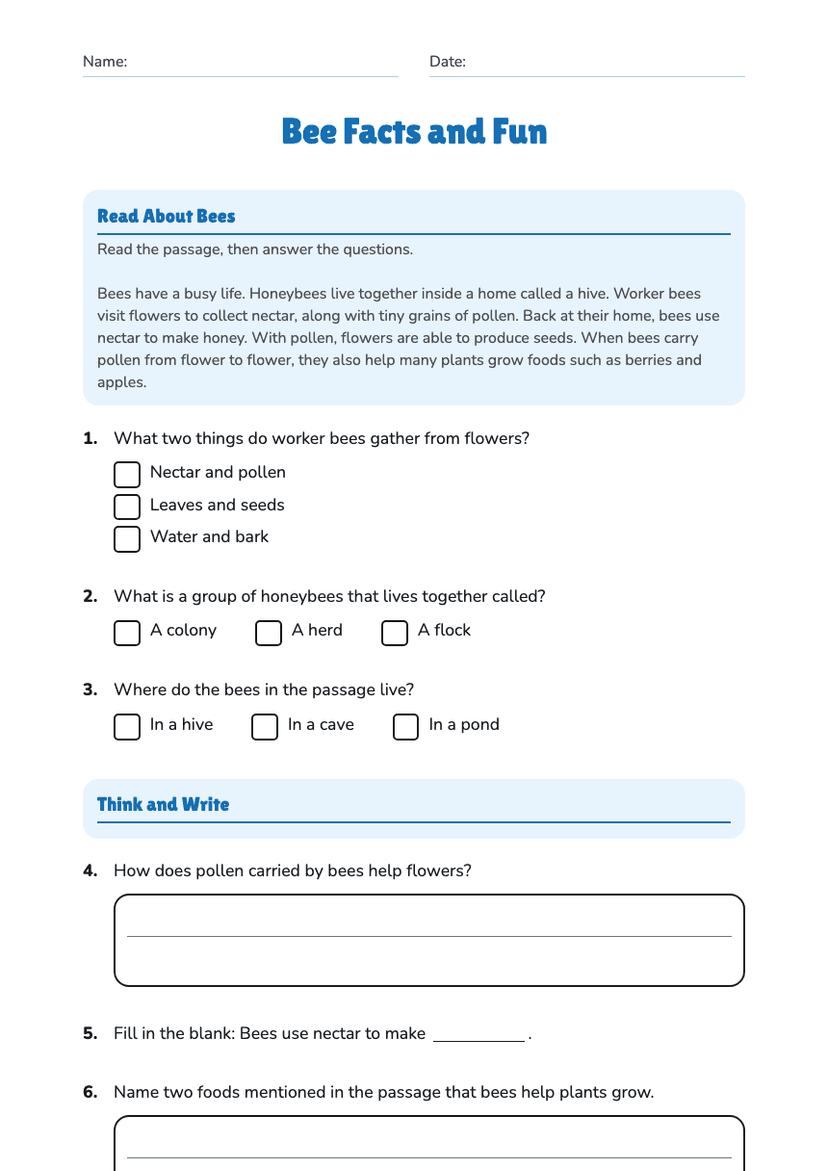
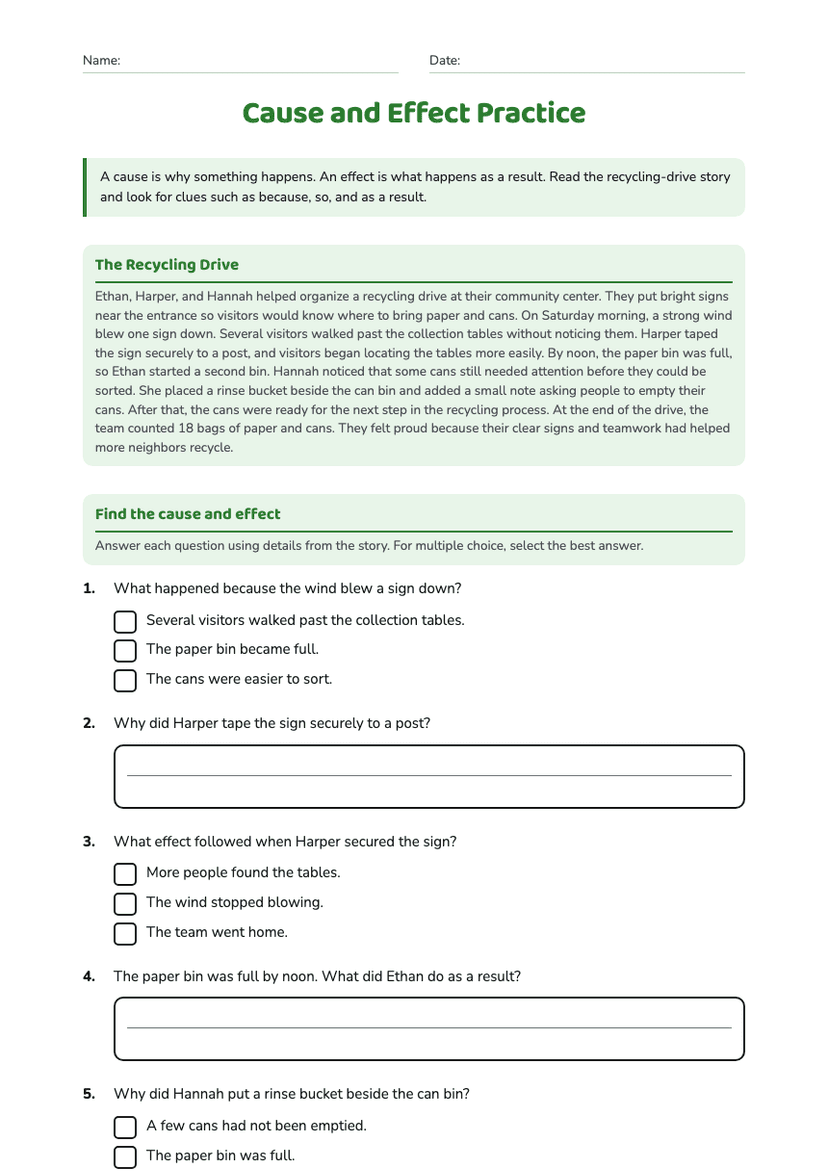
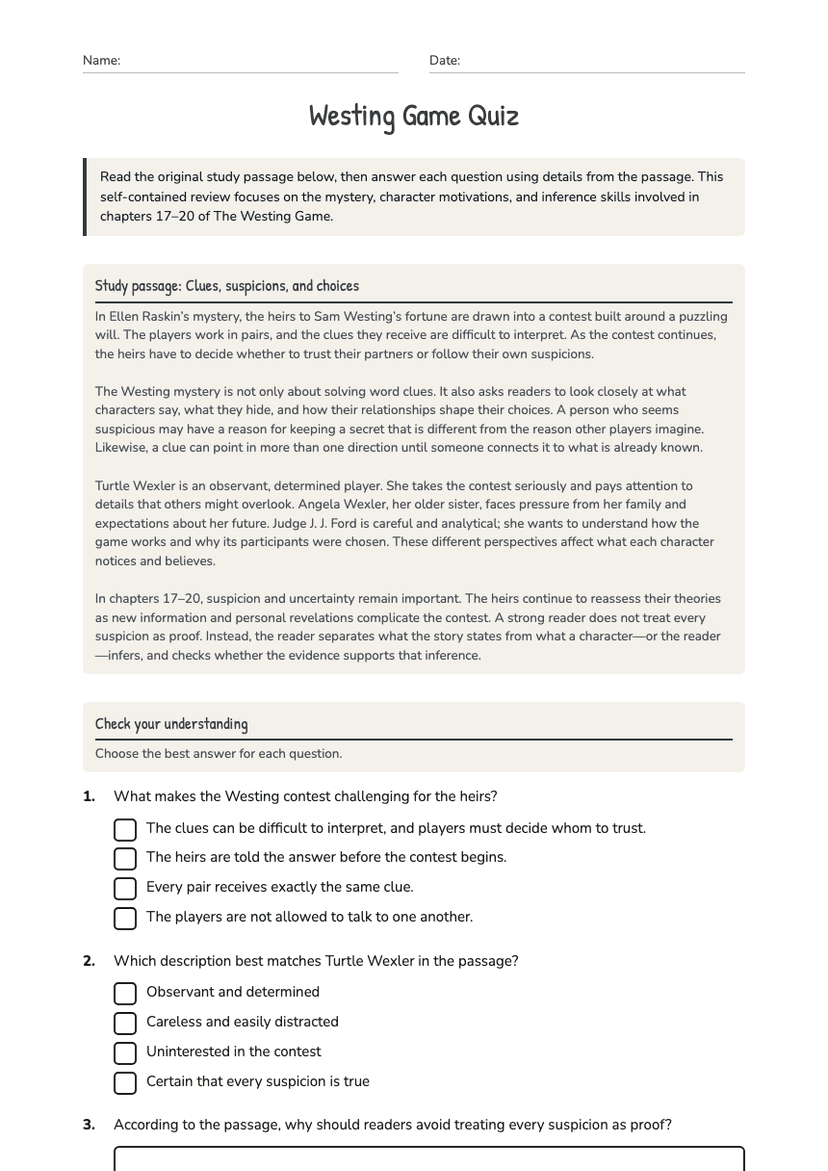
Citing Evidence and Inferences worksheet preview

Citing Evidence and Inferences

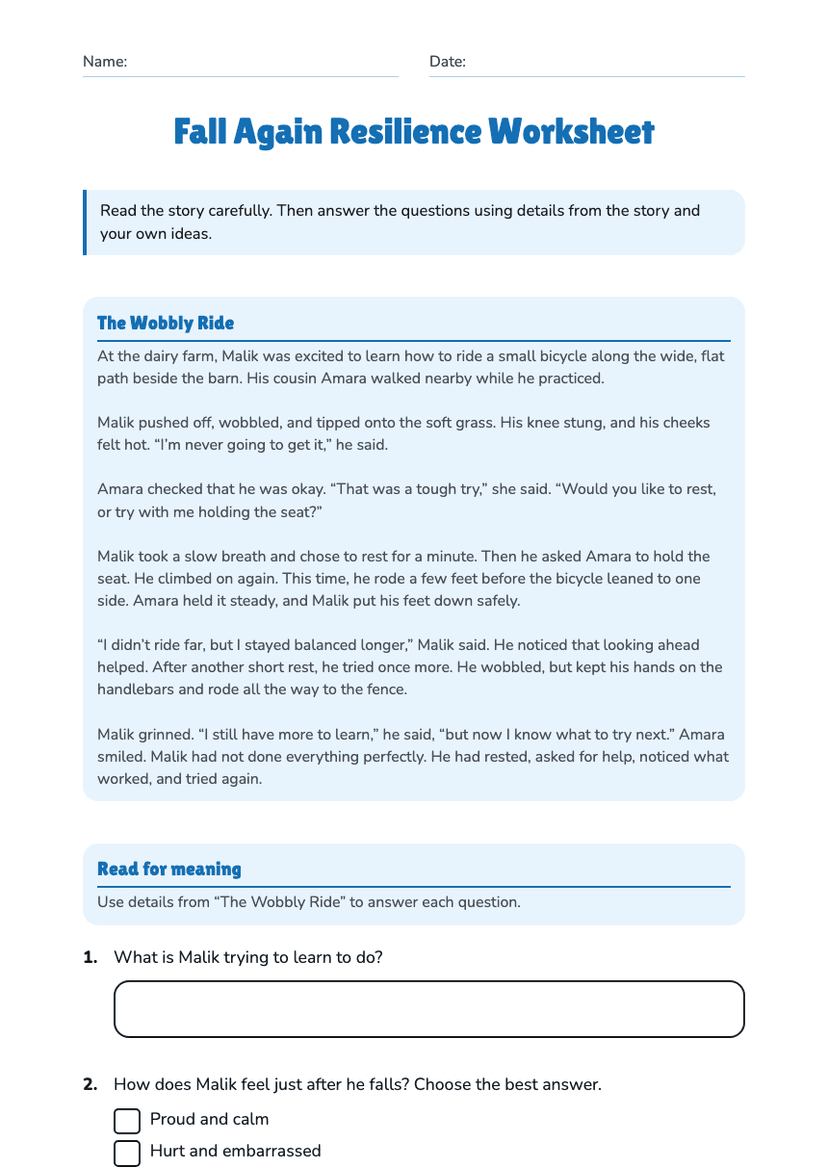
Worksheet illustration

Part 1: Read and Infer

Directions: Read each passage carefully. Choose the answer that best answers each question. Use details from the text as evidence for your thinking.

Passage 1

Maya tightened the straps on her backpack and checked the clock for the third time. Her bus was usually early, but today it had not arrived. She pulled out her phone, saw three missed calls from her mother, and quickly began walking toward the school.

1. What can the reader infer about Maya?

A. She is excited about riding the bus.

B. She may be worried about being late.

C. She is tired from walking home.

D. She plans to skip school.

2. Which detail best supports the inference that Maya may be worried about being late?

A. Maya tightened her backpack straps.

B. Her bus was usually early.

C. She received calls from her mother.

D. She checked the clock for the third time.

3. What does checking the clock three times most likely show about Maya?

A. She wants to know what time lunch is.

B. She is waiting for a friend.

C. She is closely watching the time because she feels concerned.

D. She has forgotten how to read a clock.

Passage 2

Many cities are planting trees along streets and in public parks. Trees provide shade on hot days and help lower temperatures. Their roots also absorb rainwater, which can reduce flooding. In addition, trees improve air quality by taking in carbon dioxide and releasing oxygen.

4. What is the main idea of the passage?

A. Parks are the best places to plant trees.

B. Trees grow best in cities.

C. Trees provide several important benefits to cities.

D. Hot days are common in many cities.

5. Which evidence shows that trees can help prevent flooding?

A. Trees provide shade.

B. Trees help lower temperatures.

C. Tree roots absorb rainwater.

D. Tree leaves release oxygen.

6. What can the reader infer about why cities plant trees?

A. Cities want to make streets narrower.

B. Cities want to make communities healthier and safer.

C. Cities need to replace all public parks.

D. Cities want people to stop driving cars.

Part 2: Support Your Inferences

Directions: Read each passage. Select the answer that is best supported by the details in the text.

Passage 3

Jordan had practiced the piano piece every afternoon for two weeks. On the day of the recital, his hands felt cold as he sat on the bench. He took a slow breath, placed his fingers on the keys, and began to play. When he finished, the audience applauded loudly. Jordan smiled as he returned to his seat.

7. What can the reader infer about Jordan before he began to play?

A. He feels nervous.

B. He feels angry.

C. He feels bored.

D. He feels disappointed.

8. Which detail best supports the inference that Jordan feels nervous?

A. He practiced every afternoon.

B. His hands felt cold.

C. He placed his fingers on the keys.

D. The audience applauded.

9. What can the reader infer about Jordan at the end of the passage?

A. He wants to leave the recital.

B. He is upset that he practiced.

C. He feels pleased with how he performed.

D. He is confused by the audience.

Passage 4

Aisha wanted to understand why some materials rust faster than others. She placed identical iron nails in four containers. One nail was kept dry, one was placed in water, one was placed in salt water, and one was coated with oil. After several days, the nail in salt water had the most rust. The dry nail had almost no rust.

10. Which conclusion is best supported by the evidence?

A. Oil always causes iron to rust quickly.

B. Salt water causes iron to rust faster than dry conditions.

C. All iron nails rust at the same speed.

D. Dry conditions cause the most rust.

Teacher Answer Key

1. B    2. D    3. C    4. C    5. C

6. B    7. A    8. B    9. C    10. B

About This Worksheet

Free in Kuraplan

Sign up free, grab the PDF, and customize it for your class.

Print-Ready

Formatted for standard paper. Clean layout, easy to read.

AI-Generated

Created with Kuraplan's AI, designed for real classroom use.

For Teachers & Parents

Use in classrooms, for homework, tutoring, or homeschool.

Need a custom version of this worksheet?

Kuraplan's AI generates custom worksheets in seconds — differentiated for every learner, aligned to your curriculum.

Generate Custom Worksheets — Free
No credit card Curriculum-aligned Under 60 seconds